|
Key Insights
|
Details
|
|
Forecast Period
|
2027-2031
|
|
Market Size (2025)
|
USD 13.63 Million
|
|
CAGR (2026-2031)
|
11.45%
|
|
Fastest Growing Segment
|
Cloud-based
|
|
Largest Market
|
Southern Vietnam
|
|
Market Size (2031)
|
USD 26.12 Million
|
Market Overview
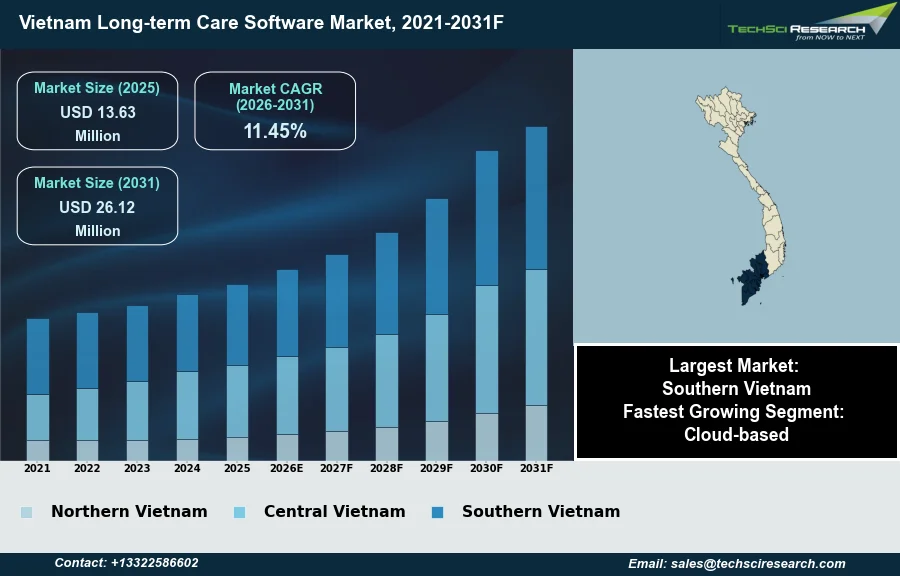
The Vietnam Long-term Care Software Market will grow from USD 13.63 Million in 2025 to USD 26.12 Million by 2031 at a 11.45% CAGR. Long-term care software encompasses specialized digital solutions designed to manage patient care, streamline operational workflows, and enhance administrative efficiency within facilities and home-based settings catering to the elderly population. The market's growth in Vietnam is primarily driven by a rapidly aging demographic, coupled with robust government initiatives promoting digital transformation in healthcare. For instance, according to the Vietnam Medical Informatics Association, in June 2026, 1,238 hospitals in Vietnam had commenced implementation of artificial intelligence and digital technologies in healthcare services, underscoring a broader national push for digital adoption across the health sector. This widespread integration is crucial for improving care coordination and resource allocation.
A significant challenge impeding market expansion, however, is the prevailing shortage of skilled caregivers within the elderly care sector. This scarcity impacts the effective utilization of advanced software solutions, as inadequate human resources can hinder the comprehensive implementation and sustained operation of these systems, thereby limiting their potential to fully address the growing demand for quality long-term care.
Key Market Drivers
Aging Demographics Drive Long-Term Care Software Demand
Accelerating population aging demographics is a primary force expanding the Vietnam Long-term Care Software Market. As the proportion of elderly individuals increases, demand for comprehensive long-term care services rises, necessitating efficient digital solutions for patient management, care coordination, and facility operations. This demographic shift places strain on existing healthcare infrastructure and traditional care models, driving software adoption to optimize resource allocation and enhance care delivery. According to the National Statistics Office, in January 2026, Vietnam's elderly population (aged 60 and above) increased to 14.5 percent in 2025. This rise underscores the critical need for scalable and integrated software platforms supporting increasing long-term care requirements.
Digital Health Reforms Accelerate EMR Adoption in Care Facilities
Complementing the demographic shift, government-led digital health transformation mandates significantly propel the market forward. These mandates aim to modernize Vietnam's healthcare system through widespread technology adoption, thereby improving efficiency and accessibility. The directive for digital integration encourages healthcare providers, including long-term care facilities, to invest in software for electronic medical records and other digital tools. According to VietnamPlus, in August 2025, 301 medical facilities nationwide had successfully implemented electronic medical records. Such initiatives ensure a standardized approach to health information management, vital for integrated long-term care. Furthermore, according to a report prepared for The Ministry of Foreign Affairs of Republic of Estonia by Orissa International, in January 2025, 99.5 percent of healthcare facilities had connected their information management software with the Vietnam Social Security Agency.
Download Free Sample Report
Key Market Challenges
Shortage of Skilled Caregivers Impedes Long-term Care Software Adoption
The prevailing shortage of skilled caregivers within the elderly care sector significantly impedes the growth of the Vietnam Long-term Care Software Market. The limited availability of qualified personnel directly affects the capacity of healthcare facilities and home-based care settings to effectively implement and utilize advanced digital solutions. Without an adequate workforce trained in geriatric care and capable of operating complex software systems, the potential benefits of these technologies, such as improved care coordination and administrative efficiency, cannot be fully realized.
Scarcity of Specialists Bottlenecks Software Adoption and Reduces ROI
This scarcity creates a critical bottleneck for software adoption. For instance, according to the Vietnam Medical Association, in November 2025, public hospitals in Vietnam alone required over 8,000 geriatric doctors, highlighting a substantial deficit in specialized healthcare professionals. This numerical gap in the skilled workforce means that even if long-term care software is procured, facilities may lack the human resources to conduct comprehensive training, data input, and ongoing system management. Consequently, the return on investment for such software diminishes, reducing incentives for further market expansion and investment in digital transformation within elderly care.
Key Market Trends
Expansion of Telehealth and Remote Monitoring in Long-Term Care
The expansion of telehealth and remote monitoring capabilities in long-term care software represents a significant trend, allowing providers to deliver care more efficiently and extend reach beyond physical facilities. These solutions enable virtual consultations, continuous vital sign monitoring, and proactive health management, which are vital for an aging population and to address caregiver scarcity in Vietnam. Such technologies improve care coordination and enhance patient engagement. According to Vietcetera, October 16 2025, in "Telemedicine: Easing Hospital Overcrowding In Vietnam While Getting The Job Done", over 1,500 connection points were established between lower and higher-tier hospitals within one year of the national Telehealth program.
Adoption of Cloud-Based Long-Term Care Software
Another pivotal trend is the growing adoption of cloud-based long-term care software solutions, driven by the imperative for scalable, flexible, and cost-efficient IT infrastructure. Cloud platforms facilitate secure data access and management from any location, promoting seamless information exchange among care teams and reducing capital expenditure for facilities. This approach enhances data security and ensures compliance with regulatory standards for sensitive patient information. The increasing scale of digital healthcare in Vietnam, with its diverse technological components including cloud infrastructure, is reflected by B&Company's report on March 17 2026, in "Digital transformation in the healthcare sector in Vietnam", which states the Vietnamese digital healthcare sector's revenue is expected to reach approximately USD 815 million in 2026.
Segmental Insights
Drivers of Cloud-Based LTCS Market Growth in Vietnam
The Cloud-based segment is rapidly emerging as the fastest-growing component within the Vietnam Long-term Care Software Market. This acceleration is primarily driven by the significant cost-efficiency offered by cloud solutions, which eliminate substantial upfront infrastructure investments, making advanced software accessible to a broader range of healthcare providers. Furthermore, the inherent scalability and flexibility of cloud platforms enable facilities to adapt swiftly to evolving patient needs and operational demands, a crucial advantage amidst Vietnam's aging population and increasing demand for long-term care services. Government-led digital health transformation initiatives, championed by bodies such as the Ministry of Health, actively encourage the adoption of such modern, efficient technologies to enhance healthcare delivery nationwide.
Regional Insights
Southern Vietnam Emerges as a Digital Health Hub Driving Long-Term Care Software Adoption
Southern Vietnam dominates the Vietnam Long-term Care Software Market, primarily due to its robust economic development and higher concentration of private healthcare facilities, which actively seek advanced technological solutions for elder care management. The region, particularly Ho Chi Minh City, functions as a digital health innovation hub, benefiting from superior infrastructure and concentrated healthcare technology investments. This environment fosters greater adoption and integration of specialized software platforms, including electronic health records, which are integral to long-term care. Furthermore, a growing, more affluent elderly population in urban centers coupled with a tech-savvy healthcare workforce drives heightened demand and readiness for these advanced software solutions. The Ministry of Health's ongoing digital transformation initiatives further underpin this regional leadership.
Recent Developments
-
In November 2025, the Taiwan Smart Healthcare Alliance expanded its operations into Vietnam by introducing advanced telemedicine solutions. This initiative focused on enhancing teleconsultation services, developing smart operating rooms, and implementing remote care technologies. The alliance established partnerships with Vietnamese stakeholders, aiming to address the rapidly growing demand for smart healthcare and long-term care solutions, driven by Vietnam’s aging population and increasing prevalence of chronic diseases.
-
In November 2024, TMA Solutions unveiled its mCare elderly care solution at the "Vietnam Golden Age Care 2024" conference and exhibition. This new product is a comprehensive technology system engineered to provide 24/7 health monitoring and issue automatic alerts for the elderly in Vietnam. The mCare solution extends beyond institutional care, supporting various at-home services such as chronic illness monitoring and online consultation, marking a significant advancement in leveraging technology for elderly healthcare needs.
-
In 2025, FPT Group, a prominent Vietnamese technology firm, collaborated with TR from South Korea to advance artificial intelligence (AI) applications within smart healthcare. This partnership was established to foster the development and integration of AI technologies, improving various healthcare services. Such innovations in smart healthcare, particularly those powered by AI, are crucial for the long-term care software market, as they enable more sophisticated patient monitoring, predictive health analytics, and personalized care management for older adults and individuals with chronic health conditions.
-
In 2025, CMC TS, a Vietnamese technology company, partnered with the Hop Luc Healthcare System to deploy IT infrastructure and various software solutions within healthcare facilities. The collaboration aimed to implement advanced systems such as AI-based Optical Character Recognition (OCR) for automated document processing and Robotic Process Automation (RPA) for streamlining workflows. These infrastructure and automation solutions are vital for enhancing operational efficiency and data management in long-term care facilities within Vietnam.
Key Market Players
- Epic Systems
- Cerner Corporation
- InterSystems
- Philips
- Siemens Healthineers
- GE HealthCare
- McKesson
- Allscripts
- NextGen
|
By Application
|
By Mode of Delivery
|
By End User
|
By Region
|
- Electronic Health Records (EHR)
- Electronic Medication Administration Record (eMAR)
- Revenue Cycle Management (RCM)
- Resident Care
- Staff Management
- Others
|
- Cloud based
- Web based
- On premise
|
- Home Healthcare Agencies
- Hospice & Palliative care
- Nursing Homes
- Assisted living facilities
- Others
|
- Northern
- Central
- Southern
|
Report Scope:
In this report, the Vietnam Long-term Care Software Market has been segmented into the following categories, in addition to the industry trends which have also been detailed below:
-
Vietnam Long-term Care Software Market, By Application:
-
Electronic Health Records (EHR)
-
Electronic Medication Administration Record (eMAR)
-
Revenue Cycle Management (RCM)
-
Resident Care
-
Staff Management
-
Others
-
Vietnam Long-term Care Software Market, By Mode of Delivery:
-
Cloud based
-
Web based
-
On premise
-
Vietnam Long-term Care Software Market, By End User:
-
Home Healthcare Agencies
-
Hospice & Palliative care
-
Nursing Homes
-
Assisted living facilities
-
Others
-
Vietnam Long-term Care Software Market, By Region:
-
Northern
-
Central
-
Southern
Competitive Landscape
Company Profiles: Detailed analysis of the major companies present in the Vietnam Long-term Care Software Market.
Available Customizations:
Vietnam Long-term Care Software Market report with the given market data, TechSci Research offers customizations according to a company's specific needs. The following customization options are available for the report:
Company Information
- Detailed analysis and profiling of additional market players (up to five).