|
Key Insights
|
Details
|
|
Forecast Period
|
2027-2031
|
|
Market Size (2025)
|
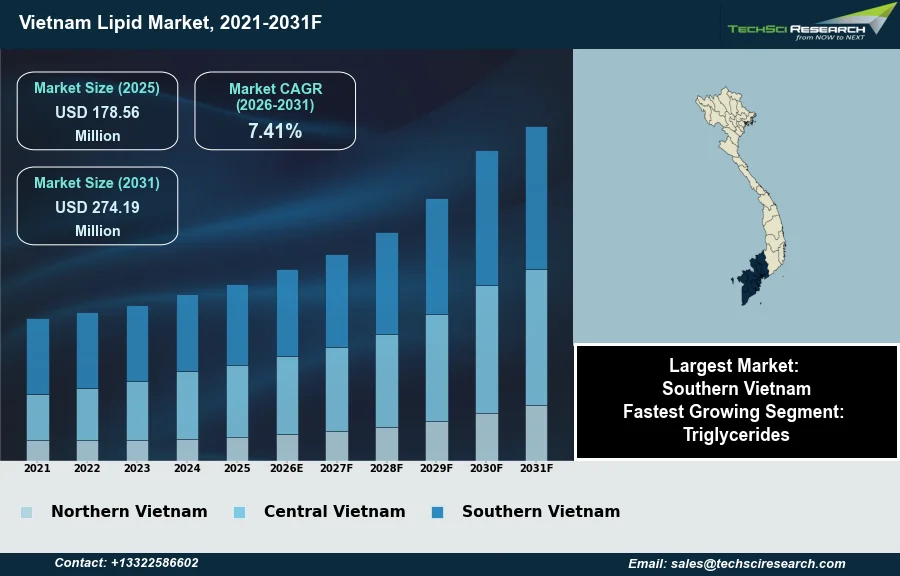
USD 178.56 Million
|
|
CAGR (2026-2031)
|
7.41%
|
|
Fastest Growing Segment
|
Triglycerides
|
|
Largest Market
|
Southern Vietnam
|
|
Market Size (2031)
|
USD 274.19 Million
|
Market Overview
The Vietnam Lipid Market will grow from USD 178.56 Million in 2025 to USD 274.19 Million by 2031 at a 7.41% CAGR. Lipids represent a broad classification of naturally occurring molecules, including fats, oils, waxes, and sterols, critical for biological functions and extensively applied across food, pharmaceutical, and cosmetic industries. Growth in the Vietnam Lipid Market is primarily propelled by heightened consumer health consciousness, driving demand for beneficial fatty acids. A rising middle class with greater disposable income also contributes significantly to market expansion. According to the USDA Foreign Agricultural Service, Vietnam's food processing industry, a major lipid consumer, reached $88 billion in 2025, marking an 11 percent increase.
Additional drivers include the increasing prevalence of lifestyle diseases, fostering demand for preventive health products utilizing functional lipids, and substantial industrial requirements from food manufacturing, animal feed, and pharmaceutical sectors. Conversely, a significant challenge hindering market expansion remains the persistent inefficiencies within the supply chain and logistical infrastructure across the agricultural and food processing value chains, potentially increasing operational complexities and costs.
Key Market Drivers
Health-Conscious Consumer Demand for Functional Lipids
Rising health consciousness and awareness significantly propels the Vietnam Lipid Market as consumers increasingly seek products offering nutritional advantages beyond basic sustenance. This heightened consumer focus translates into a growing demand for lipids rich in beneficial fatty acids, such as omega-3s, which are perceived to offer various health benefits. For example, according to the ASEAN Consumer Sentiment Study (ACSS) by UOB (Singapore), released in December 2025, 67% of Vietnamese consumers reported increasing their spending on education, healthcare, and wellness, surpassing spending increases on daily necessities. This trend underscores a fundamental shift in consumer priorities towards proactive health management through dietary choices, directly impacting the adoption of functional lipids in daily consumption.
Food & Beverage Growth Drives Lipid Market Expansion
The robust expansion of the food and beverage industry further acts as a crucial driver for the Vietnam Lipid Market, as lipids are indispensable ingredients across a wide array of food processing applications. The continuous growth in both foodservice and packaged food sectors necessitates a consistent and increasing supply of various fats and oils. Vietnam's food and beverage market is projected to reach $29.23 billion in 2026, according to a report by iPOS.vn and Nestlé Professional released on April 8, 2026. This substantial market size directly correlates with high industrial demand for lipids, which are essential for product formulation, texture, and preservation. Concurrently, the overall lipid consumption reflects this growth, with the USDA Foreign Agricultural Service in April 2025 forecasting refined vegetable oil consumption in Vietnam to reach 1.5 million tons in marketing year 2025/26.
Download Free Sample Report
Key Market Challenges
Logistical Inefficiencies Elevate Costs and Undermine Competitiveness
Persistent inefficiencies within the supply chain and logistical infrastructure across the agricultural and food processing value chains represent a significant impediment to the growth of the Vietnam Lipid Market. These shortcomings directly increase operational complexities and elevate costs for raw materials crucial to lipid production, thereby diminishing the competitiveness of Vietnamese lipids in both domestic and international markets. The higher operational expenditure can translate into increased prices for end-products, potentially curbing consumer demand.
High Agricultural Logistics Costs Elevate Lipid Production Expenses
For instance, the agricultural sector, which serves as a primary source for lipid raw materials, bears substantial cost burdens due to these logistical issues. According to Dr. Nguyen Anh Tuan, Chairman of the Vietnam's Association of Foreign Invested Enterprises (VAFIE), in March 2026, logistics costs for Vietnamese agricultural products accounted for 20-25% of production expenses. This elevated figure, significantly higher than many regional competitors, stems from factors such as fragmented production, reliance on manual supply chain processes, and inadequate cold chain facilities. Such deficiencies lead to greater post-harvest losses, extended delivery times, and additional handling requirements, all of which contribute to the final cost and limit the efficient distribution of lipids.
Key Market Trends
Sustainability-driven demand and policy support shaping the lipid market in Vietnam
The Vietnam Lipid Market is significantly influenced by the growing demand for sustainable and ethically sourced lipids, mirroring a broader shift in consumer values and national agricultural policy. Consumers are increasingly scrutinizing the origin and environmental impact of food products, urging manufacturers to adopt more responsible sourcing and production. This push is amplified by government initiatives to transform the food system towards green and low-emission practices. According to the Vietnam News Agency, in an article published on January 09, 2026, titled 'Việt Nam promotes green, low-emission food system through innovation, cooperation', exports of agricultural, forestry and fishery products from Vietnam hit a record $70.09 billion in 2025, reflecting the sector's increasing alignment with sustainable considerations.
Growth of plant-based and alternative oils in Vietnam
The emergence and increasing acceptance of plant-based and novel alternative oils represents another pivotal trend shaping the Vietnam Lipid Market. Driven by health concerns, dietary diversification, and environmental considerations, consumers are actively exploring options beyond traditional animal fats or common vegetable oils. This fosters greater market penetration for oils derived from less conventional sources or those offering specific nutritional profiles. This trend stimulates research into new plant-based lipid sources and expands product diversity. According to the USDA Foreign Agricultural Service, in its 'Oilseeds and Products Annual' report released on April 02, 2025, local soybean oil production in Vietnam is forecast to reach 399,000 tons in marketing year 2025/26, underscoring the expanding role of plant-based oils.
Segmental Insights
Triglycerides Drive Growth in Vietnam's Lipid Market, Fueled by Health Awareness and Regulation
The Vietnam Lipid Market demonstrates significant expansion, with the triglycerides segment emerging as the fastest-growing component. This rapid growth is primarily attributable to a heightened consumer health consciousness and the increasing prevalence of lifestyle-related diseases, particularly cardiovascular conditions, which underscore the demand for preventive health solutions. Triglycerides are extensively utilized as essential energy sources and functional ingredients in the burgeoning functional food and nutritional supplement sectors. Additionally, supportive initiatives from regulatory bodies, such as the Ministry of Health's guidelines on nutrition labeling, contribute to a more informed consumer base, further accelerating the adoption of triglyceride-containing products in the Vietnamese market.
Regional Insights
Southern Vietnam Leads the Lipid Market Through Urban Growth, Rising Incomes, and Strong Infrastructure
Southern Vietnam leads the Vietnam Lipid Market due to its significant economic influence and extensive urbanization, particularly centered around Ho Chi Minh City, the nation's primary commercial hub. This region benefits from a thriving middle class with higher disposable incomes, directly fueling increased consumer demand for health-oriented products and dietary supplements. A well-established healthcare and retail infrastructure, including numerous pharmacies and health food stores, ensures widespread accessibility of lipid-based offerings. Furthermore, the presence of major food processing and pharmaceutical manufacturing hubs within Southern Vietnam contributes to its robust industrial foundation, supporting the entire lipid product value chain under the oversight of bodies like the Vietnam Food Administration.
Recent Developments
-
In December 2025, Singapore’s Wilmar CLV Group announced plans to invest an additional $53 million in Vietnam during 2026, with $46 million allocated to Ho Chi Minh City. This substantial investment included the expansion of its existing vegetable oil refining and packaging plant. The company, known for its production of rice bran oil and defatted rice bran, aimed to enhance its capacity and broaden its product range to include seasoning powder and mayonnaise. This significant capital injection directly impacted the Vietnam Lipid Market by boosting local production capabilities and reinforcing food security through expanded manufacturing of lipid-based products.
-
In October 2025, Raydel Group, a South Korean health product company, expanded its operations in Vietnam by collaborating with Tuệ Tĩnh Hospital and other research entities. This partnership focused on conducting clinical research into Policosanol, a natural compound derived from Cuban sugarcane. The research aimed to investigate Policosanol's effects on cardiovascular health, specifically its ability to increase high-density lipoprotein (HDL) cholesterol levels and reduce hypertension risk. This breakthrough research initiative in Vietnam directly linked to the lipid market by advancing scientific understanding and potential applications for lipid management in preventive medicine and public health.
-
In June 2025, Vinamilk, Vietnam's leading dairy company, revealed it had introduced 125 new products throughout 2024, demonstrating its commitment to innovation. These launches included advancements in dairy offerings, directly impacting the Vietnam Lipid Market through new product formulations. Among the notable innovations were ultra-filtered high-protein, low-fat, and lactose-free milk varieties, alongside the country's first milk powder incorporating six Human Milk Oligosaccharides (HMOs). These developments aimed to meet evolving consumer demands for specialized nutrition, including dairy products with modified lipid profiles, enhancing nutritional standards within the domestic market.
-
In September 2024, Nutifood, a prominent Vietnamese nutritional products manufacturer, acquired a 51 percent controlling stake in KIDO Foods. This strategic move represented a significant collaboration within Vietnam's food industry. KIDO Foods, a subsidiary of KIDO Group, specializes in ice cream and frozen foods, product categories that inherently involve various lipid components. The acquisition underscored Nutifood's expansion strategy into new food segments and KIDO Group's focus on its essential food business, which includes a substantial presence in the cooking oil sector. This development affected the competitive landscape of lipid-containing consumer goods in the Vietnamese market.
Key Market Players
- Cargill
- Bunge
- ADM
- DuPont
- Kerry
- Local Lipid Suppliers
- Almarai Partners
- National Food Industries
- Amazon Vietnam
|
By Phase
|
By Application
|
By Product
|
By Region
|
- Clinical
- Pre-Clinical
- And Others
|
- Food & Beverages
- Pharmaceuticals
- Nutrition & Supplements
- And Others
|
- Triglycerides
- Phospholipids
- Sphingolipids
- Ionizable Lipids and Others
|
- Northern
- Central
- Southern
|
Report Scope:
In this report, the Vietnam Lipid Market has been segmented into the following categories, in addition to the industry trends which have also been detailed below:
-
Vietnam Lipid Market, By Phase:
-
Clinical
-
Pre-Clinical
-
And Others
-
Vietnam Lipid Market, By Application:
-
Food & Beverages
-
Pharmaceuticals
-
Nutrition & Supplements
-
And Others
-
Vietnam Lipid Market, By Product:
-
Triglycerides
-
Phospholipids
-
Sphingolipids
-
Ionizable Lipids and Others
-
Vietnam Lipid Market, By Region:
-
Northern
-
Central
-
Southern
Competitive Landscape
Company Profiles: Detailed analysis of the major companies present in the Vietnam Lipid Market.
Available Customizations:
Vietnam Lipid Market report with the given market data, TechSci Research offers customizations according to a company's specific needs. The following customization options are available for the report:
Company Information
- Detailed analysis and profiling of additional market players (up to five).