|
Key Insights
|
Details
|
|
Forecast Period
|
2027-2031
|
|
Market Size (2025)
|
USD 1.23 Billion
|
|
CAGR (2026-2031)
|
6.45%
|
|
Fastest Growing Segment
|
Indoor
|
|
Largest Market
|
Southern Vietnam
|
|
Market Size (2031)
|
USD 1.79 Billion
|
Market Overview
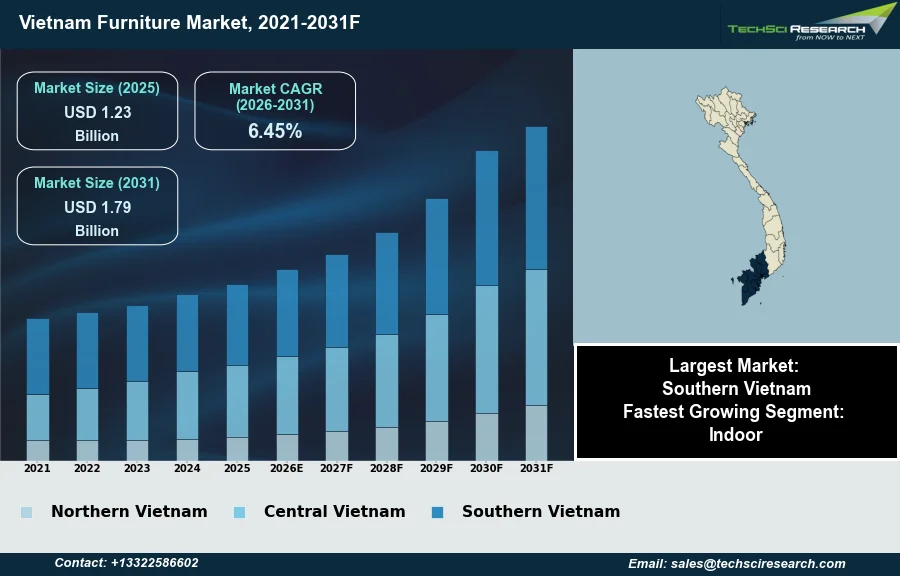
The Furniture Market in Vietnam will grow from USD 1.23 Billion in 2025 to USD 1.79 Billion by 2031 at a 6.45% CAGR. The Vietnam furniture market encompasses the design, manufacturing, and distribution of movable objects that support human activities and enhance interior environments, including items such as chairs, tables, sofas, and cabinetry. The market's expansion is fundamentally driven by robust international demand, strategic government support for the sector, and sustained foreign direct investment. Furthermore, increasing urbanization and a growing domestic middle class contribute significantly to consumption, while advantageous trade agreements enhance market access. According to Vietnam Customs, exports of wood and wood products reached $18.5 billion in 2025, marking a 6.6% year-on-year increase. Within this, wooden furniture exports alone amounted to $10.25 billion, constituting nearly 60% of the industry's total export value.
However, a significant challenge impeding market expansion stems from escalating trade tensions and the imposition of tariffs in major export destinations. This is exemplified by the 25% duty applied to certain Vietnamese kitchen cabinets and upholstered furniture entering the United States since October 2025.
Key Market Drivers
Export demand and strategic sourcing as market drivers
Global export demand and strategic sourcing shifts represent a primary driver for the Vietnam furniture market, positioning the country as a critical global manufacturing hub. International buyers increasingly look to Vietnam for furniture production, driven by its competitive manufacturing costs and established supply chain. This strategic repositioning is evident in recent trade figures. According to the Ministry of Agriculture and Environment, in June 2026, the total export turnover for wood and wood products for the first five months of 2026 reached $7.12 billion, marking a 4.4% increase compared to the same period in 2025. This sustained export performance underscores the country's capability to meet diverse international demands and its growing significance in global furniture supply chains.
Trade agreements and FDI bolster market access and capacity expansion
Favorable international trade agreements further amplify Vietnam's market access and attractiveness for foreign investment. These agreements reduce tariffs and non-tariff barriers, making Vietnamese furniture more competitive in key export destinations. For example, according to AsemconnectVietnam, in April 2026, exports of wood and wood products to RCEP markets reached US$1.43 billion in the first quarter of 2026, representing a 15.72% increase compared to the first quarter of 2025. Such agreements facilitate broader market penetration and strengthen trade relationships. Furthermore, significant foreign direct investment inflows underscore confidence in the market's long-term potential. According to JTM Asia, in 2026, Vietnam attracted US$18.24 billion in foreign direct investment during the first four months, with manufacturing and processing sectors being major beneficiaries. This capital supports capacity expansion and technological upgrades, solidifying Vietnam's competitive edge.
Download Free Sample Report
Key Market Challenges
US tariffs dampen Vietnam's furniture exports
Escalating trade tensions and the imposition of tariffs in major export destinations directly impede the growth of the Vietnam furniture market. The United States, which absorbed approximately 55% of Vietnam's total wood and wood product exports in 2025, according to the Vietnam Timber and Forest Product Association (VIFOREST), imposed a 25% duty on certain Vietnamese kitchen cabinets and upholstered furniture entering its market since October 2025. This significant tariff raises the import cost for these specific product categories, diminishing their price competitiveness for American consumers and businesses. Consequently, this has a discernible impact on export volumes. According to Furnilytics, between September and November 2025, furniture exports declined by approximately 17% compared to the same period in the prior year, marking a clear shift in performance. Such duties directly reduce the attractiveness of Vietnamese furniture, thereby hampering the sector's expansion into a primary international market.
Key Market Trends
Rising Demand for Sustainable Materials and Green Compliance
A significant trend reshaping the Vietnam furniture market is the increasing consumer preference for sustainable and eco-friendly furniture solutions. This shift is driven by a growing awareness among consumers, both domestically and in key export markets, regarding environmental impact and ethical sourcing. Manufacturers are responding by focusing on renewable materials, transparent supply chains, and green certifications to meet these evolving demands. This not only influences product development but also necessitates adherence to stricter international regulations. According to the Ho Chi Minh City Handicrafts and Wood Processing Association (HAWA), January 2026, in its 'Export & Domestic Furniture Report', there is a noticeable surge in demand for natural materials such as bamboo and rattan. This trend mandates producers to invest in sustainable material procurement and processing, thereby enhancing the market’s green credentials.
Adoption of Automation and Digital Manufacturing Upgrades
Another pivotal trend influencing the market is the increasing adoption of advanced manufacturing technologies and automation. Vietnamese furniture manufacturers are actively integrating sophisticated machinery and digital solutions to improve efficiency, precision, and scalability. This technological upgrade is crucial for maintaining competitiveness and meeting the stringent quality standards of international buyers, moving beyond traditional manual craftsmanship. Investments in automation help streamline production processes, reduce lead times, and ensure consistent product quality. According to the Vietnam Trade Promotion Agency, March 2026, foreign direct investment inflows into the wood industry for 2024 saw total capital grow by over 73 percent year-on-year, with a substantial portion of this investment specifically targeting upgrades to digital machinery and the installation of clean energy facilities. This technological transformation is fundamentally altering manufacturing capabilities and capacity within the sector.
Segmental Insights
Indoor Furniture Market Expansion Fueled by Urbanization and Rising Incomes
The Vietnam Furniture Market is currently witnessing its most dynamic expansion within the Indoor segment. This rapid growth is fundamentally driven by the country's swift urbanization and the continuous expansion of its middle-class population, which collectively fuel a significant increase in domestic consumption for residential furnishings. As more individuals relocate to urban centers and disposable incomes rise, there is a heightened demand for modern, functional, and aesthetically appealing furniture to equip new homes and evolving lifestyles. Concurrently, the booming real estate sector, including new housing projects, and a thriving tourism and hospitality industry further bolster the demand for high-quality indoor furniture in hotels, resorts, and commercial spaces. These converging factors ensure sustained momentum for the Indoor furniture segment.
Regional Insights
Southern Vietnam's Furniture Market Leadership: Clusters, Logistics, and Domestic Demand
Southern Vietnam is the leading region in the Vietnam Furniture Market, primarily due to its established industrial clusters concentrated in areas such as Ho Chi Minh City, Binh Duong, and Dong Nai, which host numerous wood processing enterprises and integrated exporters. This region benefits from strategic access to key export gateways, including major ports like Cat Lai and Cai Mep-Thi Vai, facilitating efficient logistics and timely shipments to significant international markets. The substantial economic significance of Ho Chi Minh City, alongside rapid urbanization and a burgeoning middle class, generates considerable domestic demand for residential and commercial furniture. This robust ecosystem, supported by sustained foreign direct investment, a skilled workforce, and strong manufacturing synergies, consistently reinforces Southern Vietnam's market leadership.
Recent Developments
-
In November 2025, Vietnamese furniture manufacturers showcased substantial advancements in technology adoption at the BIFA WOOD Vietnam exhibition. Local firms demonstrated significant investments in Industry 4.0 technologies, including automation, Computer Numerical Control (CNC) systems, robotics, and Artificial Intelligence (AI)-driven solutions. This concerted push towards modernization aimed to enhance production efficiency, reduce labor intensity, and meet stringent international quality benchmarks. Manufacturers also incorporated virtual showrooms and blockchain traceability to improve design customization and supply chain transparency for furniture exports from Vietnam.
-
In May 2025, Hoa Phat Group, a major Vietnamese conglomerate, launched a new 70,000 cubic meter plant dedicated to producing high-end bamboo and rubber flooring. The facility was designed to comply with rigorous international standards, including EPA, CARB, and FDA certifications. This product launch highlighted Hoa Phat Group's strategic focus on developing sustainable and certified materials for the global furniture and construction markets. The initiative contributes to elevating Vietnam's profile in environmentally conscious and premium product offerings.
-
In March 2025, Kuka Home, a prominent furniture manufacturer, expanded its production capabilities in Vietnam by opening a new 470,000-square-foot factory in Binh Duong province. This modern facility became fully operational to meet the rising demand from North American customers, specifically focusing on the production of motion upholstery. This strategic expansion underscored the company's commitment to strengthening its presence in key export markets and reinforced Vietnam's growing stature as a significant manufacturing hub in the global furniture supply chain.
-
In 2025, Truong Thanh Furniture Corporation, a leading Vietnamese manufacturer, initiated a collaboration with British Columbia Crown corporation Forestry Innovation Investment (FII). This partnership focused on developing initial trial furniture products using Canadian wood species, such as western hemlock and Douglas fir, for prospective international buyers. The collaboration aimed to diversify raw material inputs and introduce new design possibilities into the Vietnamese furniture export sector. This effort highlighted a strategic move by Vietnamese companies to explore and integrate alternative sustainable materials into their product lines.
Key Market Players
- KEA
- Home Centre
- Al Futtaim Furniture
- Pan Emirates
- Damac Interiors
- Emaar Furniture
- Alshaya Furniture
- AA Corporation
- Amazon Vietnam
|
By Material
|
By Category
|
By End User
|
By Distribution Channel
|
By Region
|
- Wood
- Metal
- Plastic
- Others
|
|
|
|
- Northern
- Central
- Southern
|
Report Scope:
In this report, the Vietnam Furniture Market has been segmented into the following categories, in addition to the industry trends which have also been detailed below:
-
Vietnam Furniture Market, By Material:
-
Wood
-
Metal
-
Plastic
-
Others
-
Vietnam Furniture Market, By Category:
-
Vietnam Furniture Market, By End User:
-
Vietnam Furniture Market, By Distribution Channel:
-
Vietnam Furniture Market, By Region:
-
Northern
-
Central
-
Southern
Competitive Landscape
Company Profiles: Detailed analysis of the major companies present in the Vietnam Furniture Market.
Available Customizations:
Vietnam Furniture Market report with the given market data, TechSci Research offers customizations according to a company's specific needs. The following customization options are available for the report:
Company Information
- Detailed analysis and profiling of additional market players (up to five).
Vietnam Furniture Market is an upcoming report to be released soon. If you wish an early delivery of this report or want to confirm the date of release, please contact us at sales@techsciresearch.com