|
Key Insights
|
Details
|
|
Forecast Period
|
2027-2031
|
|
Market Size (2025)
|
USD 67.89 Million
|
|
CAGR (2026-2031)
|
8.61%
|
|
Fastest Growing Segment
|
Salmonella
|
|
Largest Market
|
Southern Vietnam
|
|
Market Size (2031)
|
USD 111.44 Million
|
Market Overview
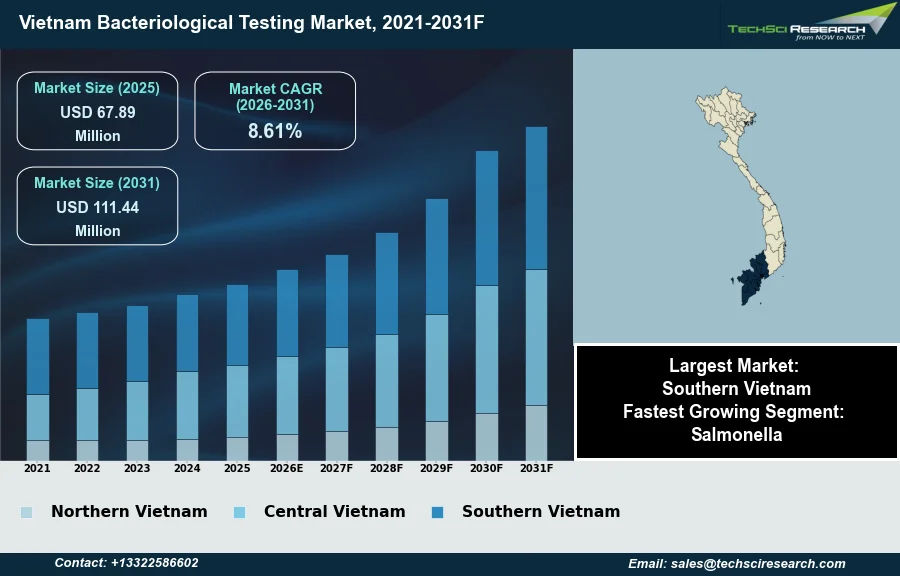
The Vietnam Bacteriological Testing Market will grow from USD 67.89 Million in 2025 to USD 111.44 Million by 2031 at a 8.61% CAGR. Bacteriological testing encompasses laboratory procedures to identify and quantify microorganisms in diverse samples, including food, water, and pharmaceutical products, ensuring safety and quality for consumption or use. The market's growth in Vietnam is primarily supported by increasingly stringent food safety regulations and heightened consumer awareness regarding foodborne illnesses. Concurrently, the expansion of the national healthcare sector, driven by rising public health concerns and the demand for enhanced diagnostic capabilities, further propels this market. Moreover, rigorous quality control requirements across pharmaceutical and environmental monitoring industries, coupled with a growing emphasis on meeting international standards for exports, are key drivers. According to the Ho Chi Minh City Food and Beverage Association (FFA), in the first two months of 2026, the industrial production index of the food processing sector, a significant end-user for bacteriological testing, demonstrated stable growth at 13.2%, markedly higher than 7.7% for the entirety of 2025.
However, a significant challenge impeding market expansion is the prevalent limitation in advanced laboratory infrastructure and the high associated costs of sophisticated testing equipment and reagents. This constraint particularly affects smaller enterprises and remote regions, potentially hindering comprehensive market penetration and consistent adherence to evolving safety standards nationwide.
Key Market Drivers
Regulatory Stringency Fuels Bacteriological Testing Demand
Strict Food Safety Regulations and International Standards Compliance are key factors driving the Vietnam Bacteriological Testing Market. The increasing stringency of domestic food safety laws, coupled with the imperative to meet rigorous international standards for export markets, mandates comprehensive bacteriological analysis across various industries. This heightened regulatory scrutiny necessitates more frequent and advanced testing of food products, water, and agricultural goods to prevent contamination and ensure consumer safety. According to Vietnam News Agency, in June 2024, the European Union increased the border inspection frequency for Vietnamese dragon fruit from 20% to 30%, indicating heightened international standards for agricultural exports. This directly fuels the demand for specialized laboratory services and testing kits within Vietnam, as producers strive to comply with importing countries' requirements to maintain and expand their market access.
Advances in Rapid and Molecular Testing Propel Market Growth
Advancements in Rapid and Molecular Testing Technologies also significantly contribute to the market's expansion. These innovations, such as real-time PCR, offer enhanced sensitivity, specificity, and speed in detecting pathogens compared to traditional methods. Such progress enables quicker identification of microbial contamination, reducing turnaround times for results and allowing for faster intervention, crucial for perishable goods and public health. According to the Vietnam News Agency, in the first four months of 2026, Vietnam secured 1.2 billion USD in high-tech foreign direct investment for a new manufacturing facility, which signifies growing demand for advanced quality control and testing capabilities, including bacteriological analysis. This adoption of modern technologies improves testing efficiency and broadens the scope of detectable microorganisms, supporting a proactive approach to quality control. Overall, according to the Vietnam Association of Seafood Exporters and Producers (VASEP), in the first six months of 2024, Vietnam's seafood export value reached 4.36 billion USD, reflecting substantial demand for product safety and quality.
Download Free Sample Report
Key Market Challenges
Infrastructure gaps and high equipment costs hinder adoption of bacteriological testing.
A significant challenge impeding the growth of the Vietnam Bacteriological Testing Market is the widespread limitation in advanced laboratory infrastructure and the high costs associated with specialized testing equipment and reagents. This constraint disproportionately affects smaller enterprises and those in remote regions, hindering their ability to invest in necessary upgrades for quality control and testing capabilities. Such financial barriers and the lack of accessible, modern facilities directly restrict the adoption of advanced bacteriological testing procedures, thereby limiting comprehensive market penetration for testing services nationwide.
Capital constraints and limited access impede market expansion.
The inability of a large segment of businesses to acquire or access up-to-date testing facilities directly hampers the overall expansion of the market. According to the Vietnam Chamber of Commerce and Industry (VCCI), over one million businesses were operating nationwide by the end of 2025. This substantial number of enterprises, many of which are small and medium-sized, struggle to allocate the considerable capital required for such investments, leading to outdated technology and inadequate quality control systems. This situation impedes consistent adherence to evolving safety standards, reducing the demand for advanced bacteriological testing and consequently constraining market growth.
Key Market Trends
AI-Driven Automation Enhances Bacteriological Testing in Vietnam
The integration of automation and artificial intelligence into bacteriological testing methodologies represents a significant trend, enhancing the efficiency and precision of diagnostic procedures across Vietnam. This advancement allows laboratories to process higher volumes of samples with reduced turnaround times and minimizes the potential for human error, which is critical for timely interventions in food safety and public health. Automated systems facilitate standardized testing protocols and improve data analysis through AI algorithms, leading to more accurate pathogen identification and quantification. According to the Vietnam Medical Informatics Association, June 2026, over 1,230 hospitals across Vietnam have begun applying artificial intelligence and digital technologies in healthcare services, laying groundwork for smart hospitals nationwide.
Expansion of Bacteriological Testing for Infection Prevention and Surveillance
The expansion of bacteriological testing within the healthcare sector for infection prevention is another prominent trend, driven by increasing awareness of hospital-acquired infections and the need for robust public health surveillance. This involves comprehensive testing of clinical samples, water systems, and environmental surfaces in hospitals and clinics to identify pathogenic bacteria and guide effective infection control strategies. Enhanced diagnostic capabilities are crucial for preventing outbreaks and ensuring patient safety, directly fueling demand for specialized bacteriological services. According to Vietnam News, November 2025, the government proposed investing more than US$4.75 billion to improve public health from 2026 through 2035, with a target that 100 percent of provincial Centres for Disease Control be capable of testing pathogens by 2030.
Segmental Insights
Salmonella Testing Growth Driven by Regulation, Awareness, and Export Needs
In the Vietnam Bacteriological Testing Market, Salmonella stands out as the fastest-growing segment, driven by a convergence of factors. Heightened consumer and producer awareness regarding foodborne illnesses has significantly increased the demand for rigorous testing. This is further amplified by stringent governmental regulations, with bodies such as the Ministry of Agriculture and Rural Development and the Department of Animal Health implementing stricter food safety standards, including mandatory surveillance and a zero-tolerance policy for Salmonella in various food products, notably meat and poultry. Furthermore, a history of high-profile Salmonella-related foodborne outbreaks and the necessity to meet international export requirements for key agricultural and seafood products have underscored the critical importance of comprehensive Salmonella testing throughout the supply chain.
Regional Insights
Southern Vietnam: Market Leader in Bacteriological Testing
Southern Vietnam leads the Vietnam Bacteriological Testing Market due to its significant role as the nation's economic and industrial hub, particularly centered around Ho Chi Minh City. This region hosts the largest concentration of manufacturing industries, encompassing substantial food production, processing, and export sectors, including numerous food manufacturers, meat processing plants, seafood exporters, and pharmaceutical companies, all requiring rigorous bacteriological testing. The imperative to comply with stringent domestic and international food safety regulations, enforced by bodies such as the Ministry of Health, drives a high demand for testing services, especially for exports to markets like the European Union and the United States. This industrial concentration and export focus critically contribute to the region's market dominance.
Recent Developments
-
In December 2025, Eurofins Consumer Product Testing Vietnam completed a substantial laboratory expansion, relocating to a new 7,000 square meter facility in Ho Chi Minh City. This enlarged facility significantly boosted Eurofins' capacity to offer comprehensive testing services in Vietnam. The expansion included enhanced capabilities across various sectors, notably in food contact materials. This investment directly impacts the Vietnam bacteriological testing market by providing advanced infrastructure and methods for ensuring the microbiological safety and quality of products, thereby supporting stricter compliance with national and international standards.
-
In April 2025, Imexpharm, a prominent pharmaceutical company in Vietnam and a leading antibiotic manufacturer, highlighted its significant investments in research and development. The company had launched 24 new pharmaceutical products in 2024 and was actively pursuing 98 ongoing R&D projects in 2025. These initiatives were geared towards expanding Imexpharm's portfolio of advanced and high-value pharmaceuticals, including antibiotics. This strategic focus by Imexpharm underscores its commitment to innovation within the pharmaceutical sector, directly influencing the demand for and advancements in bacteriological testing techniques essential for antibiotic efficacy and safety in Vietnam.
-
In May 2024, the analytica Convention was held in Hanoi, serving as a platform for various companies to present their latest advancements in analytical and laboratory technology. Among the leading companies featured at the exhibition was Merck Vietnam. The company showcased its range of products and solutions, which are integral to laboratory operations. Merck's participation and presentation of new technologies at this convention are significant for the Vietnam bacteriological testing market, as they introduce updated tools and methodologies that can enhance the accuracy and efficiency of microbial detection and analysis for various applications.
-
In January 2024, Ecolab inaugurated a new manufacturing plant in Ho Nai Industrial Park, near Ho Chi Minh City. The 3,000 square meter facility includes an advanced laboratory, a manufacturing unit, and a warehouse. This expansion by Ecolab reinforces its dedication to supporting customers across various industrial sectors in Vietnam, including food service and food and beverage processing. The advanced laboratory capabilities within this new plant are instrumental in enhancing product quality and safety, contributing to the broader bacteriological testing market by providing solutions for microbial control and analysis within these critical industries.
Key Market Players
- SGS Vietnam
- Bureau Veritas Vietnam
- Eurofins Scientific Vietnam
- Intertek Vietnam
- Quatest 3 (Quality Assurance and Testing Center 3)
- Vinmec International General Hospital Laboratory System
- Pasteur Institute Ho Chi Minh City
- National Institute of Hygiene and Epidemiology
- Medlatec General Hospital Laboratory
- TÜV SÜD Vietnam
|
By Bacteria
|
By Technology
|
By End Use
|
By Component
|
By Region
|
- Coliform
- Salmonella
- Campylobacter
- Listeria
- Legionella
- Others
|
- Traditional Technology
- Rapid Technology
|
- Food & Beverage
- Water
- Pharmaceuticals
- Others
|
- Instruments
- Test Kits
- Reagents & Consumables
|
- Northern
- Central
- Southern
|
Report Scope:
In this report, the Vietnam Bacteriological Testing Market has been segmented into the following categories, in addition to the industry trends which have also been detailed below:
-
Vietnam Bacteriological Testing Market, By Bacteria:
-
Coliform
-
Salmonella
-
Campylobacter
-
Listeria
-
Legionella
-
Others
-
Vietnam Bacteriological Testing Market, By Technology:
-
Traditional Technology
-
Rapid Technology
-
Vietnam Bacteriological Testing Market, By End Use:
-
Food & Beverage
-
Water
-
Pharmaceuticals
-
Others
-
Vietnam Bacteriological Testing Market, By Component:
-
Instruments
-
Test Kits
-
Reagents & Consumables
-
Vietnam Bacteriological Testing Market, By Region:
-
Northern
-
Central
-
Southern
Competitive Landscape
Company Profiles: Detailed analysis of the major companies present in the Vietnam Bacteriological Testing Market.
Available Customizations:
Vietnam Bacteriological Testing Market report with the given market data, TechSci Research offers customizations according to a company's specific needs. The following customization options are available for the report:
Company Information
- Detailed analysis and profiling of additional market players (up to five).