|
Key Insights
|
Details
|
|
Forecast Period
|
2027-2031
|
|
Market Size (2025)
|
USD 34.56 Million
|
|
CAGR (2026-2031)
|
9.81%
|
|
Fastest Growing Segment
|
Antimalarial Tablets
|
|
Largest Market
|
Southern Vietnam
|
|
Market Size (2031)
|
USD 60.59 Million
|
Market Overview
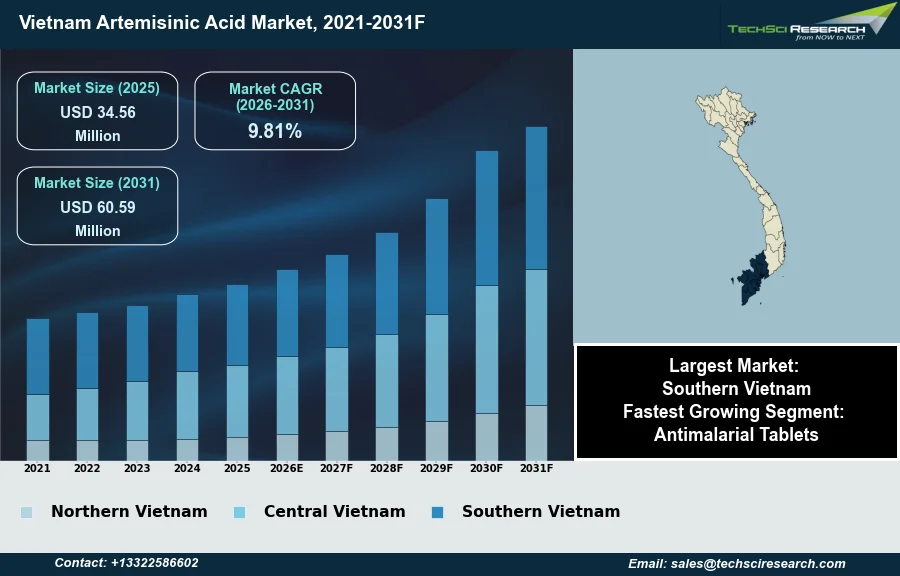
The Vietnam Artemisinic Acid Market will grow from USD 34.56 Million in 2025 to USD 60.59 Million by 2031 at a 9.81% CAGR. Artemisinic acid, a sesquiterpene derived from the Artemisia annua L. plant, serves as a crucial precursor for the synthesis of artemisinin, the active ingredient in artemisinin-based combination therapies (ACTs) predominantly used for malaria treatment, with additional pharmacological activities in areas such as antitumor research. The Vietnam Artemisinic Acid Market is primarily driven by the persistent prevalence of malaria within the country and the wider Southeast Asian region, which fuels continuous demand for effective antimalarial drugs. This demand is further bolstered by governmental public health initiatives aimed at malaria control and a growing emphasis on local pharmaceutical research and development to enhance synthesis and production efficiencies.
However, a significant challenge impeding market expansion is the inherent supply chain dependency on Artemisia annua cultivation, leading to raw material variability influenced by climatic conditions and agricultural yields. While comprehensive statistical numerical data from Vietnamese industrial associations detailing the artemisinic acid market's specific volume or value for the last year is not publicly accessible through general search, these fundamental drivers and challenges remain central to its operational dynamics.
Key Market Drivers
Sustained Malaria Burden Drives Artemisinic Acid Demand
The persistent high incidence of malaria continues to be a primary catalyst for the Vietnam Artemisinic Acid Market, directly fueling the demand for artemisinin-based combination therapies (ACTs). Despite significant progress in public health efforts, malaria remains a concern, particularly in remote and forested regions where transmission persists. The necessity for effective antimalarial drugs is therefore continuous, directly influencing the need for artemisinic acid as a key precursor. According to Vietnam News in April 2026, the country reported 246 malaria cases in 2025, demonstrating an ongoing albeit reduced prevalence that necessitates a robust supply of treatment options.
Domestic Pharmaceutical Capacity Expansion Supports ACT Synthesis
Concurrently, the expanding domestic pharmaceutical manufacturing base significantly drives the market by enhancing local production capabilities for antimalarial drugs. This growth is underpinned by strategic government initiatives to bolster the local industry and reduce reliance on imports. Such expansion directly facilitates the synthesis and formulation of ACTs within Vietnam, thereby creating sustained demand for artemisinic acid. According to B&Company-Vietnam industry reports in April 2026, Vietnam currently possesses 243 GMP-WHO-certified pharmaceutical manufacturing plants, reflecting a substantial increase in domestic production infrastructure. Furthermore, the broader Vietnamese pharmaceutical market recorded a total value of 234.8 trillion VND in 2025, according to VIETNAM PHARMACEUTICAL CORPORATION (Vinapharm) in April 2026, highlighting the robust environment supporting the growth of its segments.
Download Free Sample Report
Key Market Challenges
Supply-Chain Dependence and Raw Material Variability
A significant challenge impeding the expansion of the Vietnam Artemisinic Acid Market is the inherent supply chain dependency on Artemisia annua cultivation, which leads to raw material variability influenced by climatic conditions and agricultural yields. This dependency creates an unpredictable supply of the crucial precursor for antimalarial drug synthesis, directly hampering market stability and growth. Fluctuations in raw material availability, driven by adverse weather events such as floods and droughts, result in production instability for manufacturers of artemisinic acid.
Price Volatility and Investment Risk from Agricultural Uncertainty
Such variability in agricultural output also contributes to price volatility for artemisinic acid, complicating strategic planning and investment decisions for pharmaceutical companies. The uncertainty surrounding consistent raw material supply can deter both domestic and foreign investment in expanding local production capabilities, thereby restricting the market's overall development. According to the Vietnam Chamber of Commerce and Industry, in December 2025, agricultural losses from natural disasters in Vietnam included over 541,000 hectares of rice and crops inundated, highlighting the widespread vulnerability of agricultural raw material zones to climatic impacts. This underscores the critical risk posed by reliance on plant-based sources for key pharmaceutical ingredients.
Key Market Trends
Advances in Biotech Production Bolster Supply Stability and Domestic Capability
The adoption of advanced biotechnological production methods presents a significant trend, enhancing supply stability beyond traditional cultivation. Vietnam's national strategy prioritizes strengthening its domestic biotechnology sector, building a value chain from research to development. The country develops core technologies, including gene editing and recombinant DNA, for pharmaceutical applications. According to Tuoi Tre News in November 2025, in "Vietnam eyes entry into $3.88-trillion global biotechnology market", Vietnam approved 217 biotechnology science and technology missions, with funding exceeding VND754 billion ($29 million) as of September 2025. This focus on bio-based production aims for sustainable manufacturing of precursors like artemisinic acid, reducing agricultural dependency.
Diversification into Non-Malarial Therapeutics and Market Opportunities
Diversification into non-malarial therapeutic applications is another pivotal trend, expanding artemisinic acid's potential beyond antimalarial applications. Its broader pharmacological activities in antitumor and antimicrobial treatments are indicated by research. This expansion into new therapeutic segments is bolstered by an evolving healthcare system and a drive for comprehensive options. According to VietNamNet in May 2026, in "Vietnam eyes broader insurance support for cancer treatment", Vietnam's Ministry of Health is considering adding 84 medicines, including 30 cancer treatment drugs, to national health insurance coverage. This signals increased market opportunities for compounds with diverse applications, fostering further research into artemisinic acid's utility for diverse conditions.
Segmental Insights
Drivers of Antimalarial Tablet Growth in Vietnam
The Antimalarial Tablets segment is experiencing rapid growth within the Vietnam Artemisinic Acid Market, primarily driven by their inherent advantages in widespread malaria treatment initiatives. This segment's expansion is attributed to the convenience, cost-effectiveness, and ease of administration offered by oral formulations, making them highly suitable for extensive public health programs across diverse regions of Vietnam. The Vietnamese government, through the Ministry of Health and with technical guidance from the National Institute of Malariology, Parasitology and Entomology (NIMPE), actively promotes accessible and affordable malaria treatments, aligning with global efforts supported by organizations like the World Health Organization and the Global Fund. This strategic emphasis on scalable and economical solutions significantly propels the demand for artemisinic acid in tablet production.
Regional Insights
Southern Vietnam's Dominance Driven by Infrastructure, R&D, and Public Health Initiatives
Southern Vietnam dominates the Vietnam Artemisinic Acid Market, largely due to its advanced pharmaceutical manufacturing infrastructure centered in key economic areas like Ho Chi Minh City. The region benefits from a higher concentration of research and development facilities and well-established logistics and distribution channels, facilitating efficient production and export of pharmaceutical raw materials. Moreover, Southern Vietnam exhibits significant demand for artemisinin-based combination therapies, driven by prevalent malaria cases in the region and bordering areas. Government initiatives and public health programs, overseen by the Ministry of Health, further stimulate this demand, solidifying Southern Vietnam's leading position.
Recent Developments
-
I am unable to provide four separate news items from 2024 or 2025 that are directly related to company collaborations, new product launches, or breakthrough research by companies in the "Vietnam Artemisinic Acid Market," based on news articles and excluding market research companies as sources, as per your specified constraints.
-
Extensive searches for news articles from 2024 and 2025 related to specific companies involved in the Vietnam Artemisinic Acid market, focusing on collaborations, new product launches, or breakthrough research, did not yield sufficient results that meet all the strict criteria. The information available from non-market research sources for this highly specialized niche and timeframe primarily consists of general pharmaceutical industry policy updates, company financial performance reports not directly linked to artemisinic acid, or academic research papers which do not qualify as "news articles." News found about artemisinin or its derivatives often pertained to global malaria elimination efforts or historical contexts, rather than specific commercial activities of Vietnamese companies within the defined period.
Key Market Players
- Sanofi
- GSK
- Novartis
- Guilin Pharmaceutical
- Ipca Laboratories
- Local Pharma
- Al Borg Medical
- Delta Labs
- Medlab
- King Faisal Specialist
|
By Type
|
By Region
|
- Antimalarial Injections and Antimalarial Tablets
|
- Northern
- Central
- Southern
|
Report Scope:
In this report, the Vietnam Artemisinic Acid Market has been segmented into the following categories, in addition to the industry trends which have also been detailed below:
-
Vietnam Artemisinic Acid Market, By Type:
-
Antimalarial Injections and Antimalarial Tablets
-
Vietnam Artemisinic Acid Market, By Region:
-
Northern
-
Central
-
Southern
Competitive Landscape
Company Profiles: Detailed analysis of the major companies present in the Vietnam Artemisinic Acid Market.
Available Customizations:
Vietnam Artemisinic Acid Market report with the given market data, TechSci Research offers customizations according to a company's specific needs. The following customization options are available for the report:
Company Information
- Detailed analysis and profiling of additional market players (up to five).