|
Key Insights
|
Details
|
|
Forecast Period
|
2027-2031
|
|
Market Size (2025)
|
USD 271.92 Million
|
|
CAGR (2026-2031)
|
18.47%
|
|
Fastest Growing Segment
|
Magnetic Sensors
|
|
Largest Market
|
West
|
|
Market Size (2031)
|
USD 751.78 Million
|
Market Overview
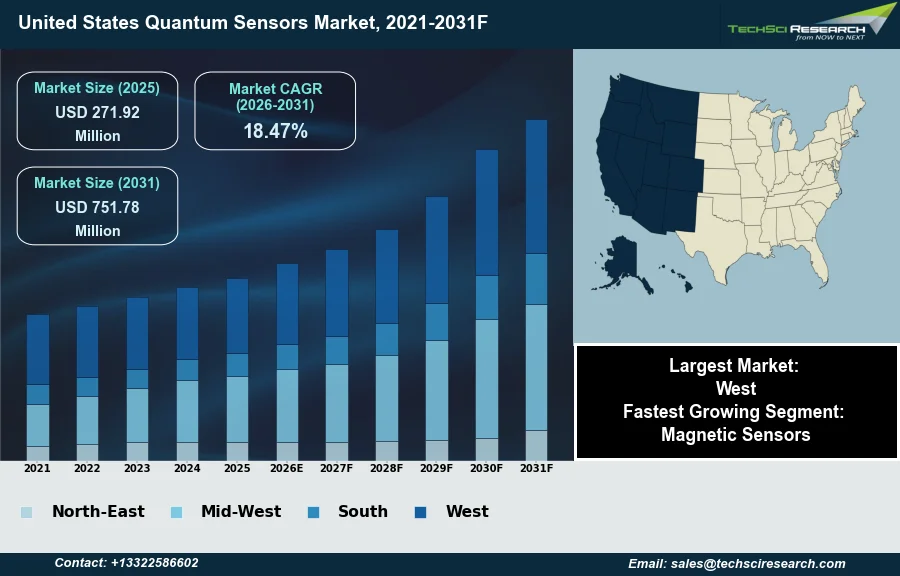
The United States Quantum Sensors Market will grow from USD 271.92 Million in 2025 to USD 751.78 Million by 2031 at a 18.47% CAGR. Quantum sensors are devices that harness quantum mechanical principles, such as superposition and entanglement, to achieve exceptionally precise and sensitive measurements of physical properties including magnetic fields, gravity, and time, thereby surpassing the performance of conventional sensors. The market in the United States is fundamentally driven by robust government investments and strategic national security initiatives, particularly for applications requiring GPS-independent navigation and advanced surveillance capabilities. Moreover, the increasing demand for ultra-accurate measurement tools across critical sectors like healthcare, for enhanced diagnostics, and the automotive industry further stimulates market growth. According to the Quantum Economic Development Consortium (QED-C), the global quantum sensing market was estimated at US$375 million in 2024.
A significant challenge impeding market expansion is the protracted commercialization process, requiring substantial investment to transition devices from laboratory prototypes to industrially viable products. This transition necessitates considerable effort in miniaturization, improving durability, and reducing production costs, alongside addressing limitations in the availability of specialized components and a specialized interdisciplinary workforce.
Key Market Drivers
Federal Funding Accelerates Quantum Sensor Development for National Security
Substantial government funding and strategic initiatives significantly propel the United States Quantum Sensors Market. These investments are largely channeled towards enhancing national security, particularly in areas requiring advanced navigation and surveillance without reliance on external systems like GPS. For instance, the Department of War's Defense Innovation Unit (DIU) is expected to invest up to $200 million within the next year in an initiative focused on transitioning mature quantum sensing and timing technologies directly to the Joint Force. This commitment underscores a concerted federal effort to accelerate research, development, and the eventual deployment of quantum sensor technologies, fostering innovation and creating a stable environment for technological advancement within the domestic industry.
Rising Demand for Ultra-High-Precision Quantum Sensors Across Civil Sectors
The rising demand for ultra-high precision measurement capabilities further stimulates market expansion, extending beyond traditional defense applications into critical civilian sectors. Industries such as healthcare and automotive increasingly seek quantum sensors to achieve unparalleled accuracy in diagnostics and autonomous systems. To address this need, the U.S. National Science Foundation selected five new teams in June 2026, each receiving $4 million over two years to develop experimental quantum technologies, including sensors capable of measuring faint properties inside a single cell. This investment reflects the growing need for superior measurement tools across diverse applications, driving further innovation and commercialization. Demonstrating the broader economic activity, IonQ, a leading quantum platform company, reported $130 million in GAAP revenue for 2025.
Download Free Sample Report
Key Market Challenges
Protracted commercialization delays the US quantum sensor market
The protracted commercialization process significantly hampers the growth of the United States quantum sensors market. Transitioning quantum sensor devices from laboratory prototypes to industrially viable products requires substantial investment, alongside considerable efforts in miniaturization, improving durability, and reducing production costs. These prerequisites delay market entry and limit the widespread adoption of advanced quantum sensing technologies. The need for robust, compact, and cost-effective sensors for diverse applications slows their integration into sectors beyond government and defense.
Specialized component shortages and talent gaps constrain deployment
Furthermore, limitations in the availability of specialized components and a skilled interdisciplinary workforce exacerbate this challenge. The highly specialized nature of quantum technology demands unique manufacturing capabilities and a talent pool proficient in both quantum mechanics and engineering. According to the Quantum Economic Development Consortium (QED-C), the quantum sensing segment contributed approximately $470 million to the global quantum technology revenue in 2025, highlighting an emerging but still relatively contained market. The persistent gap in specialized expertise impedes efficient development, scaling, and ultimately, the broad commercial deployment of quantum sensors within the United States.
Key Market Trends
Miniaturization and Chip-Scale Integration Drive Deployable Quantum Sensors
Miniaturization and chip-scale integration represent a pivotal trend transforming the United States quantum sensors market, enabling the transition of devices from laboratory settings to practical, deployable applications. This focus on reducing the size, weight, and power (SWaP) of quantum sensors is critical for expanding their utility across diverse sectors, including portable navigation, medical diagnostics, and industrial monitoring. Such advancements facilitate the mass production and cost reduction necessary for broader commercial adoption. A significant federal commitment to this area is evidenced by the U.S. National Science Foundation's X-Labs initiative, announced in May 2026, which plans to invest $1.5 billion over the next decade, with a focus on "Quantum Systems: Interconnects and Integrated Photonics" to advance integrated quantum systems.
AI and ML-Driven Performance Optimization for Quantum Sensors
The integration of artificial intelligence and machine learning for performance optimization is another significant trend enhancing the capabilities of quantum sensors within the U.S. market. These advanced computational methods are crucial for refining signal processing, effectively mitigating noise, and achieving real-time calibration, thereby pushing the boundaries of measurement accuracy and reliability. AI and machine learning algorithms enable quantum sensors to extract precise data from complex environments and optimize their operational parameters, accelerating their deployment in demanding applications. For example, according to SBU News in February 2026, the National Science Foundation awarded a $1.08 million grant to Stony Brook University researchers to develop algorithms and optimization methods for quantum sensor networks, aiming to coordinate and enhance their distributed performance.
Segmental Insights
Magnetic sensors drive growth, led by Nitrogen-Vacancy Diamond Magnetometers and government initiatives.
The United States Quantum Sensors Market identifies Magnetic Sensors as a key growth segment, notably driven by rapidly expanding sub-segments such as Nitrogen-Vacancy Diamond Magnetometers. This accelerated growth stems from their unparalleled precision, crucial for defense and national security applications like advanced GPS-denied navigation and enhanced intelligence, surveillance, and reconnaissance. Furthermore, these sensors are transforming medical imaging and diagnostics through high-sensitivity neuroimaging and cellular analysis. Pervasive government initiatives, from entities like the National Science Foundation and Department of Defense, further propel the research and commercialization of these quantum technologies.
Regional Insights
Mountain West Emerges as Leader in Quantum Sensing Through Ecosystem, Investments, and Talent
The Western United States, particularly the Mountain West, leads the nation's quantum sensors market due to a concentrated ecosystem of research, development, and commercialization. This dominance stems from significant federal and state investments, exemplified by the U.S. Department of Commerce's Economic Development Agency designating Elevate Quantum as a regional Tech Hub under the CHIPS and Science Act, fostering robust innovation and collaboration. The region benefits from a high density of national laboratories, leading academic institutions, and a strong presence of quantum technology companies, all contributing to a specialized talent pool and an environment conducive to advancing quantum sensing capabilities. This convergence of funding, infrastructure, and expertise enables the rapid progression of quantum sensor applications.
Recent Developments
-
In May 2025, Aeluma, Inc., a semiconductor company, and Thorlabs, a vertically integrated photonics products manufacturer, announced a significant breakthrough in silicon photonics. They unveiled a large-diameter wafer manufacturing platform that merges the performance characteristics of compound semiconductors with the scalability of mainstream silicon fabrication. This advancement is poised to accelerate the commercial adoption of quantum computing and communication. The demonstrated capabilities specifically enhance Aeluma’s ongoing work in quantum dot materials within silicon photonics, directly supporting the development of advanced sensing technologies and optical interconnects for artificial intelligence infrastructure within the United States Quantum Sensors Market.
-
In January 2025, TOPTICA Photonics Inc., a developer and manufacturer of optical components based in Rochester, established a partnership with the Quantum Ultra-broadband Photonic Integrated Circuits and Systems (QUPICS) team. This collaboration aims to develop a novel foundry fabrication platform specifically for quantum technologies. The QUPICS project, a coalition including multiple academic institutions, government laboratories, and technology manufacturers, receives substantial support from the U.S. Department of Defense. The integrated systems and chip-integrated lasers developed under this initiative are critical for numerous photonics-heavy quantum applications, including quantum sensing, thereby directly advancing capabilities within the United States Quantum Sensors Market.
-
In October 2024, Infleqtion, a pioneering quantum technology company, and Thorlabs, a photonics manufacturer, formed a partnership to commercialize an optical fiber collimator designed for quantum applications. This component, originally developed through a UK government-funded project, will now see expanded access. The collaboration is intended to provide advanced collimation capabilities to a broader range of researchers and product development teams. This initiative is expected to accelerate the progress of quantum technologies in the United States, offering more reliable and cost-effective solutions for various quantum sensing and computing endeavors, thereby directly contributing to the United States Quantum Sensors Market.
-
In 2024, Boeing collaborated with AOSense, Inc., a company specializing in atom interferometry based in the U.S., to conduct the inaugural in-flight test of a quantum inertial measurement unit. This significant research achievement demonstrated considerable improvements in navigational accuracy, notably reducing positional drift. The project was executed under a Defense Innovation Unit contract, which focuses on integrating next-generation quantum sensor systems onto U.S. military platforms. This successful test represents a critical advancement for the United States Quantum Sensors Market, particularly in developing navigation solutions that are resilient and independent of traditional GPS signals, enhancing national security.
Key Market Players
- Honeywell International Inc.
- Lockheed Martin Corporation
- Raytheon Technologies Corporation
- Robert Bosch GmbH
- Infineon Technologies AG
- Qnami AG
- ID Quantique SA
- AOSense Inc.
- Muquans SAS
- ColdQuanta Inc.
|
By Product
|
By Verticals
|
By Region
|
- Atomic Clocks
- Photosynthetically Active Radiation (PAR)
- Gravity Sensors
- Magnetic Sensors
|
- Oil & Gas
- Military & Defense
- Automotive
- Healthcare
- Agriculture
|
- Northeast
- Midwest
- South
- West
|
Report Scope:
In this report, the United States Quantum Sensors Market has been segmented into the following categories, in addition to the industry trends which have also been detailed below:
-
United States Quantum Sensors Market, By Product:
-
Atomic Clocks
-
Photosynthetically Active Radiation (PAR)
-
Gravity Sensors
-
Magnetic Sensors
-
United States Quantum Sensors Market, By Verticals:
-
Oil & Gas
-
Military & Defense
-
Automotive
-
Healthcare
-
Agriculture
-
United States Quantum Sensors Market, By Region:
-
Northeast
-
Midwest
-
South
-
West
Competitive Landscape
Company Profiles: Detailed analysis of the major companies present in the United States Quantum Sensors Market.
Available Customizations:
United States Quantum Sensors Market report with the given market data, TechSci Research offers customizations according to a company's specific needs. The following customization options are available for the report:
Company Information
- Detailed analysis and profiling of additional market players (up to five).
United States Quantum Sensors Market is an upcoming report to be released soon. If you wish an early delivery of this report or want to confirm the date of release, please contact us at sales@techsciresearch.com