|
Key Insights
|
Details
|
|
Forecast Period
|
2027-2031
|
|
Market Size (2025)
|
USD 2.08 Trillion
|
|
CAGR (2026-2031)
|
5.88%
|
|
Fastest Growing Segment
|
Non-Life Insurance
|
|
Largest Market
|
South
|
|
Market Size (2031)
|
USD 2.93 Trillion
|
Market Overview
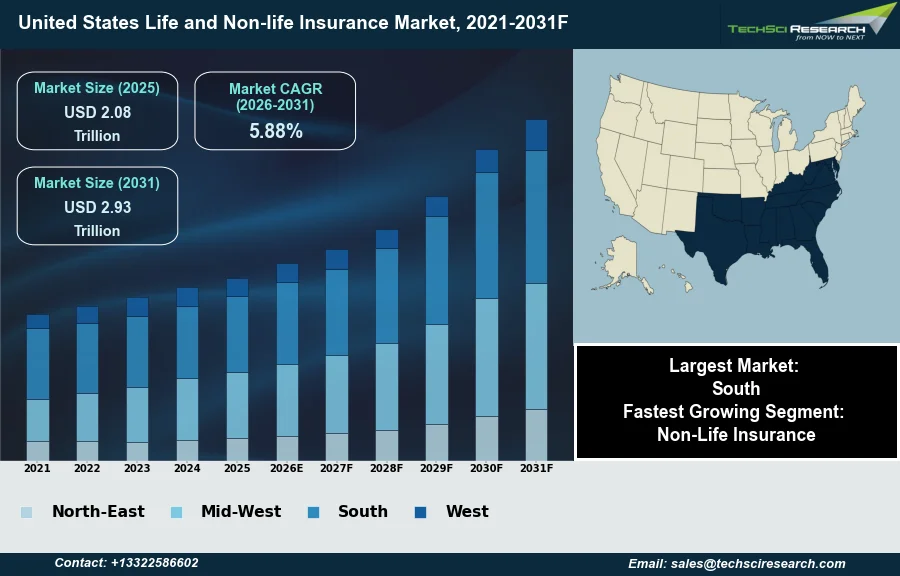
The United States Life and Non-life Insurance Market will grow from USD 2.08 Trillion in 2025 to USD 2.93 Trillion by 2031 at a 5.88% CAGR. The United States life and non-life insurance market delivers crucial financial protection, with life insurance safeguarding beneficiaries against financial loss due to mortality events, and non-life insurance encompassing property, casualty, and various other risk coverages. Market expansion is primarily driven by underlying economic stability, increasing societal awareness regarding risk mitigation, and evolving demographic profiles shaping demand for both personal and commercial insurance products.
According to the National Association of Insurance Commissioners, direct premiums written in the U.S. property and casualty industry reached $1.1 trillion in 2025. Concurrently, LIMRA reported that U.S. individual life insurance new annualized premiums achieved a record $17.5 billion in 2025. A notable challenge hindering market growth is the ongoing impact of inflationary pressures and social inflation, which consistently elevate claims costs across multiple non-life insurance lines.
Key Market Drivers
Aging population and retirement savings gap drive demand for annuities and long-term care coverage.
The aging population and the associated retirement savings gap represent a significant driving force within the United States life and non-life insurance market. As the demographic cohort of older Americans expands, demand for products that offer guaranteed income and long-term financial security, such as annuities, rises substantially. This trend addresses the necessity for sustainable income streams throughout retirement and for mitigating longevity risk. According to LIMRA, in March 2026, total U.S. annuity sales increased 7% to $464.1 billion in 2025, reflecting this growing consumer need for protected lifetime income solutions. Furthermore, increasing life expectancies contribute to the demand for long-term care insurance, as individuals seek to cover potential healthcare costs not typically covered by standard health insurance in their later years.
Climate-driven catastrophe risk reshapes non-life underwriting and pricing.
Concurrently, catastrophe loss volatility and the escalating impacts of climate change profoundly influence the non-life insurance sector. The increasing frequency and severity of natural disasters, including wildfires, hurricanes, and severe convective storms, necessitate more robust property and casualty coverage and drive insurers to innovate in risk assessment and pricing. Underwriting practices are evolving to account for these amplified risks, leading to adjustments in premiums and policy terms. According to the Insurance Information Institute (Triple-I), in April 2026, severe convective storms alone caused $51 billion in U.S. insured losses in 2025, highlighting the substantial financial exposure from these events. Across the broader market, the National Association of Insurance Commissioners reported that the insurance industry experienced an 8.7% ($121 billion) increase in direct earned Accident & Health premium to $1.51 trillion in 2025, further illustrating the dynamic nature and growth within various segments of the U.S. insurance landscape.
Download Free Sample Report
Key Market Challenges
Inflation and Social Inflation Raise Claims Costs and Underwriting Risk
The challenging factor hindering market expansion is the ongoing impact of inflationary pressures and social inflation. These elements consistently elevate claims costs across various non-life insurance lines, directly diminishing insurer profitability and increasing underwriting risk. When claims expenses escalate beyond projections, carriers must either absorb these higher costs, affecting their financial stability, or implement premium increases.
Rising Claims Severity and Social Inflation Strain Financial Performance and Market Growth
Rising claims severity, exacerbated by both economic and social inflation, significantly strains financial performance. For example, according to the Insurance Information Institute (Triple-I), U.S. insurers disbursed an estimated $1.65 billion in lightning-related homeowners insurance claims in 2025, marking a 59% increase from 2024, with the average cost per claim rising by 42.8% to $26,616. This escalation reflects higher reconstruction, labor, and material expenses. Furthermore, social inflation, characterized by legal system abuse and increasing jury awards, necessitates significant adverse reserve additions in commercial liability lines, such as commercial auto liability, creating additional financial burdens for insurers. These elevated costs impede insurers' capacity to invest in market development initiatives or offer more competitive pricing, thus directly hampering the growth of the United States life and non-life insurance market by potentially impacting affordability and access for policyholders.
Key Market Trends
AI/ML Adoption in Insurance Operations
Widespread adoption of artificial intelligence and machine learning in operations represents a transformative trend within the United States life and non-life insurance market. Insurers are leveraging AI to enhance efficiency across various functions, including underwriting, claims processing, and fraud detection, moving towards a more predictive and preventive operational model. This technological integration allows for more granular risk assessment and accelerated decision-making, improving both accuracy and speed. According to the National Association of Insurance Commissioners (NAIC), April 2026, out of 193 auto insurers responding, 88% reported they use, plan to use, or plan to explore AI/ML models in their operations. This shift underscores a strategic imperative to automate routine tasks and provide more consistent, faster service, thereby optimizing resource allocation and potentially reducing operational costs.
Cyber Insurance Growth and Underwriting Implications
Concurrently, the increased demand for and focus on cyber insurance offerings is significantly shaping the market landscape as businesses confront escalating digital threats. The growing frequency and sophistication of cyberattacks, such as ransomware and data breaches, are compelling organizations across all sectors to seek specialized protection. This trend drives insurers to innovate in product development and risk modeling to provide comprehensive coverage against cyber-related financial losses and business interruptions. According to an AM Best report, June 2026, the US cyber-insurance market generated $7.5 billion in premiums in 2025, up slightly from $7.1 billion the previous year. The expanding cyber threat landscape necessitates robust underwriting practices and an evolving understanding of digital vulnerabilities, impacting policy terms and pricing strategies across the non-life insurance segment.
Segmental Insights
Key Growth Drivers in the U.S. Non-Life Insurance Market
The United States Non-Life Insurance market is experiencing rapid growth, positioning it as the fastest-growing segment. This expansion is primarily driven by the escalating frequency and severity of natural disasters, such as floods and wildfires, which necessitate more robust property insurance coverage. Concurrently, the increasing complexity of cybersecurity threats fuels significant demand for specialized cyber insurance policies among businesses and individuals. Furthermore, a heightened awareness of diverse liabilities and evolving risks, coupled with consistent innovation in product offerings, contributes to this segment's accelerated development in the market.
Regional Insights
South Leads U.S. Insurance Market: Population, Growth, and Climate Risk Drive Demand.
The South stands as the leading region in the United States Life and Non-life Insurance Market, driven by a combination of factors. This dominance stems from the region's substantial population and robust economies, particularly evident in states like Texas, Florida, and Georgia, which collectively generate significant demand for a wide array of insurance products including homeowners', auto, and commercial policies. Furthermore, the South's frequent exposure to climatic risks, such as hurricanes and severe convective storms, consistently fuels a heightened need for comprehensive property and casualty coverage. These elements, coupled with ongoing urbanization, the expansion of small businesses, and extensive infrastructure development, collectively contribute to the sustained demand for insurance protection across the Southern states.
Recent Developments
-
In May 2025, North American Company for Life and Health Insurance expanded its collaboration with Annexus, a firm specializing in retirement product design and distribution, to launch Secure Horizon Indexed Universal Life Insurance. This new Indexed Universal Life (IUL) product was designed for the United States life insurance market to offer a combination of guaranteed death benefits with the potential for cash value growth. The ongoing partnership emphasized developing innovative insurance solutions to meet diverse client needs within the evolving financial landscape.
-
In April 2025, Guardian, a prominent U.S. life insurer and employee benefits provider, announced a strategic partnership with Janus Henderson Group, a global asset manager. Under the collaboration, Janus Henderson was slated to manage Guardian's $45 billion investment grade public fixed income portfolio, including corporate bonds and securitized credit. This significant move within the United States life insurance market involved Guardian committing up to $400 million in seed capital to support Janus Henderson's fixed income product innovation and the co-development of multi-asset model portfolios.
-
In February 2025, Cytora, a digital risk processing platform, announced a strategic partnership with Smarty, a provider of advanced property data solutions. This collaboration aimed to transform property underwriting and risk evaluation for insurers operating in the United States non-life insurance market. By integrating Smarty's property data, including structural, locational, and financial attributes, into Cytora's platform, the initiative sought to enable more informed and efficient underwriting decisions, enhancing precision in risk assessment.
-
In October 2024, OneAmerica Financial introduced Asset Care 2024, an enhanced long-term care product designed to help clients manage potential long-term care expenses or leave a financial legacy. This new offering in the United States life insurance market featured expanded inflation protection options to safeguard against rising care costs. It also included enhanced benefits to support informal caregivers, independent providers, and in-home care services, while simplifying benefit period choices to streamline access and sales. The product was developed to address the growing need for flexible solutions in the evolving care landscape.
Key Market Players
- State Farm Mutual Automobile Insurance Company
- Berkshire Hathaway Inc.
- Allstate Corporation
- Progressive Corporation
- MetLife Inc.
- Prudential Financial Inc.
- American International Group Inc. (AIG)
- Liberty Mutual Holding Company Inc.
- Travelers Companies Inc.
- Chubb Limited
|
By Insurance Type
|
By Distribution Channel
|
By Region
|
- Life Insurance
- Non-Life Insurance
|
- Direct
- Agency
- Banks
- Others
|
- Northeast
- Midwest
- South
- West
|
Report Scope:
In this report, the United States Life and Non-life Insurance Market has been segmented into the following categories, in addition to the industry trends which have also been detailed below:
-
United States Life and Non-life Insurance Market, By Insurance Type:
-
Life Insurance
-
Non-Life Insurance
-
United States Life and Non-life Insurance Market, By Distribution Channel:
-
Direct
-
Agency
-
Banks
-
Others
-
United States Life and Non-life Insurance Market, By Region:
-
Northeast
-
Midwest
-
South
-
West
Competitive Landscape
Company Profiles: Detailed analysis of the major companies present in the United States Life and Non-life Insurance Market.
Available Customizations:
United States Life and Non-life Insurance Market report with the given market data, TechSci Research offers customizations according to a company's specific needs. The following customization options are available for the report:
Company Information
- Detailed analysis and profiling of additional market players (up to five).
United States Life and Non-life Insurance Market is an upcoming report to be released soon. If you wish an early delivery of this report or want to confirm the date of release, please contact us at sales@techsciresearch.com