|
Key Insights
|
Details
|
|
Forecast Period
|
2027-2031
|
|
Market Size (2025)
|
USD 57.59 Trillion
|
|
CAGR (2026-2031)
|
7.12%
|
|
Fastest Growing Segment
|
Alternative Investment
|
|
Largest Market
|
North-East
|
|
Market Size (2031)
|
USD 87.01 Trillion
|
Market Overview
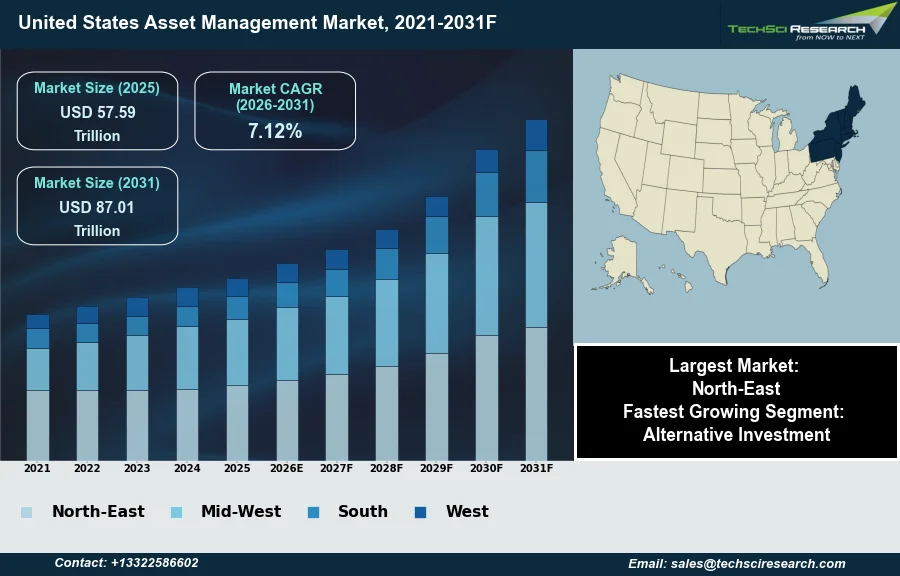
The United States Asset Management Market will grow from USD 57.59 Trillion in 2025 to USD 87.01 Trillion by 2031 at a 7.12% CAGR. Asset management constitutes the professional oversight and strategic deployment of financial assets on behalf of institutional and retail clients, aiming to maximize value and align with their specific investment objectives. The United States market is significantly propelled by several key drivers, including consistent wealth accumulation, an aging population requiring robust retirement planning solutions, and the increasing demand for diverse investment products. According to the Investment Company Institute, the combined assets of the nation's mutual funds reached $33.15 trillion in May 2026, and US households had a record $49.1 trillion earmarked for retirement at year-end 2025.
Nevertheless, market expansion faces a notable impediment in the form of escalating regulatory complexity. The frequent introduction of new rules and reporting requirements necessitates substantial compliance investments, particularly impacting resource allocation for smaller and mid-sized asset management firms.
Key Market Drivers
Wealth growth drives asset management demand.
Growing individual and institutional wealth significantly propels the United States asset management market. As households accumulate capital through savings, investments, and inheritances, and institutions expand their endowments and pension funds, there is a sustained demand for professional management services. This consistent growth in assets provides a fundamental expansion for asset management firms, enabling them to attract new clients and increase assets under management. For instance, the American middle class held $13.6 trillion in wealth during Q4 2025, according to USAFacts, June 2026, in 'How much wealth does the American middle class have?'. This accumulation necessitates sophisticated strategies for wealth preservation and growth, driving demand for diverse investment solutions across various asset classes.
Fintech and AI enhance efficiency, onboarding, and portfolio management.
Concurrently, advancements in financial technology and digital platforms are reshaping the operational landscape and client engagement strategies within the asset management industry. These technological innovations, encompassing artificial intelligence, data analytics, and automated platforms, enhance efficiency, reduce costs, and enable personalized investment solutions. The adoption of AI technologies, for example, saw 75% of financial firms implementing them in 2025, according to CFA Montréal, February 2026, in 'Fintech: what 2025 changed - what 2026 will transform'. This integration allows firms to offer more sophisticated analytical tools, streamlined client onboarding, and improved portfolio management. Furthermore, the overall United States asset management market demonstrates robust expansion, with assets under management for SEC-registered investment advisers gaining 22.3% in 2025, reaching $176.8 trillion, as reported by the Investment Adviser Association's 2026 Investment Adviser Industry Snapshot. The continuous evolution of these digital capabilities supports market growth by improving accessibility and efficiency for both managers and investors.
Download Free Sample Report
Key Market Challenges
Regulatory Burden Impedes Asset Management Growth
Escalating regulatory complexity presents a significant impediment to the expansion of the United States asset management market. The continuous introduction of new rules and reporting requirements mandates considerable investments in compliance infrastructure and personnel. This directly diverts capital and human resources from core business functions, such as product innovation, technology upgrades, and client acquisition strategies, thus hindering potential market growth.
Communication Retention Costs Hamper Market Development
This reallocation of resources particularly impacts firms' operational efficiency and their capacity for market development. For instance, according to SIFMA, in May 2026, investment advisers reported annual communication retention storage costs ranging from approximately $502,168 to over $10 million per firm. Such substantial expenditures are not marginal compliance costs; they represent funds that could otherwise be deployed for initiatives aimed at market expansion or competitive pricing, thereby restraining the overall growth trajectory of the market and potentially limiting the range of accessible investment solutions for clients.
Key Market Trends
Surge in Demand for Alternative Investments Reshapes US Asset Management
A significant trend reshaping the United States asset management market is the surging client demand for alternative investment strategies. Investors increasingly seek diversification, enhanced risk-adjusted returns, and inflation hedges, leading them to explore assets outside traditional public equities and fixed income. This shift is compelling asset managers to expand their offerings in areas such as private equity, private credit, real estate, and hedge funds, alongside developing specialized expertise and accessible product structures. For instance, private credit markets have grown to approximately USD2.5 trillion, as noted by J.P. Morgan Asset Management's Alternative Investments Outlook 2026, December 2025. This expansion reflects a fundamental re-evaluation of portfolio construction, where alternatives are no longer peripheral but core components for many investors.
Rising ESG-Integrated Investing Drives Sustainable Investing Growth
Concurrently, the growing preference for sustainable and ESG-integrated investing is profoundly influencing the market landscape. Both institutional and retail clients are increasingly aligning their investment decisions with environmental, social, and governance principles, driven by ethical considerations, risk management imperatives, and the pursuit of long-term value. This trend necessitates asset managers to develop new investment products, integrate ESG factors into their analytical frameworks, and enhance reporting transparency. U.S. sustainable investing assets under management totaled approximately $6.6 trillion in 2025, increasing from $6.5 trillion in 2024, according to the US SIF Foundation's Sustainable Investing Trends 2025/2026 report, December 2025. Firms are responding by launching dedicated ESG funds and adapting existing portfolios to meet evolving investor expectations and regulatory considerations.
Segmental Insights
Growth Drivers of Alternative Investments in US Asset Management
Within the United States Asset Management Market, Alternative Investment stands out as the fastest-growing segment. This rapid expansion is primarily driven by institutional and individual investors seeking enhanced returns and portfolio diversification beyond traditional public market offerings. In a persistent low-yield environment and with increasing market volatility, alternative assets provide avenues for capital appreciation, inflation hedging, and uncorrelated returns. Furthermore, the trend of companies remaining private for longer periods, coupled with evolving fund structures that democratize access to private equity, private credit, and real assets, significantly fuels this growth. These factors collectively position alternative investments as a critical component for optimizing modern portfolios.
Regional Insights
North-East Leads US Asset Management Through Strong Financial Infrastructure and NYC Capital Markets.
The North-East stands out as the leading region within the United States Asset Management Market, driven by a confluence of established financial infrastructure and a robust ecosystem. This dominance stems from its significant concentration of global financial institutions, wealth management firms, and institutional investors, alongside an elevated presence of high-net-worth individuals and corporate clients. These factors collectively generate substantial demand for diverse investment products and specialized wealth management services. Furthermore, the region benefits from a highly skilled talent pool within the finance and investment sectors, a strong economic foundation, and leadership in financial technology and innovation. New York City, as a pivotal global financial center, significantly contributes to this leadership with its extensive capital markets and a transparent, stable regulatory environment.
Recent Developments
-
In November 2025, Vanguard, in collaboration with Wellington Management, launched three new active equity exchange-traded funds (ETFs): Vanguard Wellington U.S. Value Active ETF (VUSV), Vanguard Wellington U.S. Growth Active ETF (VUSG), and Vanguard Wellington Dividend Growth Active ETF (VDIG). These active equity ETFs were designed as long-term allocations, employing established strategies managed by experienced investors. This expansion into active equity ETFs by a major U.S. asset manager reflects a strategic move to diversify product offerings within the competitive United States asset management market.
-
In September 2025, Goldman Sachs and T. Rowe Price announced a strategic collaboration to introduce a range of diversified public and private market solutions for retirement and wealth investors in the United States. This alliance aimed to leverage the investment expertise of both firms, broadening access to specialized market portfolios. Goldman Sachs also stated its intention to invest up to $1 billion in T. Rowe Price common stock. This initiative directly impacts the United States asset management market by integrating capabilities to serve a wider client base and enhance offerings in the wealth and retirement sectors.
-
In June 2025, J.P. Morgan Asset Management introduced the JPMorgan Active High Yield ETF (JPHY) on the Cboe BZX Exchange. This launch represented a significant expansion in the firm's active fixed income offerings within the United States asset management market. The ETF was designed to provide access to a leading active high-yield strategy, committing to allocate at least 80 percent of its assets to bonds and other debt securities rated below investment grade. This product aimed to deliver a high level of current income for investors.
-
In November 2024, Citi and Fidelity International announced a proof-of-concept for an on-chain money market fund (MMF) with a digital foreign exchange (FX) swap solution, demonstrating real-time settlement. This innovative on-chain solution could enable investors in the United States asset management market to conduct seamless, real-time settlement of multi-asset positions across different currencies. The collaboration focused on leveraging smart contracts and interoperability protocols, potentially enhancing capital efficiency and management of treasury positions for institutional clients.
Key Market Players
- BlackRock Inc.
- The Vanguard Group Inc.
- Fidelity Investments Inc.
- State Street Corporation
- JPMorgan Asset Management (JPMorgan Chase & Co.)
- Goldman Sachs Asset Management LP
- Morgan Stanley Investment Management Inc.
- Capital Group Companies Inc.
- Invesco Ltd.
- Franklin Resources Inc. (Franklin Templeton)
|
By Client Type
|
By Asset Class
|
By Region
|
- Retail
- Pension Funds
- Insurance Companies
- Banks
- Others
|
- Equity
- Fixed Income
- Cash/Money Management
- Alternative Investment
- Others
|
- Northeast
- Midwest
- South
- West
|
Report Scope:
In this report, the United States Asset Management Market has been segmented into the following categories, in addition to the industry trends which have also been detailed below:
-
United States Asset Management Market, By Client Type:
-
Retail
-
Pension Funds
-
Insurance Companies
-
Banks
-
Others
-
United States Asset Management Market, By Asset Class:
-
Equity
-
Fixed Income
-
Cash/Money Management
-
Alternative Investment
-
Others
-
United States Asset Management Market, By Region:
-
Northeast
-
Midwest
-
South
-
West
Competitive Landscape
Company Profiles: Detailed analysis of the major companies present in the United States Asset Management Market.
Available Customizations:
United States Asset Management Market report with the given market data, TechSci Research offers customizations according to a company's specific needs. The following customization options are available for the report:
Company Information
- Detailed analysis and profiling of additional market players (up to five).
United States Asset Management Market is an upcoming report to be released soon. If you wish an early delivery of this report or want to confirm the date of release, please contact us at sales@techsciresearch.com