|
Key Insights
|
Details
|
|
Forecast Period
|
2027-2031
|
|
Market Size (2025)
|
USD 312.45 Million
|
|
CAGR (2026-2031)
|
7.41%
|
|
Fastest Growing Segment
|
Biocides & Disinfectants
|
|
Largest Market
|
Dubai
|
|
Market Size (2031)
|
USD 479.79 Million
|
Market Overview
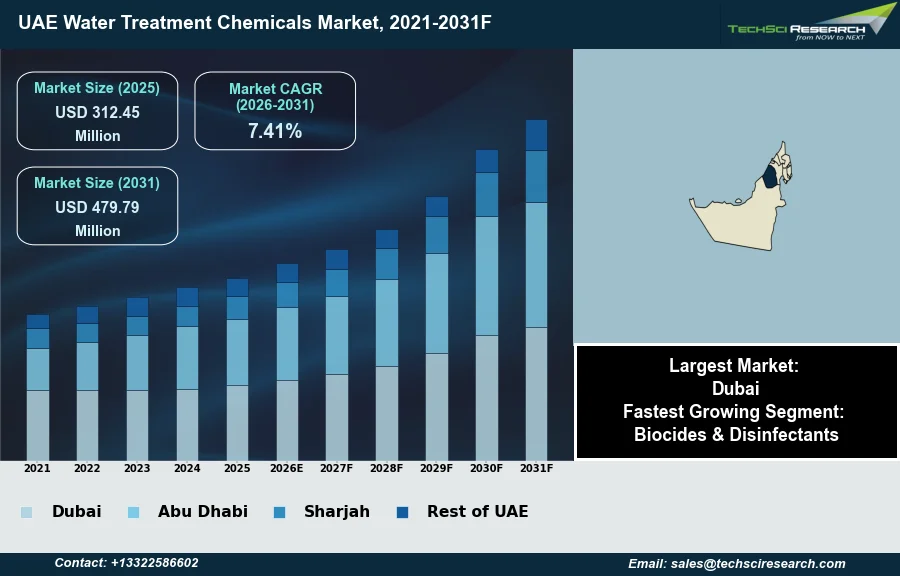
The UAE Water Treatment Chemicals Market will grow from USD 312.45 Million in 2025 to USD 479.79 Million by 2031 at a 7.41% CAGR. Water treatment chemicals are substances designed to enhance water quality, mitigating pollutants and preventing corrosion or scaling for diverse applications including potable, industrial, and wastewater treatment. The UAE market's growth is primarily driven by acute water scarcity, substantial government investment in desalination and advanced wastewater treatment infrastructure, and escalating demand from rapid population expansion and industrial development. Concurrently, stringent environmental regulations and national sustainability commitments also underpin market progression.
According to the Emirates Water and Electricity Company's 2024 Statistical Leaflet, water production via reverse osmosis technology comprised 41% of the total water generated in 2024, underscoring the significant application of chemicals in desalination. A notable challenge impeding market expansion remains the limited local manufacturing capability for these specialized chemicals, resulting in considerable reliance on imports and potential supply chain vulnerabilities.
Key Market Drivers
Desalination expansion drives demand for water treatment chemicals.
Expanding desalination capacity in the UAE is a primary driver for the water treatment chemicals market, necessitated by the region's inherent water scarcity. The increasing reliance on seawater reverse osmosis (SWRO) plants demands a steady supply of chemicals for pre-treatment, anti-scalants, and post-treatment to ensure operational efficiency and water quality. For instance, according to ENR, on June 15, 2026, in "UAE Awards $285M EPC Contract for Desalination Plant P3 Project," Etihad Water and Electricity awarded a contract for the Fujairah I Independent Water Producer project, a desalination facility with a capacity of 272,765 cubic meters per day. These chemicals are vital in preventing fouling and scaling of membranes, thereby extending asset life and maintaining output quality. This expansion directly correlates with the demand for various chemical types, including coagulants, flocculants, and disinfection agents.
Industrial water use and wastewater treatment mandates boost chemical demand.
Furthermore, the burgeoning industrial water consumption across diverse sectors such as oil and gas, manufacturing, and power generation significantly boosts the demand for water treatment chemicals. Industries require treated water for process cooling, boiler feed, and product formulation, necessitating chemicals to prevent corrosion, scale formation, and microbial growth. According to Emirates News Agency (WAM) via Gulf News, on April 17, 2026, in "UAE accelerates nationwide infrastructure push in 2026 with major energy, transport and urban projects," the Ras Al Khaimah Government signed an agreement for a wastewater treatment plant with a capacity of 60,000 cubic metres per day. This industrial demand extends to wastewater treatment before discharge or for reuse, driven by both operational needs and stringent regulatory mandates. Overall, significant investments continue in water infrastructure; according to the Climate Adaptation Platform, in June 2025, the UAE's Dubai Strategic Sewerage Tunnels Project was valued at $22 billion, highlighting substantial market opportunities for chemical suppliers.
Download Free Sample Report
Key Market Challenges
Limited local production drives import reliance and cost pressures
The limited local manufacturing capability for specialized chemicals poses a significant impediment to the growth of the UAE water treatment chemicals market. This deficiency creates a considerable reliance on imports, directly exposing the market to supply chain vulnerabilities, including global price volatility and geopolitical disruptions. Such import dependence translates into increased costs for operators due to international logistics and potential tariffs, consequently affecting the overall cost-efficiency and competitiveness of water treatment projects across the nation.
Extended procurement lead times and external sourcing constrain projects and local innovation
Moreover, extended lead times associated with procuring specialized chemicals from international sources can delay critical water infrastructure projects and routine maintenance, hindering the timely expansion of treatment capacities necessary to meet rising demand from population growth and industrial development. This situation also constrains the ability for agile local innovation in chemical formulations tailored to specific UAE water conditions and stringent environmental standards. According to the Gulf Petrochemicals and Chemicals Association (GPCA), the chemical industry in the Arabian Gulf region annually produces over USD 108 billion worth of products, yet the UAE's specialized water treatment chemicals segment continues to exhibit a reliance on external supply for advanced formulations.
Key Market Trends
Adoption of sustainable chemical formulations in UAE water treatment
The adoption of sustainable chemical formulations represents a significant trend in the UAE water treatment chemicals market, driven by increasing environmental regulations and national sustainability agendas. This shift encourages the development and deployment of eco-friendlier and more efficient chemical solutions that minimize environmental impact while maintaining high performance standards for diverse water applications. These formulations include biodegradable polymers, bio-based coagulants, and non-toxic corrosion inhibitors, reducing the ecological footprint of water treatment processes. The broader chemical sector in the UAE is already moving towards advanced formulations; according to the Gulf Petrochemicals and Chemicals Association, in 2024, the UAE maintained a production capacity of approximately 3.19 million tons in the agri-nutrient segment, reflecting the sector's gradual but focused shift toward expanding its localized downstream and specialty chemical capabilities. This trend is expected to influence purchasing decisions, fostering innovation in green chemistry tailored for the region's unique water challenges.
Digitalization of water management through smart technologies
Advanced digital water management integration is another pivotal trend transforming the UAE market, focusing on optimizing water network operations and chemical dosing through smart technologies. This involves the deployment of IoT sensors, artificial intelligence, and real-time data analytics to enhance monitoring, predictive maintenance, and overall system efficiency in water treatment plants and distribution networks. Such integration leads to more precise chemical application, reducing wastage, improving treatment effectiveness, and lowering operational costs. The Dubai Electricity and Water Authority's (DEWA) Smart Grid Programme exemplifies this, with investments totaling AED 7 billion, or USD 1.9 billion, supporting advanced water and electricity infrastructure to enhance operational efficiency and service reliability, as highlighted in reports from May 2026 and July 2025. This digitalization optimizes chemical consumption patterns and supports a more proactive approach to water quality management.
Segmental Insights
Regulatory Standards and UAE Water Security Drive Growth
The Biocides & Disinfectants segment is emerging as the fastest-growing area within the UAE Water Treatment Chemicals Market due to heightened regulatory scrutiny and an increased focus on public health. This rapid expansion is primarily driven by the stringent water quality standards enforced by bodies such as the Ministry of Climate Change and Environment (MOCCAE) and the Abu Dhabi Department of Energy's Water Quality Regulations 2025, which mandate robust microbial control across municipal, industrial, and residential applications. The nation's significant investment in desalination and wastewater reuse projects, critical for water security in an arid climate, further necessitates the consistent application of biocides to prevent biofouling and ensure the safety of treated water. Additionally, a post-pandemic emphasis on sanitation has accelerated the adoption of advanced disinfection solutions.
Regional Insights
Dubai's Market Leadership in UAE Water Treatment Chemicals Driven by Scarcity, Desalination, and Regulation
Regional insights for the UAE Water Treatment Chemicals Market indicate Dubai holds a leading position, driven by its acute water scarcity and heavy reliance on desalinated seawater for potable water supply. The emirate's rapid urbanization, high population density, and significant infrastructure investments generate substantial demand for water treatment chemicals across municipal, industrial, and commercial sectors. Dubai's stringent water quality standards, enforced by the Dubai Municipality and aligning with international guidelines, necessitate the consistent use of advanced treatment chemicals to ensure public health and environmental protection. This robust regulatory framework and the continuous need for high-quality treated water for its growing economy underscore Dubai’s influential role in the market.
Recent Developments
-
In September 2025, the United Arab Emirates University (UAEU) announced a significant scientific breakthrough with the awarding of a U.S. patent for an innovative technology. This research transformed recycled carbon fiber waste into a powerful material capable of treating brine, a highly saline byproduct of desalination, while also capturing carbon dioxide emissions. This pioneering achievement by a multidisciplinary research team directly aligns with the UAE's sustainability vision and circular economy practices. The patented method offers desalination plants and other industries in the UAE a cost-effective and environmentally responsible solution to reduce emissions and minimize waste, impacting the demand for specialized water treatment chemicals.
-
In December 2024, researchers at NYU Abu Dhabi developed a novel cationic covalent organic framework (COF) for the efficient detection and removal of perfluorooctanoic acid (PFOA) from drinking water. This breakthrough research directly addresses the global challenge of eliminating persistent perfluorinated alkylated substances (PFAS), known as "forever chemicals," which pose significant health risks. The synthesized COF material can quickly and effectively remove these contaminants at environmentally relevant concentrations, offering a promising solution that surpasses traditional water treatment methods that often struggle with PFAS. This innovation is poised to enhance water purification systems, significantly improving water quality within the UAE water treatment chemicals market.
-
In December 2024, LG Water Solutions introduced two new product lines at the IDRA World Congress in Abu Dhabi, significantly expanding its offerings within the UAE water treatment chemicals market. The company launched QuantumFlux™ Ultrafiltration (UF) and Membrane Bioreactor (MBR) Membranes, engineered with advanced polyvinylidene fluoride chemistry for superior durability in filtration applications. Concurrently, it unveiled QuantumPure™ Ion Exchange (IX) Resins, including high-performance resins for deionization, softening, and selective ion removal. These products aim to enhance operational efficiency by reducing maintenance and replacement costs, positioning LG Water Solutions as a comprehensive provider of water treatment solutions in the region.
-
In March 2024, the Mohamed bin Zayed Water Initiative (MBZWI), a UAE-led initiative, partnered with the U.S.-based XPRIZE Foundation to launch the XPRIZE Water Scarcity competition. This five-year global challenge committed $119 million to incentivize the development of breakthrough technologies for seawater desalination. The initiative's goal is to revolutionize desalination processes, making them more sustainable, affordable, and scalable. This significant collaboration directly impacts the UAE water treatment chemicals market by driving innovation in desalination technologies, which will influence the types and demand for specialized chemical formulations used in future water production across the country.
Key Market Players
- Suez Water Technologies UAE
- Veolia Water UAE
- Kemira UAE
- Ecolab UAE
- Kurita Water Industries UAE
- BASF UAE
- Dow Middle East
- Nalco Water UAE
- Hydrite Chemical UAE
- Accepta Water Treatment
|
By Type
|
By End User
|
By Application
|
By Region
|
- Coagulants & Flocculants
- Corrosion Inhibitors
- Scale Inhibitors
- Biocides & Disinfectants
- Chelating Agents
- Others
|
- Industrial
- Commercial
- Residential
|
- Water Desalination
- Raw Water Treatment
- Boiler Water Treatment
- Cooling Water Treatment
- Others
|
- Dubai
- Abu Dhabi
- Sharjah
- Rest of UAE
|
Report Scope:
In this report, the UAE Water Treatment Chemicals Market has been segmented into the following categories, in addition to the industry trends which have also been detailed below:
-
UAE Water Treatment Chemicals Market, By Type:
-
Coagulants & Flocculants
-
Corrosion Inhibitors
-
Scale Inhibitors
-
Biocides & Disinfectants
-
Chelating Agents
-
Others
-
UAE Water Treatment Chemicals Market, By End User:
-
Industrial
-
Commercial
-
Residential
-
UAE Water Treatment Chemicals Market, By Application:
-
Water Desalination
-
Raw Water Treatment
-
Boiler Water Treatment
-
Cooling Water Treatment
-
Others
-
UAE Water Treatment Chemicals Market, By Region:
-
Dubai
-
Abu Dhabi
-
Sharjah
-
Rest of UAE
Competitive Landscape
Company Profiles: Detailed analysis of the major companies present in the UAE Water Treatment Chemicals Market.
Available Customizations:
UAE Water Treatment Chemicals Market report with the given market data, TechSci Research offers customizations according to a company's specific needs. The following customization options are available for the report:
Company Information
- Detailed analysis and profiling of additional market players (up to five).
UAE Water Treatment Chemicals Market is an upcoming report to be released soon. If you wish an early delivery of this report or want to confirm the date of release, please contact us at sales@techsciresearch.com