|
Forecast Period
|
2026-2030
|
|
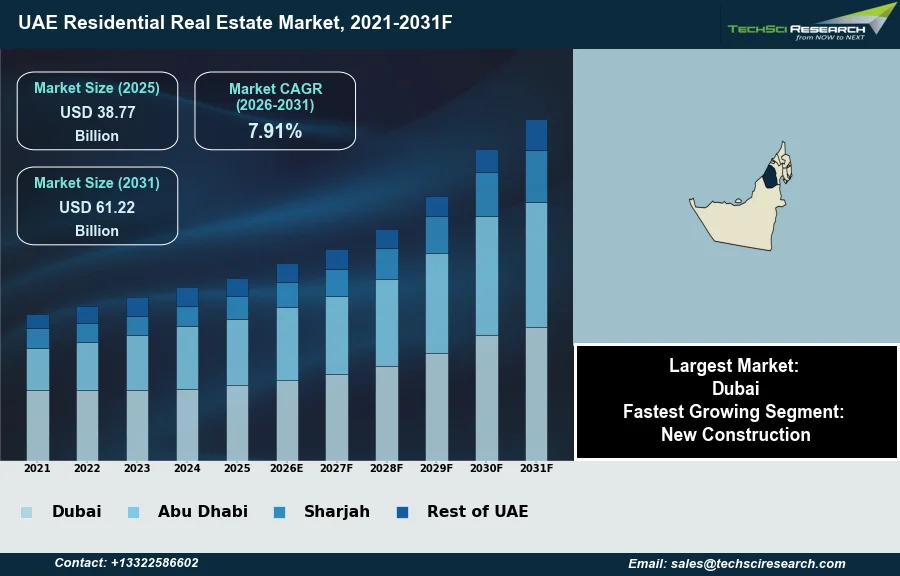
Market Size (2024)
|
USD 21 Billion
|
|
Market Size (2030)
|
USD 33 Billion
|
|
CAGR (2025-2030)
|
8.01%
|
|
Fastest Growing Segment
|
Online
|
|
Largest Market
|
Abu Dhabi
|
Market Overview
UAE Residential
Real Estate Market was valued at USD 21 Billion in 2024 and is expected to reach USD 33 Billion by 2030 with a
CAGR of 8.01% during the forecast period.
Residential real estate refers to properties that are
primarily used for living purposes, rather than for commercial or industrial
activities. This category encompasses a wide range of property types, including
single-family homes, condominiums, townhouses, duplexes, and multi-family
apartment buildings. The primary function of residential real estate is to
provide individuals or families with a place to live, but it can also serve as
an investment vehicle for buyers or landlords who rent out the property.
Residential real estate is typically divided into two
main segments: new construction and resale properties. New construction
includes newly built homes or buildings, while resale properties refer to
previously owned properties that are sold by current owners. The market for
residential real estate is influenced by factors such as interest rates, the
economy, location, and housing demand.
Residential real estate transactions involve buying,
selling, and leasing homes and apartments. These transactions are often
facilitated by real estate agents or brokers, and they may include financing
options such as mortgages. The value of residential properties can fluctuate
due to various factors, including market conditions, the overall economy, and
individual property characteristics.
Key Market Drivers
Economic Growth and Diversification
The UAE’s economic growth and diversification efforts
have played a significant role in shaping its residential real estate market.
Over the past few decades, the country has successfully moved beyond its
reliance on oil and gas industries, fostering a more diversified economy with
key sectors such as tourism, finance, real estate, and technology. This
economic transformation has created a more stable environment for both residents
and investors, contributing to a steady demand for residential properties.
The UAE government has implemented various policies
that aim to stimulate economic growth, such as investing in infrastructure,
offering tax incentives, and creating free zones that attract international
businesses. The diversification of industries has led to an influx of
expatriates and professionals seeking employment opportunities, driving demand
for residential real estate. This trend is especially noticeable in cities like
Dubai and Abu Dhabi, where commercial hubs, luxury developments, and business districts
have flourished, creating a significant need for high-quality housing options. Additionally,
the UAE’s efforts to foster tourism, including hosting global events like Expo
2020 Dubai, have boosted the local economy and increased demand for short-term
residential rentals, contributing to growth in the market. The diversification
strategy has also attracted foreign investors, particularly those interested in
real estate development and long-term residential rental opportunities.
Consequently, both the local demand for homes and the interest of international
investors have been pivotal in shaping the residential real estate market’s
expansion.
Strong economic growth has translated into higher
disposable incomes for many residents, making homeownership more accessible for
middle-class families. This shift has further fueled demand for residential
properties, particularly in suburban areas where more affordable options are
available. As the UAE continues to diversify and grow economically, the
residential real estate market is expected to remain a vital driver of wealth
creation and housing development in the country. Over the past two decades, the
contribution of non-oil sectors to the UAE's GDP has steadily increased. In
2023, non-oil sectors contributed more than 70% of the country’s GDP, with
finance, real estate, tourism, and trade leading the way.
Government Policies and Regulations
Government policies and regulations have a profound
impact on the UAE residential real estate market. The UAE government has
consistently introduced a range of initiatives to regulate the market, attract
foreign investment, and create a stable environment for both property
developers and investors. These policies have shaped the market dynamics,
fostering growth in various sectors, including residential real estate.
One of the most significant regulatory changes in
recent years has been the introduction of long-term visas for foreign investors
and skilled professionals. This policy, which grants expatriates the ability to
reside in the UAE for extended periods, has had a notable impact on the demand
for residential properties, particularly in cities like Dubai and Abu Dhabi.
Foreign investors now have greater security and incentive to invest in
long-term residential real estate, which has led to increased demand for both
high-end luxury homes and more affordable housing. Additionally, the UAE
government’s commitment to creating a transparent and investor-friendly market
through regulatory frameworks like the Dubai Land Department (DLD) has
instilled confidence among investors. Clear guidelines for property
transactions, along with initiatives like the introduction of a property
registration system, have contributed to greater market transparency. The
government also actively monitors the market to prevent speculative bubbles,
which can destabilize the housing market.
Initiatives to support first-time homebuyers, such as
reduced mortgage rates and lower down payments, have made homeownership more
accessible. The UAE Central Bank has also introduced regulations to regulate
mortgage lending, ensuring that lending practices remain responsible and that
buyers do not take on excessive debt. These policies have helped create a
stable residential real estate market, encouraging both local and foreign
buyers to enter the market. Furthermore, the government’s investment in large-scale
infrastructure projects, such as new transport networks, schools, and
healthcare facilities, has made previously undeveloped areas more attractive to
residential buyers. These projects not only increase the appeal of residential
developments but also raise property values, benefitting homeowners and
investors alike. A
5% VAT was introduced in 2018, impacting the real estate sector on
property-related transactions, including the sale of new properties, while
exempting rental income from VAT.
Population Growth and Urbanization
Population growth and rapid urbanization are key
drivers of the UAE’s residential real estate market. The country’s population
has been steadily increasing over the years, primarily due to high levels of
immigration. The UAE has become a magnet for expatriates, professionals, and
skilled workers who are drawn by the country’s vibrant economy, high salaries,
and quality of life. As the population grows, so does the demand for housing,
creating opportunities for both developers and investors.
The majority of the UAE’s population growth is
concentrated in major urban centers like Dubai and Abu Dhabi. These cities have
become global hubs for business, tourism, and entertainment, attracting a wide
range of people from different cultures and backgrounds. As a result, there is
a constant demand for residential properties in both the luxury and affordable
segments. The influx of expatriates, who make up a significant portion of the
population, has contributed to the increasing demand for rental properties,
especially in areas close to business districts and commercial centers.
Urbanization has also led to the development of new
residential communities and neighborhoods in previously undeveloped areas. As
cities expand to accommodate growing populations, residential developments are
emerging in both central urban areas and suburban locations. This has led to a
rise in new housing projects, including high-rise apartments, gated
communities, and mixed-use developments that offer both residential and
commercial spaces.
In response to this rapid urbanization, developers are
focusing on creating more sustainable and efficient housing solutions. Smart
cities and eco-friendly residential developments are becoming increasingly
popular, as residents seek modern, energy-efficient homes that are well
connected to transport networks and key amenities. These developments not only
meet the growing demand for housing but also appeal to environmentally
conscious buyers and renters.
The demand for residential real estate in the UAE is
expected to continue to rise in the coming years as the population grows and
urbanization intensifies. With more people moving to the UAE for work and
lifestyle reasons, developers will need to focus on building diverse housing
options to cater to the needs of different segments of the population, from
young professionals to families and retirees. The UAE has witnessed rapid population
growth over the past few decades. From a population of around 2.8 million in
2000, the UAE’s population grew to approximately 9.3 million by 2023. A
significant portion of this growth is driven by expatriates, who make up nearly
89% of the total population.
Global Investment Appeal
The UAE’s residential real estate market is highly
attractive to global investors due to its strategic location, favorable tax
policies, and the overall stability of the market. The UAE’s status as a global
financial hub, combined with its growing economy and robust infrastructure,
makes it an appealing destination for foreign investment, particularly in the
real estate sector. As a result, the residential market has seen a surge in
international investment, contributing to the growth and development of the
sector.
One of the most attractive features of the UAE for
foreign investors is its tax-friendly environment. The UAE has no income tax,
making it a highly appealing destination for high-net-worth individuals and
companies. This has led to an influx of international investors, particularly
from countries with high tax rates, who are keen to take advantage of the
favorable tax regime. Additionally, the introduction of long-term residency
visas for foreign investors has further boosted the UAE’s appeal as a
destination for global property investment.
The UAE’s real estate market is also known for its
transparency, which has been enhanced by government regulations and initiatives
to ensure fair property transactions. The Dubai Land Department (DLD) and other
regulatory bodies have worked to establish a clear legal framework that
protects both local and foreign investors, making the market more accessible
and less risky. This has helped foster confidence among international buyers,
further driving the demand for residential properties. Additionally, the strong
rental yields and potential for capital appreciation make UAE residential real
estate an attractive option for investors seeking long-term returns. In cities
like Dubai, investors can benefit from consistent rental income, particularly
in high-demand areas near business districts, entertainment venues, and popular
tourist destinations. The potential for property value growth, combined with
favorable market conditions, makes the UAE a top choice for investors looking
to diversify their portfolios.

Download Free Sample Report
Key Market Challenges
Oversupply of Properties and Market Saturation
One of the most significant
challenges facing the UAE residential real estate market is the issue of
oversupply and market saturation. In recent years, especially in cities like
Dubai, there has been a massive influx of residential developments, with many
new projects being launched across various segments, including luxury,
mid-range, and affordable housing. While this growth in supply was initially
driven by the booming economy and rising demand for housing, it has led to an
imbalance between supply and demand in some areas.
The rapid pace of
construction has resulted in a surplus of properties, particularly in certain
parts of Dubai and other emirates, where developers have overestimated the
demand for residential units. The influx of new residential buildings,
including high-rise apartments and gated communities, has led to an
oversaturation of the market, leaving many units vacant and unsold. This
oversupply has negatively impacted property prices and rental yields, making it
difficult for developers to sell or rent out their properties at expected
prices. As a result, some developers have been forced to lower their prices or
offer additional incentives, such as rent-to-own schemes or reduced service
fees, to attract potential buyers and tenants.
Another aspect of market
saturation is the competition between developers, which has led to an increase
in the number of similar residential offerings in certain areas. For example,
in neighborhoods with high concentrations of luxury properties, there is little
differentiation between projects, which further diminishes the appeal of
individual developments. This saturation can create a situation where buyers
have an abundance of choices but limited motivation to act quickly, resulting
in slower sales and longer time-to-market for developers. Additionally, with
the global economy facing uncertainties and regional political challenges, the
demand for luxury and high-end residential properties has softened, especially
from international investors. Although foreign investment in real estate remains
a significant driver of the market, some investors have become more cautious
due to changing market conditions, tightening regulations, and global economic
concerns. This cautious investment behavior has contributed to the difficulty
in absorbing the large volume of new properties entering the market.
In response to this
challenge, developers must be more strategic in their approach to real estate
development. They need to focus on identifying genuine market demand,
conducting thorough market research, and creating differentiated offerings that
stand out from the competition. This could include the development of more
affordable housing options, sustainable projects, or properties that cater to
specific market segments, such as families or young professionals.
Regulatory and Legal Uncertainty
Another major challenge
facing the UAE residential real estate market is regulatory and legal
uncertainty, which has the potential to disrupt market stability and investor
confidence. While the UAE has made considerable strides in improving its
regulatory framework, occasional changes in policies, rules, and regulations
can create confusion among developers, investors, and homeowners. The lack of
long-term predictability in some aspects of the regulatory environment can lead
to challenges in planning, investment, and property transactions.
One area where regulatory
uncertainty has caused concern is in the changing policies regarding foreign
ownership. Although foreign investors have traditionally been allowed to
purchase property in designated freehold areas, government regulations regarding
ownership rights and the extent of foreign control over real estate have been
subject to change. For instance, in recent years, the introduction of long-term
visas for foreign investors has provided greater stability for expatriates and
foreign investors, but there is still a level of uncertainty surrounding the
long-term viability of such programs. Regulatory changes in the future could
affect foreigners' ability to buy or own real estate, potentially leading to a
decline in international investments, which play a crucial role in the UAE
market. Furthermore, changes in property laws and fees, such as those related
to property registration, taxes, and service charges, can create additional
complications for property owners and investors. While the UAE has no income
tax, the introduction of a value-added tax (VAT) on property-related
transactions in 2018 raised concerns about the affordability and attractiveness
of real estate investments. This uncertainty regarding future tax policies or
the possibility of new levies can make it difficult for investors to accurately
forecast returns on investment, which is essential when making long-term
financial decisions.
Another challenge involves
the regulatory framework around off-plan property sales. The UAE has witnessed
a boom in off-plan property transactions, where properties are sold before they
are completed. While this has allowed developers to secure funding and generate
sales early in the construction process, the risks associated with these
transactions are high. Delays in project completion, construction defects, or
changes in market conditions can lead to significant financial losses for both
buyers and developers. The legal protections for off-plan buyers have been
strengthened over the years, but concerns about project delays, non-compliance
with standards, and disputes over payments remain prevalent. In addition, the
legal framework surrounding tenant-landlord relations in the UAE can be complex
and varies across different emirates. While the introduction of the Dubai
Rental Law and other regulations has provided more protection for tenants and
landlords, disagreements over rental rates, eviction processes, and property
maintenance can still cause challenges in the residential market. The UAE’s
real estate market also faces issues with enforcement of contracts, which can
delay resolution of disputes and cause frustration for investors and homeowners
alike.
Key Market Trends
Shift Towards Sustainable and Green Developments
In recent years, there has been a noticeable shift in
the UAE residential real estate market towards sustainable and eco-friendly
developments. As global environmental concerns rise, developers in the UAE are
increasingly prioritizing sustainability in their projects to align with
international trends and to appeal to environmentally conscious buyers. This
trend is not only driven by consumer demand but also by government initiatives
aimed at reducing the country's carbon footprint and promoting sustainable
urban growth.
The UAE government has set ambitious sustainability
goals, particularly with initiatives like the UAE Vision 2021 and the Dubai
Clean Energy Strategy 2050, which aims to make Dubai the city with the lowest
carbon footprint in the world. In response, many developers are incorporating
green building certifications, such as LEED (Leadership in Energy and
Environmental Design) and Estidama, into their residential projects. These
certifications ensure that buildings are energy-efficient, use sustainable materials,
and reduce environmental impact.
Sustainable residential properties in the UAE
typically feature energy-efficient appliances, solar panels, water-saving
systems, and advanced building technologies that reduce resource consumption.
For instance, homes with smart home technologies, which control lighting,
temperature, and appliances, are becoming more common. These technologies not
only contribute to energy savings but also appeal to tech-savvy buyers who want
to live in modern, efficient environments. Additionally, developers are paying
more attention to creating green spaces within residential communities. Parks,
tree-lined streets, and rooftop gardens are increasingly integrated into
residential developments to promote outdoor living and improve residents’
quality of life. This shift towards sustainability is also influenced by the
growing global trend of “greenwashing,” where consumers and investors seek out
environmentally responsible products and services.
From an investment perspective, sustainable real
estate developments are becoming more attractive to buyers, particularly those
looking for long-term value. Energy-efficient homes can reduce utility costs
over time, making them more affordable for residents. For investors, these
properties may offer higher rental yields due to increased demand, as both
tenants and homeowners are now more conscious of the environmental impact of
their living spaces. The trend towards sustainability in the UAE residential
real estate market is expected to continue to grow as the country’s commitment
to sustainable urbanization intensifies.
Rise of Luxury and High-End Properties
The UAE has long been recognized as a hub for luxury
and high-end real estate, and this market segment continues to grow at a rapid
pace. Cities like Dubai, in particular, are home to some of the world’s most
extravagant residential properties, attracting wealthy buyers from around the
globe. The demand for luxury homes in the UAE has been driven by a combination
of factors, including high-net-worth individuals seeking an opulent lifestyle,
the appeal of the UAE’s tax-free status, and the country’s reputation as a
global business and tourism destination.
Luxury developments in the UAE typically include
ultra-modern amenities, expansive living spaces, and prime locations with
stunning views, such as beachfront properties or homes overlooking the iconic
Dubai skyline. High-end developments often feature state-of-the-art facilities
such as private pools, gyms, spas, and 24-hour concierge services.
Additionally, many of these properties are located in exclusive neighborhoods
and gated communities, offering privacy and security for residents.
One of the key drivers of the luxury market is the
influx of foreign investors and expatriates who are attracted to the UAE’s
favorable tax policies and high standard of living. The introduction of
long-term visas for investors, retirees, and skilled professionals has helped
sustain the demand for luxury real estate, allowing high-net-worth individuals
to secure property ownership and live in the UAE for extended periods.
Furthermore, the Dubai property market's resilience and potential for capital
appreciation make luxury homes a desirable investment for those seeking to
diversify their portfolios.
In addition to international buyers, wealthy locals
are also contributing to the demand for luxury real estate, as UAE nationals
continue to see real estate as a stable and lucrative investment. The demand
for bespoke luxury properties has even extended to the ultra-wealthy, with
custom-designed homes and penthouses becoming more prevalent in the market.
The rise of luxury properties has also led to the
development of new, high-end residential projects in previously undeveloped or
less central areas, including off-the-beaten-path locations like the Palm
Jumeirah or Dubai Hills Estate. These areas have attracted affluent buyers
looking for exclusivity and privacy, further cementing the UAE’s position as a
leading destination for luxury real estate.
Segmental Insights
Type Insights
The New Construction held the largest market share
in 2024. New construction dominates the UAE
residential real estate market for several key reasons, making it a central
aspect of the country's urban development and real estate strategy.
The UAE has experienced significant economic growth
over the past few decades, driving a demand for more residential properties.
With a steadily increasing population, driven in part by expatriates moving to
the country for work opportunities, there is a constant need for new housing.
New constructions allow developers to meet this growing demand, offering
modern, efficient homes that cater to diverse consumer needs.
The UAE government plays a vital role in supporting
new construction through investments in large-scale infrastructure projects,
such as road networks, metro systems, schools, and healthcare facilities. These
developments enhance the appeal of newly constructed homes, especially in
emerging neighborhoods and suburban areas. The government's commitment to
sustainable urban planning has also encouraged the creation of new, smart, and
green residential developments that meet international standards.
New constructions in the UAE often incorporate the
latest technologies in smart home automation, energy efficiency, and
architectural design. With rapid advancements in construction techniques,
developers are now able to create high-quality, energy-efficient homes at a
faster pace. The focus on innovative building practices and sustainable
features has made newly built homes more attractive to both buyers and
investors, further driving the demand for new properties.
The UAE’s cities, particularly Dubai and Abu Dhabi,
continue to evolve into modern metropolises, with luxury developments,
high-rise apartments, and mixed-use communities. The demand for these types of
properties, especially from young professionals and international investors,
has led developers to focus on new construction projects that reflect
contemporary living standards, offering residents premium amenities and
advanced facilities.
Category Insights
The Flats and apartments held the
largest market share in 2024. Flats and
apartments dominate the UAE residential real estate market due to several key
factors that cater to the country’s unique demographic, economic, and urban
characteristics.
High population density and urbanization play a
crucial role. The UAE, particularly cities like Dubai and Abu Dhabi, has seen
rapid urban growth, with a large concentration of people living in metropolitan
areas. The country’s limited land area, combined with its status as a global
business hub, has made high-rise apartments a practical and efficient solution
to accommodate the increasing population. Multi-story buildings make better use
of the available land, offering more units in prime locations, which are in
high demand due to proximity to business, leisure, and transport hubs.
The significant presence of expatriates in the UAE has
contributed to the preference for apartments. The country hosts a large
expatriate workforce, particularly in cities like Dubai. Many expatriates live
in the UAE on short to mid-term work contracts, making apartments more suitable
for their transient lifestyles. Apartments, especially in central locations,
offer flexibility with short-term leases, allowing expats to move in and out
with ease compared to owning larger, more permanent homes. Additionally,
affordability and availability of diverse options make flats and apartments
appealing. Compared to villas, apartments generally offer a more affordable
entry point for both buyers and renters. Developers in the UAE have responded
to varying market demands by offering apartments in different sizes and price
ranges, from affordable studios to high-end luxury penthouses. This diversity
allows them to cater to various segments of the population, from young
professionals to affluent investors.
The UAE's focus on luxury living in high-rise
buildings, with amenities such as gyms, pools, and retail outlets, has made
apartment living more attractive, reinforcing its dominance in the residential
real estate market. The combination of convenience, location, and modern
lifestyle options has solidified flats and apartments as the preferred
residential choice.

Download Free Sample Report
Regional Insights
Abu Dhabi held the largest market share
in 2024. Abu Dhabi’s dominance in the UAE residential real estate market can be
attributed to several key factors, positioning it as a hub for both investment
and lifestyle.
Abu Dhabi benefits from its status as the capital of
the UAE and the political and economic center of the country. It is home to
numerous government institutions, embassies, and major international
corporations, making it a preferred location for professionals and expatriates.
The city’s economy is primarily driven by the oil and gas industry, but it is
also diversifying into sectors like finance, real estate, and tourism. This
economic stability and growth create a strong demand for residential properties,
particularly among high-net-worth individuals and expatriates working in these
key industries.
Another factor contributing to Abu Dhabi’s real estate
dominance is its emphasis on sustainability and high-quality urban planning.
The government has invested heavily in large-scale infrastructure projects and
master-planned communities that cater to a range of lifestyles. Developments
like Al Reem Island, Yas Island, and Saadiyat Island offer a blend of luxury,
modernity, and green living, appealing to both local and international buyers.
These planned communities also feature world-class amenities such as schools,
healthcare facilities, and leisure activities, attracting families and young
professionals alike. Additionally, the introduction of long-term visas for
investors and skilled professionals has enhanced Abu Dhabi’s appeal as a place
to live and invest. The city has also introduced various policies to attract
foreign capital, boosting demand for both residential and commercial real
estate.
Recent Developments
- In January 2025, Square One, a prominent real estate
marketing agency in India, unveiled two cutting-edge software
solutions—Blackboxx Real and Blackboxx VR. These innovative platforms provide
immersive 3D and virtual reality experiences that transform property
presentations. By enabling potential buyers to engage more interactively and
explore properties in an intuitive way, these tools streamline the sales
process.
- In August 2024, Godrej Properties Limited (GPL), a
leading real estate developer in India, launched its revolutionary campaign, WhereTrustResides.
This initiative recognizes the significant emotional and financial commitment
involved in purchasing a home, highlighting that buyers increasingly prioritize
brands with long-established trust and credibility. While demand for luxury
lifestyles, designer homes, and premium amenities continues to grow, the
fundamental factor influencing buyers remains the trustworthiness of the brand.
Key Market Players
- Christie International Real Estate
- ColdWell Banker Real Estate Company
- Al Habtoor Group
- DLF Ltd
- Hochtief Corporation
- IJM Corporation Berhad
- Engel & Volkers AG
- Lennar Corporation
|
By Type
|
By Category
|
By Mode
|
By Region
|
|
|
- Flats & Apartments
- Individual Houses or Private Dwellings
- Condominium
- Townhouses
- Others
|
|
- Dubai
- Abu Dhabi
- Sharjah
- Rest of UAE
|
Report Scope:
In this report, the UAE Residential
Real Estate Market has been
segmented into the following categories, in addition to the industry trends
which have also been detailed below:
- UAE
Residential
Real Estate Market, By Type:
o New Construction
o Resale
- UAE
Residential
Real Estate Market, By Category:
o Flats & Apartments
o Individual Houses or Private Dwellings
o Condominium
o Townhouses
o Others
- UAE Residential
Real Estate Market, By Mode:
o Online
o Offline
- UAE Residential
Real Estate Market, By Region:
o Dubai
o Abu Dhabi
o Sharjah
o Rest of UAE
Competitive Landscape
Company Profiles: Detailed analysis of the major companies
present in the UAE Residential Real Estate Market.
Available Customizations:
UAE Residential Real Estate Market report
with the given market data, TechSci Research offers customizations according
to a company's specific needs. The following customization options are
available for the report:
Company Information
- Detailed analysis and
profiling of additional market players (up to five).
UAE Residential Real Estate Market is an upcoming
report to be released soon. If you wish an early delivery of this report or
want to confirm the date of release, please contact us at [email protected]