Main Content start here
Main Layout
Report Description

Report Description

Forecast Period

2026-2030

Market Size (2024)

USD 1.4 Billion

Market Size (2030)

USD 2.67 Billion

CAGR (2025-2030)

11.2%

Fastest Growing Segment

Epoxy-Coated Rebar

Largest Market

Dubai

Market Overview

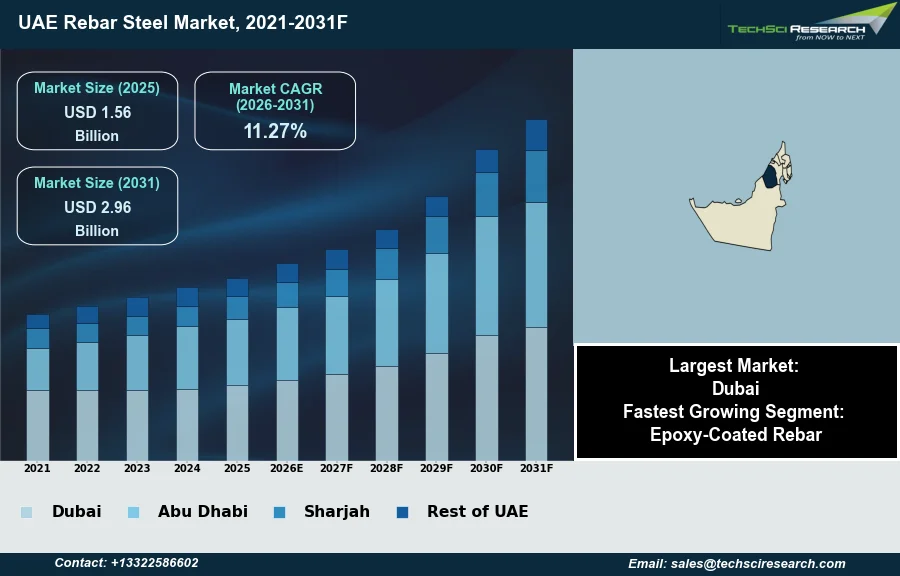
UAE Rebar Steel Market was valued at USD 1.4 Billion in 2024 and is expected to reach USD 2.67 Billion in 2030, and project robust growth in the forecast period with a CAGR of 11.2% through 2030.

The UAE Rebar Steel Market is experiencing significant growth driven by the country’s ongoing infrastructure expansion and construction activities. As a key component in the construction of buildings, bridges, roads, and other infrastructure projects, rebar steel plays a crucial role in supporting the growing demand for urban development and large-scale construction projects in the UAE. With the government's focus on Vision 2030, which aims to diversify the economy and create sustainable urban spaces, there has been an increase in the demand for construction materials, including rebar steel. The UAE’s construction boom, particularly in the real estate, commercial, and industrial sectors, has led to a surge in rebar steel consumption.

Additionally, the upcoming major events such as World Expo 2020 (now extended) have further bolstered construction activity, with the need for new buildings, transport infrastructure, and public facilities. The rebar steel market is also benefiting from technological advancements in steel manufacturing, improving quality and cost-efficiency, thus making it more accessible for developers. Additionally, the rise in government infrastructure projects, including transportation networks, and housing developments, is expected to sustain the demand for rebar steel in the long term. Overall, the UAE Rebar Steel Market is poised for continued growth, driven by a strong construction sector and robust economic initiatives.

Key Market Drivers

Robust Construction and Infrastructure Development

The UAE’s construction and infrastructure sectors continue to expand, with about $875 billion in projects planned or underway. This scale reflects steady use of rebar steel across towers, roads, bridges, and housing. Etihad Rail’s 900 km network, which includes 593 bridges and crossings and nine tunnels totaling 6.5 km, shows the scope of structural work that relies on reinforced concrete.

Large programs, for example Expo 2020 Dubai, smart city development, and plans linked to UAE Vision 2021, add steady construction needs. Expo 2020 drew 24,102,967 visits, hosted 192 countries on a 4.38 square kilometre site, and now transitions into Expo City Dubai across about 3.5 square kilometres. These projects call for materials that meet strict safety and strength rules, including rebar produced locally to global standards.

Growth across tourism, real estate, and transport also supports wider infrastructure spending. The ongoing Etihad Rail programme targets about 1,200 km of national rail with around AED 40 billion in investment. Rapid urban growth in Dubai and Abu Dhabi adds more activity, with awarded projects reaching about $31 billion in 2025. High-rise work, data centres, and mixed-use schemes continue to fill construction pipelines.

Rebar rolling capacity in the UAE exceeds 3.5 million tons each year, led by EMSTEEL up to 2.5 million and Hamriyah Steel at 1 million. Extra needs are met through imports covered by customs measures on rebar and wire rod extended until October 12, 2025.

Increase in High-Rise Building and Urbanization

Urban growth in the UAE continues to raise the need for rebar steel, supported by over US$ 600 billion of active building projects in 2025. Rising populations in Dubai and Abu Dhabi push builders toward vertical expansion, with 126 high-rise buildings announced in 2025. These towers, along with about 8.2 million square feet of office space under construction for delivery by 2028, rely on reinforced concrete that uses large volumes of rebar.

Complex building designs and advanced engineering create further needs for high-strength steel. Costs for commercial buildings ranged from AED 5,500 to 7,300 per square meter in H1 2025, reflecting the technical demands of projects built to handle seismic activity and severe weather. Developers continue to plan landmark structures, including new skyscrapers inspired by the Burj Khalifa, supported by US$ 328.7 billion of contracts awarded from 2020 to August 2025.

Urbanization also drives broader infrastructure work. Metro systems, bridges, and tunnels depend on reinforced structures, seen in the Dubai Metro Blue Line and the 900 km Etihad Rail network with 593 bridges and nine tunnels totaling 6.5 km. This expansion aligns with about 33,074 residential units under construction in Abu Dhabi through 2029 and nearly 175,000 square meters of planned office stock for 2027.

A USD 46 billion transport investment program adds further momentum. These combined trends keep rebar needs high as developers pursue new residential towers, commercial complexes, and supporting public works across the UAE..

Growing Real Estate Sector and Residential Projects

The rapid expansion of the UAE’s real estate sector, particularly in residential developments, is another primary driver of the rebar steel market. With a growing population and an influx of expatriates, there is an ongoing demand for new housing, including villas, apartments, and affordable housing units. As cities like Dubai, Abu Dhabi, and Sharjah continue to experience significant population growth, developers are investing heavily in large-scale residential projects to meet the housing needs of both nationals and expatriates. These projects, which include residential towers, gated communities, and master-planned developments, require significant amounts of rebar for the reinforcement of concrete structures. The strong demand for housing, coupled with the development of luxurious residential complexes and mixed-use properties, ensures that the rebar steel market in the UAE remains robust.

Additionally, the government’s initiatives to create affordable housing options and improve residential infrastructure contribute to the sustained growth in this segment. Real estate development is further supported by favorable lending rates, government housing schemes, and investment incentives, which encourage both private and public-sector investments in residential projects. As demand for residential space continues to rise, the need for rebar to support the construction of high-quality and structurally sound buildings will remain a significant driver in the market. The continued growth in the UAE real estate sector, bolstered by government support and private sector involvement, ensures that the rebar steel market will see sustained demand in the years to come. Abu Dhabi’s Vision 2030 plans to invest over USD 81.7 billion in infrastructure, including transportation, housing, and commercial development projects.


Download Free Sample Report

Key Market Challenges

Volatility in Raw Material Prices

One of the significant challenges in the UAE Rebar Steel Market is the volatility in the prices of raw materials, particularly iron ore and scrap metal. The cost of steel production is closely tied to the prices of these raw materials, and fluctuations in global supply chains can have a direct impact on the cost of rebar steel. Price instability is driven by various factors, including changes in international demand, geopolitical tensions, and disruptions in global trade. For example, global shortages or supply chain interruptions caused by events such as the COVID-19 pandemic have caused significant fluctuations in steel prices. In addition, the UAE relies on importing raw materials for steel production, making it vulnerable to price changes in the global market.

These fluctuations can lead to uncertainties in production costs, which impact the pricing of rebar steel in the local market. For manufacturers, the unpredictability of raw material prices makes it difficult to forecast and control production expenses, potentially eroding profit margins. This also places pressure on construction companies, as they may face increased project costs or delays in their timelines if the cost of rebar increases unexpectedly. As a result, companies operating in the UAE Rebar Steel Market must navigate these price swings, which could affect their competitiveness, profitability, and the overall stability of the construction industry.

Environmental Regulations and Sustainability Requirements

Environmental regulations and sustainability requirements present another significant challenge for the UAE Rebar Steel Market. As the UAE continues its push toward sustainability and reducing its carbon footprint, the steel industry faces increasing pressure to adopt greener practices in the production of rebar steel. Steel production is energy-intensive and a significant contributor to CO2 emissions, which has led to stricter environmental regulations, both locally and internationally. In response to the UAE’s National Vision 2030 and global sustainability goals, the construction industry, including steel manufacturers, is under growing scrutiny to adopt more environmentally friendly methods.

Implementing green technologies and processes, such as recycling scrap steel and using renewable energy sources in steel production, is costly and requires substantial investments. For smaller manufacturers, this can present financial challenges, as they may lack the capital to make such significant changes. Furthermore, the demand for environmentally responsible products in construction projects is increasing, with developers and contractors opting for materials that meet sustainability certifications like LEED or Estidama. The pressure to comply with these regulations and meet the growing market demand for sustainable construction materials can create challenges for rebar steel producers, who must balance environmental responsibility with profitability. Moreover, these regulations often vary between regions, adding complexity to market operations. As the trend toward sustainability continues, the need for the rebar steel market to innovate and adopt green practices will become more pronounced, posing both challenges and opportunities for the industry.

Intense Competition and Overcapacity

Intense competition and overcapacity within the UAE Rebar Steel Market represent another significant challenge for industry players. The UAE market is highly competitive, with both local and international manufacturers vying for market share in a growing construction sector. The entry of new players, along with the expansion of existing manufacturers, has led to an oversupply of rebar steel in the market. This overcapacity has resulted in price wars, with manufacturers undercutting one another to secure contracts, which in turn erodes profit margins. Smaller or less efficient producers may struggle to maintain profitability, while larger firms are also facing pressure to maintain their market positions despite the competitive landscape.

In addition, the overcapacity issue can lead to inefficiencies in production, as some manufacturers may not be able to operate at full capacity or may experience excess stock, leading to storage and handling costs. This excess supply can also lead to fluctuating prices, with prices dropping in response to the oversupply, impacting the profitability of rebar steel producers. The competition is further intensified by the fact that construction projects often prioritize cost-effectiveness, which can drive down the price of steel in tenders and contracts. Additionally, the emergence of new technologies and alternative materials in the construction sector, such as high-strength concrete and composite materials, may further intensify competition for rebar steel producers. To overcome these challenges, companies must focus on operational efficiencies, technological innovation, and differentiation to remain competitive in a crowded market.

Key Market Trends

Increased Demand for Sustainable Steel Production

A clear trend in the UAE’s rebar steel sector is the move toward cleaner production shaped by the National Vision 2030 goals. Builders now place more weight on materials that support lower emissions, which encourages steelmakers to adopt electric arc furnaces, expand scrap recycling, and source renewable power. Emirates Steel’s Al Reyadah facility captures about 800,000 tonnes of CO2 each year from direct-reduced iron units, and the Mohammed bin Rashid Al Maktoum Solar Park aims for 5,000 MW by 2030 to support cleaner energy use. Pilot green-hydrogen work for ironmaking is also in progress as producers explore ways to reduce emissions across the DRI-EAF route.

Producers are improving recyclability and cutting waste across operations. Progress in low-carbon steel technologies and energy-efficient systems is expected to guide future production plans. As construction needs shift toward stronger and cleaner materials, demand grows for rebar that meets both performance and environmental rules.

Global and local certification systems add pressure for greener inputs. LEED and Estidama require sustainable choices in project planning. Abu Dhabi’s Pearl Rating System has required at least 1 Pearl for new buildings since 2010, and Dubai has applied Green Building Regulations to new permits since 2014. These rules shape buying decisions and push suppliers to meet higher environmental targets.

As expectations rise, sustainable rebar production stands out as a key advantage. Companies that invest in cleaner processes and reliable environmental performance are better placed to meet the needs of upcoming construction programs across the UAE..

Technological Advancements in Steel Manufacturing

Another key trend in the UAE Rebar Steel Market is the growing integration of advanced technologies in steel manufacturing. With the increasing demand for higher-quality, stronger, and more reliable rebar steel, manufacturers are adopting innovative technologies to enhance their production processes. Automation, artificial intelligence, and data analytics are being used to optimize production lines, reduce waste, and improve the consistency and quality of rebar products. For instance, the use of automated quality control systems ensures that the rebar steel produced meets stringent industry standards for strength, durability, and performance. Additionally, the implementation of Industry 4.0 technologies is improving supply chain efficiency, allowing manufacturers to better track inventory, predict demand fluctuations, and streamline logistics.

The incorporation of smart technologies into the steel production process not only boosts operational efficiency but also reduces costs by minimizing errors and increasing productivity. Moreover, new advancements in steel metallurgy, such as the development of higher-strength rebar that requires less material to achieve the same load-bearing capacity, are expected to continue influencing market trends. This allows construction companies to reduce material costs while maintaining the required structural integrity. With the increasing focus on improving the performance and sustainability of rebar steel, these technological advancements are anticipated to play a crucial role in shaping the future of the UAE Rebar Steel Market, driving both product innovation and cost efficiency.

Growing Demand for High-Strength Rebar

The growing demand for high-strength rebar is another critical trend in the UAE Rebar Steel Market. As the construction industry in the UAE moves towards more complex and large-scale projects, there is an increasing need for high-performance materials that can support the growing demands of modern architecture and infrastructure. High-strength rebar is essential in ensuring the safety and durability of buildings, especially high-rise buildings, bridges, and other structures that must endure substantial weight and pressure. With the expansion of urban infrastructure, including metro systems, bridges, and multi-story residential buildings, the need for high-strength rebar that can withstand higher loads and extreme environmental conditions is rising. High-strength rebar is not only more efficient in terms of structural performance but also provides cost-saving advantages as less material is required compared to standard rebar for the same structural strength.

This trend is being driven by the growing preference for taller buildings, more complex structures, and projects that incorporate modern architectural designs, all of which require superior-quality steel reinforcement. Additionally, the trend is supported by evolving construction standards and regulations, which increasingly demand higher performance from materials used in infrastructure. As the demand for these specialized materials increases, rebar manufacturers are focusing on developing advanced steel alloys and production techniques to meet the specifications required by high-rise buildings and other complex construction projects. The trend toward high-strength rebar is expected to continue in the UAE, especially as developers strive for improved construction efficiency and enhanced structural safety in large-scale projects.

Expansion of Infrastructure and Mega Projects

The ongoing expansion of infrastructure and the launch of mega construction projects across the UAE are key drivers of the rebar steel market. In line with the UAE's economic diversification efforts and Vision 2030, the country continues to invest heavily in large-scale projects aimed at enhancing its infrastructure, including transportation networks, residential communities, and commercial developments. Major developments such as the construction of new airports, seaports, roads, bridges, and rail systems are fueling the demand for rebar steel. Additionally, mega real estate projects, such as the development of smart cities, mixed-use developments, and luxury resorts, require substantial amounts of steel reinforcement.

The construction of new iconic structures and stadiums for events like the FIFA World Cup 2022 has also contributed to the increase in demand for rebar. As the UAE government pushes forward with initiatives to enhance its infrastructure in preparation for global events, the need for rebar steel to reinforce these structures grows. Moreover, the drive for sustainable urbanization is leading to increased demand for rebar in the development of energy-efficient and resilient infrastructure. The rising investment in mega projects, coupled with the growth in residential and commercial construction, is expected to continue supporting the expansion of the rebar steel market in the UAE. This trend positions the rebar steel market as a crucial element in the realization of the country’s ambitious infrastructure and urban development plans, ensuring the sustained growth of the sector in the coming years.

Segmental Insights

Type Insights

In 2024, the Deformed Rebar segment dominated the UAE Rebar Steel Market and is expected to maintain its dominance during the forecast period. Deformed rebar, characterized by its surface patterns that provide enhanced bonding with concrete, plays a critical role in the construction of high-rise buildings, bridges, highways, and other infrastructure projects that require high strength and durability. This segment's dominance is primarily driven by the increasing demand for reinforced concrete in complex construction projects, which require materials that can withstand higher tensile and compressive forces. As the UAE continues to witness rapid urbanization and large-scale infrastructure development, including the construction of skyscrapers, residential complexes, commercial buildings, and transportation infrastructure, deformed rebar becomes a preferred choice due to its superior structural performance.

Additionally, the increasing focus on seismic safety in the region, particularly in earthquake-prone areas, further drives the demand for deformed rebar, as its superior bonding properties help ensure the stability of buildings during seismic events. The deformed rebar segment is also favored due to its cost-efficiency, as it reduces the amount of steel required for construction without compromising on strength, making it highly suitable for large-scale projects. Furthermore, government initiatives supporting the development of robust infrastructure under national plans such as the UAE Vision 2030, which emphasizes sustainability and high-quality construction, further boost the demand for deformed rebar.

While mild steel rebar still holds a share of the market for use in less demanding applications, the growing complexity and scale of construction projects in the UAE ensure that deformed rebar continues to be the dominant segment. As urbanization continues to drive demand for high-performance materials in both residential and commercial sectors, deformed rebar is poised to maintain its leading position in the UAE Rebar Steel Market during the forecast period.


Download Free Sample Report

Regional Insights

In 2024, Dubai dominated the UAE Rebar Steel Market and is expected to maintain its dominance during the forecast period. As the economic and commercial hub of the UAE, Dubai remains the primary driver of construction activities in the region. The city’s ongoing urbanization, large-scale infrastructure projects, and rapid population growth significantly contribute to the high demand for rebar steel, particularly in high-rise buildings, residential complexes, commercial spaces, and transportation networks. Dubai is home to some of the world’s most iconic developments, including towering skyscrapers, luxury hotels, and expansive malls, all of which require substantial quantities of rebar for structural reinforcement.

Additionally, Dubai's strategic location as a global trade and tourism hub further stimulates construction activities, with continuous projects related to tourism, retail, and real estate, ensuring a steady demand for rebar steel. The government’s emphasis on infrastructure development, urban regeneration, and the hosting of global events such as Expo 2020 Dubai further accelerates the demand for construction materials, including rebar. With Dubai’s robust real estate sector, driven by both residential and commercial projects, and its focus on sustainable and resilient infrastructure, the demand for deformed rebar, in particular, is projected to remain high. Furthermore, the city’s ongoing mega-projects, such as the development of smart cities, transportation systems (like metro expansions), and large-scale urban development, will continue to propel the need for rebar steel. While other regions like Abu Dhabi, Sharjah, and Ras Al Khaimah contribute to the overall market, Dubai’s leading position in terms of both the number of ongoing projects and the scale of its developments ensures its continued dominance in the UAE Rebar Steel Market throughout the forecast period.

Recent Developments

  • In Jan 2025, Arabian Gulf Steel Industries (AGSI) has partnered with SEE Holding to promote sustainable construction practices in the UAE. The collaboration, formalized through a Memorandum of Understanding (MoU), will focus on integrating low-carbon steel into future projects, advancing both companies’ net-zero goals. The partnership will also explore circular economy practices, such as steel recycling, to reduce environmental impact. The initiative underscores AGSI's leadership in low-carbon steel manufacturing and aims to accelerate the decarbonization of the construction sector, fostering innovation in sustainable infrastructure.
  • In Jan 2024, Madar Building Materials has signed a strategic partnership agreement with Future Development Company, a key partner of the Iraqi Ministry of Commerce. This collaboration aims to strengthen trade relations between Saudi Arabia and Iraq, focusing on enhancing trade, sharing expertise, and supporting Iraq’s economy. The agreement was signed in the presence of key government officials and Saudi Export Authority representatives. Madar, a leading building materials provider in Saudi Arabia, operates over 70 outlets across the GCC, further expanding its presence in the region.
  • In Feb 2025, UAE-based Sharaf Group has announced a Rs 5,000 crore investment in Kerala over the next five years, focusing on infrastructure projects, including the development of two dry ports. This move aims to create significant job opportunities and enhance Kerala’s business environment, which has been simplified under state government initiatives. Sharaf Group’s investment is expected to attract further investments, energizing the sector. The decision was made during the Invest Kerala Global Summit, with the state’s industries minister expressing strong support for the initiative.
  • In Feb 2025, EMSTEEL has expanded its regional collaboration by securing a strategic agreement with Hafeet Rail Infrastructure LLC to transport raw materials between the UAE and Oman. The partnership will utilize the region’s first cross-border rail network, facilitating the transport of limestone and red shale for EMSTEEL’s cement production. This agreement, with a 15-year term, ensures the efficient and sustainable supply chain of up to 4.2 million tons of raw materials annually, aligning with both nations’ Vision 2040 and sustainability goals.

Key Market Players

  • Hamriyah Steel
  • Gulf Steel Industries
  • Emsteel
  • Emirates Rebar Limited
  • Union Iron & Steel
  • Madar Building Materials Co. Ltd.
  • Union Rebar Factory
  • Shattaf Group

By Type

By Process

By End Use

 By Finishing Type

By Region

  • Deformed
  • Mild
  • Basic Oxygen Steelmaking
  • Electric Arc Furnace
  • Residential
  • Commercial
  • Industrial
  • Public
  • Epoxy-Coated Rebar
  • Carbon Steel rebar
  • Others
  • Abu Dhabi
  • Dubai
  • Sharjah
  • Ajman
  • Umm Al Quwain
  • Ras Al Khaimah
  • Fujairah


Report Scope:

In this report, the UAE Rebar Steel Market has been segmented into the following categories, in addition to the industry trends which have also been detailed below:

  • UAE Rebar Steel Market, By Type:

o   Deformed

o   Mild

  • UAE Rebar Steel Market, By Process:

o   Basic Oxygen Steelmaking

o   Electric Arc Furnace

  • UAE Rebar Steel Market, By End Use:

o   Residential

o   Commercial

o   Industrial

o   Public

  • UAE Rebar Steel Market, By Finishing Type:

o   Epoxy-Coated Rebar

o   Carbon Steel rebar

o   Others

  • UAE Rebar Steel Market, By Region:

o   Abu Dhabi

o   Dubai

o   Sharjah

o   Ajman

o   Umm Al Quwain

o   Ras Al Khaimah

o   Fujairah

  • Competitive Landscape

Company Profiles: Detailed analysis of the major companies present in the UAE Rebar Steel Market.

Available Customizations:

UAE Rebar Steel Market report with the given market data, Tech Sci Research offers customizations according to a company's specific needs. The following customization options are available for the report:

Company Information

  • Detailed analysis and profiling of additional market players (up to five).

UAE Rebar Steel Market is an upcoming report to be released soon. If you wish an early delivery of this report or want to confirm the date of release, please contact us at [email protected]

Table of content

Table of content

1.        Product Overview

1.1.    Market Definition

1.2.    Scope of the Market

1.2.1.         Markets Covered

1.2.2.         Years Considered for Study

1.2.3.         Key Market Segmentations

2.        Research Methodology

2.1.    Objective of the Study

2.2.    Baseline Methodology

2.3.    Key Industry Partners

2.4.    Major Association and Secondary Sources

2.5.    Forecasting Methodology

2.6.    Data Triangulation & Validation

2.7.    Assumptions and Limitations

3.        Executive Summary

4.        Voice of Customers

5.        UAE Rebar Steel Market Outlook

5.1.    Market Size & Forecast

5.1.1.         By Value

5.2.    Market Share & Forecast

5.2.1.         By Type (Deformed, Mild)

5.2.2.         By End Use (Residential, Commercial, Industrial, Public)

5.2.3.         By Process (Basic Oxygen Steelmaking, Electric Arc Furnace)

5.2.4.         By Finishing Type (Epoxy-Coated Rebar, Carbon Steel rebar, Others)

5.2.5.         By Region (Abu Dhabi, Dubai, Sharjah, Ajman, Umm Al Quwain, Ras Al Khaimah, Fujairah)

5.3.    By Company (2024)

5.4.    Market Map

6.        Abu Dhabi Rebar Steel Market Outlook

6.1.    Market Size & Forecast

6.1.1.         By Value

6.2.    Market Share & Forecast

6.2.1.         By Type

6.2.2.         By End Use

6.2.3.         By Process

6.2.4.         By Finishing Type

7.        Dubai Rebar Steel Market Outlook

7.1.    Market Size & Forecast

7.1.1.         By Value

7.2.    Market Share & Forecast

7.2.1.         By Type

7.2.2.         By End Use

7.2.3.         By Process

7.2.4.         By Finishing Type

8.        Sharjah Rebar Steel Market Outlook

8.1.    Market Size & Forecast

8.1.1.         By Value

8.2.    Market Share & Forecast

8.2.1.         By Type

8.2.2.         By End Use

8.2.3.         By Process

8.2.4.         By Finishing Type

9.        Ajman Rebar Steel Market Outlook

9.1.    Market Size & Forecast

9.1.1.         By Value

9.2.    Market Share & Forecast

9.2.1.         By Type

9.2.2.         By End Use

9.2.3.         By Process

9.2.4.         By Finishing Type

10.     Umm Al Quwain Rebar Steel Market Outlook

10.1. Market Size & Forecast

10.1.1.       By Value

10.2. Market Share & Forecast

10.2.1.       By Type

10.2.2.       By End Use

10.2.3.       By Process

10.2.4.       By Finishing Type

11.     Ras Al Khaimah Rebar Steel Market Outlook

11.1. Market Size & Forecast

11.1.1.       By Value

11.2. Market Share & Forecast

11.2.1.       By Type

11.2.2.       By End Use

11.2.3.       By Process

11.2.4.       By Finishing Type

12.     Fujairah Rebar Steel Market Outlook

12.1. Market Size & Forecast

12.1.1.       By Value

12.2. Market Share & Forecast

12.2.1.       By Type

12.2.2.       By End Use

12.2.3.       By Process

12.2.4.       By Finishing Type

13.     Market Dynamics

13.1. Drivers

13.2. Challenges

14.     Market Trends & Developments

15.     Policy & Regulatory Landscape

16.     Company Profiles

16.1. Hamriyah Steel

16.1.1.     Business Overview

16.1.2.     Key Revenue and Financials  

16.1.3.     Recent Developments

16.1.4.     Key Personnel/Key Contact Person

16.1.5.     Key Product/Services Offered

16.2. Gulf Steel Industries

16.2.1.     Business Overview

16.2.2.     Key Revenue and Financials  

16.2.3.     Recent Developments

16.2.4.     Key Personnel/Key Contact Person

16.2.5.     Key Product/Services Offered

16.3. Emsteel

16.3.1.     Business Overview

16.3.2.     Key Revenue and Financials  

16.3.3.     Recent Developments

16.3.4.     Key Personnel/Key Contact Person

16.3.5.     Key Product/Services Offered

16.4. Emirates Rebar Limited

16.4.1.     Business Overview

16.4.2.     Key Revenue and Financials  

16.4.3.     Recent Developments

16.4.4.     Key Personnel/Key Contact Person

16.4.5.     Key Product/Services Offered

16.5. Union Iron & Steel

16.5.1.     Business Overview

16.5.2.     Key Revenue and Financials  

16.5.3.     Recent Developments

16.5.4.     Key Personnel/Key Contact Person

16.5.5.     Key Product/Services Offered

16.6. Madar Building Materials Co. Ltd.

16.6.1.     Business Overview

16.6.2.     Key Revenue and Financials  

16.6.3.     Recent Developments

16.6.4.     Key Personnel/Key Contact Person

16.6.5.     Key Product/Services Offered

16.7. Union Rebar Factory

16.7.1.     Business Overview

16.7.2.     Key Revenue and Financials  

16.7.3.     Recent Developments

16.7.4.     Key Personnel/Key Contact Person

16.7.5.     Key Product/Services Offered

16.8. Shattaf Group

16.8.1.     Business Overview

16.8.2.     Key Revenue and Financials  

16.8.3.     Recent Developments

16.8.4.     Key Personnel/Key Contact Person

16.8.5.     Key Product/Services Offered

17.     Strategic Recommendations

18. About Us & Disclaimer

Figures and Tables

Frequently asked questions

Frequently asked questions

The market size of the UAE Rebar Steel Market was USD 1.4 Billion in 2024.

The Deformed Rebar segment dominated the UAE Rebar Steel Market in 2024 due to its superior bonding properties with concrete, making it ideal for high-strength applications in large-scale construction projects such as high-rise buildings, infrastructure, and commercial developments.

Dubai dominated the UAE Rebar Steel Market due to its rapid urbanization, high demand for large-scale infrastructure and real estate projects, iconic developments, and government investments in mega projects, making it the primary hub for construction and rebar steel consumption.

The major drivers for the UAE Rebar Steel Market include rapid urbanization, significant infrastructure development, large-scale construction projects, government investments in infrastructure, and increasing demand for high-strength, durable materials in high-rise buildings and mega construction ventures.

Related Reports

We use cookies to deliver the best possible experience on our website. To learn more, visit our Privacy Policy. By continuing to use this site or by closing this box, you consent to our use of cookies. More info.