Main Content start here
Main Layout
Report Description

Report Description

Forecast Period

2026-2030

Market Size (2024)

USD 187 Million

Market Size (2030)

USD 269 Million

CAGR (2025-2030)

6.11%

Fastest Growing Segment

Electronics & Electrical

Largest Market

Abu Dhabi

Market Overview

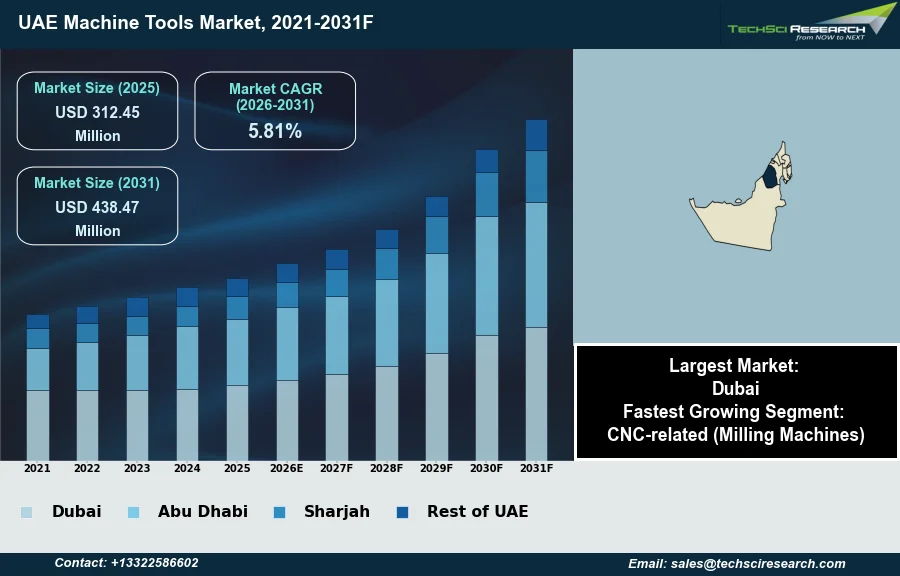
UAE Machine Tools Market was valued at USD 187 Million in 2024 and is expected to reach USD 269 Million by 2030 with a CAGR of 6.11% during the forecast period. 

Machine tools are power-driven equipment or machines used to shape, cut, form, or machine raw materials into precise parts and components. They play a crucial role in the manufacturing industry, enabling the production of metal, plastic, wood, and other materials with high accuracy and consistency. These tools typically work by utilizing various methods such as turning, milling, grinding, drilling, and boring to shape or finish a material.

Common machine tools include lathes, milling machines, drilling machines, grinders, and CNC (Computer Numerical Control) machines, which are capable of performing complex tasks with minimal human intervention. The integration of CNC technology has significantly improved the precision, speed, and automation of machining processes.

Machine tools are essential in the production of a wide range of items, from small components in electronics to large mechanical parts used in the automotive and aerospace industries. They are also widely used in the creation of molds, dies, and tooling for mass production. Overall, machine tools are indispensable for achieving high-quality, intricate designs in the manufacturing world, contributing to the efficiency and advancement of modern industries.

Key Market Drivers

Industrial Growth and Diversification

The rapid industrial growth and diversification in the UAE have played a significant role in driving the demand for machine tools. Over the past few decades, the UAE has transformed from a primarily oil-based economy into a diversified industrial hub. The government has made substantial investments in non-oil sectors, such as manufacturing, aerospace, automotive, and construction. These sectors require advanced manufacturing techniques and precise machinery to produce high-quality components, driving the need for machine tools.

The UAE’s Vision 2021 and its subsequent initiatives, like the National Industrial Strategy 2030, aim to establish the country as a leading global player in industrial innovation and production. The focus on sectors such as advanced manufacturing, robotics, and automation has created a growing demand for modern machine tools that can meet the high precision and efficiency standards required by these industries. Additionally, the UAE's role as a gateway to the Middle East, Africa, and South Asia markets has made it an attractive location for international manufacturers and suppliers, further fueling the need for advanced machine tools.

The increasing presence of foreign multinational companies in the UAE’s industrial landscape has also driven demand for state-of-the-art machinery. These companies require specialized equipment to manufacture complex parts and products, leading to a surge in the adoption of sophisticated machine tools. Furthermore, the expansion of local manufacturing capabilities for sectors like defense, transportation, and electronics, where precision is critical, has spurred growth in the UAE machine tools market.

In essence, the ongoing industrialization and diversification of the UAE economy have created a fertile environment for the machine tools market, with manufacturers and industries seeking efficient, precise, and technologically advanced solutions to meet their production needs. The UAE's government has been focused on reducing its reliance on oil, with non-oil sectors such as manufacturing, aerospace, construction, and technology becoming significant contributors to GDP. By 2021, the non-oil sector accounted for approximately 70% of the UAE’s GDP, with Dubai and Abu Dhabi leading in industrial growth

Technological Advancements and Automation

Technological advancements and automation are reshaping the global manufacturing landscape, and the UAE is no exception. The increasing demand for higher efficiency, accuracy, and reduced human error in manufacturing processes is driving the adoption of advanced machine tools in the UAE. Technologies such as Computer Numerical Control (CNC), robotics, and artificial intelligence (AI) are becoming integral to modern manufacturing processes, enabling companies to produce high-quality products at faster rates.

CNC machines, in particular, have revolutionized the production of components in the UAE. These machines allow manufacturers to automate the entire production process, from designing the product to executing the machining operation. This results in greater consistency, precision, and the ability to produce complex geometries that would be difficult or impossible with traditional manual tools. As industries in the UAE continue to modernize, there is a growing demand for CNC machines, including multi-axis machines, vertical and horizontal machining centers, and 3D printers, which offer flexibility and efficiency in various manufacturing processes. Additionally, robotics and automation are becoming more prevalent in industries such as automotive, aerospace, and electronics. Automated production lines are not only increasing the speed and volume of production but also reducing the reliance on manual labor. As industries in the UAE continue to invest in Industry 4.0 technologies, including machine learning and data analytics, the demand for machine tools capable of integrating with these systems is expected to rise significantly.

The push for smart manufacturing in the UAE is also encouraging the development and adoption of machine tools that can communicate with other systems on the factory floor. Machine tools equipped with sensors and IoT capabilities can provide real-time data on performance, maintenance needs, and potential issues, allowing manufacturers to optimize their operations. As these technological advancements continue to evolve, they will further enhance the capabilities of machine tools, ensuring that the UAE remains at the forefront of the global manufacturing sector. The UAE is making significant strides in additive manufacturing, with applications spanning industries from aerospace to healthcare. The Dubai 3D Printing Strategy 2030 aims to position the city as a global leader in 3D printing technology.

Government Initiatives and Support

The UAE government’s proactive approach to developing the manufacturing sector is a key driver of the country’s machine tools market. Over the years, the government has launched various initiatives and programs to foster industrial growth and technological advancement, creating an environment that supports the demand for advanced machinery.

One of the most significant initiatives is the UAE Vision 2021, which aims to transform the country into a global hub for innovation, industry, and advanced manufacturing. This vision focuses on increasing the industrial sector’s contribution to the national economy, diversifying away from oil reliance, and establishing sustainable, knowledge-based industries. The government has been supporting these objectives through initiatives such as the National Industrial Strategy 2030, which outlines a comprehensive plan for the growth of key industries, including aerospace, defense, medical devices, and automotive. These industries require precision-engineered parts and sophisticated machinery, further driving the demand for high-quality machine tools. Moreover, the UAE government has established free trade zones, offering tax incentives and favorable regulations to attract foreign investment in manufacturing. The development of these zones has encouraged international companies to set up manufacturing facilities in the UAE, creating a growing need for advanced machine tools to support production processes. Additionally, the government’s investments in infrastructure, such as the expansion of ports, airports, and industrial parks, have facilitated the growth of the manufacturing sector and its reliance on machine tools.

Another critical factor is the UAE’s commitment to embracing new technologies, such as 3D printing and artificial intelligence, which require advanced machine tools capable of supporting these innovations. Government-supported initiatives aimed at fostering the adoption of these technologies are creating new opportunities for machine tool suppliers to meet the needs of high-tech industries.

Growing Demand from Key End-User Industries

The growing demand for machine tools in the UAE is closely linked to the development and expansion of key end-user industries such as automotive, aerospace, construction, and electronics. As these industries continue to thrive, the need for advanced machinery that can produce high-quality components with precision and speed is becoming more pronounced.

The automotive industry in the UAE, although still in its early stages compared to other regions, is rapidly evolving. Both domestic and international manufacturers are establishing production facilities in the UAE to serve the local market and neighboring regions. This sector requires specialized machine tools for tasks like machining engine parts, chassis, and transmission systems. The automotive industry’s growth is, therefore, a significant driver of demand for advanced machine tools capable of producing precise automotive components with high efficiency.

Similarly, the UAE’s aerospace industry is expanding, driven by the country’s investments in space exploration and aviation. Companies in this sector require machine tools that can meet the rigorous demands of aerospace manufacturing, including precision machining of components such as turbine blades, fuselage parts, and structural components. As the UAE strives to become a leader in aerospace technology, the demand for advanced machine tools capable of producing these complex components is expected to rise.

The construction and real estate sectors in the UAE have also been significant contributors to the country’s economic growth. As large-scale infrastructure projects continue to develop, there is an increasing demand for machine tools used in the production of building materials, such as steel beams, concrete components, and other construction-related products. Additionally, industries such as electronics and medical devices, which require high-precision components, are also driving the demand for advanced machinery. Dubai remains a global leader in construction and real estate development, with over USD 100 billion in planned infrastructure projects in the coming years, including mega projects like the Dubai Creek Tower and Expo 2020 site.


Download Free Sample Report

Key Market Challenges

High Initial Investment Costs

One of the primary challenges facing the UAE machine tools market is the high initial investment cost associated with acquiring advanced machinery. While the demand for machine tools is increasing due to the country’s industrial diversification and technological advancements, the financial outlay required to purchase and maintain these tools can be a significant barrier for both local manufacturers and international companies looking to establish operations in the UAE.

The upfront cost of purchasing sophisticated machine tools, particularly Computer Numerical Control (CNC) machines, multi-axis machines, and 3D printers, can be extremely high. These machines are typically equipped with advanced technology that requires substantial capital investment. For example, CNC machines, which offer high precision and automation capabilities, come with a hefty price tag due to the complexity of their design and the technology involved. The need for constant software upgrades, specialized training for operators, and routine maintenance also adds to the long-term costs of owning and operating such machines.

For smaller and medium-sized manufacturers in the UAE, these high costs can make it difficult to compete with larger firms that have more substantial financial resources. Even with the UAE government’s support for industrial growth, particularly in sectors like aerospace, automotive, and manufacturing, the financial burden of investing in the latest machine tools may hinder the ability of small and medium enterprises (SMEs) to adopt state-of-the-art technology. This limitation can result in slower adoption of new technologies, keeping local manufacturers behind their international counterparts who are able to secure more advanced machinery. Additionally, the UAE’s heavy reliance on importing machine tools means that local businesses may face challenges related to currency fluctuations, import duties, and logistical complexities, all of which further increase the cost of acquisition. Although there are financing options available, such as leasing or loans, these still represent a significant financial commitment, particularly in the face of potential market volatility.

As a result, high initial investment costs represent a substantial challenge for companies looking to upgrade their manufacturing capabilities. Overcoming this challenge will require targeted government incentives, such as subsidies or tax breaks, as well as industry-specific support programs to encourage the wider adoption of advanced machine tools among local manufacturers.

Skilled Labor Shortage

Another significant challenge for the UAE machine tools market is the shortage of skilled labor. Despite the country’s rapid industrialization and advancements in manufacturing technologies, the availability of a skilled workforce capable of operating and maintaining high-tech machine tools remains a critical issue. As machine tools become more advanced, they require operators with specialized knowledge of both the machinery itself and the integrated software systems that control them.

Machine tools like CNC machines, automated robotic arms, and advanced 3D printing systems rely on operators who are not only skilled in the operation of the hardware but also in understanding complex programming and troubleshooting. However, the UAE faces a skills gap in its workforce, particularly in high-tech manufacturing and precision engineering roles. Many companies are struggling to find qualified workers with the expertise needed to operate modern machine tools, leading to inefficiencies in production and increased operational costs.

The shortage of skilled labor is partly due to the rapid pace of technological advancement in the manufacturing sector. While the UAE has made significant strides in education and vocational training, the fast-moving nature of technological innovation in machine tools means that existing training programs may not always align with the latest industry needs. Many skilled workers in the UAE have been trained on older, less automated machinery and lack the experience required to work with cutting-edge equipment like CNC machines or robotics. Additionally, the country’s reliance on foreign labor exacerbates this issue, as the influx of workers from abroad often leads to an imbalance in the availability of highly skilled professionals. Skilled workers in specialized fields such as advanced machining and automation may be limited, while many foreign workers may only possess general skills. This mismatch between the demand for specialized labor and the supply of appropriately trained personnel can stifle the growth of the machine tools market.

To address this challenge, there is a growing need for targeted educational and training programs aimed at upskilling the UAE workforce in advanced manufacturing technologies. Government and private sector initiatives should focus on developing training centers that offer hands-on experience with modern machine tools and integration with Industry 4.0 technologies. By improving access to high-quality training and education, the UAE can begin to close the skills gap and ensure that it has the talent necessary to support the continued growth and development of its machine tools market.

Key Market Trends

Increasing Adoption of CNC Machines

One of the most prominent trends in the UAE machine tools market is the growing adoption of Computer Numerical Control (CNC) machines. CNC technology has revolutionized the manufacturing industry by offering precision, automation, and efficiency that traditional manual machining processes could not achieve. In the UAE, industries like aerospace, automotive, and electronics are increasingly relying on CNC machines to meet the demand for high-quality, precise, and complex components.

The primary reason for the rise in CNC machine adoption is the significant advantages these machines offer, such as the ability to produce intricate parts with a high degree of accuracy, repeatability, and consistency. This is particularly important in sectors like aerospace, where precision is critical to ensure the safety and reliability of components. Similarly, in the automotive sector, CNC machines are used to produce complex engine parts, transmission systems, and chassis components that require precise tolerances.

CNC machines also play a key role in enhancing production efficiency by reducing the need for manual labor and minimizing the chances of human error. With the integration of automation, CNC systems can operate 24/7, boosting productivity and enabling manufacturers to meet increasing demand with shorter lead times. As the UAE's manufacturing sector continues to grow, industries are recognizing that investing in advanced CNC technology is essential to maintain competitiveness in an increasingly globalized market. Furthermore, the trend towards Industry 4.0 is fueling the adoption of CNC machines that can be integrated with other smart factory technologies. These machines are equipped with sensors and connected to central monitoring systems that can analyze real-time data to optimize production and predict maintenance needs, thus improving efficiency and reducing downtime.

Integration of Industry 4.0 and Smart Manufacturing

The UAE’s push towards becoming a leader in industrial innovation has spurred the adoption of Industry 4.0 technologies in the machine tools market. Industry 4.0 refers to the integration of digital technologies such as automation, data analytics, Internet of Things (IoT), artificial intelligence (AI), and machine learning into manufacturing processes. In the UAE, many companies are embracing smart manufacturing to improve productivity, reduce operational costs, and enhance product quality.

Machine tools are at the heart of this transformation. The integration of IoT with machine tools allows for real-time monitoring and data collection, which can provide manufacturers with valuable insights into machine performance, production processes, and maintenance schedules. For instance, sensors embedded in CNC machines can detect potential malfunctions before they occur, allowing for predictive maintenance and minimizing unplanned downtime. This data-driven approach helps manufacturers optimize their operations and reduce costs associated with repairs and production delays.

AI and machine learning are also playing an increasing role in smart manufacturing. These technologies enable machine tools to learn from data and make autonomous decisions to optimize machining processes. This can lead to higher-quality production, faster cycle times, and better resource utilization. Moreover, AI-powered systems can assist in process optimization, tool selection, and even in the design of new manufacturing workflows.

The UAE’s Vision 2021 and the National Industrial Strategy 2030 emphasize the importance of embracing digital transformation in manufacturing. The country’s growing adoption of Industry 4.0 technologies is expected to further boost the demand for machine tools capable of integrating with these advanced systems. By leveraging automation, connectivity, and data analytics, manufacturers in the UAE can position themselves at the forefront of the global manufacturing landscape.

Segmental Insights

Type Insights

The Turning Machines held the largest market share in 2024. Turning machines dominated the UAE machine tools market due to several key factors, including their versatility, precision, and widespread application across various industries. A turning machine, typically in the form of a CNC (Computer Numerical Control) lathe, is essential for producing a wide range of cylindrical components with high accuracy and surface finish. In the UAE, industries such as oil and gas, aerospace, automotive, and manufacturing all rely heavily on turning machines to produce critical components such as shafts, pins, and tubes.

The UAE’s oil and gas sector, in particular, has significantly influenced the dominance of turning machines. The production of high-precision parts required for drilling equipment, pipelines, and refining processes necessitates the use of advanced turning technology. The ability of turning machines to produce parts with tight tolerances and smooth finishes makes them indispensable in the energy sector, where quality and reliability are crucial. Additionally, the UAE’s growing industrial diversification, particularly in sectors like aerospace, automotive, and heavy machinery, has driven demand for turning machines. These industries require the production of complex, high-precision components that cannot be easily achieved through manual processes. CNC turning machines, with their automation capabilities, not only improve production speed but also ensure consistency and repeatability, which are essential for industries that require large volumes of high-quality parts.

The relatively lower cost of CNC turning machines compared to other complex machine tools, such as multi-axis milling machines, also contributes to their dominance. The UAE's focus on industrialization and its efforts to maintain a competitive edge in manufacturing make turning machines a cost-effective investment for many companies.

The ease of integration with Industry 4.0 technologies, such as automation and data analytics, has enhanced the attractiveness of turning machines in the UAE. As the market embraces digitalization and smart manufacturing, turning machines offer flexibility and scalability, making them a preferred choice for businesses looking to improve operational efficiency.

Material Insights

The High-Speed Steel held the largest market share in 2024.  High-Speed Steel (HSS) dominates the UAE machine tools market due to its exceptional properties and versatility, making it highly suitable for a wide range of machining applications. HSS is widely recognized for its ability to maintain its hardness and cutting efficiency at high temperatures, which is a crucial attribute for the harsh conditions often encountered in manufacturing processes. This characteristic makes it ideal for tools used in high-speed operations, where friction can cause rapid wear on other materials.

In the UAE, where industries such as aerospace, automotive, and construction are growing rapidly, HSS tools are essential for producing precision components that require both high durability and cost-effectiveness. The increasing demand for high-performance tools in these sectors, particularly for cutting, drilling, and milling operations, has driven HSS’s dominance in the market. HSS is also valued for its ability to be easily sharpened and maintained, which further enhances its appeal to manufacturers looking for tools that offer both high performance and a lower total cost of ownership.

The UAE's machine tools market is increasingly embracing automation and advanced manufacturing techniques, which demand materials capable of sustaining higher speeds and loads. HSS’s superior wear resistance and thermal stability make it well-suited for these high-performance applications, allowing manufacturers to achieve better precision, longer tool life, and reduced downtime. Additionally, the affordability of HSS, compared to more expensive materials such as carbide, makes it an attractive option for both local and international manufacturers in the UAE who aim to balance performance with cost-efficiency. Furthermore, HSS tools are highly adaptable and can be used for a wide range of applications, from high-mix, low-volume production to mass production runs, which aligns well with the UAE’s industrial diversity. Overall, the combination of durability, versatility, cost-effectiveness, and performance makes High-Speed Steel a dominant material in the UAE machine tools market.


Download Free Sample Report

Regional Insights

Abu Dhabi held the largest market share in 2024. Abu Dhabi dominates the UAE machine tools market due to several key factors, including its strategic economic positioning, industrial infrastructure, and government support. As the capital of the UAE, Abu Dhabi holds significant influence over the country’s economy and plays a central role in its industrial development, particularly in sectors requiring high-precision manufacturing.

One of the primary reasons for Abu Dhabi's dominance is its rich resource base, particularly in oil and gas. These industries demand advanced machinery for drilling, refining, and the production of precision parts, creating a strong market for machine tools. Additionally, the UAE’s commitment to diversifying its economy beyond oil, as outlined in its Vision 2021 and the National Industrial Strategy 2030, has led to substantial investments in Abu Dhabi's non-oil sectors, including aerospace, automotive, and manufacturing, all of which require advanced machine tools for production.

Abu Dhabi's robust industrial infrastructure, with extensive free zones and industrial parks, offers favorable conditions for machine tool manufacturers and users. These zones attract global manufacturers due to competitive tax incentives, modern facilities, and proximity to key markets. The city's focus on creating a business-friendly environment has fostered the establishment of various high-tech industries, leading to increased demand for modern machine tools. Furthermore, the government's focus on research, innovation, and technology has positioned Abu Dhabi as a center for advanced manufacturing. The growing emphasis on automation, robotics, and smart manufacturing solutions aligns with the increasing need for high-precision machine tools in industries like aerospace and electronics.

Recent Developments

  • In April 2025, Nidec Corporation initiated a tender offer to acquire shares of Makino Milling Machine Co., Ltd., with the objective of making it a wholly owned subsidiary. The offer, launched on April 4, 2025, followed key decisions made at Nidec’s board meeting on April 3, 2025. In response, Makino provided clarifications regarding the tender offer, addressing concerns over "takeover defense measures" and perceived inconsistencies in corporate policy.
  • In November 2024, Okuma Corporation introduced the MS-320H, a compact horizontal machining center designed to address labor shortages and enhance automation in the electric vehicle and semiconductor industries. The MS-320H is optimized for flexible, space-efficient production of small components, catering to high-mix, low-volume, and mass production environments. It improves operational efficiency by minimizing the need for manual loading and unloading, thereby supporting workstyle reforms and boosting productivity across multiple sectors.

Key Market Players

  • DMG Mori Co., Ltd.
  • Yamazaki Mazak Corporation
  • Haas Automation, Inc.
  • Makino Milling Machine Co., Ltd.
  • Okuma Corporation
  • CNC Systems Inc.
  • Trumpf SE + Co. KG
  • FANUC Corporation

By Type

By Material

By End User

By Region

  • Turning Machines
  • Milling Machines
  • Drilling Machines
  • Grinding Machines
  • Electrical Discharge Machines
  • Forming Machines
  • Others
  • High-Speed Steel
  • Carbide
  • Ceramic
  • Diamond
  • Job Shops
  • Manufacturing Enterprises
  • Repair & Maintenance Workshops
  • Automotive Workshops, Aerospace & Defense
  • Electronics & Electrical
  • Others
  • Dubai
  • Abu Dhabi
  • Sharjah
  • Rest of UAE


Report Scope:

In this report, the UAE Machine Tools Market has been segmented into the following categories, in addition to the industry trends which have also been detailed below:

  • UAE Machine Tools Market, By Type:

o   Turning Machines

o   Milling Machines

o   Drilling Machines

o   Grinding Machines

o   Electrical Discharge Machines

o   Forming Machines

o   Others

  • UAE Machine Tools Market, By Material:

o   High-Speed Steel

o   Carbide

o   Ceramic

o   Diamond  

  • UAE Machine Tools Market, By End User:

o   Job Shops

o   Manufacturing Enterprises

o   Repair & Maintenance Workshops

o   Automotive Workshops, Aerospace & Defense

o   Electronics & Electrical

o   Others

  • UAE Machine Tools Market, By Region:

o   Dubai

o   Abu Dhabi

o   Sharjah

o   Rest of UAE

Competitive Landscape

Company Profiles: Detailed analysis of the major companies present in the UAE Machine Tools Market.

Available Customizations:

UAE Machine Tools Market report with the given market data, TechSci Research offers customizations according to a company's specific needs. The following customization options are available for the report:

Company Information

  • Detailed analysis and profiling of additional market players (up to five).

UAE Machine Tools Market is an upcoming report to be released soon. If you wish an early delivery of this report or want to confirm the date of release, please contact us at [email protected]  

Table of content

Table of content

1.         Product Overview

1.1.     Market Definition

1.2.     Scope of the Market

1.2.1. Markets Covered

1.2.2. Years Considered for Study

1.3.     Key Market Segmentations

2.         Research Methodology

2.1.     Objective of the Study

2.2.     Baseline Methodology

2.3.     Formulation of the Scope

2.4.     Assumptions and Limitations

2.5.     Sources of Research

2.5.1. Secondary Research

2.5.2. Primary Research

2.6.     Approach for the Market Study

2.6.1. The Bottom-Up Approach

2.6.2. The Top-Down Approach

2.7.     Methodology Followed for Calculation of Market Size & Market Shares

2.8.     Forecasting Methodology

2.8.1. Data Triangulation & Validation

3.         Executive Summary

3.1.     Overview of the Market

3.2.     Overview of Key Market Segmentations

3.3.     Overview of Key Market Players

3.4.     Overview of Key Regions/Countries

3.5.     Overview of Market Drivers, Challenges, and Trends

4.         Voice of Customer

5.         UAE Machine Tools Market Outlook

5.1.     Market Size & Forecast

5.1.1. By Value

5.2.     Market Share & Forecast

5.2.1. By Type (Turning Machines, Milling Machines, Drilling Machines, Grinding Machines, Electrical Discharge Machines, Forming Machines, Others)

5.2.2. By Material (High-Speed Steel, Carbide, Ceramic, Diamond)

5.2.3. By End User (Job Shops, Manufacturing Enterprises, Repair & Maintenance Workshops, Automotive Workshops, Aerospace & Defense, Electronics & Electrical, Others)

5.2.4. By Region (Dubai, Abu Dhabi, Sharjah, Rest of UAE)

5.2.5. By Company (2024)

5.3.     Market Map

6.         Dubai Machine Tools Market Outlook

6.1.     Market Size & Forecast

6.1.1. By Value

6.2.     Market Share & Forecast

6.2.1. By Type

6.2.2. By Material

6.2.3. By End User

7.         Abu Dhabi Machine Tools Market Outlook

7.1.     Market Size & Forecast

7.1.1. By Value

7.2.     Market Share & Forecast

7.2.1. By Type

7.2.2. By Material

7.2.3. By End User

8.         Sharjah Machine Tools Market Outlook

8.1.     Market Size & Forecast

8.1.1. By Value

8.2.     Market Share & Forecast

8.2.1. By Type

8.2.2. By Material

8.2.3. By End User

9.         Market Dynamics

9.1.     Drivers

9.2.     Challenges

10.      Market Trends & Developments

10.1.  Merger & Acquisition (If Any)

10.2.  Product Launches (If Any)

10.3.  Recent Developments

11.      Company Profiles

11.1.  DMG Mori Co., Ltd.

11.1.1. Business Overview

11.1.2. Key Revenue and Financials 

11.1.3. Recent Developments

11.1.4. Key Personnel/Key Contact Person

11.1.5. Key Product/Services Offered

11.2.  Yamazaki Mazak Corporation

11.3.  Haas Automation, Inc.

11.4.  Makino Milling Machine Co., Ltd.

11.5.  Okuma Corporation

11.6.  CNC Systems Inc.

11.7.  Trumpf SE + Co. KG

11.8.  FANUC Corporation

12.      Strategic Recommendations

13.      About Us & Disclaimer

Figures and Tables

Frequently asked questions

Frequently asked questions

The market size of the UAE Machine Tools Market was USD 187 Million in 2024.

In 2024, Manufacturing enterprises dominated the UAE machine tools market due to the country's industrial growth, economic diversification, and investment in sectors like aerospace, automotive, and electronics. These industries require advanced, high-precision machinery for production, driving demand for machine tools to enhance efficiency, automation, and product quality.

The major challenges for the UAE machine tools market include high initial investment costs, which can hinder small businesses, and a shortage of skilled labor capable of operating advanced machinery. Additionally, reliance on imported tools, fluctuating currency rates, and maintaining technological advancements in a competitive global market further complicate growth.

The major drivers for the UAE machine tools market include industrial diversification, increasing demand for precision machinery in sectors like aerospace and automotive, advancements in automation and Industry 4.0 technologies, government support for manufacturing, and the push for sustainability and energy-efficient production methods.

Related Reports

We use cookies to deliver the best possible experience on our website. To learn more, visit our Privacy Policy. By continuing to use this site or by closing this box, you consent to our use of cookies. More info.