|
Key Insights
|
Details
|
|
Forecast Period
|
2027-2031
|
|
Market Size (2025)
|
USD 4.56 Billion
|
|
CAGR (2026-2031)
|
7.61%
|
|
Fastest Growing Segment
|
SUV/MPV
|
|
Largest Market
|
Dubai
|
|
Market Size (2031)
|
USD 7.08 Billion
|
Market Overview
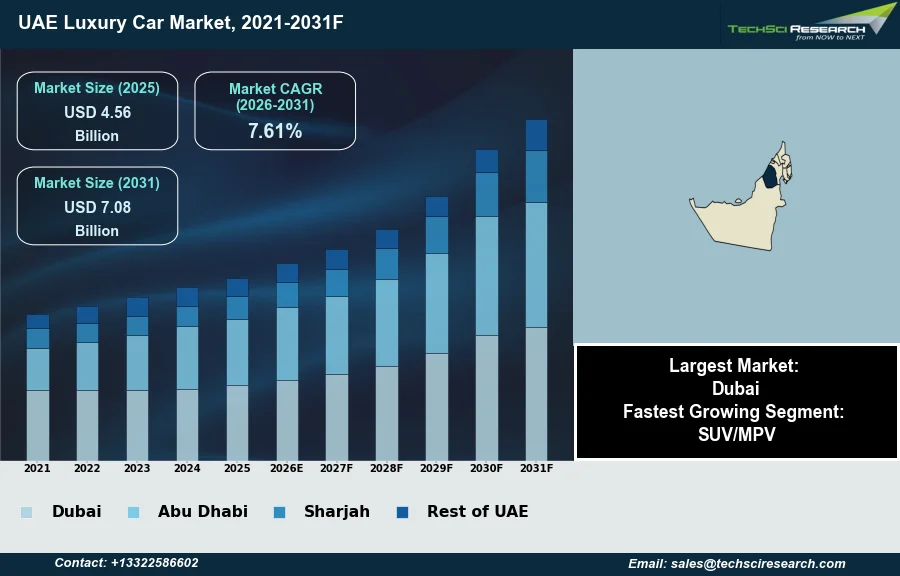
The UAE Luxury Car Market will grow from USD 4.56 Billion in 2025 to USD 7.08 Billion by 2031 at a 7.61% CAGR. The UAE luxury car market comprises high-value automotive products distinguished by their advanced engineering, superior performance capabilities, premium interior materials, and established brand reputation. Main growth drivers for this market include the nation's high disposable income levels, a substantial affluent expatriate population, and a well-developed road infrastructure. Additionally, favorable government policies and the cultural significance of luxury vehicles as indicators of status consistently bolster demand. According to AutoData Middle East, electric vehicle adoption within the UAE automotive market constituted 7.7% of total sales in the first half of 2025.
However, one significant challenge impeding market expansion is the increasing market saturation, particularly within major urban centers, leading to intense competition among a wide array of premium brands. This necessitates continuous innovation in product features, pricing strategies, and after-sales service to maintain brand loyalty and capture market share. Furthermore, geopolitical tensions in the broader region can disrupt supply chains and temper consumer sentiment, impacting sales.
Key Market Drivers
Rising Affluence Expands UAE Luxury-Car Market
The growing affluent population and high disposable income significantly bolster the UAE luxury car market. As individual wealth increases, there is a corresponding rise in the propensity to purchase high-value automotive products, often seen as indicators of personal success and social standing. The sustained influx of wealthy individuals directly expands the core demographic for luxury vehicle sales, fostering a continuously broadening customer base for premium brands. According to Forbes Middle East, in June 2025, the UAE was projected to attract 9,800 new millionaires, representing the highest net inflow globally. This demographic shift, coupled with the nation's robust economic environment, underpins a consistent demand for luxury automobiles, from high-performance sports cars to ultra-premium sedans.
SUVs and EVs Drive Luxury Segment Growth
A significant trend further influencing the market is the rising demand for luxury SUVs and electric vehicles. Consumers are increasingly seeking versatile, spacious, and technologically advanced SUVs that offer both opulence and practicality for the diverse UAE landscape. Concurrently, a growing awareness of environmental sustainability, supported by government initiatives, is accelerating the adoption of luxury electric vehicles, appealing to eco-conscious affluent buyers who desire performance without compromising green credentials. According to the International Energy Agency, as reported in May 2026, the UAE accounted for almost half of the Middle East's electric car sales in 2025, with regional sales reaching approximately 75,000 units. Overall, the nation’s strong economic performance further supports this market, with the Central Bank of the United Arab Emirates reporting a real GDP growth of 5.6% in 2025.
Download Free Sample Report
Key Market Challenges
Market Saturation and Growth Constraints in UAE Luxury Cars
Increasing market saturation, particularly within major urban centers, presents a significant challenging factor impeding growth in the UAE luxury car market. This environment fosters intense competition among a wide array of premium brands, making it increasingly difficult for manufacturers to expand their customer base and secure additional market share. The extensive availability of luxury vehicles in the market leads to diminishing brand exclusivity and exerts pressure on pricing strategies, necessitating continuous investment in product differentiation and customer retention programs.
Sales Contraction and Cost Pressures in UAE Luxury Segment
This competitive landscape directly hampers the market's expansion by affecting sales performance. According to Focus2Move, in the first quarter of 2026, the UAE's vehicle market reported losses of 19.1%, with 69,320 units sold, reflecting a contraction in overall sales. For the luxury segment, this market tightening translates into higher operational and marketing costs required to stand out. Such conditions ultimately impact potential revenue growth and profitability for luxury automotive brands operating within the highly saturated UAE market.
Key Market Trends
Hyper-personalization and bespoke customization in UAE luxury cars
A significant trend reshaping the UAE luxury car market is the increasing demand for hyper-personalization and bespoke creations. Affluent buyers are progressively seeking vehicles that distinctly reflect their individual identity, cultural heritage, and personal narratives rather than standard factory models. This extends beyond aesthetic modifications to include unique material choices, specialized finishes, and advanced technological integrations, elevating the vehicle to a unique work of art. This desire for unparalleled exclusivity is driving manufacturers to offer extensive customization programs, where clients collaborate directly on their vehicle's design. According to Rolls-Royce, its Private Offices around the world saw bespoke commissions more than double year-on-year in 2025, underscoring this strong client engagement in unique automotive expressions.
Robust growth of the pre-owned luxury segment
Another pivotal trend influencing the market is the robust growth of the pre-owned luxury segment. A growing number of consumers are turning to the pre-owned market for high-value vehicles, recognizing the opportunity to acquire premium brands at more accessible price points without compromising on quality or features. This trend is bolstered by the availability of well-maintained, relatively new luxury cars, often supported by certified pre-owned programs that offer extended warranties and comprehensive inspections. The accessibility provided by this segment allows a broader demographic to enter the luxury car ownership landscape, driving consistent demand. As reported by ArabWheels in January 2026, demand for pre-owned Rolls-Royce, Ferrari, Lamborghini, and Bentley models increased by more than 30% year over year, indicating a strong appetite for value in the luxury segment.
Segmental Insights
Drivers of UAE SUV/MPV Growth: Affluence, Versatility, and Infrastructure
The UAE luxury car market is witnessing significant expansion in the SUV/MPV segment, driven by a confluence of economic and lifestyle factors. This rapid growth is primarily attributed to the high disposable income and affluent population in the UAE, who often view luxury vehicles as significant symbols of status and achievement. Furthermore, the versatility of SUV/MPV models, which seamlessly blend comfort, space, and robust performance, makes them highly suitable for the diverse urban and challenging off-road terrains prevalent across the Emirates. This caters to evolving consumer preferences for vehicles that support a dynamic lifestyle, from family use to leisure activities such as desert excursions. Additionally, the country's advanced road infrastructure further enhances the appeal and practicality of these larger luxury vehicles.
Regional Insights
Dubai: The UAE Luxury Car Market's Regional Epicenter
Dubai leads the UAE Luxury Car Market, primarily driven by its high concentration of affluent residents, expatriates, and tourists who possess a strong preference for premium vehicles. The city's vibrant economy, coupled with world-class infrastructure, fosters a luxury-oriented lifestyle that creates a highly conducive environment for high-end automotive sales. Furthermore, Dubai benefits from favorable tax policies, including low import duties, which make luxury vehicles more accessible. The presence of numerous global luxury car dealerships, expansive showrooms, and exclusive automotive events further solidifies Dubai’s position as a regional epicenter for the luxury car sector, fulfilling the strong cultural demand for prestige and status that premium vehicles represent.
Recent Developments
-
In October 2025, Mercedes-Benz officially showcased its CONCEPT AMG GT XX at GITEX Global in Dubai. This revolutionary electric concept represented a substantial leap in electric performance, highlighting advanced developments in drive systems, aerodynamics, battery technology, and software integration. The debut at GITEX Global underscored Mercedes-Benz Middle East's ongoing collaboration with e&, utilizing the platform to exhibit the automaker's most progressive innovations. The partnership emphasized the UAE's national focus on smart mobility and leadership in innovation, positioning the concept as a preview of a future four-door series-production sports car.
-
In August 2025, iCAUR hosted an exclusive launch event in the UAE, revealing five new models developed in collaboration with AutoMillennium. This partnership marked a significant milestone for iCAUR's presence in the MENA region, demonstrating a commitment to advanced luxury mobility and intelligent design. The unveiled models, including the iCAUR Nova electric tourer, R7 Falcon, Xterra SUV, V-Line Executive, and ZR One Concept, collectively represented a forward-looking vision for the future of luxury vehicles in the UAE market, emphasizing performance and autonomous capabilities.
-
In January 2025, Automobili Lamborghini unveiled the all-new Temerario to customers and media at an exclusive event held in Dubai. The Temerario, the latest super sports car from Lamborghini, features a new hybrid powertrain that integrates a twin-turbo V8 engine with three electric motors, delivering a total output of 920 CV. This model is notable for its V8 engine, which was developed from scratch in Sant'Agata Bolognese and is engineered to reach 10,000 rpm. Its introduction to the Middle East marked a significant step in Lamborghini's High Performance Electrified Vehicle (HPEV) range, completing the hybridization of its lineup for the region.
-
In June 2024, Rolls-Royce Motor Cars, in conjunction with ACMC, officially introduced the all-new Cullinan Series II to the UAE market. This launch represented a notable advancement for the British luxury brand, presenting a combination of sophisticated design, contemporary technology, and performance-oriented attributes. The Cullinan Series II aimed to significantly influence the luxury SUV segment across the UAE by addressing evolving customer preferences. This new model reinforces the brand's commitment to innovation and excellence in automotive design, offering a compelling proposition for discerning buyers seeking a blend of power and luxury.
Key Market Players
- Mercedes-Benz UAE
- BMW UAE
- Audi UAE
- Porsche UAE
- Land Rover UAE
- Lexus UAE
- Bentley UAE
- Rolls-Royce UAE
- Ferrari UAE
- Lamborghini UAE
|
By Vehicle Type
|
By Propulsion Type
|
By Price Segment
|
By Region
|
|
|
|
- Entry Level
- Mid-Range
- Premium-Range
|
- Dubai
- Abu Dhabi
- Sharjah
- Rest of UAE
|
Report Scope:
In this report, the UAE Luxury Car Market has been segmented into the following categories, in addition to the industry trends which have also been detailed below:
-
UAE Luxury Car Market, By Vehicle Type:
-
UAE Luxury Car Market, By Propulsion Type:
-
UAE Luxury Car Market, By Price Segment:
-
Entry Level
-
Mid-Range
-
Premium-Range
-
UAE Luxury Car Market, By Region:
-
Dubai
-
Abu Dhabi
-
Sharjah
-
Rest of UAE
Competitive Landscape
Company Profiles: Detailed analysis of the major companies present in the UAE Luxury Car Market.
Available Customizations:
UAE Luxury Car Market report with the given market data, TechSci Research offers customizations according to a company's specific needs. The following customization options are available for the report:
Company Information
- Detailed analysis and profiling of additional market players (up to five).
UAE Luxury Car Market is an upcoming report to be released soon. If you wish an early delivery of this report or want to confirm the date of release, please contact us at sales@techsciresearch.com