|
Key Insights
|
Details
|
|
Forecast Period
|
2027-2031
|
|
Market Size (2025)
|
USD 28.79 Million
|
|
CAGR (2026-2031)
|
4.48%
|
|
Fastest Growing Segment
|
Rapid Technology
|
|
Largest Market
|
Dubai
|
|
Market Size (2031)
|
USD 37.45 Million
|
Market Overview
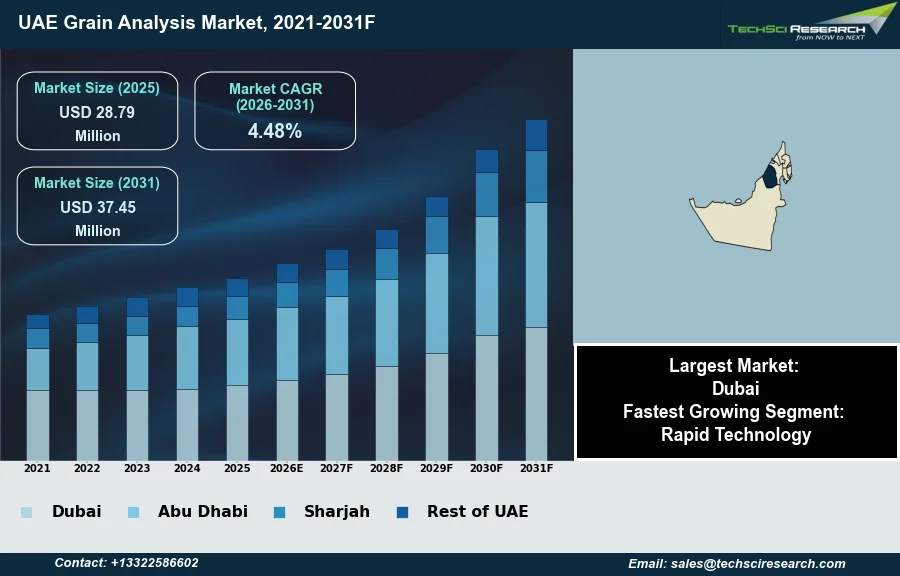
The Grain Analysis Market in UAE will grow from USD 28.79 Million in 2025 to USD 37.45 Million by 2031 at a 4.48% CAGR. Grain analysis in the UAE market encompasses the laboratory assessment of grain quality, composition, and safety through various scientific methodologies. This market's growth is primarily driven by the stringent food safety regulations implemented by government bodies to ensure consumer protection and the increasing demand for quality assurance within the nation's burgeoning food and feed industries. The UAE's substantial reliance on grain imports also necessitates rigorous analysis for compliance with international and national standards. For instance, according to the USDA Foreign Agricultural Service, for the marketing year 2025-2026, UAE's all wheat imports were forecast to increase by 30,000 metric tons, reaching 1.980 million metric tons.
A significant challenge impeding market expansion is the complexity arising from the diverse origins of imported grains due to limited domestic production. This necessitates a broader range of analytical expertise and equipment to accommodate varied grain characteristics and potential contaminants, thereby increasing operational costs for analysis providers.
Key Market Drivers
Rising grain import reliance drives need for rigorous grain analysis
The increasing reliance on grain imports is a primary factor driving the UAE Grain Analysis Market, necessitating rigorous quality and safety checks for vast quantities of incoming commodities. With limited domestic agricultural production, the UAE sources a significant portion of its food requirements internationally to meet the demands of its growing population and robust tourism sector. This substantial import volume directly correlates with the need for enhanced grain analysis services to ensure compliance with national and international standards. According to Dubai Municipality, in the first half of 2025, 173,775 food shipments totaling 4.9 million tons were cleared through Dubai's ports, underscoring the continuous influx of food items requiring thorough analytical scrutiny for quality assurance and to prevent the entry of contaminants. The strategic position of the UAE as a regional re-export hub further amplifies this demand, as imported grains often undergo further processing or transshipment, each stage requiring verification.
Regulatory stringency and processing sector sustain demand for grain analysis
Concurrently, stringent food safety regulations and standards imposed by government bodies are profoundly influencing the UAE Grain Analysis Market. These mandates are crucial for protecting public health and maintaining consumer confidence in the food supply chain. Regulatory frameworks, such as the unified food safety laws introduced in 2025, require meticulous testing for a wide array of parameters, including mycotoxins, pesticides, and allergens, across all food products. This regulatory stringency drives consistent demand for advanced analytical testing. For instance, according to Dubai Municipality, in the first five months of 2026, 24,820 inspections of food establishments were conducted across the emirate, demonstrating sustained regulatory oversight. This environment fosters significant activity for grain analysis providers. Furthermore, the extensive food and beverage processing industry in the UAE creates a substantial and consistent demand for grain analysis services to ensure raw materials and final products meet strict quality and safety criteria. According to the USDA Foreign Agricultural Service, in 2025, over 570 food and beverage processors operated in the UAE, producing 5.96 million metric tons annually.
Download Free Sample Report
Key Market Challenges
Diversity of grain origins increases analytical complexity and costs, hindering market growth.
The complexity arising from the diverse origins of imported grains presents a significant impediment to the growth of the UAE grain analysis market. Due to limited domestic production, the nation relies heavily on a multitude of international suppliers, each potentially adhering to varying agricultural practices and quality standards. This necessitates a broader spectrum of analytical expertise and specialized equipment to accurately assess varied grain characteristics and potential contaminants, such as mycotoxins, pesticide residues, and heavy metals. Consequently, operational costs for analysis providers escalate as they must invest in advanced diagnostic infrastructure and continuous training for technical personnel. According to the Abu Dhabi Agriculture and Food Safety Authority, in 2024, the authority inspected approximately 1.5 million tons of imported food to ensure compliance with safety protocols. This substantial volume, coupled with the diversity of origins, strains existing analytical resources. Such increased costs inevitably lead to higher service fees, potentially deterring some industry players from comprehensive testing or slowing the adoption of new testing mandates, thereby directly hampering the overall market expansion.
Key Market Trends
AI-Driven Grain Quality Inspection
AI-Powered Grain Quality Inspection Systems represent a pivotal trend, enhancing the efficiency and precision of analysis beyond traditional methods. These systems utilize advanced computer vision and machine learning algorithms to rapidly detect defects, spoilage, and contaminants in grain, automating processes that previously required manual and time-consuming efforts. This shift allows for more consistent quality assessment and faster decision-making, significantly impacting the operational workflows for grain analysis providers. According to 'How UAE Companies Are Leading the 2025 Supply Chain Technology Revolution' published in July 2025, 50% of UAE food companies are prioritizing AI investments. This adoption reduces human error and accelerates the throughput of analytical laboratories, meeting the high-volume demands of the UAE's import-dependent market.
Real-Time Grain Supply Chain Traceability
Concurrently, real-time digital supply chain traceability is transforming the oversight of grain movements, offering unprecedented transparency from origin to consumption. This trend goes beyond basic documentation by integrating technologies such as IoT sensors and blockchain to provide continuous monitoring of environmental conditions and handling processes throughout the supply chain. Such comprehensive visibility is crucial for validating the integrity and safety of imported grains, allowing for swift identification and isolation of any issues. For instance, the NRTC Group launched its Mazraati digital platform in February 2026, with a goal to onboard over 260 farmers by 2027 for real-time, end-to-end agri-food supply chain visibility. This enhances trust and enables proactive risk management, influencing the demand for integrated digital analysis solutions within the UAE Grain Analysis Market.
Segmental Insights
Rapid Growth in UAE Grain Analysis Driven by Food Security, Quality Control, and Contaminant Detection
The Rapid Technology segment stands out as the fastest-growing in the UAE Grain Analysis Market, primarily driven by the nation's pronounced focus on food security and stringent quality control for its substantial grain imports. The escalating demand for prompt and precise assessment of grain quality and safety is crucial for adherence to global trade standards and compliance with local regulations. This rapid growth is further fueled by the imperative for efficient detection of potential contaminants, mitigating foodborne illness risks. Consequently, governmental bodies, particularly the Ministry of Industry and Advanced Technology (MoIAT), which oversees standardization efforts previously managed by ESMA, actively promote the adoption of these advanced analytical methods to uphold public health and facilitate robust trade.
Regional Insights
Dubai: Strategic Hub and Infrastructure Driving the UAE Grain Analysis Market
Dubai leads the UAE Grain Analysis Market due to its strategic geographical position, which establishes it as a central hub for global grain trade, facilitating significant import and re-export activities. The emirate benefits from robust infrastructure, including world-class ports and advanced logistics facilities, which are essential for handling high volumes of grain. Institutions such as the Dubai Multi Commodities Centre (DMCC) further support this dominance by providing state-of-the-art facilities for grain storage and testing. Moreover, Dubai's commitment to stringent food safety standards, enforced by entities like the Dubai Municipality (DM), drives the necessity for comprehensive grain analysis to ensure the quality and safety of imported grains for its growing population and flourishing food and beverage sector.
Recent Developments
-
In June 2025, French multinational seed company Limagrain partnered with Abu Dhabi Developmental Holding Company (ADQ) to establish a joint research and development center in Abu Dhabi. This collaboration focused on breakthrough research in developing seeds specifically adapted for desert and arid climates. The center intended to leverage genetic advancements to enhance the resilience, yield, and nutritional profile of various crops, including those relevant to grain production, in high-temperature and low-water environments. This strategic alliance underscored an investment in climate-smart innovation directly impacting the future of grain analysis in the UAE.
-
In February 2025, TopFrame, a company specializing in inspection services and laboratory research for grain, oilseeds, and vegetable oils, actively participated as an official partner at the III International Global Grain and Pulses Forum in Dubai. The company's presence at this significant industry event highlighted its commitment to the UAE grain analysis market. By showcasing its comprehensive services to a diverse gathering of international delegates, TopFrame reinforced its role in providing essential quality assurance and laboratory research capabilities crucial for the trade and consumption of grains in the region.
-
In September 2024, UAE agritech food company Silal, in collaboration with the International Centre for Biosaline Agriculture (ICBA) and Abu Dhabi-based investment company ADQ, initiated crucial quinoa trials. This partnership focused on the research and development of seed cultivation and post-harvest processing techniques for two new quinoa varieties suitable for the region. Supported by ADQ's Dh100 million research and development fund, the "Quinoa Value Chain Development in the UAE" project aimed to evaluate potential efficacy, yield, and nutritional quality of this grain in the UAE's climate and soil conditions, directly influencing the local grain analysis market through the development of new testing protocols.
-
In mid-2025, Al Dahra, an Abu Dhabi-based agribusiness group, committed US$30 million to modernize its operations in Egypt, specifically targeting the production and processing of cereals like wheat and corn. This significant investment, part of the company's strategy to focus on proprietary farming, included irrigation upgrades and machinery modernization. These enhancements were aimed at improving yields and export potential, inherently necessitating advanced grain analysis and quality control measures within Al Dahra's supply chain, thereby contributing to the development of sophisticated analytical practices linked to the UAE's food security objectives.
Key Market Players
- Bureau Veritas SA
- ALS Limited
- Intertek Group PLC
- SGS SA
- Neogen Corporation
- Eurofins Scientific SE
- Thermo Fisher Scientific, Inc.
- Romer Labs Division Holding GmbH
- Sciex
- Waters Corporation
|
By Grain Type
|
By Technology
|
By Region
|
|
|
- Traditional Technology
- Rapid Technology
|
- Dubai
- Abu Dhabi
- Sharjah
- Rest of UAE
|
Report Scope:
In this report, the UAE Grain Analysis Market has been segmented into the following categories, in addition to the industry trends which have also been detailed below:
-
UAE Grain Analysis Market, By Grain Type:
-
UAE Grain Analysis Market, By Technology:
-
Traditional Technology
-
Rapid Technology
-
UAE Grain Analysis Market, By Region:
-
Dubai
-
Abu Dhabi
-
Sharjah
-
Rest of UAE
Competitive Landscape
Company Profiles: Detailed analysis of the major companies present in the UAE Grain Analysis Market.
Available Customizations:
UAE Grain Analysis Market report with the given market data, TechSci Research offers customizations according to a company's specific needs. The following customization options are available for the report:
Company Information
- Detailed analysis and profiling of additional market players (up to five).
UAE Grain Analysis Market is an upcoming report to be released soon. If you wish an early delivery of this report or want to confirm the date of release, please contact us at sales@techsciresearch.com