|
Key Insights
|
Details
|
|
Forecast Period
|
2027-2031
|
|
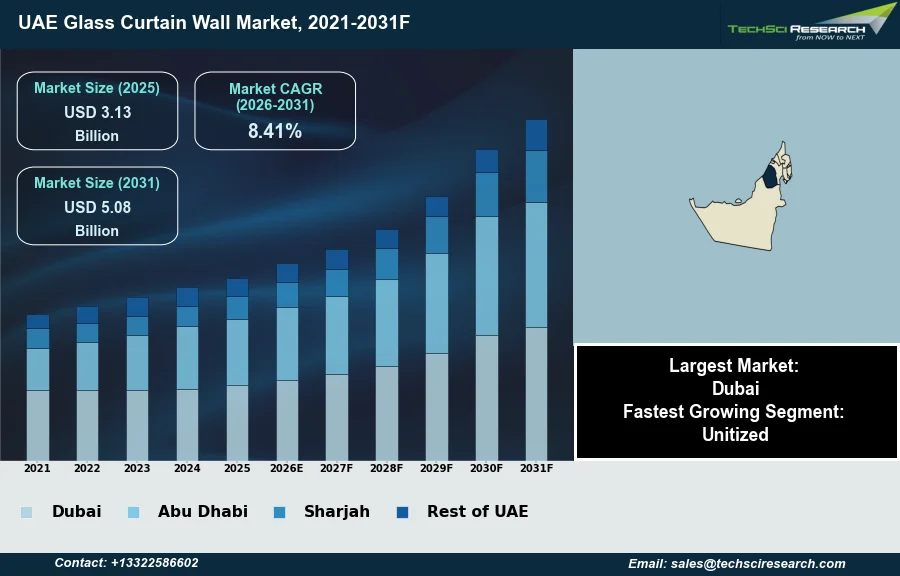
Market Size (2025)
|
USD 3.13 Billion
|
|
CAGR (2026-2031)
|
8.41%
|
|
Fastest Growing Segment
|
Unitized
|
|
Largest Market
|
Dubai
|
|
Market Size (2031)
|
USD 5.08 Billion
|
Market Overview
The UAE Glass Curtain Wall Market will grow from USD 3.13 Billion in 2025 to USD 5.08 Billion by 2031 at a 8.41% CAGR. A glass curtain wall is a non-structural building envelope system, typically lightweight, composed of vision glass or opaque infill panels supported by an aluminum framework, designed to resist weather conditions, seismic forces, and provide thermal performance. The market for these systems in the UAE is primarily driven by extensive urban development projects, ambitious government initiatives such as Dubai Vision 2040, and the increasing preference for energy-efficient and aesthetically appealing facades in commercial and residential high-rise constructions. According to the Dubai Chamber of Commerce, in 2025, the chamber recorded the largest annual increase in memberships in its history, reflecting robust business confidence and expansion across various sectors, including construction.
However, a significant challenge impeding market expansion is the persistent volatility in global supply chains for specialized glass and aluminum components, leading to potential project delays and elevated material costs.
Key Market Drivers
Real estate expansion drives demand for glass curtain walls.
Growth in commercial and residential real estate development is a primary catalyst for the UAE glass curtain wall market, driven by sustained population expansion and robust investor confidence. New urban centers and upscale developments necessitate advanced facade solutions that offer both aesthetic appeal and enhanced performance. According to Arabian Business, April 2026, in the 'Dubai real estate transactions hit $68.6 billion in Q1 as values jump 31%' article, Dubai’s real estate market recorded transactions worth AED252 billion in the first quarter of 2026, marking a 31 percent increase in value from a year earlier. This substantial activity reflects ongoing demand for modern, high-quality structures, frequently incorporating extensive glass facades. The ongoing delivery of new apartment and villa units across key emirates underscores the continuous requirement for innovative building envelopes.
Government-led mega projects expand demand for curtain wall systems.
Government-led mega projects and strategic initiatives significantly contribute to the demand for glass curtain wall systems across the UAE. These ambitious undertakings, designed to bolster economic diversification and enhance urban landscapes, often feature large-scale, iconic architectural designs. For instance, according to Arabian Business, April 2026, in the 'UAE launches major 2026 infrastructure projects worth billions across energy, transport and real estate sectors' article, Dubai announced expansion projects for the Dubai International Financial Centre valued at AED100 billion. Such projects require specialized facade technologies that meet stringent performance and aesthetic criteria. Furthermore, the broader construction sector continues to experience notable expansion; according to ZAWYA, in 2026, Abu Dhabi’s real estate transactions surged to AED66 billion in the first quarter, reflecting strong underlying market vitality that directly supports the glass curtain wall segment.
Download Free Sample Report
Key Market Challenges
Supply-chain volatility drives costs and delays in UAE glass curtain wall projects
A significant challenge impeding the growth of the UAE Glass Curtain Wall Market stems from the persistent volatility in global supply chains for specialized glass and aluminum components. This instability directly contributes to elevated material costs and potential project delays, impacting the financial viability and timely completion of construction initiatives. The reliance on international sourcing for specific grades of glass and aluminum exposes the market to geopolitical tensions, shipping disruptions, and fluctuating global commodity prices, making accurate cost forecasting and consistent material availability difficult for developers and contractors.
Hormuz disruptions and regional aluminum output constrain supply and raise costs
For instance, according to the International Aluminium Institute, GCC countries produced approximately 6.16 million metric tons of primary aluminum in 2025, representing about 8% of global output. Despite this regional capacity, ongoing maritime traffic disruptions through the Strait of Hormuz, a vital shipping corridor for aluminum, have effectively led to standstills. This situation drives up the cost of aluminum and creates concerns about supply shortages for critical components in the UAE construction sector. Such pressures undermine project scheduling and increase overall expenditure, consequently hampering the market's ability to capitalize on urban development opportunities.
Key Market Trends
Smart and Adaptive Glass Trends in the UAE
Most of the search results for "smart glass" are from market research firms (The Report Cube, Research and Markets, Cognitive Market Research, Global Market Insights, Fortune Business Insights, Business Research Insights). I need to avoid these.
Result mentions "AI, Smart Living, and Sustainable Design. Developers are integrating AI-driven community management, energy-efficient design, and advanced home automation" in "Smart Real Estate Investments in the UAE 2025–2026" from October 30, 2025, but no specific numerical data for smart glass.
Result mentions "The UAE ranks 14th globally with 869 green-rated buildings, and Dubai proudly holds the 3rd place for cities with the highest number of green-certified buildings" (July 1, 2024), which is a good general green building stat. It also mentions "Al Bahr Towers...feature a dynamic facade...adjusts based on the sun's position, significantly reducing solar gain and energy consumption." This is a good example of adaptive glass.
Result mentions the Zayed National Museum was built with a "double-skin façade to improve air flow and cooling efficiency" and "advanced 6D modeling to track the cost, schedule, and embodied carbon simultaneously throughout the design and construction phases made it easier to accurately predict emissions and support the UAE-wide commitment to reach net-zero by 2050" (September 2, 2025). This mentions double-skin facade which is a potential trend, but also touches on advanced fabrication and sustainability.
Result "The UAE construction sector...2026...performance-driven engineering. Developers are no longer focused solely on completing projects quickly. The emphasis has moved toward building assets that are energy-efficient, technologically integrated, regulation-compliant and operationally sustainable over the long term." (March 2, 2026) This is good context, but no specific numerical data.
Unitized Curtain Wall Systems and Efficiency Gains
Let's re-strategize for data. Maybe look for specific project investments in smart technologies.
Or, I can use the "869 green-rated buildings" in UAE from July 2024, if it's not already in the provided content. It is not. This fits the "sustainable design" aspect of smart/energy-efficient glass.
Segmental Insights
Unitized Systems Accelerate UAE Curtain Wall Growth: Quality, Speed, and Green Compliance.
The Unitized segment is the fastest-growing within the UAE Glass Curtain Wall Market, primarily driven by the region's ambitious high-rise construction and rigorous quality standards. This growth is attributed to the inherent advantages of unitized systems, which are prefabricated off-site, ensuring superior quality control and precision. Their modular nature facilitates rapid on-site installation, significantly compressing project timelines and reducing labor requirements, a crucial factor for large-scale developments across Dubai and Abu Dhabi. Furthermore, unitized systems offer enhanced thermal performance and weather resistance, addressing the demanding climate and aligning with stringent green building regulations such as Dubai's Green Building Regulations and Abu Dhabi's Estidama Pearl Rating System, which prioritize energy efficiency in modern architectural designs.
Regional Insights
Development Momentum and Regulatory Push Drive Dubai Glass Curtain Wall Adoption
Dubai dominates the UAE Glass Curtain Wall Market due to its expansive urban development and continuous emergence of ambitious real estate projects, which necessitate aesthetically striking and high-performance facade solutions. The emirate's commitment to modern architecture, coupled with a strategic focus on energy efficiency, strongly influences the adoption of advanced glass curtain wall systems. Furthermore, strict adherence to regulations set by bodies such as Dubai Municipality, including the Dubai Green Building Regulations, mandates the integration of high-performance glazing, thereby driving demand for these solutions in new constructions. The widespread use of efficient unitized curtain wall systems also supports accelerated construction timelines for Dubai's numerous high-rise developments.
Recent Developments
-
In October 2025, China Southern Glass (CSG), a global leader in energy-saving glass, announced its plan to establish its first overseas intelligent manufacturing facility in Abu Dhabi's Khalifa Economic Zones (KEZAD) Group. This project, representing an investment of AED 300 million, would create a regional headquarters for manufacturing high-performance energy-saving glass. The new plant was expected to commence operations in late 2026, aiming to supply locally produced advanced glass to UAE developers and reduce regional reliance on imports for the construction industry, including glass curtain wall systems.
-
In September 2025, Emirates Glass, a prominent glass processing company and a subsidiary of Dubai Investments, entered a five-year manufacturing and distribution agreement with Australia-based ClearVue Technologies Limited. This collaboration brought advanced solar glazing solutions to the UAE and the broader GCC market. The agreement enabled Emirates Glass to locally produce ClearVue's solar-integrated glass, a technology designed to generate electricity from sunlight while maintaining clarity and high insulation. This innovation directly impacts the UAE glass curtain wall sector by offering energy-generating facades for various building types.
-
In June 2025, Dubai Investments reported that its glass manufacturing portfolio, including Emirates Glass, achieved significant growth in 2024. Emirates Glass launched new offerings to support the UAE glass curtain wall market, including Intertek-certified fire-rated glass. The company also commissioned a high-precision Glass Digital Printing unit to address the increasing demand for bespoke architectural glass solutions. These product introductions enhanced Emirates Glass's capacity to provide advanced glazing options for façade and curtain walling applications in high-rise and commercial developments across the region.
-
In May 2025, Emirates Extrusion Factory, a subsidiary of Dubai Investments, collaborated with UCS Green Solutions Building and Construction Materials Trading to introduce the UAE's first Green Curtain Wall System featuring zero material wastage. This strategic partnership, formalized during the 'Make it in the Emirates' forum, positioned Emirates Extrusion Factory as the exclusive manufacturer of this pioneering façade solution. The system was engineered to eliminate material waste during installation, marking a significant advancement in sustainable construction practices for the UAE glass curtain wall market and aligning with national environmental goals.
Key Market Players
- Al Abbar Group
- Gulf Glass Industries
- Reynaers Aluminium Middle East
- Kawneer Middle East
- Schüco Middle East
- Permasteelisa Gulf
- Guardian Glass UAE
- Technoform
- Aluworks
- Caparol UAE
|
By System Type
|
By End Use
|
By Region
|
|
|
- Commercial
- Public
- Residential
|
- Dubai
- Abu Dhabi
- Sharjah
- Rest of UAE
|
Report Scope:
In this report, the UAE Glass Curtain Wall Market has been segmented into the following categories, in addition to the industry trends which have also been detailed below:
-
UAE Glass Curtain Wall Market, By System Type:
-
UAE Glass Curtain Wall Market, By End Use:
-
Commercial
-
Public
-
Residential
-
UAE Glass Curtain Wall Market, By Region:
-
Dubai
-
Abu Dhabi
-
Sharjah
-
Rest of UAE
Competitive Landscape
Company Profiles: Detailed analysis of the major companies present in the UAE Glass Curtain Wall Market.
Available Customizations:
UAE Glass Curtain Wall Market report with the given market data, TechSci Research offers customizations according to a company's specific needs. The following customization options are available for the report:
Company Information
- Detailed analysis and profiling of additional market players (up to five).
UAE Glass Curtain Wall Market is an upcoming report to be released soon. If you wish an early delivery of this report or want to confirm the date of release, please contact us at sales@techsciresearch.com