|
Key Insights
|
Details
|
|
Forecast Period
|
2027-2031
|
|
Market Size (2025)
|
USD 2.34 Billion
|
|
CAGR (2026-2031)
|
24.49%
|
|
Fastest Growing Segment
|
Passenger Car
|
|
Largest Market
|
Dubai
|
|
Market Size (2031)
|
USD 8.71 Billion
|
Market Overview
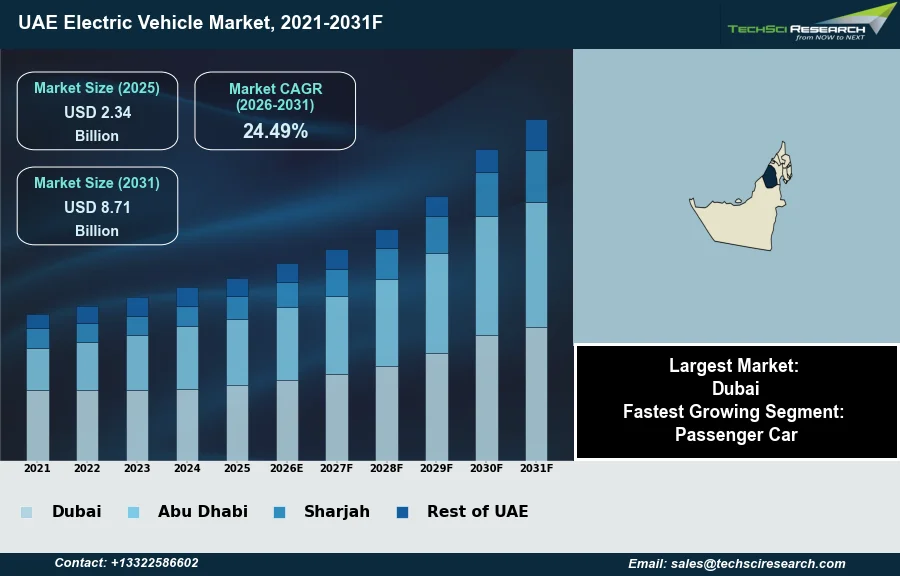
The UAE Electric Vehicle Market will grow from USD 2.34 Billion in 2025 to USD 8.71 Billion by 2031 at a 24.49% CAGR. Electric Vehicles (EVs) are automobiles propelled by electric motors, deriving energy from rechargeable battery packs or onboard generators, which notably reduce or eliminate tailpipe emissions. The UAE Electric Vehicle market's expansion is driven by robust governmental commitment to sustainability, exemplified by initiatives like the Net Zero by 2050 Strategic Initiative and the National Electric Vehicles Policy launched in 2023. These policies are complemented by a rapidly expanding charging infrastructure and various consumer incentives, fostering a conducive environment for EV adoption. According to the International Energy Agency's Global EV Outlook 2026 report, in 2025, the UAE accounted for nearly 50 percent of total EV sales across the Middle East, underscoring its regional leadership in green mobility.
Further supporting growth are governmental and private sector investments aimed at diversifying the economy and achieving environmental targets. However, a significant challenge impeding broader market expansion remains the relatively high initial acquisition cost of electric vehicles compared to conventional automobiles, which can deter a wider demographic of potential buyers.
Key Market Drivers
Policy incentives accelerating UAE EV adoption
Government incentives and supportive policies are significantly accelerating the adoption of electric vehicles in the UAE market by reducing financial barriers and fostering consumer confidence. These initiatives, encompassing reduced registration fees, free parking, and free charging at select public stations, directly influence purchasing decisions. The success of such governmental backing is evident as the registered users of the Dubai Electricity and Water Authority (DEWA) Green Charger Initiative, which provides essential charging infrastructure access, touched 23,600 customers by mid-January 2026. This substantial increase reflects growing consumer engagement with electric mobility solutions, driven by tangible government support that mitigates the initial investment concerns for potential EV buyers.
Expansion of charging infrastructure and rising Dubai EV registrations
Complementing these policy efforts, the continuous expansion of the charging infrastructure network remains a critical driver for market growth, addressing a primary concern for prospective EV owners regarding range anxiety and convenience. This commitment to robust infrastructure development is demonstrated by the significant build-out across the emirate. For instance, Dubai's electric vehicle charging infrastructure expanded to more than 1,860 charging points in 2025, according to Dubai Electricity and Water Authority data. This rapid deployment of charging facilities, including ultra-fast, fast, and public chargers, makes EV ownership more practical and accessible. Moreover, by the end of 2025, the number of EVs registered in Dubai climbed to 47,944, marking a notable growth of 27.9 percent from the previous year.
Download Free Sample Report
Key Market Challenges
High upfront cost constrains UAE EV adoption
The challenging factor impeding broader market expansion in the UAE Electric Vehicle market is the relatively high initial acquisition cost of electric vehicles compared to conventional automobiles. This elevated upfront investment directly hinders the widespread adoption of EVs within the country. Potential buyers, particularly those sensitive to immediate financial outlay, are often deterred by the substantial price difference, which limits the market primarily to early adopters or higher-income segments.
Cost barrier limits EV sales and growth despite incentives
This economic barrier significantly impacts the volume of new EV sales, as consumers weigh the immediate financial commitment against long-term operational savings. Consequently, the high entry cost constrains the market's reach, preventing a larger demographic from participating in the transition to green mobility. The comparatively higher purchase price makes electric vehicles less competitive on the showroom floor, even with governmental incentives designed to address this disparity. For instance, despite various initiatives to promote adoption, the market's growth could be further accelerated if the cost barrier were lower, encouraging a more diverse range of consumers to consider electric alternatives.
Key Market Trends
Diversification of EV Models Expands UAE Market and Competition
The diversification of electric vehicle model offerings represents a significant trend reshaping the UAE market by catering to a wider array of consumer preferences and price points. This expansion extends beyond initial luxury segments, with manufacturers introducing a broader range of compact SUVs, sedans, and more budget-friendly options. The increasing availability of diverse models, particularly from international brands, intensifies competition, enabling more consumers to find an EV that suits their needs. For instance, according to The National, October 2025, in its article "New cars for 2026: Eight electric and luxury models coming to UAE roads," at least eight new electric and luxury models were announced for release in the UAE during 2026. This strategic influx is crucial for driving broader adoption.
Growth of Commercial and Fleet Electrification
The expansion of commercial and fleet electrification is another pivotal trend, driven by corporate sustainability mandates and operational cost efficiencies. Businesses across various sectors, including logistics, ride-hailing, and public transport, are increasingly integrating electric vehicles into their fleets to reduce emissions and fuel expenses. This trend fosters a distinct segment focused on robust, efficient, and purpose-built commercial electric vehicles, along with specialized charging solutions and service models. For example, according to Middle East Briefing, May 2026, DEWA and Dubai Taxi Company signed a long-term strategic contract in 2025 to deploy 208 ultra-fast EV charge points specifically for Dubai Taxi's fleet. This highlights the growing commitment from commercial entities to transition towards electric mobility.
Segmental Insights
Policy Support and Infrastructure Accelerate UAE Passenger EV Growth
The passenger car segment is the fastest-growing in the UAE Electric Vehicle Market, primarily driven by comprehensive governmental support and a maturing market ecosystem. This rapid expansion stems from strategic national initiatives, such as the National Electric Vehicles Policy, and local efforts like Dubai's Green Mobility Strategy 2030, which actively promote electric vehicle adoption through significant incentives including reduced registration fees, complimentary public parking, and toll exemptions. Concurrently, a substantial expansion of the charging infrastructure by entities like the Dubai Electricity and Water Authority (DEWA) has improved accessibility and alleviated range concerns. These factors, combined with increasing consumer environmental awareness and the availability of diverse models, are collectively accelerating the transition to electric passenger cars.
Regional Insights
Dubai's EV Market Leadership: Strategic Initiatives, Infrastructure, and Incentives
Dubai stands as a leader in the UAE Electric Vehicle Market due to comprehensive strategic foresight and proactive implementation. The emirate's dominance is driven by robust government initiatives, notably the Dubai Clean Energy Strategy 2050 and the Green Mobility Strategy 2030, which foster an environment conducive to EV adoption. The Dubai Electricity and Water Authority (DEWA) has been pivotal, establishing the region's first public charging infrastructure through its "EV Green Charger Initiative" and regulating its expansion to ensure widespread accessibility. Furthermore, the Dubai government offers substantial incentives, including free charging services and preferential parking, along with proactive regulations from entities like the Roads and Transport Authority (RTA), making EV ownership increasingly attractive. This concerted effort, coupled with high urban awareness, underpins Dubai's strong market position.
Recent Developments
-
In May 2025, Tellus Power Globe Holding Limited, in a strategic joint venture with BinHendi Holding and SFE Group, announced plans to establish an electric vehicle (EV) charging equipment manufacturing company in the UAE. This collaboration directly responds to the rapid growth of the EV market across the Middle East and the critical need for advanced e-mobility infrastructure. Supported by the UAE Ministry of Investment, the initiative anticipates producing high-power DC charging stations, with the first "Made in UAE" products projected for launch by the end of 2025, thereby enhancing local industrial capabilities.
-
In April 2025, Smart Mobility International (SMI), the exclusive distributor of AVATR electric vehicles in the UAE, revealed plans to introduce Range-Extended Electric Vehicles (REEVs) to the local market. This strategic move aims to cultivate a more flexible and practical electric vehicle ecosystem, catering to the specific driving conditions and habits prevalent in the UAE. Models like the AVATR 07, featuring KUNLUN range-extending technology, integrate electric propulsion with a petrol-powered generator to mitigate range concerns. This expansion aligns with the UAE's objective of achieving 50% electric vehicles on its roads by 2050.
-
In March 2024, Al-Futtaim Electric Mobility Company, in collaboration with BYD, introduced three new electric vehicle models to the UAE market: the BYD SEAL, BYD SONG PLUS, and BYD QIN PLUS. This product launch expanded BYD's offerings, providing a range of all-electric and plug-in hybrid vehicles designed to meet varied consumer preferences. The introduction of these models aims to enhance accessibility to electric vehicles and foster their widespread adoption, significantly contributing to the UAE's developing sustainable mobility landscape by presenting diverse options for regional consumers.
-
In January 2024, Al-Futtaim Electric Mobility Company and e& entered a collaboration to integrate 100 BYD electric vehicles into e&'s operational fleet within the UAE. This partnership marked a significant step towards achieving net-zero emissions and promoting sustainable transportation in the region. The initiative supports e&'s environmental commitments by phasing in electric vehicles for its light vehicle requirements. This strategic alliance, which originated from discussions at the Mobility Live Middle East event, highlights a mutual dedication to advancing green mobility solutions within the dynamic UAE Electric Vehicle Market.
Key Market Players
- Tesla UAE
- BYD UAE
- Mercedes-Benz UAE
- BMW UAE
- Audi UAE
- Porsche UAE
- Rivian UAE
- Lucid Motors UAE
- NIO UAE
- MG Motor UAE
|
By Vehicle Type
|
By Range
|
By Propulsion
|
By Region
|
- Two-Wheeler
- Passenger Car
- LCV
- M&HCV
|
- 0-50 Miles
- 51-150 Miles
- 151-200 Miles
- 201-400 Miles
- above 400 Mile
|
|
- Dubai
- Abu Dhabi
- Sharjah
- Rest of UAE
|
Report Scope:
In this report, the UAE Electric Vehicle Market has been segmented into the following categories, in addition to the industry trends which have also been detailed below:
-
UAE Electric Vehicle Market, By Vehicle Type:
-
Two-Wheeler
-
Passenger Car
-
LCV
-
M&HCV
-
UAE Electric Vehicle Market, By Range:
-
0-50 Miles
-
51-150 Miles
-
151-200 Miles
-
201-400 Miles
-
above 400 Mile
-
UAE Electric Vehicle Market, By Propulsion:
-
UAE Electric Vehicle Market, By Region:
-
Dubai
-
Abu Dhabi
-
Sharjah
-
Rest of UAE
Competitive Landscape
Company Profiles: Detailed analysis of the major companies present in the UAE Electric Vehicle Market.
Available Customizations:
UAE Electric Vehicle Market report with the given market data, TechSci Research offers customizations according to a company's specific needs. The following customization options are available for the report:
Company Information
- Detailed analysis and profiling of additional market players (up to five).
UAE Electric Vehicle Market is an upcoming report to be released soon. If you wish an early delivery of this report or want to confirm the date of release, please contact us at sales@techsciresearch.com