|
Key Insights
|
Details
|
|
Forecast Period
|
2027-2031
|
|
Market Size (2025)
|
USD 178.56 Million
|
|
CAGR (2026-2031)
|
8.61%
|
|
Fastest Growing Segment
|
Clinical Chemistry
|
|
Largest Market
|
Northern & Central
|
|
Market Size (2031)
|
USD 293.09 Million
|
Market Overview
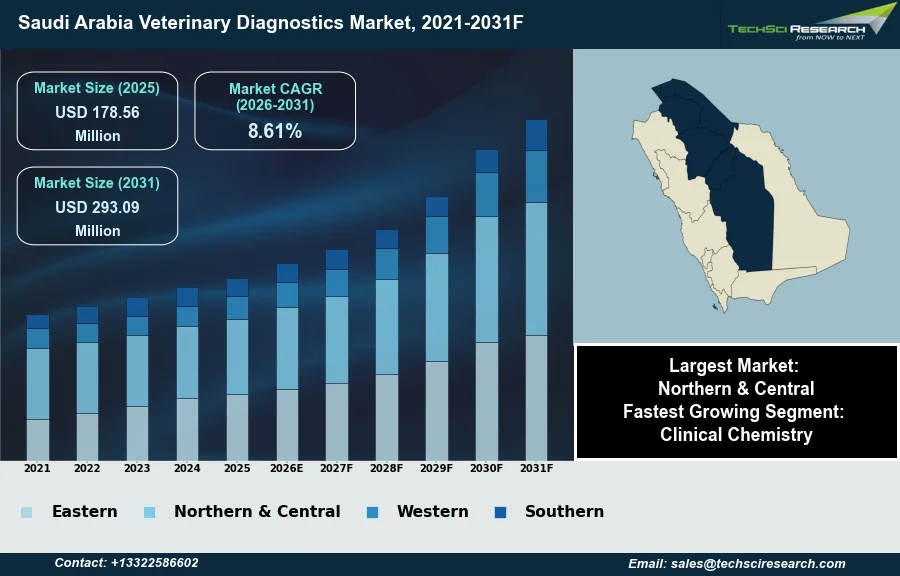
The Saudi Arabia Veterinary Diagnostics Market will grow from USD 178.56 Million in 2025 to USD 293.09 Million by 2031 at a 8.61% CAGR. Veterinary diagnostics refers to the tests and evaluations identifying animal diseases, monitoring health conditions, and guiding treatment strategies. The Saudi Arabia Veterinary Diagnostics Market's growth is primarily driven by the increasing demand for livestock products and a significant rise in companion animal ownership, particularly in urban areas. Heightened awareness of animal diseases, including zoonotic risks, alongside robust government support for animal health initiatives and food security under Vision 2030, further fuels market expansion.
According to the World Organisation for Animal Health (WOAH) and the Ministry of Environment, Water and Agriculture (MEWA), Saudi Arabia's total equid population was estimated at 61,748 animals in March 2025, representing a notable animal base requiring diagnostic services. A significant challenge impeding market expansion, however, is the substantial cost associated with advanced diagnostic tools and equipment, potentially limiting widespread adoption among smaller veterinary clinics and agricultural entities.
Key Market Drivers
Rising prevalence of animal and zoonotic diseases drives diagnostic demand
The growing prevalence of animal and zoonotic diseases significantly propels the Saudi Arabia Veterinary Diagnostics Market. Disease outbreaks, including those transmissible to humans, pose considerable public health and economic risks, necessitating early and accurate diagnosis for timely intervention. The Ministry of Environment, Water and Agriculture's focus on prevention is clear; according to the Saudi Press Agency, April 2026, in the "Environment, Water, Agriculture Sector Achieves Record Milestones in 2025" report, 41.2 million animals were vaccinated in 2025. This approach underscores the continuous need for robust diagnostic tools to identify pathogens, monitor disease spread, and evaluate vaccination efficacy, strengthening biosecurity for animal and human populations.
Public investment in veterinary infrastructure fuels diagnostic market growth
Concurrently, robust government initiatives and substantial investment in animal healthcare infrastructure are foundational market drivers. The Saudi government's commitment to enhancing veterinary services and research capabilities directly increases demand for advanced diagnostic technologies. According to the Saudi Press Agency, July 2025, in "Saudi Arabia Builds First Animal Disease Research Center in Arar," the Ministry of Environment, Water and Agriculture began constructing the National Excellence Center for Animal Research and Disease Control with a budget of SAR 29.6 million, specifically to improve veterinary services and protect livestock. Such investments foster sophisticated diagnostic laboratories and facilitate modern testing. The sheer scale of animal populations further emphasizes this growth; according to the Saudi Press Agency, in 2025, the Northern Borders region alone was home to over 7.5 million animals, including extensive sheep, goat, camel, and cattle populations. These concentrated animal bases necessitate widespread, accessible diagnostic services, driving continuous market demand.
Download Free Sample Report
Key Market Challenges
Cost Barriers to Advanced Diagnostics Adoption
The substantial cost associated with advanced diagnostic tools and equipment significantly impedes the growth of the Saudi Arabia Veterinary Diagnostics Market. This considerable financial outlay restricts widespread adoption of essential technologies, particularly among smaller veterinary clinics and agricultural entities. These operations often manage constrained budgets, making the capital investment for modern diagnostic equipment prohibitive.
Investment Constraints Impeding Diagnostic Capacity and Growth
The prohibitive investment for sophisticated diagnostic tools, such as PCR machines or advanced imaging devices, limits the ability of many facilities to acquire these instruments. This directly curtails their capacity to provide comprehensive and timely disease identification, consequently delaying treatment strategies and potentially impacting animal health outcomes. According to the Ministry of Environment, Water and Agriculture, in 2025, the Northern Borders region alone had over 7.5 million animals, representing a substantial base requiring diagnostic services. The inability of a large portion of the veterinary infrastructure to invest in modern diagnostics creates a significant bottleneck, preventing the market from fully expanding its reach and capabilities across the Kingdom.
Key Market Trends
Growth of Molecular Diagnostics in the Saudi Arabian Veterinary Diagnostics Market
The increasing integration of molecular diagnostic technologies represents a significant trend in the Saudi Arabia Veterinary Diagnostics Market, driven by the demand for enhanced precision in disease identification and genetic analysis. These advanced methods, including PCR and genomic sequencing, offer superior sensitivity and specificity for detecting pathogens, monitoring disease outbreaks, and informing targeted treatment strategies in both livestock and companion animals. Such technological adoption enables earlier and more accurate diagnoses, contributing to improved animal health outcomes and biosecurity. This focus is supported by scientific endeavors, with the Saudi Food and Drug Authority (SFDA) reporting the completion of 72 research projects and scientific studies in 2024, many encompassing human and veterinary medicines. These efforts foster the advancement and integration of sophisticated molecular diagnostic tools.
Expansion of Point-of-Care Testing in the Saudi Arabian Veterinary Diagnostics Market
Concurrently, the expansion of point-of-care (POC) testing solutions is transforming veterinary diagnostics by providing rapid, on-site results outside centralized laboratory settings. This trend addresses the critical need for immediate diagnostic capabilities, particularly in remote agricultural regions and for a growing urban pet population. POC devices enhance accessibility to essential diagnostic services for a diverse animal base, empowering veterinary professionals in smaller clinics and on farms to perform tests efficiently. The existing infrastructure in Saudi Arabia supports this expansion, exemplified by the presence of 434 veterinary clinics nationwide, which serve as key sites for the deployment and utilization of these decentralized testing platforms. This network creates a fertile ground for widespread POC diagnostic solution adoption.
Segmental Insights
Clinical Chemistry Drives Growth in Saudi Veterinary Diagnostics Through Welfare Focus, Pet Ownership, Livestock Expansion, and Government Investment
The Saudi Arabia Veterinary Diagnostics Market exhibits robust growth, with Clinical Chemistry emerging as the fastest-growing segment. This accelerated expansion is largely attributable to a heightened focus on animal welfare and disease prevention across both companion animals and a burgeoning livestock sector within the Kingdom. Increasing disposable incomes have fueled higher rates of pet ownership, consequently driving a greater demand for advanced diagnostic testing to ensure comprehensive animal health management. Moreover, strategic initiatives by governmental entities, such as the Ministry of Environment, Water and Agriculture, aimed at bolstering food security and improving livestock health, are stimulating significant investments in modern veterinary diagnostic capabilities. These combined factors critically underscore the escalating importance and rapid development of clinical chemistry applications in supporting animal healthcare throughout Saudi Arabia.
Regional Insights
Northern & Central Region: Market Leader Driven by Population Density, Agriculture, and Government Support
The Northern & Central region currently leads the Saudi Arabia Veterinary Diagnostics Market, primarily due to its significant population density, especially in urban centers like Riyadh, which fosters a high volume of pet ownership and subsequent demand for veterinary services. Furthermore, this region encompasses a substantial portion of the nation's agricultural and large-scale livestock farming activities, necessitating advanced diagnostic solutions for disease detection and effective health management in animal populations. Government initiatives, championed by the Ministry of Environment, Water and Agriculture, actively support this growth through investments in veterinary infrastructure and disease control programs, further solidifying the region's market dominance.
Recent Developments
-
In December 2025, Sysmex Healthcare Regional Headquarters signed a Memorandum of Understanding with the Saudi Arabian government to establish a diagnostic reagent factory in the Kingdom. This agreement marked a significant step towards local manufacturing and the introduction of a logistics hub for the Middle East, aimed at supporting the Saudi Arabia Veterinary Diagnostics Market. The factory will facilitate the production of advanced diagnostic products locally, enhancing the region's healthcare ecosystem. This strategic investment aligns with Saudi Arabia’s Vision 2030 objectives by fostering local employment and improving access to essential diagnostic solutions.
-
In December 2025, the National Livestock and Fisheries Development Program in Saudi Arabia launched the Biotech Park project in Riyadh, designating it as the world's first city exclusively dedicated to veterinary biotechnology. This ambitious project, situated in Dhurma Governorate, includes a state-of-the-art laboratory and a research center. It is designed to attract international companies specializing in developing and localizing veterinary products and vaccines, thereby enhancing the capabilities within the Saudi Arabia Veterinary Diagnostics Market. The initiative aims to improve the efficiency of the livestock health system by adopting advanced diagnostic solutions and strengthening local supply chains.
-
In June 2025, IDEXX Laboratories, a global leader in veterinary diagnostics, introduced the Catalyst Cortisol Test. This new product enhances point-of-care diagnostic capabilities for veterinary practices by providing rapid, in-clinic quantitative measurement of cortisol levels. The test aids in the timely and accurate diagnosis of Addison's disease and Cushing's syndrome in dogs. Integrated with IDEXX’s VetLab Station and VetConnect PLUS, it offers interpretive guidance and streamlines clinic workflows. This launch contributes to strengthening veterinary diagnostic options available in the Saudi Arabia Veterinary Diagnostics Market, addressing clinical needs across the Middle East region.
-
In May 2025, Vetanco, an international animal health company, announced a strategic partnership with Arasco, a prominent Saudi Arabian food supply and security company, through its Al-Emar International business unit. This collaboration granted Al-Emar International distribution rights for Vetanco's product line across Saudi Arabia. The initiative aims to significantly enhance the growing animal health industry in the Kingdom by providing innovative solutions focused on food safety. This partnership is positioned to support Saudi Arabia's Vision 2030 goals for increased food security, impacting the availability of advanced veterinary products in the Saudi Arabia Veterinary Diagnostics Market.
Key Market Players
- IDEXX Laboratories
- Antech Diagnostics
- Zoetis
- Heska
- Abaxis
- Neogen
- Thermo Fisher
- VCA Labs
- Mars Veterinary Health
- Eurofins
|
By Animal Type
|
By Testing
|
By Region
|
|
|
- Clinical Chemistry
- Microbiology
- Parasitology
- Histopathology
- Hematology
- Others
|
- Eastern
- Northern & Central
- Western
- Southern
|
Report Scope:
In this report, the Saudi Arabia Veterinary Diagnostics Market has been segmented into the following categories, in addition to the industry trends which have also been detailed below:
-
Saudi Arabia Veterinary Diagnostics Market, By Animal Type:
-
Saudi Arabia Veterinary Diagnostics Market, By Testing:
-
Clinical Chemistry
-
Microbiology
-
Parasitology
-
Histopathology
-
Hematology
-
Others
-
Saudi Arabia Veterinary Diagnostics Market, By Region:
-
Eastern
-
Northern & Central
-
Western
-
Southern
Competitive Landscape
Company Profiles: Detailed analysis of the major companies present in the Saudi Arabia Veterinary Diagnostics Market.
Available Customizations:
Saudi Arabia Veterinary Diagnostics Market report with the given market data, TechSci Research offers customizations according to a company's specific needs. The following customization options are available for the report:
Company Information
- Detailed analysis and profiling of additional market players (up to five).
Saudi Arabia Veterinary Diagnostics Market is an upcoming report to be released soon. If you wish an early delivery of this report or want to confirm the date of release, please contact us at sales@techsciresearch.com