|
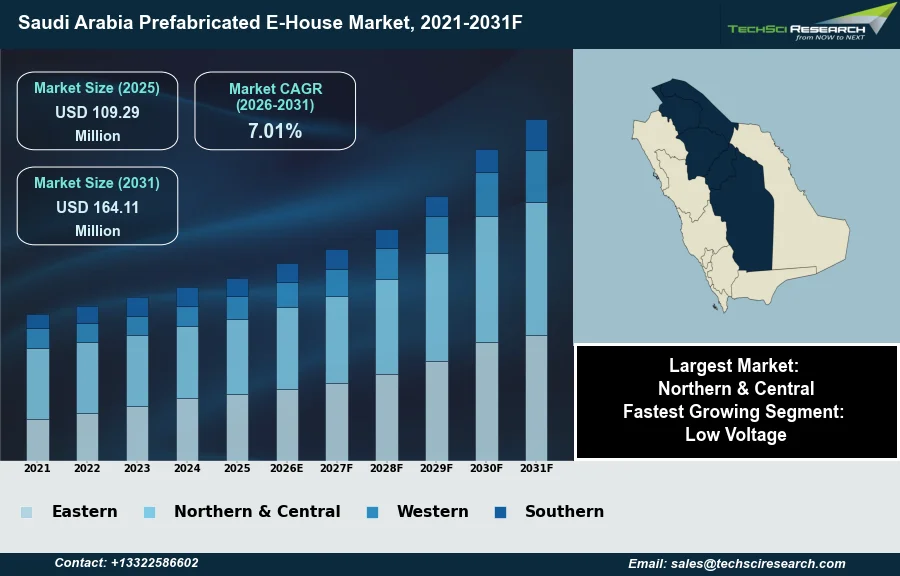
Forecast Period
|
2026-2030
|
|
Market Size (2024)
|
USD 108 Million
|
|
Market Size (2030)
|
USD 163 Million
|
|
CAGR (2025-2030)
|
7.01%
|
|
Fastest Growing Segment
|
Low Voltage
|
|
Largest Market
|
Riyadh
|
Market Overview
Saudi Arabia Prefabricated E-House Market was
valued at USD 108 Million in 2024 and is expected to reach USD 163 Million by 2030 with a
CAGR of 7.01% during the forecast period.
A Prefabricated E-House (Electrical House) is a
modular, pre-engineered, and factory-built structure designed to house
electrical equipment, such as transformers, switchgear, and control panels, for
industrial or commercial use. These units are constructed off-site in a
controlled environment, allowing for rapid assembly, reduced construction time,
and high-quality standards. Prefabricated E-Houses are typically used in
environments where space, safety, and efficiency are critical, such as power
plants, oil and gas facilities, substations, and large-scale construction
projects.
The primary advantage of an E-House is its ability to
be delivered as a fully functional, pre-assembled unit, including all necessary
electrical systems, wiring, and HVAC systems. This eliminates the need for
extensive on-site construction, reducing installation time and labor costs.
Prefabricated E-Houses also provide excellent safety and protection against
environmental factors, ensuring that the electrical equipment inside remains
secure and operates efficiently. Moreover, these units can be customized to
meet specific operational and space requirements, making them versatile for
various industrial applications. Overall, the use of Prefabricated E-Houses
enhances operational efficiency, reduces risks, and offers a more
cost-effective solution for managing electrical infrastructure.
Key Market Drivers
Increasing
Demand for Efficient Power Generation and Distribution
Saudi Arabia’s growing focus on improving its power
generation and distribution infrastructure is a significant driver for the
prefabricated E-House market. With the country’s ambitious Vision 2030 plan,
which includes the diversification of energy sources, the demand for efficient,
reliable, and scalable power systems has risen dramatically. Prefabricated
E-Houses are ideal solutions for power generation, transmission, and
distribution applications due to their modular and customizable design.
Saudi Arabia is investing heavily in renewable energy
projects, such as solar and wind power, to reduce its reliance on fossil fuels.
The integration of renewable energy into the grid requires the development of
robust electrical infrastructure that is both flexible and scalable.
Prefabricated E-Houses allow for easy integration of solar power plants and
other renewable energy sources into the existing power grid by providing a
compact, pre-assembled space for electrical equipment. These units offer a fast
and reliable solution, meeting the increasing demand for electricity in both
urban and remote areas, especially in light of Saudi Arabia’s commitment to
expand its renewable energy capacity.
The prefabricated E-Houses support the kingdom’s need
for energy-efficient systems that can manage and monitor power distribution
efficiently. With increased demand for electricity due to population growth,
urbanization, and industrialization, E-Houses can be deployed quickly and with
minimal disruption, ensuring continuity in power supply. Moreover, these
structures allow for easy expansion as future energy needs increase, making
them an essential tool for meeting Saudi Arabia’s long-term energy goals.
Saudi Arabia's
population is growing rapidly, with projections estimating a population of over
40 million by 2030. This growth, combined with increased urbanization, drives
higher energy demand, particularly in cities like Riyadh, Jeddah, and Dammam,
necessitating more efficient power generation and distribution.
Rapid
Urbanization and Infrastructure Development
The rapid pace of urbanization and infrastructure
development in Saudi Arabia is driving the demand for prefabricated E-Houses.
With the country's population continuing to grow, particularly in major urban
centers like Riyadh, Jeddah, and Dammam, there is a need for swift development
of power systems to accommodate this expansion. Prefabricated E-Houses offer an
efficient solution to house electrical equipment required for urban
infrastructure projects, including commercial and residential developments, transportation
networks, and new industrial zones.
Saudi Arabia’s infrastructure development projects,
including mega-projects like NEOM and the Red Sea Project, require large-scale
electrical infrastructure that must be both reliable and adaptable.
Prefabricated E-Houses, with their modular design and pre-engineered
capabilities, can be deployed quickly and effectively to meet these demands.
The E-Houses can house all necessary electrical components, including
substations, transformers, circuit breakers, and switchgear, in a compact and
easily accessible manner, ensuring that the power supply infrastructure can
keep up with the rapid pace of construction.
The ability to install prefabricated E-Houses in
challenging or remote locations further accelerates their adoption in
infrastructure projects. Saudi Arabia's vast desert areas and arid regions make
it difficult to deploy traditional electrical infrastructure. E-Houses provide
an ideal solution as they are modular, transportable, and quick to install,
ensuring a stable and continuous power supply across the country. This
adaptability is crucial for meeting the evolving needs of Saudi Arabia's
urbanization and infrastructure growth. Key initiatives such as NEOM, the Red
Sea Project, and the Riyadh Metro are central to the kingdom’s infrastructure
development. These projects aim to modernize cities, enhance livability, and
diversify the economy under Vision 2030.
Government Initiatives and Regulations Supporting
Infrastructure Modernization
The Saudi government’s initiatives and regulations
aimed at modernizing the country’s electrical infrastructure are key drivers
for the growth of the prefabricated E-House market. As part of its Vision 2030
goals, Saudi Arabia is focusing on diversifying its energy sources, improving
power reliability, and enhancing energy efficiency. The government’s commitment
to infrastructure development and the modernization of its electrical networks
has created a strong demand for innovative solutions like prefabricated
E-Houses.
One of the main drivers behind this trend is the
government’s push for more sustainable, cost-effective, and technologically
advanced infrastructure. Traditional methods of building electrical houses can
be slow and expensive, especially when dealing with remote or hard-to-reach
locations. Prefabricated E-Houses, on the other hand, are cost-effective,
reduce installation time, and ensure a higher level of quality control, making
them an attractive solution for public sector projects.
Regulations that emphasize the importance of safety,
reliability, and environmental impact in energy infrastructure are further
boosting the demand for prefabricated E-Houses. These structures meet stringent
safety standards and are designed to operate efficiently under harsh
environmental conditions, ensuring that they can withstand the extreme
temperatures and dust storms commonly found in Saudi Arabia. The government’s
regulatory framework, which focuses on improving infrastructure while reducing
environmental footprints, aligns with the benefits of prefabricated E-Houses,
further solidifying their role in the country’s energy transformation.
National
Industrial Development and Logistics Program (NIDLP): This program, part of
Vision 2030, aims to transform Saudi Arabia into a global industrial
powerhouse. It focuses on developing infrastructure across sectors such as
energy, transport, and manufacturing, with a strong emphasis on modernizing
electrical and energy infrastructure.
Cost Efficiency and Reduced Project Time
Cost efficiency and the need for faster project
delivery are two crucial factors driving the adoption of prefabricated E-Houses
in Saudi Arabia. The construction and deployment of traditional electrical
houses can be time-consuming and expensive due to the labor-intensive process,
the need for skilled workers, and the prolonged construction timelines. With
the growing demand for energy infrastructure and the urgency of completing
major projects quickly, prefabricated E-Houses offer a significant advantage in
terms of both cost and time savings.
Prefabricated E-Houses are built off-site in
controlled factory environments, which means that much of the construction
work, including electrical wiring, installation of HVAC systems, and
integration of power distribution equipment, is completed before the unit is
transported to the project site. This process minimizes on-site construction
time, reducing labor costs and project delays. Additionally, since the
components are pre-engineered and tested before delivery, the risk of errors or
delays due to faulty construction is significantly reduced, ensuring that
projects are completed on schedule.
The modular nature of prefabricated E-Houses also
makes them a cost-effective solution for scaling up power infrastructure as
needed. Rather than building custom electrical houses for each project,
companies can opt for standardized units that can be customized to meet
specific needs. This approach allows for quicker delivery and more predictable
costs, which is particularly important for large-scale projects in Saudi
Arabia’s fast-paced construction environment. The cost and time savings,
combined with the high quality and flexibility of prefabricated E-Houses, make
them an increasingly attractive option for businesses and government agencies
looking to modernize and expand the country’s electrical infrastructure.
Saudi Arabia's
Vision 2030 focuses on modernizing infrastructure and enhancing cost-effective
construction practices. Prefabricated solutions, like E-Houses, are in high
demand due to their ability to reduce both construction time and costs,
directly aligning with the Kingdom's goals.
Download Free Sample Report
Key Market Challenges
Logistical and Transportation Challenges
One of the main challenges
facing the Saudi Arabia prefabricated E-House market is the logistical
complexity involved in transporting these large, modular structures to remote
and often difficult-to-reach locations. Saudi Arabia’s vast geographical
landscape includes desert regions and rugged terrain, which can present
significant barriers to the efficient transportation and installation of
prefabricated E-Houses. The sheer size of these units, coupled with the
logistical challenges of navigating through roads that may not be fully
developed or easily accessible, can result in delays, increased transportation
costs, and potential damage during transit.
The transportation process
requires specialized equipment and vehicles, such as cranes and flatbed trucks,
to ensure that the E-Houses are delivered safely and on time. Additionally,
these structures are often designed for heavy-duty applications and can be
quite large, necessitating careful planning and coordination to ensure they can
pass through the country’s infrastructure. In some cases, roads or bridges may
not be capable of supporting the weight of these pre-assembled units, requiring
infrastructure upgrades or the use of alternative, longer routes. The need for
precise scheduling and route planning adds to the complexity of delivering
prefabricated E-Houses, particularly when the demand for these units is high
and there are multiple projects underway at the same time.
Saudi Arabia’s extreme
weather conditions, such as high temperatures, dust storms, and heavy rainfall
in some regions, can further complicate transportation logistics. The risk of
damage to both the E-Houses and the transportation vehicles increases in such
challenging environments, making it essential for companies to take additional
precautions and factor these weather-related delays into project timelines.
These logistical hurdles contribute to higher operational costs, which could
affect the overall affordability and competitiveness of prefabricated E-Houses
in the market.
Customization and Design Limitations
While prefabricated E-Houses
offer several benefits in terms of speed, cost-effectiveness, and ease of
installation, one of the challenges in the Saudi Arabian market is the
limitation in customization and design flexibility. Although these structures
are modular and can be tailored to some extent to meet specific needs, they may
not always accommodate highly specialized or unique project requirements. In
industries where highly customized electrical systems are needed, or where the
infrastructure needs to adapt to specific site conditions, prefabricated
E-Houses might not always offer the same level of design flexibility as
traditional on-site construction.
In Saudi Arabia, where
large-scale infrastructure projects such as NEOM and other urban developments
require highly sophisticated electrical systems to support advanced
technologies, the demand for highly customized solutions can be a challenge for
prefabricated E-House providers. These projects may require specific
configurations of electrical equipment, intricate layouts, and advanced safety
measures that pre-fabricated modular units may not be able to fully accommodate
without extensive modifications. The need to balance standardization with
customization can lead to longer lead times, increased costs, and potential
difficulties in meeting tight deadlines.
While prefabricated E-Houses
are often seen as a solution for speeding up construction and reducing costs,
the need for substantial customization can undermine these advantages. The
process of customizing prefabricated units can require changes to the manufacturing
process, which could increase production times and add to the cost.
Furthermore, in remote locations or regions with less access to skilled labor,
the ability to modify or adapt these units to meet unique project needs can be
limited, reducing the overall flexibility and practicality of prefabricated
E-Houses in some cases.
The design limitations can
also impact the aesthetic and functional integration of E-Houses into the
overall project. In urban developments or high-profile projects, the appearance
of infrastructure elements may need to align with architectural guidelines or
aesthetic considerations, which prefabricated E-Houses may not easily support.
The balance between speed and cost-effectiveness versus flexibility and
customization can therefore pose a challenge for stakeholders in Saudi Arabia's
increasingly complex and high-tech construction and energy sectors.
Key Market Trends
Integration with Renewable Energy Projects
One of the key market trends driving the Saudi Arabia
prefabricated E-House market is the integration of these units with renewable
energy projects. As part of its Vision 2030 goals, Saudi Arabia is investing
heavily in renewable energy sources, such as solar, wind, and other clean
energy technologies, to diversify its energy mix and reduce reliance on oil.
Prefabricated E-Houses, due to their modular and customizable nature, are
increasingly being utilized in these renewable energy projects, especially solar
and wind farms, to house the electrical infrastructure required for power
generation, transmission, and distribution.
Solar power plants, in particular, require reliable,
efficient, and scalable solutions to manage the energy output and integrate it
into the national grid. Prefabricated E-Houses are well-suited for these tasks,
as they can be pre-engineered with all necessary electrical components, such as
transformers, switchgear, and power monitoring systems. They also offer
flexibility, allowing for easy expansion as the capacity of renewable energy
plants increases. Given the remote locations of many renewable energy projects
in Saudi Arabia, E-Houses are an ideal solution due to their ease of transport
and installation.
The increasing focus on renewable energy has also led
to the development of more energy-efficient and environmentally friendly
prefabricated E-Houses. Manufacturers are incorporating advanced materials,
energy-saving technologies, and smart grid capabilities to align these
structures with the sustainability goals of Saudi Arabia. This trend is
expected to continue as the kingdom continues to ramp up its renewable energy
initiatives, further boosting the demand for prefabricated E-Houses that can
support these evolving energy systems.
Advancements in Smart Grid and Digitalization
The prefabricated E-House market in Saudi Arabia is
also experiencing a growing trend towards digitalization and the integration of
smart grid technologies. With the kingdom’s push for modernization and
automation in its energy infrastructure, the adoption of smart grid solutions
is becoming increasingly important. Smart grids enhance the efficiency,
reliability, and security of power systems by integrating advanced
communication technologies, real-time monitoring, and automated control
systems.
Prefabricated E-Houses are evolving to meet the needs
of these advanced systems. Manufacturers are now equipping E-Houses with
digital technologies, such as Internet of Things (IoT) sensors, data analytics
tools, and remote monitoring capabilities. These digital features allow
operators to monitor the performance of electrical equipment housed within the
E-House, detect faults, and optimize energy use in real time. This trend is
helping improve the operational efficiency of power systems, reduce maintenance
costs, and increase the overall reliability of the electrical infrastructure.
As Saudi Arabia invests in the development of smart
cities, such as NEOM, and upgrades its existing cities’ infrastructure, the
demand for intelligent energy management systems is rising. Prefabricated
E-Houses equipped with smart grid technologies are playing a crucial role in
enabling these initiatives. With the integration of digital tools, E-Houses are
becoming more than just physical structures; they are evolving into
sophisticated hubs that support the digital transformation of the kingdom’s
energy systems. This trend is expected to gain further momentum, as Saudi
Arabia seeks to enhance the capabilities of its power networks in line with the
global shift toward digitalization and automation.
Segmental Insights
Product Type Insights
The Fixed E House held the largest
market share in 2024. Fixed E-Houses
dominate the prefabricated E-House market in Saudi Arabia primarily due to the country's
focus on long-term infrastructure development, large-scale industrial projects,
and the need for high-capacity, durable electrical systems. These permanent
structures are better suited for projects that require a stable and robust
power supply, such as power generation plants, petrochemical facilities,
transmission substations, and utility-scale renewable energy projects. Fixed
E-Houses can accommodate larger and more complex electrical systems, offering
greater customization, structural integrity, and operational reliability over
an extended period.
Saudi Arabia’s Vision 2030 initiative, which includes
mega-projects like NEOM, the Red Sea Project, and various industrial cities,
requires substantial and permanent electrical infrastructure. Fixed E-Houses
are ideal for these applications because they can be engineered to withstand
harsh environmental conditions, such as high temperatures, sandstorms, and
heavy dust—factors commonly encountered in the kingdom’s desert regions. Their
durability and ability to be integrated into permanent infrastructure make them
a preferred choice for both public and private sector developments.
Fixed E-Houses offer more space for integrating
advanced technologies such as smart grid systems, automation, and digital
monitoring tools. Their stable setup ensures safer and more efficient operation
of critical electrical components, which is essential for projects with high
energy demands and strict safety standards.
While mobile E-Houses serve important functions in
temporary or remote applications, their use is limited compared to the scale
and permanence required in most Saudi projects. As a result, fixed E-Houses
continue to lead the market, driven by their ability to meet the technical,
environmental, and operational demands of Saudi Arabia’s expanding
infrastructure and energy sectors. This dominance is expected to persist as the
country continues investing in long-term, high-impact projects requiring
reliable and permanent electrical solutions.
Application Insights
The Oil & Gas held the largest
market share in 2024. The oil and gas
sector dominated the prefabricated E-House market in Saudi Arabia due to the
industry's scale, complexity, and critical need for reliable power
infrastructure. As one of the world’s leading oil producers, Saudi Arabia has
an extensive network of upstream and downstream facilities, including
exploration sites, refineries, petrochemical plants, and pipeline networks,
many of which are located in remote or harsh environments. These operations
demand robust, scalable, and quickly deployable electrical solutions to ensure
continuous power supply, safety, and operational efficiency—needs that
prefabricated E-Houses are specifically designed to meet.
Prefabricated E-Houses offer a practical and efficient
alternative to conventional electrical buildings by reducing on-site
construction time, lowering labor costs, and ensuring high-quality standards
through factory-controlled assembly. For the oil and gas industry, where
downtime can lead to significant financial losses, the rapid deployment and
plug-and-play nature of E-Houses is a major advantage. They are engineered to
handle demanding conditions such as high temperatures, dust, and corrosive
environments typical in Saudi Arabia’s oil fields.
Oil and gas facilities require a wide range of
electrical and automation equipment, including motor control centers (MCCs),
switchgear, transformers, and SCADA systems. Prefabricated E-Houses can be
fully customized to integrate this equipment in a compact, secure structure,
allowing for centralized control and simplified maintenance.
Saudi Arabia’s strategic investments in expanding and
modernizing its energy infrastructure—especially through initiatives led by
Saudi Aramco—have led to increased demand for reliable and efficient electrical
housing solutions. With continuous exploration activities and new oilfield
developments underway, the need for fast, durable, and relocatable E-House
units continues to grow.

Download Free Sample Report
Regional Insights
Riyadh held the largest market share in
2024. Riyadh holds a dominant position in the Saudi Arabia prefabricated
E-House market due to its strategic role as the political, economic, and
administrative capital of the kingdom. As the largest city in Saudi Arabia,
Riyadh is at the center of major infrastructure developments, government
initiatives, and industrial expansion projects—all of which drive significant
demand for advanced electrical infrastructure like prefabricated E-Houses.
One of the key reasons for Riyadh’s dominance is the
concentration of mega-projects and urban development plans within and around
the city. Projects such as King Abdullah Financial District (KAFD), Riyadh
Metro, and numerous residential and commercial developments require
high-capacity, reliable, and quickly deployable electrical systems.
Prefabricated E-Houses provide a flexible and time-efficient solution for
powering these large-scale developments while meeting modern standards of
energy efficiency and safety.
Riyadh is a hub for government ministries, regulatory
bodies, and corporate headquarters, which accelerates investment and policy
implementation for technological upgrades in the energy sector. The city’s
growing population and expanding industrial zones further contribute to
increased energy consumption, prompting the need for scalable power
infrastructure solutions that can be delivered rapidly—an area where
prefabricated E-Houses excel.
Riyadh’s central location also offers logistical
advantages, facilitating the transportation and installation of prefabricated
units across various project sites in the region. Additionally, the presence of
engineering firms, EPC contractors, and suppliers headquartered in the city
creates a strong ecosystem for the procurement, customization, and deployment
of E-Houses.
Recent Developments
- In January 2025, DuBox is
transforming modular construction by introducing its new productization
approach. This innovative model streamlines the design and manufacturing
processes, offering standardized, high-quality modular units that can be easily
customized to meet specific client needs. By productizing modular construction,
DuBox enhances efficiency, reduces costs, and accelerates project timelines,
making it a more scalable and sustainable solution for various industries. This
launch positions DuBox as a leader in modernizing the modular construction
sector.
- In March 2025, Champion Homes
has introduced its inaugural National Manufactured Duplex Series, designed to
address the ongoing affordable housing shortage across the country. This new
series offers an efficient, cost-effective housing solution that combines
quality construction with affordability. By utilizing innovative manufacturing
techniques, Champion Homes aims to provide accessible housing options to a
broader population, contributing to the nation’s efforts to resolve the housing
crisis. This launch marks a significant step in meeting growing housing
demands.
- In September 2024, DigiTRACKER has launched with a seminar
focused on the collaboration between humans and AI in modular building
production. The event highlighted how artificial intelligence can enhance
efficiency, precision, and innovation in the construction industry. By
exploring the integration of AI into modular production processes, DigiTRACKER
aims to showcase the potential of smart technology in revolutionizing
construction, improving project timelines, and driving cost-effectiveness. The
seminar emphasized the future of human-AI synergy in shaping the industry's
next evolution.
Key Market Players
- Eaton
Arabia
- ABB
Limited
- WESCOSA
- Siemens
AG
- General
Electric Company
- Powell
Industries
- Base
Control Tech
- MFC
Concepts
|
By Product Type
|
By Application
|
By Voltage Type
|
By Region
|
- Fixed E House
- Mobile E House
|
- Oil & Gas
- Mining
- Power Utilities
- Railways
- Data Centers
- Others
|
- Low Voltage
- Medium Voltage
- High Voltage
|
- Riyadh
- Makkah
- Madinah
- Eastern Province
- Dammam
- Rest of Saudi Arabia
|
Report Scope:
In this report, the Saudi Arabia Prefabricated
E-House Market has been
segmented into the following categories, in addition to the industry trends
which have also been detailed below:
- Saudi
Arabia Prefabricated
E-House Market, By Product Type:
o Fixed E House
o Mobile E House
- Saudi
Arabia Prefabricated
E-House Market, By Application:
o Oil & Gas
o Mining
o Power Utilities
o Railways
o Data Centers
o Others
- Saudi
Arabia Prefabricated E-House Market, By Voltage Type:
o Low Voltage
o Medium Voltage
o High Voltage
- Saudi
Arabia Prefabricated E-House Market, By Region:
o Riyadh
o Makkah
o Madinah
o Eastern Province
o Dammam
o Rest of Saudi Arabia
Competitive Landscape
Company Profiles: Detailed analysis of the major companies
present in the Saudi Arabia Prefabricated E-House Market.
Available Customizations:
Saudi Arabia Prefabricated E-House Market report
with the given market data, TechSci Research offers customizations according
to a company's specific needs. The following customization options are
available for the report:
Company Information
- Detailed analysis and
profiling of additional market players (up to five).
Saudi Arabia Prefabricated E-House Market is an upcoming report
to be released soon. If you wish an early delivery of this report or want to
confirm the date of release, please contact us at [email protected]