|
Key Insights
|
Details
|
|
Forecast Period
|
2027-2031
|
|
Market Size (2025)
|
USD 112.45 Million
|
|
CAGR (2026-2031)
|
9.81%
|
|
Fastest Growing Segment
|
Liquid Biopsy
|
|
Largest Market
|
Northern & Central
|
|
Market Size (2031)
|
USD 197.16 Million
|
Market Overview
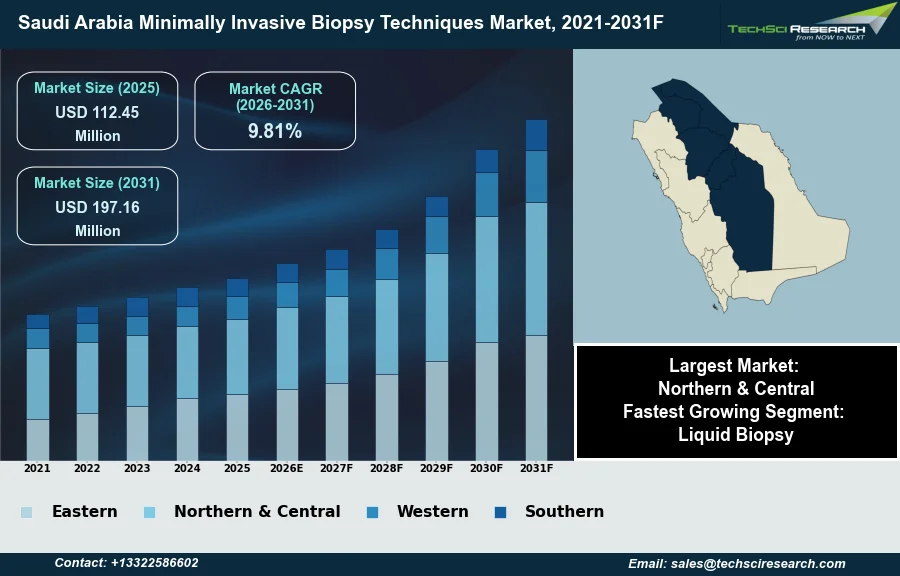
The Saudi Arabia Minimally Invasive Biopsy Techniques Market will grow from USD 112.45 Million in 2025 to USD 197.16 Million by 2031 at a 9.81% CAGR. Minimally invasive biopsy techniques encompass diagnostic procedures that obtain tissue samples with reduced patient trauma, expedited recovery periods, and minimal post-procedural scarring, often facilitated by advanced imaging modalities such as ultrasound or magnetic resonance imaging. Key drivers propelling this market in Saudi Arabia include the increasing prevalence of chronic diseases, particularly various forms of cancer, which necessitates early and accurate pathological diagnosis. Furthermore, substantial governmental healthcare investments aligning with Vision 2030 are fostering the adoption of advanced medical technologies and prioritizing patient-centric care models.
The growing awareness among both healthcare practitioners and patients regarding the clinical advantages of less invasive procedures also contributes significantly to market expansion. Conversely, a primary challenge impeding broader market penetration remains the considerable initial capital outlay for specialized equipment and the requisite training for healthcare professionals. According to the Saudi Food and Drug Authority, in 2025, the medical devices sector encompassed 25 licensed factories and 1,313 licensed warehouses, underscoring the developing industrial infrastructure supporting the broader healthcare technology landscape.
Key Market Drivers
Rising chronic disease burden drives demand for minimally invasive biopsies
The rising prevalence of chronic diseases, particularly various forms of cancer, stands as a primary catalyst for the Saudi Arabia Minimally Invasive Biopsy Techniques Market. These conditions necessitate timely and accurate diagnostic procedures for effective treatment planning and improved patient outcomes. Minimally invasive biopsies facilitate precise tissue acquisition with reduced patient trauma. According to the Saudi Medical Journal, in December 2025, Saudi nationals had a crude incidence rate of 66.86 per 100,000 population for cancer in 2021-2022, highlighting the continuous demand for advanced diagnostic tools. This trend underscores the need for methods that can identify diseases at earlier stages, enhancing medical interventions.
Advances in biopsy/imaging technology and related investments propel market growth
Advancements in biopsy and imaging technologies further propel market expansion. Innovations in areas such as guided imaging systems, robotic assistance, and enhanced needle designs have significantly improved the precision, safety, and efficiency of minimally invasive biopsy procedures. These enhancements enable higher quality tissue samples with greater accuracy, reducing the need for more invasive surgical alternatives. The commitment to technological progress is substantial; according to MOH News, in October 2025, USD 3.24 billion was committed to venture capital and strategic funds at the Global Health Exhibition 2025 to accelerate innovation and localization within the health investment ecosystem. This focus on advanced medical technology underpins the shift towards effective, less invasive diagnostic pathways. Concurrently, general healthcare infrastructure growth supports this; according to MOH News, in 2025, USD 8.4 billion was announced for new hospital and infrastructure development projects at the same exhibition.
Download Free Sample Report
Key Market Challenges
Capital and training costs constrain Saudi Arabia's minimally invasive biopsy market.
The considerable initial capital outlay for specialized equipment and the requisite training for healthcare professionals poses a significant impediment to the expansion of the Saudi Arabia Minimally Invasive Biopsy Techniques Market. Acquiring advanced imaging modalities, such as high-resolution ultrasound or MRI-guided biopsy systems, represents a substantial financial commitment for healthcare institutions. This high procurement cost for advanced technology directly impacts the ability of many facilities, particularly smaller clinics or those with constrained budgets, to invest in these diagnostic tools. Furthermore, the effective utilization of these advanced systems necessitates specialized training for physicians, radiologists, and technical staff. This professional development, essential for accurate procedure execution and optimal patient outcomes, incurs additional considerable expense. According to the Medical Technology Association for the Middle East and Africa (Mecomed), their 2024 report highlighted efforts including training programs that reached over 400 participants across the MEA region, underscoring the ongoing and significant investment required in human capital development to support such technologies. These combined high costs of both equipment and training directly restrict broader market penetration and slow the adoption rate of minimally invasive biopsy techniques across Saudi Arabia, as healthcare providers face significant financial barriers to entry and expansion.
Key Market Trends
Rising Utilization of Liquid Biopsy in Saudi Arabia
Increased utilization of liquid biopsy is a transformative trend in the Saudi Arabia Minimally Invasive Biopsy Techniques Market, offering a less invasive yet highly effective approach for cancer diagnosis, monitoring, and treatment response assessment. This method analyzes circulating biomarkers from a blood sample, eliminating the need for invasive tissue procedures. Such non-invasiveness enhances patient comfort, reduces procedural risks, and enables more frequent testing. For example, King Faisal Specialist Hospital and Research Centre (KFSH&RC) in Riyadh became the first in the Middle East to adopt liquid biopsy technology in November 2023, capable of detecting around 50 cancer-related genes and over 3,000 genetic mutations. This expands diagnostic accessibility and supports personalized treatment.
AI-Driven Diagnostics and Saudi Healthcare Investment
The adoption of Artificial Intelligence (AI) in diagnostics profoundly influences the Saudi Arabia Minimally Invasive Biopsy Techniques Market by augmenting the accuracy, efficiency, and scalability of diagnostic interpretations. AI algorithms swiftly analyze complex medical images, pathological findings, and genomic data, aiding healthcare providers in earlier disease identification and refined treatment planning. This technological shift improves diagnostic throughput and minimizes human error. Reflecting this strategic importance, Saudi Arabia is investing over SAR 13.3 billion in AI and digital health to elevate healthcare outcomes, with AI-powered solutions specifically integrating into various medical diagnostic applications as of June 2026. This commitment drives modernization and efficiency across diagnostic pathways within the Kingdom.
Segmental Insights
Rapid growth and strategic integration of liquid biopsy in Saudi Arabia
Liquid Biopsy stands as the fastest-growing segment within the Saudi Arabia Minimally Invasive Biopsy Techniques Market, driven by its distinct advantages over traditional methods. This technique offers a non-invasive approach, minimizing patient discomfort and enabling the early detection of various diseases, particularly cancer, through the identification of genetic mutations and molecular markers. The ability to facilitate personalized treatment strategies and quicker clinical decision-making contributes to its rapid adoption, aligning with Saudi Arabia's Vision 2030 objectives for healthcare modernization and a patient-centric approach. Furthermore, the introduction of this technology by key institutions like King Faisal Specialist Hospital and Research Centre signifies its increasing integration into the Kingdom's evolving diagnostic landscape.
Regional Insights
Northern and Central Saudi Arabia Leads the Market Through Advanced Infrastructure and Vision 2030 Support
Northern and Central Saudi Arabia leads the Minimally Invasive Biopsy Techniques Market due to its advanced healthcare infrastructure. This region, particularly Riyadh, contains the highest concentration of specialized hospitals and diagnostic centers equipped with state-of-the-art medical technology and experienced professionals essential for these sophisticated procedures. Government initiatives under Vision 2030 further prioritize modernizing healthcare, directing substantial investments into these areas to enhance technology adoption and accessibility. The higher population density and economic prosperity within Northern and Central regions also contribute to a greater demand for advanced diagnostic services. This strategic alignment of infrastructure, skilled personnel, and governmental support firmly establishes its market dominance.
Recent Developments
-
In June 2025, Saudi biotech startup Novo Genomics formed a key collaboration with Tracer Biotechnologies. The agreement centered on localizing circulating tumor DNA (ctDNA) monitoring technologies within Saudi Arabia. This partnership aimed to adapt advanced polygenic risk scoring models, utilizing local genomic data to enhance the prediction and diagnosis of various diseases, including cancer. This strategic alliance underscored the Kingdom's commitment to advancing precision medicine and expanding the availability of sophisticated, minimally invasive liquid biopsy techniques to improve patient outcomes.
-
In January 2025, King Faisal Specialist Hospital & Research Centre (KFSH&RC) announced the modernization of its Biobank Center. The upgraded facility was specifically designed to accommodate the storage of up to 10 million high-quality biospecimens. These critical biological samples included liquid biopsies, fresh tissue, and various blood derivatives, thereby significantly enhancing the infrastructure for advanced medical research and diagnostics in Saudi Arabia. This development directly supported the expanded use and research capabilities for minimally invasive biopsy techniques by providing robust sample management and accessibility.
-
In November 2024, Axbio Inc. showcased its cutting-edge diagnostic innovations at the Riyadh Global Medical Biotechnology Summit. The company presented its molecular testing and multi-omics platforms, notably highlighting fourth-generation nanopore sequencing technology. These advancements were designed to address various scientific research and clinical requirements across the Middle East, including applications in genetic analysis and infectious disease diagnostics. Axbio Inc. also engaged with key Saudi institutions, such as the Saudi Food and Drug Authority and King Abdullah International Medical Research Center, to discuss regulatory frameworks and future collaboration opportunities within the Kingdom's medical biotechnology landscape.
-
In July 2024, King Faisal Specialist Hospital & Research Centre (KFSH&RC) in Saudi Arabia collaborated with the University of Birmingham's Bladder Cancer Research Centre (BCRC). This five-year partnership aimed to revolutionize bladder cancer diagnosis and monitoring through the development of advanced, non-invasive diagnostic tools. The initiative focused on utilizing state-of-the-art liquid biopsy technology, including a 23-gene panel, to identify critical genetic variations relevant for early detection and personalized treatment strategies in the Saudi Arabian healthcare sector. This collaboration represented a significant step in enhancing minimally invasive diagnostic capabilities.
Key Market Players
- Roche
- Illumina
- Tempus AI
- PathAI
- Aidoc
- Medtronic
- Johnson & Johnson
- B. Braun
- Stryker
- Boston Scientific
|
By Product
|
By Technique
|
By Region
|
- Tests
- Kits & Consumables
- Instruments
|
- Liquid Biopsy
- Optical Biopsy
- Brush Biopsy
- Pigmented Lesion Assays
- Others
|
- Eastern
- Northern & Central
- Western
- Southern
|
Report Scope:
In this report, the Saudi Arabia Minimally Invasive Biopsy Techniques Market has been segmented into the following categories, in addition to the industry trends which have also been detailed below:
-
Saudi Arabia Minimally Invasive Biopsy Techniques Market, By Product:
-
Tests
-
Kits & Consumables
-
Instruments
-
Saudi Arabia Minimally Invasive Biopsy Techniques Market, By Technique:
-
Liquid Biopsy
-
Optical Biopsy
-
Brush Biopsy
-
Pigmented Lesion Assays
-
Others
-
Saudi Arabia Minimally Invasive Biopsy Techniques Market, By Region:
-
Eastern
-
Northern & Central
-
Western
-
Southern
Competitive Landscape
Company Profiles: Detailed analysis of the major companies present in the Saudi Arabia Minimally Invasive Biopsy Techniques Market.
Available Customizations:
Saudi Arabia Minimally Invasive Biopsy Techniques Market report with the given market data, TechSci Research offers customizations according to a company's specific needs. The following customization options are available for the report:
Company Information
- Detailed analysis and profiling of additional market players (up to five).