|
Key Insights
|
Details
|
|
Forecast Period
|
2027-2031
|
|
Market Size (2025)
|
USD 23.13 Million
|
|
CAGR (2026-2031)
|
8.92%
|
|
Fastest Growing Segment
|
Budget-Conscious
|
|
Largest Market
|
Northern & Central
|
|
Market Size (2031)
|
USD 38.62 Million
|
Market Overview
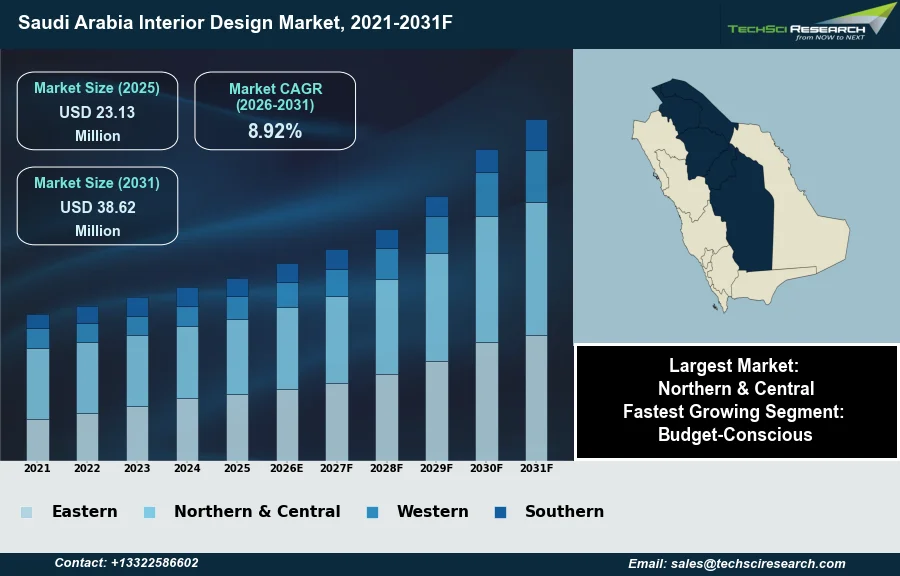
The Saudi Arabia Interior Design Market will grow from USD 23.13 Million in 2025 to USD 38.62 Million by 2031 at a 8.92% CAGR. The Saudi Arabia Interior Design Market provides professional services and material specification for planning and executing internal spaces across residential, commercial, and public sectors. Vision 2030 initiatives, including urban development and housing programs, drive this market's growth. According to the Ministry of Municipalities and Housing, 78,000 building permits were issued in 2025, indicating substantial construction activity. The Housing Program's 2024 Annual Report also noted the homeownership rate reached 65.4% by late 2024, surpassing its 2025 target, stimulating demand for new interiors.
A significant challenge to market expansion is human capital localization. Effective December 31, 2025, a joint decision by the Ministry of Human Resources and Social Development and the Ministry of Municipalities and Housing mandates a 30% Saudization rate for 46 designated engineering professions in private sector establishments with five or more engineers. This policy, encompassing architectural engineers, poses a substantial challenge for sourcing qualified local talent in specialized design roles.
Key Market Drivers
Vision 2030 and Giga-Projects Drive Interior Design Demand
The Saudi Arabia Interior Design Market is significantly propelled by the ambitious Government-led Vision 2030 Initiatives and Giga-Projects. These massive undertakings, such as NEOM, The Red Sea Project, and Diriyah Gate, necessitate extensive interior design services for their diverse components, including luxury residences, hospitality establishments, cultural venues, and commercial spaces. The sheer scale of these developments creates sustained demand for bespoke and innovative interior solutions, encompassing everything from initial space planning to material specification and execution. This directly contributes to market expansion as design firms are engaged in large-scale, long-term contracts. According to The National News, in October 2025, Saudi Arabia awarded contracts worth $196 billion for its commissioned giga projects, reflecting a 20 percent increase from 2024 and underscoring the ongoing shift from planning to execution in these major developments.
Real Estate and Construction Activity as a Growth Driver
Complementing the impact of giga-projects, the booming Real Estate and Construction Sector acts as another primary driver for the interior design market. Robust activity in residential, commercial, and hospitality construction directly translates into a heightened need for interior design expertise to furnish and finish new properties and redevelopment projects. This consistent construction pipeline ensures a steady flow of new opportunities for interior designers. For instance, the total value of real estate loans from banks in Saudi Arabia grew by 10.8 percent year-on-year in the third quarter of 2025, as reported by the Saudi Central Bank and cited by GlobeNewswire in February 2026, indicating strong investment and development in the property sector. This growth is underpinned by broader economic diversification efforts, with the non-oil GDP having expanded by 4.9 percent in 2025, according to the National Transformation Program 2025 Annual Report, as referenced by Gulf News in June 2026.
Download Free Sample Report
Key Market Challenges
Saudization Mandate and Local Talent Sourcing
A significant challenging factor impacting the Saudi Arabia Interior Design Market is human capital localization, specifically the mandate for Saudization rates within engineering professions. Effective December 31, 2025, a joint decision by the Ministry of Human Resources and Social Development and the Ministry of Municipalities and Housing requires private sector establishments employing five or more engineers to achieve a 30% Saudization rate for 46 designated engineering professions, which includes architectural engineers. This policy directly hampers market growth by creating substantial difficulties in sourcing qualified local talent for specialized design roles.
Challenges in Meeting the 30% Saudization Target
Meeting the 30% Saudization quota poses a considerable challenge for interior design firms, which rely heavily on architectural engineers for planning and executing internal spaces. Despite a large overall engineering workforce, according to the Saudi Council of Engineers, in November 2025, over 310,000 engineers were registered. However, the availability of a sufficient pool of specifically qualified Saudi architectural engineers to fulfill these mandates, particularly for specialized interior design projects, remains limited. This scarcity of local expertise can lead to bottlenecks in project staffing, potential delays in project completion, and increased operational expenditure for companies endeavoring to comply with the new regulations. These factors directly impede the market's capacity for expansion and its ability to capitalize on the robust urban development and housing programs driving demand.
Key Market Trends
Sustainable design becomes foundational in Saudi interiors
Sustainable and eco-friendly design adoption is increasingly influencing the Saudi Arabia Interior Design Market, driven by a global shift towards environmental responsibility and the Kingdom's commitment to Vision 2030's green initiatives. This trend involves the selection of sustainable materials, the implementation of energy-efficient systems, and a focus on creating healthier indoor environments. Designers are responding to a growing demand for spaces that minimize ecological footprints and enhance occupant well-being. According to the Saudi Green Building Forum's Saaf index, as reported by the Saudi Press Agency in February 2026, Saudi Arabia certified over 1.03 million square meters of sustainable building space in 2025, demonstrating a tangible commitment to green construction practices. This reflects a market where environmentally conscious design is gaining substantial traction, moving beyond niche applications to become a foundational element of project specifications.
Smart home integration and IoT-driven interior efficiency
The integration of smart home technology represents another significant trend, transforming interior spaces into highly functional and connected environments. This trend encompasses automated lighting, advanced climate control, integrated security systems, and responsive entertainment features, all managed through intuitive interfaces. It addresses consumer desires for convenience, enhanced energy efficiency, and elevated comfort within residential and commercial properties. The increasing embrace of digital infrastructure across the Kingdom further supports this trend. Building security, for instance, recorded the highest Internet of Things (IoT) adoption rate at 71.4 percent among Saudi establishments, according to the General Authority for Statistics (GASTAT) in June 2026. This illustrates a robust market for intelligent building solutions that cater to modern lifestyle demands and operational efficiencies.
Segmental Insights
Budget-Conscious Segment Growth Driven by Vision 2030 Housing Initiatives
The Budget-Conscious segment represents the fastest-growing area within the Saudi Arabia interior design market. This rapid expansion is primarily driven by governmental initiatives under Saudi Vision 2030, which prioritizes addressing housing shortages through the provision of new, affordable homes. As the Kingdom focuses on expanding access to residential properties, the demand for cost-effective interior design solutions is significantly increasing. This strategic emphasis on accessible housing directly fuels the growth of the Budget-Conscious segment, as a broader consumer base seeks practical yet aesthetically pleasing design within defined financial parameters.
Regional Insights
Northern & Central Region: Riyadh-Led Growth Under Vision 2030
The Northern & Central region holds a prominent position in the Saudi Arabia Interior Design Market, driven primarily by the significant economic and administrative activity concentrated in Riyadh. This dominance is attributed to substantial government investments under Vision 2030, which are catalyzing extensive urban development and a booming real estate sector across residential, commercial, and hospitality segments. As the Kingdom's capital, Riyadh serves as a central hub for numerous large-scale construction and renovation projects, generating considerable demand for comprehensive interior design services. Furthermore, the region benefits from a growing populace with increasing disposable incomes, fostering a strong preference for modern and luxurious design solutions.
Recent Developments
-
In October 2025, SMD Group, a Saudi-Turkish firm specializing in luxury interior and architectural design, advanced its offerings with the integration of artificial intelligence and future technologies. Operating in Riyadh and Jeddah, the company launched AI-powered design solutions to create integrated sensory experiences that combine luxury, comfort, and smart investment. This breakthrough research focused on utilizing AI for analyzing site conditions, generating precise 3D diagrams, selecting optimal materials, and simulating environmental factors before construction. This innovation was aimed at contributing to smart and sustainable city development within Saudi Arabia.
-
In December 2024, Bentley Home expanded its presence in the Saudi Arabia interior design market by opening two new stores in Riyadh and Jeddah. These showrooms, established in collaboration with Dar Al Arkan Interiors, showcased Bentley Home's latest 2024 collection alongside its classic luxury furnishings. The expansion was a strategic move to offer high-end furniture and a bespoke 360-degree interior design service to commercial and private clients. This initiative by the luxury brand aimed to meet the growing demand for sophisticated home interiors, further solidifying its commitment to the Kingdom’s luxury lifestyle sector.
-
In October 2024, Tiger Sign, an interior design firm operating in Riyadh and Al Khobar, received recognition for its innovative approach to luxury interior design in compact spaces. The company’s Studio Apartment project in Riyadh was lauded for successfully blending luxury, functionality, and intelligent design within a limited area. This breakthrough in design emphasized maximizing small footprints without compromising elegance. Tiger Sign also offered custom furniture design services, enabling clients to acquire bespoke pieces tailored to their specific aesthetic preferences and spatial requirements within the Saudi Arabian market.
-
In September 2024, Sedar Global Interiors, a prominent window and wall décor company, unveiled its newest product lines at INDEX Saudi in Riyadh. The company introduced its Pergola collections and enhanced automated smart living solutions, reflecting a strategic response to evolving consumer demands for comfortable and technologically integrated living. These offerings were presented to cater to the burgeoning interior design fit-out market, driven by numerous real estate projects across retail, commercial, hospitality, and residential sectors. The launch demonstrated the company's focus on innovative products that align with contemporary interior trends in Saudi Arabia.
Key Market Players
- Gensler
- The Cannon Corporation
- NBBJ L.P.
- HKS, Inc.
- HOK Group, Inc.
- SmithGroup Companies, Inc.
- LEO A DALY, LLC
- Stantec Inc.
|
By Decoration Type
|
By Budget
|
By Application
|
By Region
|
|
|
- Luxury/High-End
- Mid-Range
- Budget-Conscious
|
|
- Eastern
- Northern & Central
- Western
- Southern
|
Report Scope:
In this report, the Saudi Arabia Interior Design Market has been segmented into the following categories, in addition to the industry trends which have also been detailed below:
-
Saudi Arabia Interior Design Market, By Decoration Type:
-
Saudi Arabia Interior Design Market, By Budget:
-
Luxury/High-End
-
Mid-Range
-
Budget-Conscious
-
Saudi Arabia Interior Design Market, By Application:
-
Saudi Arabia Interior Design Market, By Region:
-
Eastern
-
Northern & Central
-
Western
-
Southern
Competitive Landscape
Company Profiles: Detailed analysis of the major companies present in the Saudi Arabia Interior Design Market.
Available Customizations:
Saudi Arabia Interior Design Market report with the given market data, TechSci Research offers customizations according to a company's specific needs. The following customization options are available for the report:
Company Information
- Detailed analysis and profiling of additional market players (up to five).
Saudi Arabia Interior Design Market is an upcoming report to be released soon. If you wish an early delivery of this report or want to confirm the date of release, please contact us at sales@techsciresearch.com