|
Key Insights
|
Details
|
|
Forecast Period
|
2027-2031
|
|
Market Size (2025)
|
USD 1.56 Billion
|
|
CAGR (2026-2031)
|
5.82%
|
|
Fastest Growing Segment
|
Radial
|
|
Largest Market
|
Northern & Central
|
|
Market Size (2031)
|
USD 2.19 Billion
|
Market Overview
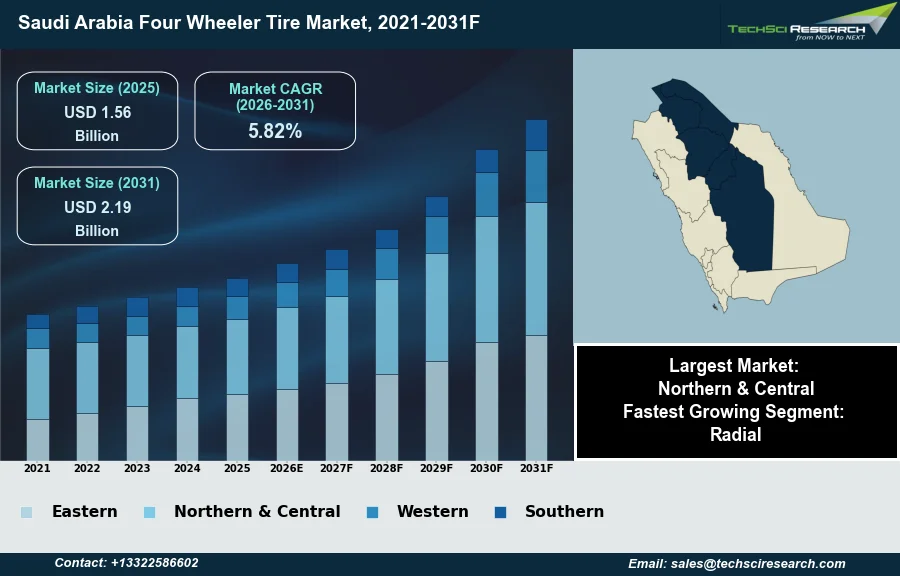
The Saudi Arabia Four Wheeler Tire Market will grow from USD 1.56 Billion in 2025 to USD 2.19 Billion by 2031 at a 5.82% CAGR. The Saudi Arabia four-wheeler tire market encompasses all pneumatic circular components engineered to fit vehicle wheel rims, facilitating traction, absorbing road shocks, and enabling vehicle movement. This market's growth is primarily driven by an expanding vehicle fleet resulting from rising disposable incomes and a growing population, coupled with extensive government investments in infrastructure and road network development. Additionally, the Kingdom's harsh climatic conditions, characterized by high temperatures and often rugged terrains, necessitate more frequent tire replacements due to accelerated wear. According to the International Organization of Motor Vehicle Manufacturers, new vehicle sales in Saudi Arabia reached 827,544 units in 2025, underscoring a consistent demand for original equipment and replacement tires.
Despite these robust drivers, a significant challenge impeding market expansion is the heavy reliance on imported raw materials for tire production, which exposes the market to global supply chain disruptions and volatile pricing. This dependence can lead to increased operational costs for manufacturers and distributors, potentially affecting market stability and product availability within the Kingdom.
Key Market Drivers
Rising vehicle ownership and fleet expansion drive tire demand
Growing vehicle ownership and an expanding fleet size significantly contribute to the Saudi Arabia four-wheeler tire market's growth. As disposable incomes rise and the population increases, more individuals acquire new vehicles, leading to higher demand for original equipment tires. Furthermore, the existing vehicle base continues to expand, ensuring a steady requirement for replacement tires over time. According to Focus2Move, in February 2026, the Saudi new vehicle market reached 857,247 units in 2025, demonstrating sustained purchasing activity and fleet expansion. This continuous influx of vehicles, coupled with the Kingdom's diverse terrains and climatic conditions that accelerate tire wear, creates a perpetual demand cycle for tire manufacturers and distributors.
Infrastructure investment and Vision 2030 bolster tire demand and domestic production
Government-led infrastructure development and Vision 2030 initiatives also serve as powerful catalysts for the tire market. Extensive government investments in road networks, new cities, and logistical hubs directly stimulate demand for tires across various vehicle segments, including commercial and off-road vehicles essential for construction and transportation. These strategic endeavors are attracting substantial capital; for example, TradeArabia reported in April 2026 that Public Investment Fund companies attracted approximately SAR 57 billion in direct foreign investment across several sectors, including automotive and logistics, from 2021 through the third quarter of 2025. According to the Saudi Arabia Automotive Industry Report 2025, a joint venture between the Public Investment Fund and Pirelli is set to produce 3.5 million tires annually in Saudi Arabia, with operations slated to commence in 2026, further cementing domestic supply capabilities.
Download Free Sample Report
Key Market Challenges
Import Dependence Impedes Growth and Increases External Exposure
The Saudi Arabia four-wheeler tire market faces a significant impediment to growth due to its substantial reliance on imported raw materials for tire production. This dependence renders the market vulnerable to global supply chain disruptions and volatile pricing mechanisms. According to GASTAT, Saudi Arabia's imports of chemical products and related industries, which are crucial for tire manufacturing, reached approximately SAR 80.6 billion in 2025. This considerable import volume highlights the exposure to external market forces.
Cost Pressures and Inadequate Input Control Constrain Expansion
Such heavy reliance leads to increased operational costs for domestic manufacturers and distributors. Fluctuations in international raw material prices, driven by geopolitical events, trade policies, or supply shortages, directly translate into higher production expenses. This can compress profit margins for businesses operating within the Saudi Arabian four-wheeler tire market, potentially affecting investment in local production capabilities and overall market stability. The inability to fully control the supply and cost of essential inputs directly hampers the ability of the market to expand competitively and reliably meet domestic demand.
Key Market Trends
EV adoption drives EV-specific tire innovation and demand
The Saudi Arabia four-wheeler tire market is significantly influenced by the increasing adoption of electric vehicles (EVs) and the consequent demand for EV-specific tires. This trend drives innovation in tire technology, focusing on aspects like lower rolling resistance for extended range, enhanced durability to manage heavier battery packs, and reduced noise for a quieter cabin experience. Tire manufacturers are responding by developing specialized compounds and tread designs optimized for EV performance characteristics. According to Arab News citing the International Energy Agency (IEA), May 30, 2026, in the article 'Saudi Arabia Shoots Gas in Electric Cars, Middle East EV Sales Up 40 Percent', EV sales in the Middle East reached around 75,000 units in 2025, with Saudi Arabia and Qatar together accounting for approximately 45 percent of this regional demand. This growing EV fleet directly translates into a rising demand for tires engineered to meet these unique requirements, shaping product development and market offerings.
Premium and performance tires for SUVs and safety systems
Another prominent trend reshaping the market is a discernible shift towards premium and performance-based tires, driven by evolving consumer preferences for enhanced driving dynamics and vehicle aesthetics. As the automotive landscape in Saudi Arabia includes a growing segment of larger and more feature-rich vehicles, there is a corresponding increase in demand for tires that offer superior grip, handling, and longevity under varied driving conditions. This consumer inclination also extends to tires that complement advanced vehicle safety systems and contribute to overall vehicle performance. This preference is particularly evident in the popular sport utility vehicle (SUV) segment. According to the article 'Best Selling Car Brand in Saudi Arabia: Market Leaders Revealed', May 27, 2026, SUVs are highly popular, accounting for over 60% of new car sales in the Gulf, indicating a strong preference within the Saudi Arabian market for vehicles that often require robust, higher-performance tire specifications.
Segmental Insights
Radial tires: fastest-growing segment in the Saudi Arabia Four Wheeler Tire Market due to durability, efficiency, and regulatory alignment.
The radial segment is the fastest-growing in the Saudi Arabia Four Wheeler Tire Market, driven by its distinct performance advantages crucial for the Kingdom's challenging environmental and operational conditions. Radial tires offer superior durability, extended tread life, and enhanced road grip, which are particularly beneficial given Saudi Arabia's high temperatures and extensive road networks. Moreover, these tires contribute to improved fuel efficiency through lower rolling resistance, aligning with governmental efforts, such as those by the Saudi Energy Efficiency Center, to promote sustainable automotive practices and energy conservation. This combination of robust performance, economic benefits, and alignment with regulatory standards solidifies radial tires as the preferred choice across various vehicle categories.
Regional Insights
Northern & Central Region: Market Leadership Driven by Urbanization and Infrastructure
The Northern & Central region dominates the Saudi Arabia Four Wheeler Tire Market due to its significant urbanization and dense population, particularly encompassing the capital city Riyadh and surrounding urban clusters. This area features a high concentration of administrative and commercial hubs, driving substantial vehicle ownership and consistent demand for both original equipment and replacement tires. The region's strategic economic vitality, coupled with extensive highway connectivity and ongoing infrastructure development projects, further cultivates a robust automotive ecosystem, ensuring sustained tire consumption across passenger and light commercial vehicle segments.
Recent Developments
-
In April 2025, the Public Investment Fund (PIF) of Saudi Arabia and Pirelli Tyre S.P.A. advanced their joint venture to establish a tire manufacturing facility in King Abdullah Economic City, with an estimated investment of $550 million. This partnership involved PIF holding a 75% stake and Pirelli the remaining 25%, with Pirelli also serving as the strategic technology partner. The factory was designed to produce 3.5 million units annually, manufacturing high-quality tires for passenger vehicles under the Pirelli brand and a new local brand for the domestic and regional markets.
-
In April 2025, Hankook Tire launched its fourth-generation ultra-high performance Ventus evo tire in the Saudi Arabian market. This new product utilized AI-enhanced compounds to deliver improved braking performance, better cornering stability, and a 32% increase in mileage compared to previous models. The introduction of the Ventus evo tire aimed to reinforce Hankook's position in the premium segment of Saudi Arabia's four-wheeler tire market, catering to the growing demand for advanced tire technologies.
-
In February 2025, The Goodyear Tire & Rubber Company introduced its advanced Tire Pressure Monitoring System (TPMS) in Saudi Arabia. This innovative solution integrated digital technology with Goodyear's tire expertise to provide real-time tire health monitoring and insights specifically for commercial fleets. Designed to operate effectively in Saudi Arabia's demanding environmental conditions, the TPMS aimed to optimize fleet performance, reduce operational costs, and enhance safety by enabling proactive tire maintenance and management.
-
In 2024, a significant collaboration occurred between Saudi Arabia's Black Arrow Tire Co. (Blatco) and Thailand's Golden Star Rubber Co., leading to the launch of the Middle East's largest tire factory in Yanbu. This substantial investment, valued at $470 million, aimed for an initial production capacity of 4 million passenger vehicle tires annually. The project was set to create over 2,000 local jobs and strategically enhance local manufacturing capabilities within the Saudi Arabian four-wheeler tire market under Vision 2030 initiatives.
Key Market Players
- Bridgestone KSA
- Michelin KSA
- Goodyear KSA
- Pirelli KSA
- Continental KSA
- Yokohama KSA
- Hankook KSA
- Apollo Tyres KSA
- MRF KSA
- Dunlop KSA
|
By Vehicle Type
|
By Tire Construction Type
|
By Price Segment
|
By Region
|
- Passenger Cars
- Light Commercial Vehicle (LCV)
|
|
- Budget
- Ultra Budget
- Premium
|
- Eastern
- Northern & Central
- Western
- Southern
|
Report Scope:
In this report, the Saudi Arabia Four Wheeler Tire Market has been segmented into the following categories, in addition to the industry trends which have also been detailed below:
-
Saudi Arabia Four Wheeler Tire Market, By Vehicle Type:
-
Passenger Cars
-
Light Commercial Vehicle (LCV)
-
Saudi Arabia Four Wheeler Tire Market, By Tire Construction Type:
-
Saudi Arabia Four Wheeler Tire Market, By Price Segment:
-
Budget
-
Ultra Budget
-
Premium
-
Saudi Arabia Four Wheeler Tire Market, By Region:
-
Eastern
-
Northern & Central
-
Western
-
Southern
Competitive Landscape
Company Profiles: Detailed analysis of the major companies present in the Saudi Arabia Four Wheeler Tire Market.
Available Customizations:
Saudi Arabia Four Wheeler Tire Market report with the given market data, TechSci Research offers customizations according to a company's specific needs. The following customization options are available for the report:
Company Information
- Detailed analysis and profiling of additional market players (up to five).
Saudi Arabia Four Wheeler Tire Market is an upcoming report to be released soon. If you wish an early delivery of this report or want to confirm the date of release, please contact us at sales@techsciresearch.com