|
Key Insights
|
Details
|
|
Forecast Period
|
2027-2031
|
|
Market Size (2025)
|
USD 29.84 Billion
|
|
CAGR (2026-2031)
|
7.45%
|
|
Fastest Growing Segment
|
Quick Service Restaurants
|
|
Largest Market
|
Northern & Central
|
|
Market Size (2031)
|
USD 45.92 Billion
|
Market Overview
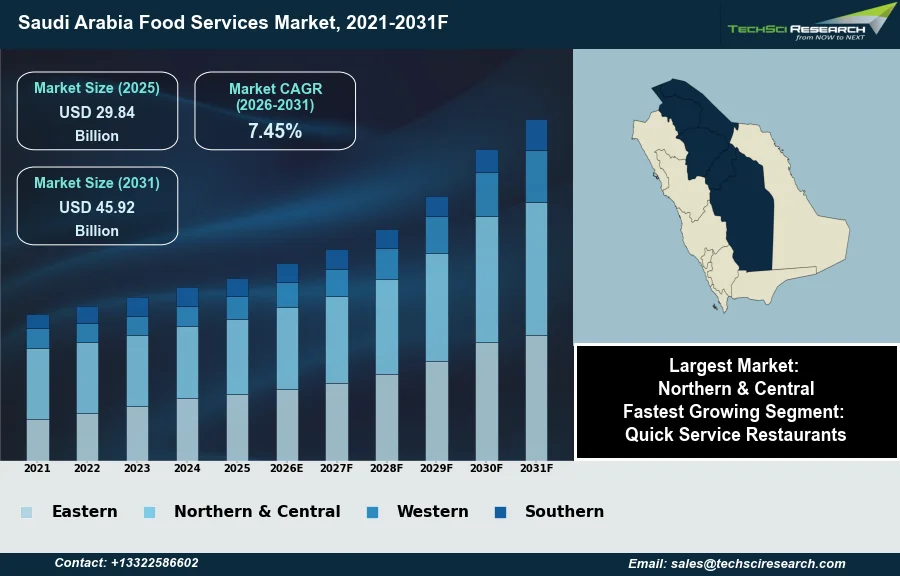
The Food Services Market in Saudi Arabia will grow from USD 29.84 Billion in 2025 to USD 45.92 Billion by 2031 at a 7.45% CAGR. The Saudi Arabia Food Services Market encompasses establishments that prepare and supply food and beverages for immediate consumption, spanning full-service restaurants, quick-service outlets, cafes, and catering services. This market’s expansion is primarily driven by the Kingdom’s increasing urbanization, a growing domestic population, and rising disposable incomes. Further support stems from significant government initiatives, particularly Vision 2030, which actively promotes tourism and diverse entertainment offerings, thereby stimulating demand for dining experiences.
According to the Saudi Central Bank, in the first quarter of 2025, restaurant and café spending totaled SAR 99 billion, representing 29% of all point-of-sale transactions. However, the market faces a notable challenge from the intensifying competitive landscape, characterized by a proliferation of both local and international food service providers, which can exert pressure on operational margins and customer retention.
Key Market Drivers
Vision 2030: Tourism and Entertainment Driving Food Services Growth
The Saudi Arabia Food Services Market is significantly propelled by government-led tourism and entertainment development, particularly under Vision 2030. These initiatives aim to diversify the economy and position the Kingdom as a global leisure destination, directly stimulating demand for diverse dining experiences. According to TTN, by the end of 2025, Saudi Arabia welcomed 123 million tourists, generating more than SAR300 billion in total spending, surpassing earlier national targets. This influx of visitors, coupled with a focus on enhancing quality of life for residents through entertainment infrastructure, drives sustained growth across various food service segments, from upscale restaurants to casual dining.
Digital Delivery and Cloud Kitchens as Growth Catalysts
Another potent driver is the proliferation of digital food delivery and cloud kitchens, which have fundamentally reshaped consumer access to food and operational models for businesses. This trend caters to evolving consumer lifestyles, marked by a preference for convenience and diverse culinary options available at home. According to Arab News, in October 2025, foodtech platform Kaykroo, a Dubai-based operator, runs over 77 digital-first brands in Saudi Arabia alone, demonstrating the scale of this delivery-centric expansion. This model allows for rapid market penetration and caters to varied tastes efficiently. The broader Saudi Arabia food market is projected to generate US$57.41 billion in 2025, according to Yamada Consulting & Spire, underscoring the substantial economic landscape within which these food service trends operate.
Download Free Sample Report
Key Market Challenges
Intensifying competition compresses margins and diverts resources
The Saudi Arabia Food Services Market faces a significant challenge from an intensifying competitive landscape. The proliferation of both local and international food service providers directly pressures operational margins and customer retention, thereby impeding market growth. This high level of competition necessitates increased investment in marketing and customer loyalty programs, diverting resources that might otherwise be allocated to expansion or innovation.
Pricing pressure and churn amid competitive dynamics erode growth
For instance, according to Aaron Allen & Associates, during the period of May 2024 versus May 2023, sales for restaurants and cafés in Saudi Arabia grew below the average of 13% observed across other industries in the Kingdom, indicating weakening sales and falling margins for these establishments. This intense competition forces businesses to maintain competitive pricing, which can compress profit margins even as operational costs may rise. Furthermore, the sheer volume of choices available to consumers makes retaining customers more difficult, as establishments must continuously innovate and differentiate their offerings to prevent customer churn. This constant struggle for market share and customer loyalty directly impacts the sustained growth and profitability of individual players and the overall market.
Key Market Trends
Shift to fast-casual dining in Saudi Arabia
The Saudi Arabia Food Services Market is notably experiencing a significant shift towards fast casual dining, reflecting an evolving consumer desire for a balance between speed, quality ingredients, and a more engaging ambiance than traditional quick-service establishments. This trend caters to a populace increasingly seeking convenient yet high-quality meal options that fit busy lifestyles without compromising on dining experience. The robust activity in the broader food and beverage sector provides a fertile ground for this segment, with the Kingdom's F&B sector processing SAR 3.7 billion in a single week in March 2026, according to the Saudi Central Bank (SAMA). This substantial spending underscores a market receptive to concepts that blend efficiency with an elevated culinary offering.
Growing demand for healthy and sustainable eating options
Concurrently, the market is profoundly influenced by a growing demand for healthy and sustainable eating options, driven by heightened health awareness and environmental consciousness among consumers. Food service providers are responding by integrating more nutritious, locally sourced, and plant-based alternatives into their menus, as well as focusing on responsible sourcing and waste reduction. This shift indicates a deeper engagement with wellness and ethical consumption, with consumers demonstrating a willingness to support these initiatives. According to PwC Middle East's 'Voice of the Consumer 2025: Saudi Arabia findings,' published in September 2025, 38% of respondents are willing to pay more for sustainable food options, highlighting a clear market opportunity for establishments that align with these values.
Segmental Insights
Rapid QSR Growth Fueled by Urbanization, Tech Adoption, and Vision 2030
The Quick Service Restaurants segment stands out as the fastest-growing component within the Saudi Arabia Food Services Market. This rapid expansion is primarily driven by the nation's ongoing urbanization and evolving consumer lifestyles, which necessitate convenient and time-efficient dining solutions. A significant young, tech-savvy population with rising disposable incomes increasingly favors quick, affordable, and modern dining experiences. Furthermore, widespread digital adoption and the proliferation of food delivery services have substantially enhanced accessibility and convenience, making QSRs an appealing choice. Government initiatives under Saudi Vision 2030, aimed at diversifying the economy and boosting tourism, also create a conducive environment for the establishment and growth of various food service outlets, including QSRs.
Regional Insights
Northern & Central Region as the Core Growth Driver
The Northern & Central region is the primary driver of the Saudi Arabia Food Services Market due to its significant population density and robust economic activity. Central Saudi Arabia, anchored by Riyadh, functions as the nation's business, governmental, and cultural hub, attracting a substantial base of both residents and international visitors. This concentration of people, coupled with high disposable incomes, fuels demand for a diverse range of food service offerings, from casual dining to premium establishments. Furthermore, governmental initiatives under Saudi Vision 2030 actively promote investment in tourism and infrastructure across both Northern and Central areas, further bolstering the region's appeal for food service operators and stimulating continued market growth.
Recent Developments
-
In October 2025, Almarai, a prominent food and beverage manufacturer and distributor, launched "Trofos," a new authentic Greek Feta cheese brand in Saudi Arabia and the wider GCC market. This product introduction strengthens Almarai's position in the premium cheese sector within the Saudi food services market. The cheese, with Protected Designation of Origin (PDO) certification, combines 70% sheep's milk and 30% goat's milk, offering a rich flavor. This launch aligns with the company's strategy to diversify consumer choices and introduce high-quality products.
-
In July 2025, Americana Restaurants International signed an exclusive franchise agreement with carpo, a Greek premium lifestyle brand specializing in nuts, artisanal chocolates, and coffee. This collaboration marks Americana's strategic entry into the luxury food retail sector, extending beyond its core restaurant operations. The agreement includes plans for expansion across Bahrain and Saudi Arabia, with flagship carpo stores expected to open in late 2025. This diversification enriches the offerings within Saudi Arabia's evolving food services market.
-
In April 2025, BRF, a global food sector leader, commenced construction on a new processed food factory in Jeddah, Saudi Arabia. This significant investment, totaling approximately US$160 million through BRF Arabia Holding Company, aims to bolster processed food manufacturing capacity. The facility is designed to have an annual production capacity of around 40,000 tons, primarily addressing the increasing demand in the Saudi market. This expansion supports the local food services sector by enhancing the availability of processed food products.
-
In February 2025, Herfy Food Services Company, one of Saudi Arabia's largest fast-food chains, adopted the RISE with SAP Premium Edition solution, hosted on Google Cloud Platform's local data centers. This move represents a significant digital transformation for Herfy, aiming to enhance operational excellence and foster innovation. By transitioning to a cloud-based solution, Herfy sought to improve data security, achieve 360-degree visibility across operations, and leverage real-time analytics and artificial intelligence for informed decision-making within the Saudi food services landscape.
Key Market Players
- McDonald's Saudi Arabia
- KFC Corporation
- Al Baik Food Systems Company Ltd. (Al Baik)
- Herfy Food Services Company
- Starbucks Coffee Saudi Arabia
- Domino's Pizza Saudi Arabia
- Subway IP Inc.
- Pizza Hut Saudi Arabia
- Hardee's Restaurants LLC
- Papa John's International, Inc.
|
By Type
|
By Ownership
|
By Brands
|
By Region
|
- Full-Service Restaurants
- Quick Service Restaurants
- Others
|
- Standalone Outlets
- Chained Outlets
|
|
- Eastern
- Northern & Central
- Western
- Southern
|
Report Scope:
In this report, the Saudi Arabia Food Services Market has been segmented into the following categories, in addition to the industry trends which have also been detailed below:
-
Saudi Arabia Food Services Market, By Type:
-
Full-Service Restaurants
-
Quick Service Restaurants
-
Others
-
Saudi Arabia Food Services Market, By Ownership:
-
Standalone Outlets
-
Chained Outlets
-
Saudi Arabia Food Services Market, By Brands:
-
Saudi Arabia Food Services Market, By Region:
-
Eastern
-
Northern & Central
-
Western
-
Southern
Competitive Landscape
Company Profiles: Detailed analysis of the major companies present in the Saudi Arabia Food Services Market.
Available Customizations:
Saudi Arabia Food Services Market report with the given market data, TechSci Research offers customizations according to a company's specific needs. The following customization options are available for the report:
Company Information
- Detailed analysis and profiling of additional market players (up to five).
Saudi Arabia Food Services Market is an upcoming report to be released soon. If you wish an early delivery of this report or want to confirm the date of release, please contact us at sales@techsciresearch.com