|
Key Insights
|
Details
|
|
Forecast Period
|
2027-2031
|
|
Market Size (2025)
|
USD 4.82 Billion
|
|
CAGR (2026-2031)
|
5.63%
|
|
Fastest Growing Segment
|
Sunflower Oil
|
|
Largest Market
|
Western
|
|
Market Size (2031)
|
USD 6.69 Billion
|
Market Overview
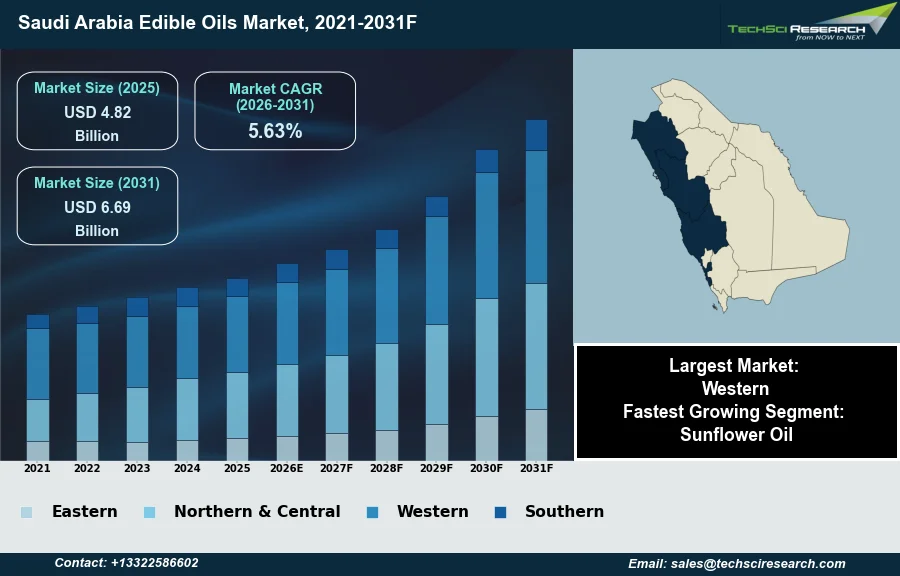
The Edible Oils Market in Saudi Arabia will grow from USD 4.82 Billion in 2025 to USD 6.69 Billion by 2031 at a 5.63% CAGR. Edible oils are fats of plant, animal, or microbial origin that are liquid at room temperature and suitable for human consumption, primarily employed in cooking, baking, and as ingredients across the food industry. The Saudi Arabia edible oils market is significantly propelled by a growing population, increasing disposable incomes, and the expansion of the domestic food processing sector. Supporting this industrial growth, according to the Saudi Food and Drug Authority, in 2025, the total number of licensed food facilities reached 9,155, reflecting an 18% increase over 2024.
A primary challenge impeding market expansion is the inherent vulnerability of the supply chain. Saudi Arabia's substantial reliance on imported raw materials for edible oils, such as palm, soybean, and sunflower oils, exposes the market to global price volatility and potential supply disruptions.
Key Market Drivers
Population growth and urbanization drive edible oil demand.
The Saudi Arabia Edible Oils Market is significantly driven by the nation's growing population and ongoing urbanization. This demographic expansion directly translates to increased consumer demand for essential food items, including edible oils used in daily cooking and home consumption. As more people reside in urban areas, dietary patterns often shift, influencing the types and quantities of edible oils purchased. According to the General Authority for Statistics, in a July 2025 bulletin, Saudi Arabia's population increased to 35.3 million by the end of 2024, marking a 4.7% growth compared to 2023. This sustained population increase ensures a continually expanding consumer base for edible oil products across various categories.
Growth in food service under Vision 2030 drives demand.
Another pivotal driver is the robust expansion of the food service and hospitality sector. This sector, encompassing restaurants, cafes, hotels, and catering services, is a substantial consumer of edible oils for food preparation. Saudi Arabia's Vision 2030 initiatives, focusing on tourism development and diversification, have significantly boosted this sector. According to the USDA Foreign Agricultural Service, in its September 2025 'Retail Foods Annual' report, Saudi Arabia's food service sales reached $29 billion in 2024. This growth directly escalates the demand for bulk and specialized edible oils. Furthermore, reflecting broader market confidence and strategic national development, according to the Saudi Press Agency, in October 2024, private sector investments in the Kingdom's agriculture and food sector surpassed SAR37 billion.
Download Free Sample Report
Key Market Challenges
Supply-chain vulnerability from dependence on imported oils and palm oil concentration risk
A primary challenge impeding the growth of the Saudi Arabia edible oils market is the inherent vulnerability of its supply chain, driven by a substantial reliance on imported raw materials like palm, soybean, and sunflower oils. This dependence exposes the market to significant global price volatility and potential supply disruptions, directly hindering consistent expansion. For instance, the market faces considerable concentration risk in crude palm oil imports. According to the Global Trade Analysis & Information Center, Indonesia accounted for 73.7% of the import value from January to July 2025. Such high reliance on a single major source renders the market vulnerable to price fluctuations or policy changes in the exporting country, leading to unpredictable input costs for domestic edible oil producers.
Concentration risk in refined soybean oil supply and resulting pricing and availability challenges
Furthermore, a similar trend is observed in refined soybean oil. The Global Trade Analysis & Information Center indicates that the top three suppliers collectively controlled 80% of the market from January to July 2025. This concentrated supply structure magnifies the impact of any geopolitical tensions or logistical impediments, potentially leading to shortages and instability in the local market. Consequently, this reliance on external, often concentrated, sources impedes the market's ability to maintain stable pricing and ensures consistent product availability, thus hampering overall market growth.
Key Market Trends
Health Awareness Drives Demand for Healthier Oils
The Saudi Arabia edible oils market is currently experiencing a significant consumer shift towards health-oriented varieties. This trend is driven by increasing health awareness among the population, who are actively seeking edible oils perceived to offer greater nutritional benefits and support healthier lifestyles. Consumers are demonstrating a rising preference for options such as olive oil, known for its monounsaturated fats and antioxidants. This heightened demand is reflected in trade figures; according to The Observatory of Economic Complexity, Saudi Arabia imported $36 million of olive oil in 2024, highlighting the growing consumer inclination towards these healthier alternatives and influencing product offerings across the market.
Digital Channels Reshape Edible Oil Distribution
Concurrently, the expansion of e-commerce and modern retail channels is reshaping the distribution landscape for edible oils in Saudi Arabia. This trend provides consumers with greater accessibility and convenience, particularly within urban areas where digital adoption is high. The increasing penetration of online grocery platforms and modern retail outlets is facilitating wider product availability and influencing purchasing habits. This is underscored by robust logistical activity; according to the Saudi Press Agency, in its January 2026 update, Saudi delivery activity recorded 124 million orders during Q4 of 2025, marking a 60% increase. This expanding infrastructure significantly impacts how edible oil products reach consumers, fostering innovation in retail strategies.
Segmental Insights
Sunflower oil: fastest-growing segment driven by health trends and regulatory changes
In the Saudi Arabia Edible Oils Market, sunflower oil stands out as the fastest-growing segment. This rapid expansion is primarily driven by increasing consumer health consciousness, leading to a strong preference for cooking oils perceived as healthier, such as sunflower oil, which offers lower saturated fat content and a favorable nutritional profile. Furthermore, its neutral flavor and high smoke point enhance its versatility for a wide range of culinary applications in both households and the expanding food processing industry. The Saudi Food and Drug Authority's (SFDA) implementation of regulations banning partially hydrogenated oils has also encouraged a significant shift towards healthier alternatives like sunflower oil, reinforcing its market growth.
Regional Insights
Western Region: Market Leader Fueled by Population Density, Diversity, and Port Access
The Western region stands as a leading contributor to the Saudi Arabia Edible Oils Market. This significant market position is primarily driven by its high population density, particularly within prominent cities like Jeddah and Mecca. Moreover, the cosmopolitan nature of the Western region's population, including a notable expatriate presence, generates demand for a diverse array of edible oil types, catering to a wide spectrum of culinary preferences. Crucially, the strategic location of major ports in Jeddah facilitates the efficient import of edible oils, ensuring a consistent and robust supply to satisfy the substantial consumer base across the region.
Recent Developments
-
In May 2024, Pakistani and Saudi investors were set to establish a joint venture for a new edible oil refinery in Saudi Arabia, with an anticipated investment of $5 million. The agreement for this project was expected to be finalized within six months of the announcement. This initiative, supported by Saudi authorities, aimed for the refinery to export 50% of its produced oil, significantly contributing to the local edible oils market by enhancing domestic processing capabilities and potentially reducing import dependency within the Kingdom.
-
In April 2024, IFFCO, a prominent multinational FMCG group, actively participated as a platinum sponsor at SaudiFood Manufacturing 2024. During this event, the company emphasized its commitment to sustainability by highlighting its carbon-neutral olive oil product. This focus on environmentally conscious offerings within the edible oils sector demonstrates a strategic response to evolving consumer preferences in the Saudi Arabian market, indicating a move towards more sustainable and health-oriented product lines for consumers.
-
In 2024, a significant breakthrough research initiative was undertaken by King Abdullah University of Science and Technology (KAUST), in collaboration with the Saudi Food and Drug Authority (SFDA). They successfully developed an innovative method utilizing nuclear magnetic resonance (NMR) technology to detect adulterated olive oil. This research was specifically designed to address increasing concerns regarding olive oil authenticity, aiming to bolster consumer protection and enhance food safety standards within the Saudi Arabia edible oils market.
-
In 2024, Cargill, a global agribusiness entity, strategically focused on expanding its product portfolio within the Saudi Arabia edible oils market. The company introduced innovative edible oil products, including specialty fats and high-oleic sunflower oils. These new offerings were designed to cater to the growing consumer demand for healthier cooking alternatives, reflecting a market trend towards improved nutritional profiles and specialized culinary applications in Saudi Arabia.
Key Market Players
- Savola Group
- Almarai Company
- Cargill Incorporated
- Wilmar International Limited
- Bunge Limited
- Olam Group Limited
- IFFCO Group
- Americana Group
- BRF S.A.
- AAK AB
|
By Product Type
|
By Nature
|
By Application
|
By Region
|
- Canola Oil
- Vegetable Oil
- Olive Oil
- Avocado Oil
- Sunflower Oil
- Others
|
|
- Seasoning
- Frying
- Baking
- Food Processing
- Others
|
- Eastern
- Northern & Central
- Western
- Southern
|
Report Scope:
In this report, the Saudi Arabia Edible Oils Market has been segmented into the following categories, in addition to the industry trends which have also been detailed below:
-
Saudi Arabia Edible Oils Market, By Product Type:
-
Canola Oil
-
Vegetable Oil
-
Olive Oil
-
Avocado Oil
-
Sunflower Oil
-
Others
-
Saudi Arabia Edible Oils Market, By Nature:
-
Saudi Arabia Edible Oils Market, By Application:
-
Seasoning
-
Frying
-
Baking
-
Food Processing
-
Others
-
Saudi Arabia Edible Oils Market, By Region:
-
Eastern
-
Northern & Central
-
Western
-
Southern
Competitive Landscape
Company Profiles: Detailed analysis of the major companies present in the Saudi Arabia Edible Oils Market.
Available Customizations:
Saudi Arabia Edible Oils Market report with the given market data, TechSci Research offers customizations according to a company's specific needs. The following customization options are available for the report:
Company Information
- Detailed analysis and profiling of additional market players (up to five).
Saudi Arabia Edible Oils Market is an upcoming report to be released soon. If you wish an early delivery of this report or want to confirm the date of release, please contact us at sales@techsciresearch.com