|
Key Insights
|
Details
|
|
Forecast Period
|
2027-2031
|
|
Market Size (2025)
|
USD 2.38 Billion
|
|
CAGR (2026-2031)
|
11.41%
|
|
Fastest Growing Segment
|
Healthcare
|
|
Largest Market
|
Northern & Central
|
|
Market Size (2031)
|
USD 4.55 Billion
|
Market Overview
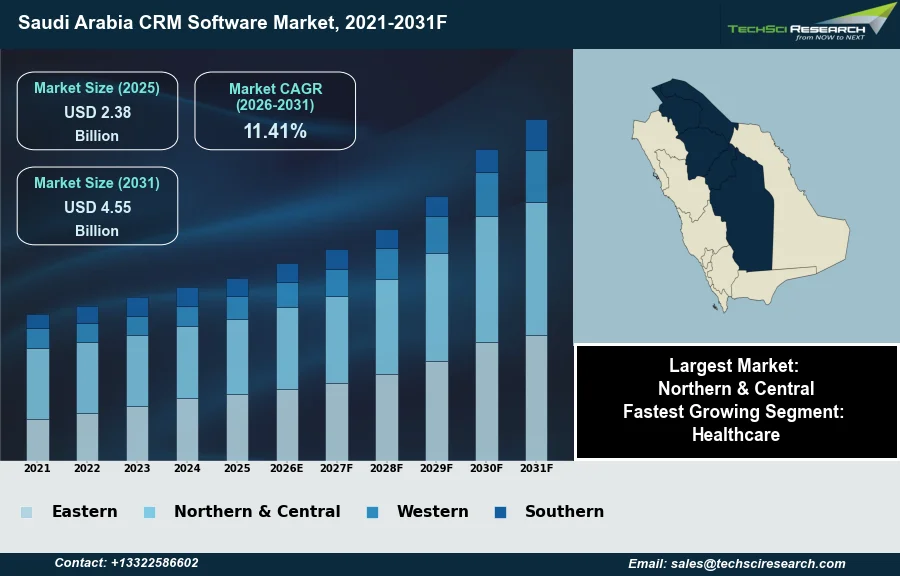
The Saudi Arabia CRM Software Market will grow from USD 2.38 Billion in 2025 to USD 4.55 Billion by 2031 at a 11.41% CAGR. Customer Relationship Management (CRM) software provides enterprises with comprehensive solutions for managing and analyzing customer interactions and data throughout the customer lifecycle, aiming to improve business relationships with customers and assist in customer retention and sales growth. The Saudi Arabia CRM software market is experiencing growth driven by the Kingdom's extensive digital transformation initiatives, particularly under Vision 2030, which mandates increased efficiency and technological adoption across various sectors. Organizations are prioritizing enhanced customer experiences, requiring robust platforms for centralized client data management, operational streamlining, and real-time customer engagement. This strategic focus is evident in broader digital investments; according to the U.S. International Trade Administration, Saudi Arabia's Information and Communications Technology (ICT) sector was valued at nearly $48 billion as of May 2025, indicating a significant digital investment landscape that supports software adoption.
A notable challenge impeding market expansion, however, is the scarcity of highly specialized local talent in advanced CRM implementation and data analytics. While the market benefits from substantial investment, developing a sufficient pool of skilled professionals to deploy, customize, and maintain complex CRM ecosystems remains crucial for sustained growth. This talent gap necessitates reliance on external expertise, potentially increasing operational costs and extending implementation timelines for local businesses.
Key Market Drivers
Government-Led Digitization Drives CRM Market Growth
The pervasive influence of National Digital Transformation Agendas and the strategic imperatives of Saudi Vision 2030 stand as a primary catalyst for the Saudi Arabia CRM software market. These overarching national initiatives mandate widespread technological adoption, efficiency gains, and diversification across economic sectors. Government-led programs actively promote the digitalization of services and operations, compelling both public and private entities to invest in robust software solutions like CRM. This strategic direction drives significant public and private sector expenditure toward digital infrastructure and enterprise applications. According to the Digital Government Strategy (2025-2030), the anticipated cumulative impact by 2030 includes an estimated SAR 11.4 billion contribution to GDP from the digital government transformation. This commitment underscores a sustained demand for platforms that streamline citizen and business interactions, directly benefiting CRM adoption.
Rising Customer-Centricity and AI-Driven Personalization
Complementing this top-down impetus is the rising focus on customer-centric business models and the surging demand for personalized customer experiences. As Saudi Arabian enterprises mature and operate within an increasingly competitive global landscape, the strategic importance of understanding, engaging, and retaining customers has grown significantly. Businesses are actively seeking CRM solutions to centralize customer data, automate marketing efforts, enhance sales processes, and deliver tailored interactions across multiple touchpoints. The integration of advanced technologies, such as artificial intelligence, into CRM platforms is crucial for achieving this personalization. According to the U.S. International Trade Administration, in May 2026, artificial intelligence spending in Saudi Arabia was projected to surpass $800 million in 2025, reflecting investment in technologies that underpin sophisticated customer experience capabilities. Overall, the dynamic Saudi digital economy, which, according to the World Economic Forum in November 2025, contributed SAR 495 billion to the GDP, underscores a fertile environment for technology investments that enhance customer relationships.
Download Free Sample Report
Key Market Challenges
Local Talent Scarcity Impedes CRM Growth and Raises Costs
The scarcity of highly specialized local talent in advanced Customer Relationship Management (CRM) implementation and data analytics presents a significant impediment to the growth of the Saudi Arabia CRM software market. This talent gap necessitates a reliance on external expertise for the deployment, customization, and ongoing maintenance of complex CRM ecosystems. Such dependency invariably leads to elevated operational costs for local businesses due to higher engagement fees and additional logistical expenditures associated with foreign specialists. Moreover, the limited availability of qualified local professionals often results in extended implementation timelines, which delays the realization of operational efficiencies and crucial customer engagement improvements.
Skill Shortages Hamper CRM Adoption Amid Digital Transformation
This challenge directly hinders organizations within the Kingdom from fully leveraging the strategic potential of CRM solutions, despite substantial digital transformation drivers. According to the Hays Saudi Arabia Salary Guide 2026, 93% of firms in Saudi Arabia reported experiencing skill shortages across technology roles in 2025, which includes the technical skills and data capabilities vital for advanced CRM. This pronounced skills deficit restricts the pace and depth of CRM adoption and utilization across various sectors.
Key Market Trends
Cloud-based CRM adoption and expanding data-center capacity
Increased adoption of cloud-based CRM solutions represents a significant trend in the Saudi Arabia market, primarily driven by the need for scalable and flexible enterprise applications. Organizations are increasingly shifting away from on-premise deployments to leverage the benefits of cloud infrastructure, including reduced operational overhead and enhanced accessibility. This transition enables businesses to rapidly deploy CRM capabilities, integrate with other cloud services, and support remote workforces more effectively. The foundational infrastructure for this shift is expanding considerably; according to Sharikat Mubasher, May 2026, in "Saudi Arabia becomes 2nd most attractive data center market globally", the Kingdom's data center capacity reached 467 megawatts in the first quarter of 2026, marking steady growth.
Data-security and regulatory compliance emphasis in CRM
Another influential trend is the growing emphasis on data security and regulatory compliance within CRM platforms. As businesses manage increasing volumes of sensitive customer data, adherence to stringent local data protection laws, such as the Personal Data Protection Law, has become paramount. Companies are seeking CRM solutions that offer robust security features, data residency options, and audit trails to meet these regulatory requirements and safeguard customer information. This focus is evidenced by heightened enforcement; according to the International Association of Privacy Professionals, February 2026, in "Saudi Arabia's data protection authority steps up enforcement", the Saudi Data and Artificial Intelligence Authority's specialized committees issued 48 decisions over the past year against organizations violating the Personal Data Protection Law.
Segmental Insights
Vision 2030 Drives Healthcare CRM Adoption
The healthcare sector is emerging as the fastest-growing segment within the Saudi Arabia CRM Software Market, primarily propelled by the ambitious Saudi Vision 2030 and its accompanying Health Sector Transformation Program. This strategic national agenda prioritizes significant investment in digital health solutions aimed at modernizing healthcare delivery, enhancing operational efficiency, and fostering a patient-centric approach across the Kingdom. Initiatives from the Ministry of Health, such as the development of unified health data platforms, expanded telemedicine services like the Seha Virtual Hospital, and the integration of artificial intelligence, necessitate robust CRM capabilities. These advancements enable healthcare providers to manage patient relationships more effectively, streamline care coordination, and deliver personalized services, thereby accelerating CRM software adoption to meet evolving healthcare demands.
Regional Insights
Riyadh: Leading Driver of CRM Adoption in Saudi Arabia
The Northern & Central region, particularly Riyadh, stands as the leading segment within the Saudi Arabia CRM Software Market. This dominance stems from Riyadh's position as the nation's political, economic, and technological center, hosting a high concentration of large enterprises and multinational corporations. These entities actively invest in CRM solutions to align with the national digital transformation agenda, notably Saudi Vision 2030, which prioritizes digital excellence and economic diversification. Government-led initiatives, supported by institutions such as the Digital Government Authority, further drive the adoption of advanced technologies and robust digital infrastructure, fostering an environment conducive to widespread CRM software implementation for enhancing customer engagement and operational efficiency across various industries.
Recent Developments
-
In November 2025, Salesforce took significant steps to reinforce its long-term commitment to Saudi Arabia's digital transformation and economic diversification goals, in line with Vision 2030. The company activated its USD $500 million investment to foster artificial intelligence innovation, cloud adoption, and digital skills development across the Kingdom. This initiative involved the establishment of a regional headquarters in Saudi Arabia and the impending opening of a new office in Riyadh. Furthermore, Salesforce hosted its initial Innovation Day in Riyadh, where local customers showcased the measurable impact achieved using AI-powered CRM solutions.
-
In June 2025, Doctorna, a healthcare technology provider, expanded its presence into Saudi Arabia, rolling out its comprehensive healthcare customer relationship management (CRM) and telehealth services. This strategic market entry aimed to align with Saudi Vision 2030's objectives, specifically by enhancing the nation's digital health infrastructure. The Doctorna platform integrates intelligent patient management systems, virtual care options, and AI-powered analytics to improve operational efficiency and patient engagement in clinics and hospitals across the Kingdom. The company emphasized its solutions were tailored to meet specific Saudi Arabian healthcare market requirements, including compliance with data handling regulations and providing localized support.
-
In January 2025, Hollat, a prominent Saudi customer relationship management platform, introduced its new cloud-based CRM version to the market. This product launch occurred after the company's successful completion of the Flat6Labs business accelerator program. Concurrently, Hollat announced the opening of a new seed investment round, securing $3 million. The cloud-based CRM was designed to enable companies and government entities to manage tickets and beneficiaries effectively, with flexible service level agreements. This strategic development is poised to support Hollat’s market expansion and bolster its role in advancing customer support systems within the Saudi Arabia CRM software market.
-
In October 2024, Unifonic, a leading conversational AI platform and SaaS provider in the Middle East, launched its enterprise-grade customer data platform (CDP) named 'Audience' at the Seamless KSA 2024 event in Riyadh. This new offering is designed to centralize first-party data and unify customer profiles, enabling highly personalized marketing campaigns across various communication channels such as WhatsApp, SMS, and voice. The 'Audience' platform leverages data-driven insights and real-time automation to improve critical metrics like customer retention, engagement, and overall satisfaction rates, marking a significant product introduction for customer engagement strategies within the Saudi Arabia CRM software market.
Key Market Players
- Salesforce Inc.
- Microsoft Corporation
- Oracle Corporation
- SAP SE
- Zoho Corporation Pvt. Ltd.
- Freshworks Inc.
- HubSpot, Inc.
- SugarCRM Inc.
|
By Deployment
|
By Enterprise
|
By Application
|
By Vertical
|
By Region
|
|
|
|
- Marketing and Sales Automation
- Customer Management
- Lead Generation & Customer Retention
- Others
|
- BFSI
- Manufacturing
- IT & Telecom
- Retail & Consumer Goods
- Healthcare
|
- Eastern
- Northern & Central
- Western
- Southern
|
Report Scope:
In this report, the Saudi Arabia CRM Software Market has been segmented into the following categories, in addition to the industry trends which have also been detailed below:
-
Saudi Arabia CRM Software Market, By Deployment:
-
Saudi Arabia CRM Software Market, By Enterprise:
-
Saudi Arabia CRM Software Market, By Application:
-
Marketing and Sales Automation
-
Customer Management
-
Lead Generation & Customer Retention
-
Others
-
Saudi Arabia CRM Software Market, By Vertical:
-
BFSI
-
Manufacturing
-
IT & Telecom
-
Retail & Consumer Goods
-
Healthcare
-
Saudi Arabia CRM Software Market, By Region:
-
Eastern
-
Northern & Central
-
Western
-
Southern
Competitive Landscape
Company Profiles: Detailed analysis of the major companies present in the Saudi Arabia CRM Software Market.
Available Customizations:
Saudi Arabia CRM Software Market report with the given market data, TechSci Research offers customizations according to a company's specific needs. The following customization options are available for the report:
Company Information
- Detailed analysis and profiling of additional market players (up to five).
Saudi Arabia CRM Software Market is an upcoming report to be released soon. If you wish an early delivery of this report or want to confirm the date of release, please contact us at sales@techsciresearch.com