|
Key Insights
|
Details
|
|
Forecast Period
|
2027-2031
|
|
Market Size (2025)
|
USD 1.45 Billion
|
|
CAGR (2026-2031)
|
5.33%
|
|
Fastest Growing Segment
|
City Bus
|
|
Largest Market
|
Northern & Central
|
|
Market Size (2031)
|
USD 1.98 Billion
|
Market Overview
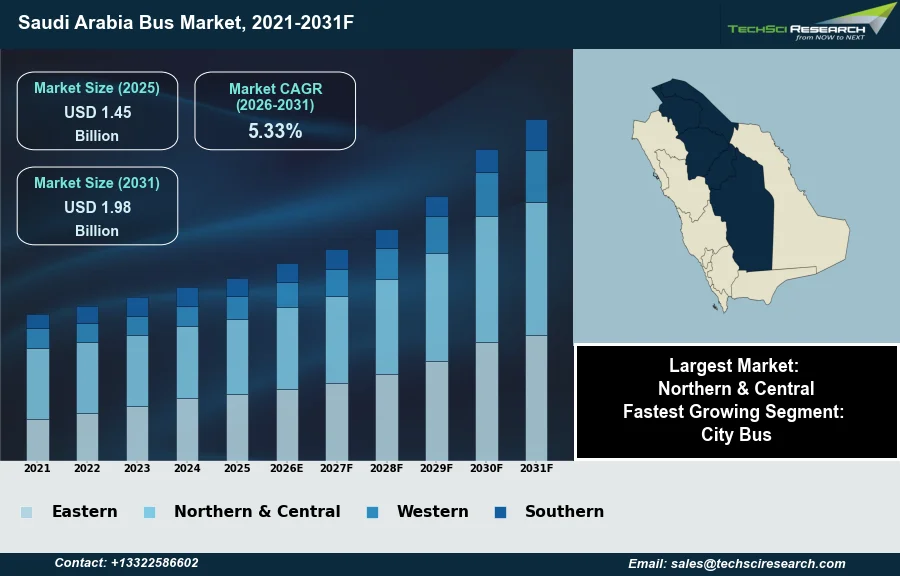
The Saudi Arabia Bus Market will grow from USD 1.45 Billion in 2025 to USD 1.98 Billion by 2031 at a 5.33% CAGR. The Saudi Arabia Bus Market encompasses the provision and operation of vehicles designed for collective passenger transport across various applications, including public transit, intercity travel, tourism, and staff movement. This sector is driven by substantial government initiatives under Vision 2030, which prioritize public transportation infrastructure development, rapid urbanization leading to increased demand for efficient intra-city mobility, and a burgeoning tourism sector, particularly religious tourism to Makkah and Medina. For instance, according to Jeddah Transport Company, a significant expansion occurred in May 2025 with the launch of a 91-bus network to enhance urban connectivity.
Despite robust growth drivers, the market faces a significant impediment in its heavy reliance on imported buses and components, which can expose the sector to international supply chain disruptions and limit local maintenance and repair capabilities. The high initial capital expenditure associated with modern, environmentally friendly technologies like electric buses also presents a challenge, necessitating substantial infrastructure investment for charging networks.
Key Market Drivers
Vision 2030-Driven Public-Transit Modernization Drives Bus Market Growth
Government-Led Public Transport Modernization Programs represent a primary catalyst for the Saudi Arabia Bus Market. These initiatives, integral to Vision 2030, focus on enhancing urban mobility and intercity connectivity through substantial infrastructure investments and fleet upgrades. The commitment extends to integrating advanced and sustainable technologies, aiming for a modern, efficient transport network. For example, according to Saudi Public Transport Company (SAPTCO) in January 2026, a significant fleet expansion plan was announced, involving the procurement of 1,500 new buses, including 300 electric buses, for urban routes in Riyadh and Jeddah, backed by a USD 450 million investment. This strategic direction directly drives demand for new bus acquisitions and associated technological solutions.
Pilgrimage Tourism Expands Demand for Specialized Bus Services
The burgeoning Growth in Religious Tourism and Pilgrimage also profoundly impacts the Saudi Arabia Bus Market, particularly in the holy cities of Makkah and Madinah. The annual influx of millions of Hajj and Umrah pilgrims necessitates a highly organized and robust transport system to facilitate their movement between sacred sites. This leads to substantial demand for specialized bus services and the continuous readiness of large fleets. To meet this demand, according to the Transport General Authority in May 2026, more than 33,000 buses were prepared to serve pilgrims during the Hajj season 2026. More broadly, the Kingdom's public transport sector continues to expand, with total ridership reaching 420.6 million passengers in 2025, according to the Transport General Authority in April 2026.
Download Free Sample Report
Key Market Challenges
Import Dependency: Procurement, Supply Chain, and Maintenance Risks
The Saudi Arabia Bus Market faces a significant impediment due to its heavy reliance on imported buses and components. This dependency exposes the sector to substantial vulnerabilities, particularly from international supply chain disruptions and currency fluctuations, which can lead to increased procurement costs and extended delivery times for new vehicles. Furthermore, this reliance limits the development of robust local maintenance and repair capabilities, increasing operational expenses and potentially affecting vehicle uptime due to delays in acquiring specialized spare parts and skilled expertise.
Dependency Impedes Domestic Manufacturing, Jobs, and Growth
This structural dependency directly hampers market growth by hindering the establishment of a robust domestic manufacturing ecosystem. It constrains opportunities for local job creation and technology transfer within the automotive sector, thereby reducing the Kingdom's economic resilience to global market shifts. According to the Saudi Zakat, Tax, and Customs Authority (ZATCA), vehicle imports to Saudi Arabia reached approximately 959,403 units in 2025, following 942,118 units in 2024. This demonstrates a continued high volume of imported vehicles, highlighting the market's substantial external reliance.
Key Market Trends
Local EV Bus Assembly to Strengthen Domestic Capabilities
Local manufacturing and assembly of electric buses represents a significant trend aimed at bolstering domestic industrial capabilities and reducing import dependence within the Saudi Arabia Bus Market. This strategic shift is crucial for fostering in-country value, creating skilled employment, and facilitating technology transfer. For instance, according to Acko Drive, November 29, 2025, in "Ashok Leyland Sets Up Saudi Arabia Subsidiary For Bus And Truck Assembly," Ashok Leyland Saudi Company was incorporated on June 30, 2025, with a paid-up share capital of 500,000 Saudi Riyal, specifically to establish a vehicle assembly plant for buses and trucks in the Kingdom. This commitment signals a move towards a more self-reliant and sustainable automotive ecosystem, aligning with national economic diversification goals.
Smart Technology and Digital Systems in Public Transit
The integration of smart technologies and digital systems is another pivotal trend, enhancing the efficiency and passenger experience within the Saudi bus market. This involves deploying advanced solutions like real-time bus tracking, digital payment options, and intelligent fleet management. These technologies optimize route planning, improve service reliability, and provide passengers with greater convenience and access to information. For example, according to SAPTCO and JTC, May 22, 2025, in "SAPTCO & JTC Launch New Phase of Public Bus Project," Jeddah's public bus transport project, launched in May 2025, aims to serve over 30 million passengers within three years, supported by a mobile application featuring real-time tracking and e-ticket purchasing functionalities. Such digital innovations are fundamental to modernizing public transportation infrastructure.
Segmental Insights
Growth Drivers and Regulatory Support for City Buses
The City Bus segment is currently the fastest-growing within the Saudi Arabia Bus Market, primarily driven by rapid urbanization and significant government initiatives aimed at modernizing urban mobility. This expansion is a direct result of the Kingdom's Vision 2030, which prioritizes diversifying the economy and enhancing the quality of life for its growing population by investing heavily in public transport infrastructure. Projects such as the Riyadh Bus Network and the Makkah Public Transport Program exemplify these efforts, introducing extensive and efficient bus services to alleviate traffic congestion and improve accessibility across major cities. The Transport General Authority (TGA), as the regulatory and legislative body for land transport, plays a crucial role in overseeing the development and expansion of these vital city bus services, thereby fostering increased ridership and supporting sustainable urban development.
Regional Insights
Northern and Central Region: Leading Saudi Bus Market Driven by Population Density, Pilgrimage Demand, and Vision 2030 Initiatives
The Northern and Central region stands as the leading segment in the Saudi Arabia Bus Market due to its significant strategic importance and high population density. This region encompasses key urban centers such as Riyadh, the nation's capital, which drives substantial public transit demand through its expansive urban footprint and economic activity. Furthermore, the presence of global religious hubs like Mecca and Medina within this area generates immense demand for buses, facilitating the annual movement of millions of Hajj and Umrah pilgrims. Government initiatives, particularly under Vision 2030, strongly support extensive investments in advanced public transportation infrastructure and sustainable mobility solutions, further bolstering the region's dominance. The Transport General Authority plays a crucial role in regulating and developing the land transport sector, ensuring robust bus networks meet these escalating requirements.
Recent Developments
-
In December 2025, Ankai Bus announced the delivery of 1,800 bus units to Saudi Arabia, marking a significant milestone in its long-term strategic partnership with the Naghi Group. This substantial export further cemented Ankai Bus's presence and influence within the Saudi market, showcasing a continued collaboration that spans over a decade. The partnership contributes to the development of local transportation and exemplifies industrial cooperation between China and Saudi Arabia, supporting various transport sectors, including public transportation and tourism.
-
In October 2025, Mobico Group's ALSA subsidiary, operating as part of a joint venture with a local company, secured an eight-year contract valued at €500 million in Saudi Arabia. This agreement involves the operation of 156 vehicles, with 126 of these being electric buses, to serve Qiddiya, a new development located near Riyadh. The contract encompasses Park & Ride facilities and shuttle services, reinforcing ALSA's established presence and commitment to providing sustainable transport solutions within the growing Saudi Arabian bus market.
-
In October 2024, Yutong introduced its new battery-electric bus models, the E11PRO and D8E, to the Saudi Arabian market. The E11PRO, specifically, was noted for its exceptional performance during extreme high-temperature tests conducted in Jeddah, becoming the company's primary model for the "Extremely Hot Challenge." This product launch signifies an expansion of electric bus offerings tailored to the unique environmental conditions of Saudi Arabia, providing advanced solutions for public and private transportation operators in the region.
-
In August 2024, Riyadh Air initiated the launch of its first electric bus for employee transportation. This development was a collaborative effort with National Transportation Solutions Co. and TAM-Europe, aiming to support Saudi Arabia's Vision 2030 objectives for emissions reduction. The introduction of this electric bus fleet contributes to the advancement of public transit solutions within the Kingdom, aligning with broader goals for sustainable transportation. This move highlights a company's commitment to integrating eco-friendly options into its operational logistics within the Saudi Arabian bus market.
Key Market Players
- Mercedes-Benz Bus KSA
- Volvo Bus KSA
- MAN Bus KSA
- Scania Bus KSA
- King Long Bus KSA
- Yutong Bus KSA
- Al Futtaim Bus
- Al Naboodah Bus
- United Motors Bus
- Local Bus Manufacturers KSA
|
By Bus Length
|
By Fuel Type
|
By Bus Type
|
By Region
|
- Up to 7m
- 7 to12 m
- Over 12m
|
|
- City Bus
- Intercity Bus
- Tourist Buses
- School Buses
|
- Eastern
- Northern & Central
- Western
- Southern
|
Report Scope:
In this report, the Saudi Arabia Bus Market has been segmented into the following categories, in addition to the industry trends which have also been detailed below:
-
Saudi Arabia Bus Market, By Bus Length:
-
Up to 7m
-
7 to12 m
-
Over 12m
-
Saudi Arabia Bus Market, By Fuel Type:
-
Saudi Arabia Bus Market, By Bus Type:
-
City Bus
-
Intercity Bus
-
Tourist Buses
-
School Buses
-
Saudi Arabia Bus Market, By Region:
-
Eastern
-
Northern & Central
-
Western
-
Southern
Competitive Landscape
Company Profiles: Detailed analysis of the major companies present in the Saudi Arabia Bus Market.
Available Customizations:
Saudi Arabia Bus Market report with the given market data, TechSci Research offers customizations according to a company's specific needs. The following customization options are available for the report:
Company Information
- Detailed analysis and profiling of additional market players (up to five).
Saudi Arabia Bus Market is an upcoming report to be released soon. If you wish an early delivery of this report or want to confirm the date of release, please contact us at sales@techsciresearch.com