|
Key Insights
|
Details
|
|
Forecast Period
|
2027-2031
|
|
Market Size (2025)
|
USD 125.55 Million
|
|
CAGR (2026-2031)
|
7.81%
|
|
Fastest Growing Segment
|
BOPP
|
|
Largest Market
|
West
|
|
Market Size (2031)
|
USD 197.14 Million
|
Market Overview
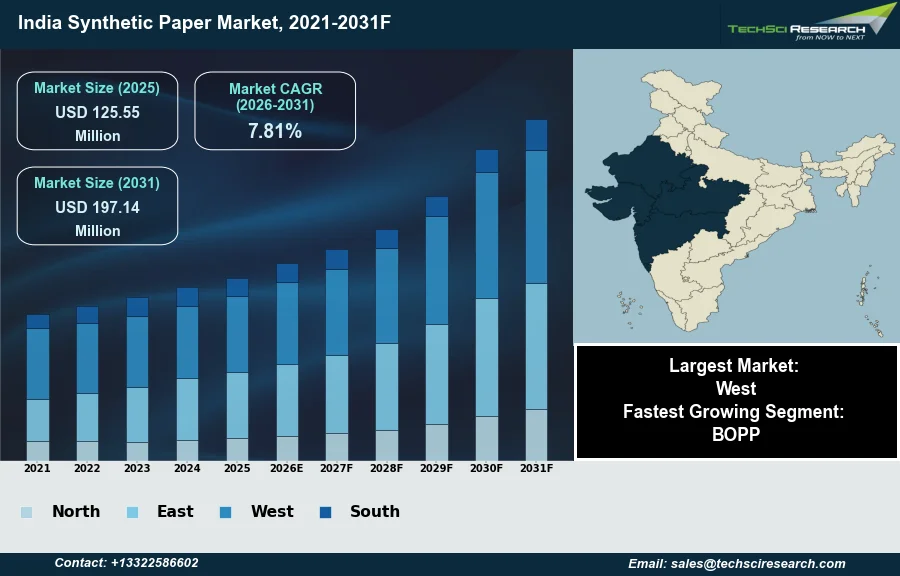
The India Synthetic Paper Market is expected to grow from USD 125.55 Million in 2025 to USD 197.14 Million by 2031 at a 7.81% CAGR. Synthetic paper is a high-performance material produced from synthetic resins, such as polypropylene or polyethylene, designed to emulate the appearance and printability of traditional paper while offering superior properties including water, tear, and chemical resistance. The India synthetic paper market's growth is primarily driven by the increasing demand for durable and resilient materials in applications such as labels, packaging, and specialty printing. Expanding requirements for tamper-proof and long-lasting documents across diverse end-use industries also contribute significantly to market expansion.
This growing market benefits from the broader plastics sector's performance; according to the Plastics Export Promotion Council, India's plastics and allied product exports, encompassing films and sheets which include synthetic paper, increased 25.9% to USD 1327.4 million in September 2026 from USD 1054.1 million in September 2025. However, a significant challenge impeding broader market expansion is the higher initial cost of synthetic paper compared to conventional paper substrates, which can limit its adoption in price-sensitive segments despite its long-term durability benefits.
Key Market Drivers
Advancements in Synthetic Paper Technology
Technological advancements in synthetic paper production represent a significant driving factor for the India market. Innovations in manufacturing processes enhance the material's performance characteristics, including printability, durability, and cost-effectiveness, making it a more attractive alternative to traditional paper. These continuous improvements support broader adoption in demanding applications. For instance, the digital production print industry in India is experiencing growth, with print volumes increasing across the sector at 10%, reflecting a shift towards more advanced and efficient printing methods that synthetic paper readily supports. Such advancements enable manufacturers to produce synthetic paper with finer textures, improved ink adhesion, and enhanced resistance properties, aligning with evolving industrial requirements for high-quality and reliable substrates.
E-commerce Growth Fuels Packaging Demand
The rapid expansion of e-commerce and retail further bolsters the India synthetic paper market. The burgeoning online shopping landscape necessitates robust and tamper-proof packaging and labeling solutions that can withstand varying transit conditions. Synthetic paper, with its inherent tear and water resistance, is well-suited for these applications, ensuring product integrity and brand presentation during delivery. The growth in online transactions is evident as India's e-commerce market recorded 21% year-on-year growth in order volumes during the 2026 festive shopping season. This surge in online retail directly drives demand for high-performance packaging and labeling materials. The broader packaging industry in India also demonstrates strong potential, with projections indicating a compound annual growth rate of approximately 9% over the next five years. This sustained expansion of related industries provides a fertile ground for the increased penetration of synthetic paper.
Download Free Sample Report
Key Market Challenges
Cost barriers and rising input costs constrain synthetic paper adoption in India.
The primary challenge hindering the expansion of the India synthetic paper market is its elevated initial cost compared to conventional paper substrates. This higher pricing significantly limits adoption, particularly within price-sensitive market segments where cost-effectiveness remains a critical purchasing criterion. Despite the long-term durability, water, and tear resistance benefits offered by synthetic paper, the immediate budget constraints of various end-use industries often lead to the continued preference for cheaper traditional paper. This directly impacts the market's ability to penetrate broader applications. According to the All India Plastic Manufacturers Association, during March 2026, input costs for plastic producers increased by 50 to 60 percent, leading to a 20 to 100 percent rise in finished plastic product prices across categories. Such substantial cost increases are directly passed on to consumers, making synthetic paper a less viable option for businesses operating on tighter margins.
Key Market Trends
Eco-Friendly Innovation and Regulatory Push
The India Synthetic Paper Market is significantly influenced by the innovation in eco-friendly and biodegradable formulations, reflecting a growing industry emphasis on environmental sustainability. This trend is driven by heightened consumer awareness and stringent regulatory mandates encouraging the adoption of materials with reduced environmental impact. Manufacturers are increasingly developing synthetic paper variants offering biodegradability or renewable sourcing, responding to demand for greener packaging and labeling solutions where traditional plastics face scrutiny. According to the CPCB's 2026-27 framework, a 70% processing of Category IV compostable plastic packaging waste is required, signaling a clear regulatory push towards sustainable alternatives.
RFID-Driven Security and Tracking Applications
Another prominent trend shaping the India Synthetic Paper Market is the growing integration in security and RFID tagging applications. This development extends beyond basic identification, leveraging synthetic paper's durability and printability for advanced anti-counterfeiting and tracking solutions. The material's resistance to tampering makes it ideal for embedding RFID tags and integrating covert security features, crucial for product authentication and supply chain integrity in industries requiring precise tracking. The widespread adoption of such technologies is evident as, according to Indian Infrastructure in February 2026, over 98% of national highway toll was collected through FASTag during 2025-26, demonstrating extensive RFID integration in critical infrastructure.
Segmental Insights
BOPP Synthetic Paper: Durable, Printable, and Sustainable Packaging in India
In the India Synthetic Paper Market, the BOPP segment is experiencing rapid growth due to its intrinsic properties and evolving market demands. BOPP synthetic paper offers superior durability, including resistance to tearing, moisture, and chemicals, ensuring product integrity for diverse applications. Its excellent printability enhances brand visibility and appeal, crucial for the expanding packaged food, fast-moving consumer goods (FMCG), and e-commerce sectors in India. Furthermore, its lightweight and recyclable nature aligns with increasing sustainability initiatives and regulatory mandates, such as the Extended Producer Responsibility guidelines under India's Plastic Waste Management Rules, promoting its adoption as an efficient and environmentally conscious packaging solution.
Regional Insights
West India's Market Leadership: Concentrated Capacity, Port Access, and Policy Support.
West India is a pivotal region, emerging as the dominant force in the India Synthetic Paper Market. This leadership is primarily driven by the significant concentration of established paper and synthetic paper manufacturing facilities across states such as Maharashtra and Gujarat. These states benefit from strategic access to ports, facilitating both import of raw materials and export of finished products efficiently. The presence of major industry players and substantial governmental initiatives promoting industrial development further solidifies the region's preeminence. This combination of robust manufacturing infrastructure, advantageous geographical positioning, and supportive policy frameworks creates a conducive environment for the growth and dominance of the synthetic paper sector in West India.
Recent Developments
-
In June 2025, UKHI officially launched EcoGran, a biodegradable biopolymer derived from India's agricultural waste, including hemp and flax. This revolutionary product is designed to replace petroleum-based plastics at scale, addressing issues of plastic waste and stubble burning. While EcoGran is a new material in the broader biopolymer market, its application as a home-compostable and biodegradable alternative provides a new option for packaging solutions in India. This development introduces a sustainable competitive material in the market, indirectly influencing the landscape for plastic-based synthetic papers by offering an eco-friendly substitute for certain applications.
-
In September 2024, Jindal Poly Films announced plans for a substantial expansion of its biaxially-orientated polypropylene (BOPP) film production in Nashik, India. The company intends to construct a new plant with a projected capacity of 60,000 tonnes per year, representing an investment of approximately INR 2.5 billion. This strategic expansion is directly relevant to the India Synthetic Paper Market, as BOPP films are a key raw material for manufacturing synthetic paper used in various flexible packaging and labeling applications. The increased production capacity will support the growing demand for durable and moisture-resistant packaging materials in the region.
-
In April 2024, Cosmo Synthetic Paper, a division of Cosmo Films, introduced eight new synthetic paper brands to address diverse printing requirements in the Indian market. These innovations provide durable and long-lasting alternatives to conventional paper across various applications, including commercial printing, tags and labels, retail packaging, identification credentials, and outdoor uses. The expanded portfolio offers solutions compatible with multiple printing technologies, directly serving the growing demand for high-performance paper-like materials. This strategic product launch enhances Cosmo Films' position in the India Synthetic Paper Market by offering specialized solutions for demanding applications where durability and print quality are paramount.
-
In January 2024, Reliance Industries Limited achieved a significant breakthrough by becoming the first Indian company to chemically recycle plastic waste-based pyrolysis oil into International Sustainability & Carbon Certification (ISCC)-Plus certified circular polymers. This innovation represents a crucial step towards a circular economy in India's materials sector. While not exclusively for synthetic paper, the development of these circular polymers by a major industry player provides a sustainable feedstock alternative for various plastic-based products, including potential applications within the synthetic paper market. This research by Reliance showcases a commitment to developing advanced, environmentally responsible material solutions.
Key Market Players
- Yupo Corporation
- Arjobex
- PPG Industries
- HOP Industries
- Taghleef Industries
- Nan Ya Plastics
- Formosa Plastics
- Cosmo Films Ltd
- Transcendia
- MDV Papier
|
By Product Type
|
By Application
|
By Region
|
- Biaxially Oriented Polypropylene [BOPP]
- High Density Polyethylene [HDPE]
|
|
- North India
- East India
- West India
- South India
|
Report Scope:
In this report, the India Synthetic Paper Market has been segmented into the following categories, in addition to the industry trends which have also been detailed below:
-
India Synthetic Paper Market, By Product Type:
-
Biaxially Oriented Polypropylene [BOPP]
-
High Density Polyethylene [HDPE]
-
India Synthetic Paper Market, By Application:
-
India Synthetic Paper Market, By Region:
-
North India
-
East India
-
West India
-
South India
Competitive Landscape
Company Profiles: Detailed analysis of the major companies present in the India Synthetic Paper Market.
Available Customizations:
India Synthetic Paper Market report with the given market data, TechSci Research offers customizations according to a company's specific needs. The following customization options are available for the report:
Company Information
- Detailed analysis and profiling of additional market players (up to five).