|
Key Insights
|
Details
|
|
Forecast Period
|
2027-2031
|
|
Market Size (2025)
|
USD 150.78 Million
|
|
CAGR (2026-2031)
|
6.51%
|
|
Fastest Growing Segment
|
Water-Based
|
|
Largest Market
|
West
|
|
Market Size (2031)
|
USD 220.13 Million
|
Market Overview
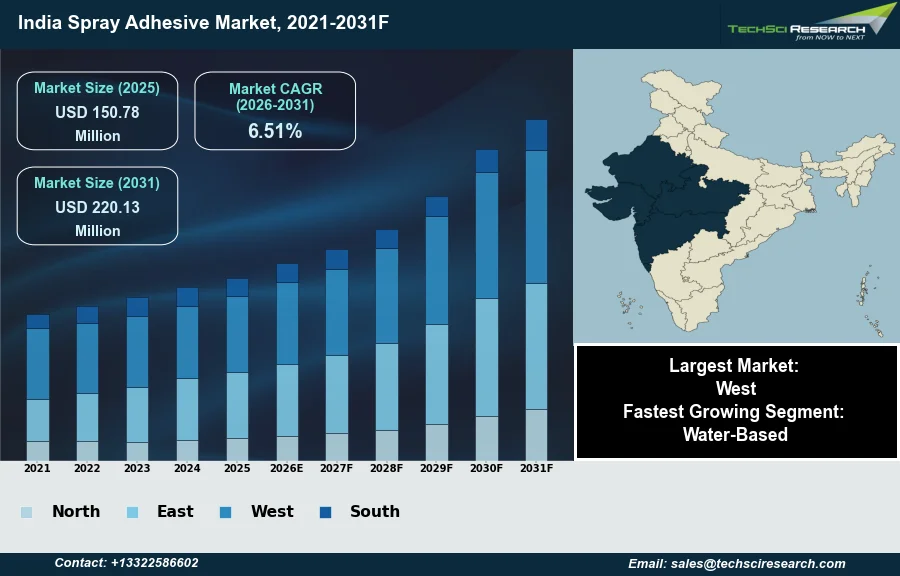
The India Spray Adhesive Market is expected to grow from USD 150.78 Million in 2025 to USD 220.13 Million by 2031 at a 6.51% CAGR. Spray adhesive, a product combining an adhesive resin with a liquid carrier, is dispensed as a fine mist from a pressurized container, facilitating quick and uniform bonding across diverse surfaces. The India spray adhesive market growth is primarily driven by expanding industrial applications in the automotive and construction sectors, coupled with significant infrastructure development projects across the nation. Additionally, the flourishing packaging industry, fueled by e-commerce and fast-moving consumer goods expansion, consistently demands versatile bonding solutions. According to the India Brand Equity Foundation, in a May 2026 report, India's packaging sector encompassed over 22,000 units, with 85% identified as small and medium enterprises, indicating a broad base for adhesive consumption.
However, a significant challenge impeding market expansion is the substantial reliance on imported raw materials, particularly specialty chemicals and resins. This dependency exposes manufacturers to global supply chain disruptions and price volatility, impacting production costs and overall market stability.
Key Market Drivers
Construction and infrastructure growth drives spray adhesive demand
Robust growth in construction and infrastructure development significantly propels the India spray adhesive market, with extensive demand arising from various large-scale projects. Adhesives are essential for numerous applications in building and infrastructure, including insulation, flooring, roofing, and interior finishing, where they offer quick and efficient bonding solutions. The government’s sustained focus on urban development, industrial corridors, and public infrastructure projects necessitates a steady supply of high-performance bonding agents. According to the India Brand Equity Foundation, in a February 2025 report, the National Highway construction pace in India rose 2.8 times from 12.1 km/day in 2014-15 to 33.8 km/day in 2023-24. This accelerated construction activity directly translates into increased consumption of spray adhesives for various assembly and finishing stages, particularly in prefabricated structures and modular construction.
Automotive manufacturing expansion sustains spray adhesive demand
The expanding automotive manufacturing sector also represents a crucial driving factor for the India spray adhesive market. Spray adhesives are integral to modern vehicle production, used in bonding interior components such as headliners, seat fabrics, door panels, and sound insulation materials, offering lightweighting benefits and design flexibility. The consistent growth in both domestic production and exports of vehicles underscores this demand. According to the Society of Indian Automobile Manufacturers, in an April 2025 release, the total production of passenger vehicles, commercial vehicles, three-wheelers, two-wheelers, and quadricycles in India reached 3,10,34,174 units in April 2024 - March 2025. This substantial output, driven by increasing consumer purchasing power and a burgeoning middle class, ensures a sustained requirement for spray adhesives within automotive assembly lines. Furthermore, India’s chemical sector, encompassing adhesives, was estimated to be worth around US$ 250 billion in 2024, according to the India Brand Equity Foundation in September 2026.
Download Free Sample Report
Key Market Challenges
Import Dependence Driving Production Costs and Pricing Pressure
The India spray adhesive market faces a significant impediment due to its substantial reliance on imported raw materials, particularly specialty chemicals and resins. This dependency exposes domestic manufacturers to considerable global supply chain disruptions and inherent price volatility. Such external factors directly escalate production costs, making it challenging for local producers to maintain stable pricing strategies and competitive market offerings.
Imported Input Costs Affect Profitability and Demand
The fluctuating costs of these critical imported inputs directly impact the profitability and operational stability of spray adhesive producers. According to CHEMEXCIL, in its FY2025-26 report, India's annual chemical and petrochemical imports were approximately USD 60 billion, highlighting the extensive reliance on foreign sources for fundamental raw materials. This substantial import bill and potential for price spikes compel manufacturers to either absorb higher expenses, thereby diminishing profit margins, or pass them on to end-users through increased product prices. Consequently, elevated prices for spray adhesives can dampen demand across key application sectors such as automotive and construction, where cost-effectiveness is a crucial consideration. This situation ultimately restricts the market's potential for expansion and innovation by creating an unfavorable cost structure for domestic production.
Key Market Trends
Low-VOC, eco-friendly adhesives aligned with green-building standards
The rising demand for sustainable and low-volatile organic compound (VOC) formulations is a significant trend in the India spray adhesive market, driven by increasing environmental awareness and stricter regulations. Manufacturers are developing eco-friendly adhesives that minimize harmful emissions, aligning with green building standards and industrial sustainability initiatives for healthier indoor air quality. This is evidenced by the introduction of new adhesive systems complying with stringent global environmental standards as low-VOC and non-flammable formulations. The widespread adoption of green construction also fuels this trend; according to the Indian Green Building Council (IGBC), as of 2026, it has registered over 19,820 projects covering 16.20 billion square feet of certified green building space, directly encouraging the preference for sustainable bonding solutions.
Expansion into DIY and retail consumer segments
The growing use of spray adhesives in DIY and retail consumer segments marks another pivotal trend, expanding the market beyond traditional industrial applications. This trend is fueled by increasing disposable incomes, urbanization, and a burgeoning middle class, which are collectively driving higher consumer spending on home improvement and personal projects. Consumers increasingly seek convenient, easy-to-use, and effective bonding solutions for minor repairs, crafts, and aesthetic upgrades in residential settings. The expansion of organized retail and e-commerce platforms further facilitates access to these products for a broader consumer base. Reflecting this growth, India's retail sector recorded 8% year-on-year growth in September 2026, according to the Retailers Association of India's (RAI) Business Survey Round 75, indicating a robust environment for consumer product consumption, including DIY adhesives.
Segmental Insights
Water-Based Segment: Fast Growth Driven by VOC Reduction and Regulatory Compliance
In the India Spray Adhesive Market, the Water-Based segment stands out as the fastest growing, a trend driven primarily by escalating environmental awareness and increasingly stringent government regulations. This rapid expansion is a direct consequence of the imperative to minimize Volatile Organic Compound (VOC) emissions, which are detrimental to both human health and the environment. Regulatory bodies such as the Central Pollution Control Board (CPCB) and various State Pollution Control Boards (SPCBs) play a crucial role by enforcing emission norms for industrial processes under acts like the Air (Prevention and Control of Pollution) Act, 1981, which encourages industries to adopt greener alternatives. Consequently, there is a pronounced shift among manufacturers and consumers across sectors like packaging, automotive, and construction towards eco-friendly, low-VOC water-based spray adhesives to meet sustainability objectives and comply with these evolving standards.
Regional Insights
West Region Leads the India Spray Adhesive Market Through Industrial Strength and Logistics
The West region significantly leads the India Spray Adhesive Market due to its robust industrial foundation and advanced manufacturing capabilities. States such as Maharashtra and Gujarat boast thriving industrial landscapes, characterized by a vibrant mix of automotive, construction, and textile manufacturing units that serve as major consumers of spray adhesives. This dominance is further strengthened by well-developed industrial clusters, superior logistics infrastructure, and seamless connectivity that facilitate efficient supply chains for raw materials and finished products. The presence of a strong petrochemical feedstock base in Gujarat, coupled with Maharashtra's dense concentration of automotive original equipment manufacturers and extensive commercial construction activities, significantly drives demand for specialized spray adhesive solutions.
Recent Developments
-
In February 2025, Henkel inaugurated a new application engineering center in Chennai, India. This advanced facility was equipped with five specialized laboratories, focusing on adhesive and thermal-management materials primarily for the consumer electronics sector. The center was established to expedite the introduction of new products tailored for applications in smartphones, wearables, and other electronic devices. This strategic investment reinforced Henkel's commitment to driving innovation in high-performance adhesives for the rapidly evolving Indian electronics market, impacting the development of specialized adhesive solutions.
-
In December 2024, Avery Dennison highlighted its strategic focus on sustainable adhesive technologies within the Indian market. The company emphasized its efforts to develop and offer a comprehensive portfolio of eco-friendly packaging solutions, which included labels made from recycled materials and innovative adhesive technologies designed to improve PET and HDPE recycling processes. This initiative underscored Avery Dennison's commitment to reducing waste and promoting environmentally responsible practices, influencing the demand for sustainable adhesive options, including spray adhesives, across various industries in India.
-
In August 2024, Henkel Adhesives Technologies India Private Limited completed Phase III of its LEED Gold-certified manufacturing facility in Kurkumbh, near Pune, Maharashtra. This strategic expansion aimed to meet the increasing demand for high-performance adhesives, sealants, and surface treatment products across India. The enhanced capacity directly supported vital sectors such as automotive components, industrial manufacturing, and maintenance, thereby bolstering the availability of advanced adhesive solutions, including spray adhesives, within the Indian market.
-
In 2024, Pidilite Industries initiated a collaboration with Colltech for the exclusive distribution of electronics adhesives in India. As part of this partnership, Pidilite also established a dedicated application laboratory in Bangalore. This facility was created to provide technical support and accelerate the adoption of high-growth electronics adhesive technologies in the Indian market. This move by a key player like Pidilite indicates a focused effort on specialized adhesive solutions, indirectly impacting the broader technological advancements and market dynamics for various adhesive types, including spray adhesives where applicable in electronics assembly.
Key Market Players
- 3M India
- Henkel India
- H.B. Fuller
- Bostik
- Sika
- ITW
- Avery Dennison
- Arkema
- Beardow Adams
- Adhesives Research
|
By Chemistry
|
By Type
|
By End User
|
By Region
|
- Epoxy
- Polyurethane
- Synthetic Rubber
- Vinyl Acetate Ethylene
- Others
|
- Solvent-Based
- Water-Based
- Hot Melt
|
- Transportation
- Construction
- Furniture
- Packaging
- Textile
- Others
|
- North India
- East India
- West India
- South India
|
Report Scope:
In this report, the India Spray Adhesive Market has been segmented into the following categories, in addition to the industry trends which have also been detailed below:
-
India Spray Adhesive Market, By Chemistry:
-
Epoxy
-
Polyurethane
-
Synthetic Rubber
-
Vinyl Acetate Ethylene
-
Others
-
India Spray Adhesive Market, By Type:
-
Solvent-Based
-
Water-Based
-
Hot Melt
-
India Spray Adhesive Market, By End User:
-
Transportation
-
Construction
-
Furniture
-
Packaging
-
Textile
-
Others
-
India Spray Adhesive Market, By Region:
-
North India
-
East India
-
West India
-
South India
Competitive Landscape
Company Profiles: Detailed analysis of the major companies present in the India Spray Adhesive Market.
Available Customizations:
India Spray Adhesive Market report with the given market data, TechSci Research offers customizations according to a company's specific needs. The following customization options are available for the report:
Company Information
- Detailed analysis and profiling of additional market players (up to five).
India Spray Adhesive Market is an upcoming report to be released soon. If you wish an early delivery of this report or want to confirm the date of release, please contact us at sales@techsciresearch.com