|
Key Insights
|
Details
|
|
Forecast Period
|
2027-2031
|
|
Market Size (2025)
|
USD 1.87 Billion
|
|
CAGR (2026-2031)
|
9.48%
|
|
Fastest Growing Segment
|
Power Amplifier
|
|
Largest Market
|
South
|
|
Market Size (2031)
|
USD 3.22 Billion
|
Market Overview
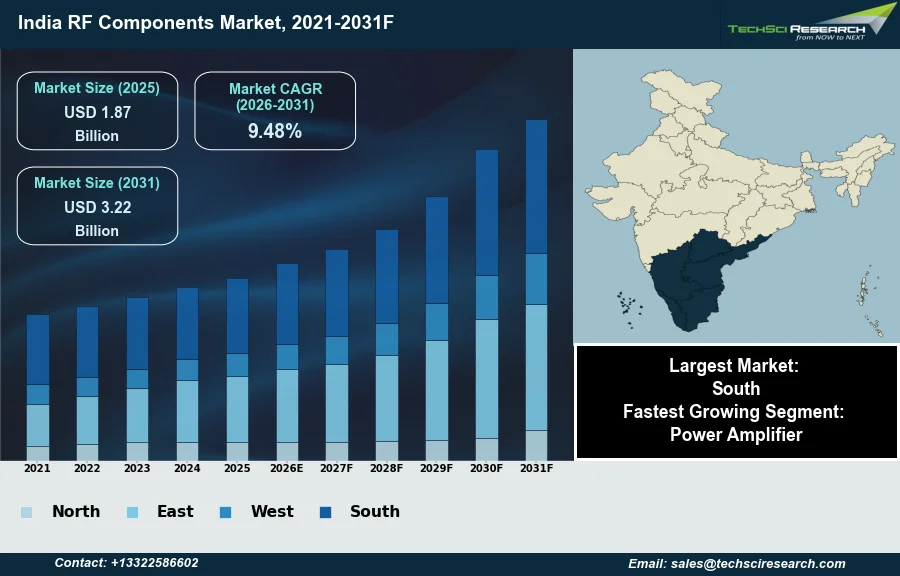
The India RF Components Market is expected to grow from USD 1.87 Billion in 2025 to USD 3.22 Billion by 2031 at a 9.48% CAGR. Radio Frequency (RF) components are indispensable electronic elements enabling wireless communication by efficiently transmitting and receiving radio frequency signals, serving as critical building blocks in devices such as smartphones, base stations, and radar systems. The India RF components market is primarily driven by the rapid expansion of wireless communication networks, notably the extensive deployment of 5G infrastructure, coupled with the increasing proliferation of Internet of Things devices across various industrial and consumer applications. Additionally, the growing demand for consumer electronics and strategic government initiatives promoting domestic electronics manufacturing further stimulate market growth. According to the India Cellular and Electronics Association (ICEA), India's electronics production reached USD 133 billion in 2025, with mobile phone production projected to reach USD 75 billion by the end of fiscal year 2026.
Despite these robust drivers, a significant challenge impeding market expansion is the elevated cost associated with the development and manufacturing of advanced RF components. This complexity arises from substantial investments required for research, specialized material procurement, and precision manufacturing processes, especially for components catering to advanced 5G, IoT, and satellite communication technologies.
Key Market Drivers
5G Rollout and FWA Expand RF Components Demand
Rapid 5G network deployment significantly propels the India RF components market by necessitating advanced infrastructure capable of handling higher frequencies, greater bandwidths, and increased data throughput. This extensive rollout drives demand for a variety of RF components, including power amplifiers, filters, switches, and antenna systems, essential for both macro base stations and small cell deployments. The expansion of 5G Fixed Wireless Access (FWA) further exemplifies this growth; according to the Telecom Regulatory Authority of India (TRAI), in its "India's Wireless Telecom Subscriber Base Rises to Over 1.30 Billion in August 2026: TRAI" report, total wireless 5G FWA subscribers increased from 13.21 million at the end of July 2026 to 13.45 million at the end of August 2026. Such robust subscriber growth for FWA directly translates into higher demand for specialized RF transceivers and other related components.
IoT Proliferation and Domestic Initiatives Boost RF Components Demand
The proliferation of IoT devices also serves as a crucial catalyst for the India RF components market, creating substantial demand for compact, energy-efficient RF modules and connectivity solutions across diverse applications. From smart home devices and wearables to industrial sensors and connected vehicles, each IoT endpoint requires specialized RF components for seamless wireless communication. This trend is underscored by the increasing adoption of machine-to-machine (M2M) cellular connectivity; according to the Telecom Regulatory Authority of India (TRAI), in its "India's Wireless Telecom Subscriber Base Rises to Over 1.30 Billion in August 2026: TRAI" report, M2M cellular mobile connections increased to 140.50 million in August 2026. This escalating demand for connected devices is further supported by broader initiatives aimed at strengthening domestic electronics manufacturing. For instance, according to DD News, in November 2026, the Ministry of Electronics and Information Technology approved 12 additional applications under the Electronics Components Manufacturing Scheme (ECMS), involving a projected investment of ₹7,503 crore.
Download Free Sample Report
Key Market Challenges
Capital Costs Hindering India RF Components Market Growth
The elevated cost associated with the development and manufacturing of advanced radio frequency components presents a significant impediment to the growth of the India RF components market. This challenge stems from the substantial capital outlay required for intensive research and development activities, the procurement of specialized materials, and the implementation of precision manufacturing processes. Such high investment is particularly critical for producing components compatible with advanced communication standards such as 5G, Internet of Things, and satellite communication technologies.
ECMS Investment Reflects Capital Intensity and Market Accessibility
These elevated costs directly affect the competitiveness of domestically produced RF components. The need for significant financial commitment can deter new entrants and limit the expansion capabilities of existing local manufacturers. According to the Ministry of Electronics and Information Technology, as of November 2026, the cumulative approved investment under the Electronics Component Manufacturing Scheme, which aims to boost local production of various components, reached ₹77,051 crore. This substantial investment demonstrates the capital-intensive nature of establishing and scaling component manufacturing within the country, directly impacting market accessibility and the final pricing of RF components.
Key Market Trends
5G Advanced and 6G Drive RF Component Innovation and TTDF R&D
The evolution towards 5G Advanced and 6G technologies is a significant trend, pushing wireless communication capabilities beyond current deployments. This progression necessitates innovations in RF component design to accommodate higher frequency bands, wider bandwidths, and new modulation schemes for future ultra-low latency and massive connectivity. For the India RF components market, this translates into demand for advanced materials, sophisticated packaging, and specialized testing infrastructure. This focus drives research and investment in new RF integrated circuits, filters, and antenna systems. As of February 2026, the government approved 104 projects amounting to ₹271 crore for research and development of 6G technology under the Telecom Technology Development Fund (TTDF) scheme, as informed by the Ministry of Communications to Parliament.
Localization of RF Manufacturing Strengthens India's Domestic Supply Chain
Localization of RF component manufacturing represents a pivotal shift, reducing import reliance and strengthening domestic supply chains within India. This trend stems from national initiatives to boost self-sufficiency in electronics production, fostering indigenous design and manufacturing ecosystems. For the RF components market, this means increased investment in local production facilities for power amplifiers, filters, and modules, alongside developing a skilled workforce. This emphasis aims to mitigate global supply chain disruptions and reduce production costs for device makers. The Ministry of Electronics and Information Technology (MeitY) approved 12 new electronics manufacturing projects worth ₹7,503 crore under the Electronics Components Manufacturing Scheme (ECMS) on November 6, 2026, targeting enhanced domestic production.
Segmental Insights
Key growth drivers for India's Power Amplifier segment
The Power Amplifier segment is experiencing rapid growth within the India RF Components Market. This surge is primarily driven by the aggressive rollout of 5G infrastructure across the nation, necessitating high-performance power amplifiers capable of managing increased data transmission speeds and higher frequencies in modern communication networks. The Department of Telecommunications (DoT) plays a crucial role in shaping this landscape through its policies on licensing and spectrum allocation, which directly influences the expansion of wireless communication capabilities. Furthermore, the escalating demand for wireless connectivity in consumer electronics, such as smartphones, coupled with the proliferation of IoT devices, significantly contributes to the heightened need for efficient RF power amplifiers to ensure seamless and robust signal processing.
Regional Insights
South India as a Manufacturing and R&D Hub for RF Components
South India leads the India RF Components Market, primarily driven by its robust electronics manufacturing ecosystem and supportive infrastructure. The region, particularly Tamil Nadu, has emerged as a significant electronics manufacturing services hub, attracting major global companies and fostering extensive supplier networks. This dominance is further strengthened by a concentrated base of design and research and development facilities, alongside a highly skilled engineering workforce dedicated to advanced electronics and semiconductor technologies. Key states like Tamil Nadu and Telangana host critical manufacturing clusters and companies specializing in high-frequency RF modules for applications spanning wireless communication, telecommunications, and the growing aerospace and defense sectors. Government initiatives, such as the Electronics Components Manufacturing Scheme overseen by the Ministry of Electronics and Information Technology (MeitY), actively promote investment and localized production, solidifying South India's strategic advantage in this essential market segment.
Recent Developments
-
In March 2025, the Indian government approved a $2.7 billion Production Linked Incentive (PLI) scheme designed to bolster local manufacturing of electronic components. This initiative, announced by an Information Minister, aimed to reduce India's reliance on imported components and increase domestic value addition in the electronics sector. The scheme targeted critical sub-assemblies, including those essential for telecommunications, automotive, and consumer electronics industries. This strategic program was projected to attract $7 billion in investments over six years and generate approximately 92,000 direct employment opportunities, thereby strengthening India's position in global supply chains.
-
In December 2024, SAR Televenture collaborated with Vodafone Idea to commence the rollout of additional 4G small cell sites across India, with deployment scheduled to begin in the first quarter of 2025. This initiative formed a part of Vodafone Idea's broader network expansion strategy. SAR Televenture planned to invest INR 42.5 crore for the construction of 1,000 new towers, focusing on micro sites to improve localized coverage. These small base stations necessitate high-performance RF front-end modules, which are crucial for enabling advanced functionalities such as millimeter-wave frequencies and carrier aggregation, directly impacting the India RF components market.
-
In October 2024, CG Power and Industrial Solutions announced an agreement to acquire the Radio Frequency (RF) components business of Japan-based Renesas Electronics Corporation for $36 million. This acquisition allowed CG Power to enter the semiconductor design business. The transaction included intellectual property, tangible assets, and the transfer of select employees involved in semiconductor design and marketing functions. The Chairman of CG Power and Industrial Solutions indicated that this strategic move aimed to enhance India's presence in the semiconductor design and development sector. Completion of the acquisition was anticipated within approximately six months, pending necessary regulatory approvals.
-
In 2025, IndieSemiC introduced India's first IoT Evolution Board at Semicon India. This new product was developed in collaboration with C-DAC, integrating an indigenous VEGA processor with both Bluetooth and LoRa connectivity capabilities. The board aimed to accelerate the prototyping and deployment of secure, scalable IoT solutions across various sectors. Its launch represented a significant step in developing domestic hardware-software stacks and enhancing the availability of integrated RF modules for connected devices within the Indian market.
Key Market Players
- Qualcomm
- Broadcom
- Skyworks
- Qorvo
- Murata
- Analog Devices
- Infineon
- NXP
- Texas Instruments
- MACOM
|
By Product
|
By Material
|
By Module
|
By Application
|
By Region
|
- Filters
- Duplexer
- Power Amplifier
- Antenna Switches
- Modulators & Demodulators & Others
|
- Silicon
- Gallium Arsenide
- Indium Phosphide & Nitride
|
- TX Module
- RX Module & Others
|
- Consumer Electronics
- Automotive
- Military
- Wireless Communication & Others
|
- North India
- East India
- West India
- South India
|
Report Scope:
In this report, the India RF Components Market has been segmented into the following categories, in addition to the industry trends which have also been detailed below:
-
India RF Components Market, By Product:
-
Filters
-
Duplexer
-
Power Amplifier
-
Antenna Switches
-
Modulators & Demodulators & Others
-
India RF Components Market, By Material:
-
Silicon
-
Gallium Arsenide
-
Indium Phosphide & Nitride
-
India RF Components Market, By Module:
-
TX Module
-
RX Module & Others
-
India RF Components Market, By Application:
-
Consumer Electronics
-
Automotive
-
Military
-
Wireless Communication & Others
-
India RF Components Market, By Region:
-
North India
-
East India
-
West India
-
South India
Competitive Landscape
Company Profiles: Detailed analysis of the major companies present in the India RF Components Market.
Available Customizations:
India RF Components Market report with the given market data, TechSci Research offers customizations according to a company's specific needs. The following customization options are available for the report:
Company Information
- Detailed analysis and profiling of additional market players (up to five).
India RF Components Market is an upcoming report to be released soon. If you wish an early delivery of this report or want to confirm the date of release, please contact us at sales@techsciresearch.com