Market Overview
The India Pharmacy Automation Market was valued at USD 40.30 Million in 2024 and is expected to reach USD 66.67 Million by 2030 with a CAGR of 8.71% during the forecast period. The market's expansion is primarily driven by the increasing need for greater efficiency and accuracy in pharmacy operations across the country.
Forecast Period | 2026-2030 |
Market Size (2024) | USD 40.30 Million |
CAGR (2025-2030) | 8.71% |
Fastest Growing Segment | Automated Medication Dispensing and Storage Systems |
Largest Market | South India |
Market Size (2030) | USD 66.67 Million |
A key driver for the pharmacy automation market is the rising demand for improved medication safety and accuracy. Automated systems significantly reduce the risk of human error in dispensing, packaging, and storing medications. Additionally, the growing prevalence of chronic diseases and an aging population are increasing prescription volumes, which pushes pharmacies to adopt automation to manage the workload and ensure timely delivery.
The expansion of hospital chains and e-pharmacies, particularly in major metropolitan areas like Bengaluru, Chennai, and Delhi-NCR, is accelerating the adoption of automated systems. Furthermore, government initiatives such as Ayushman Bharat and the National Digital Health Mission are promoting digital healthcare infrastructure. These policies are creating a favorable environment for integrating automation technologies into pharmacies across India.
Despite strong growth drivers, the market faces notable challenges. The high initial investment required for automation systems is a significant barrier for smaller pharmacies, especially in rural regions. There is also a lack of a trained workforce capable of operating advanced automation technologies. Resistance to change from traditional pharmacy operators who are accustomed to manual processes also remains an obstacle to widespread adoption.
Key Market Drivers
Growing Ageing Population
- India’s
growing ageing population is a key driver of the pharmacy automation
market in India. As the number of older adults rises, demand for
healthcare services, prescription processing, and efficient medication
management is increasing, creating a stronger need for pharmacy automation
solutions.
- The
country’s elderly population, currently around 153 million, is
projected to more than double to 347 million by 2050. This demographic
expansion is expected to place substantial pressure on the healthcare
system, making pharmacy automation increasingly important for handling
higher prescription volumes and improving operational efficiency.
- Pharmacy
automation systems help pharmacies manage the growing medication burden
associated with an ageing population. Automated dispensing systems,
storage solutions, and workflow tools improve the speed, accuracy, and
reliability of medication delivery while reducing the workload on
pharmacists and caregivers.
- Older
adults are more likely to live with chronic diseases such as diabetes,
hypertension, and cardiovascular disorders, which often require multiple
medicines and long-term treatment plans. This increases the need for
automated pharmacy systems that can support precise dispensing, reduce
manual errors, and streamline drug management for patients with ongoing
healthcare needs.
- The 80+ age group in
India is expected to grow by nearly 279% by 2050, making it one of the
most vulnerable and support-dependent population segments. For this group,
pharmacy automation plays a critical role in improving medication
adherence by ensuring timely, accurate dosage delivery and reducing the
need for repeated manual intervention.
- Overall,
the ageing population trend is strengthening demand for pharmacy
automation technologies in India because these systems improve patient
safety, support better medication adherence, and help healthcare providers
manage rising prescription demand more efficiently.
Increasing Chronic Disease Prevalence
- The
increasing prevalence of chronic diseases in India is another major factor
driving the growth of the pharmacy automation market. As more people are
diagnosed with long-term illnesses, the need for reliable, accurate, and
scalable medication management systems is becoming more urgent.
- Data
indicates that 21% of India’s
elderly population lives with at least one chronic condition, with
hypertension and diabetes being the most common. This high chronic disease
burden increases the complexity of treatment regimens and creates strong
demand for pharmacy automation systems that can support consistent and
safe medication dispensing.
- Chronic
diseases often require patients to manage multiple prescriptions over long
periods, raising the risk of dosage mistakes, missed medication, and
dispensing errors. Automated pharmacy technologies such as smart pill
dispensers, automated dispensing systems, and medication compounding
solutions are therefore becoming essential for improving patient safety
and treatment adherence.
- Pharmacy
automation is especially valuable for patients with multi-morbidity, where
several coexisting conditions require careful coordination of medicines.
These technologies help reduce human error, support more accurate
prescription fulfillment, and make it easier for patients to follow
complex treatment plans.
- Chronic
diseases account for the majority of deaths globally and have a
particularly strong impact on low- and middle-income countries such as
India. As India’s population continues to age and chronic disease
prevalence rises, the demand for automated pharmacy solutions is expected
to grow steadily.
- In
the long term, rising chronic disease prevalence will continue to expand
the pharmacy automation market in India by increasing the need for
efficient medication handling, better adherence support, and improved
healthcare delivery quality across pharmacies and healthcare institutions.

Download Free Sample Report
Key Market Challenges
High
Initial Investment Cost
A significant challenge facing the India Pharmacy Automation Market is the high initial cost of implementing automated systems. While automation provides long-term benefits in efficiency and accuracy, the substantial upfront financial commitment is a major barrier. This hurdle particularly affects smaller pharmacies and rural healthcare providers, limiting their ability to adopt modern technology.
The total investment includes more than just the primary hardware, such as robotic dispensing units or automated storage systems. Additional expenses for software, installation, maintenance, and staff training contribute to the high cost. Integrating these systems into existing workflows also adds to the financial burden, making it prohibitive for many smaller businesses.
This high cost creates a disparity in technology adoption between large, well-funded urban pharmacies and their smaller, rural counterparts. Many independent pharmacy owners are hesitant to invest due to an unclear immediate return on investment. This gap means the benefits of automation, such as improved patient safety and efficiency, are not being realized evenly across the country.
To promote wider adoption, more accessible financial models are essential. Solutions like government subsidies, public-private partnerships, or targeted loan schemes could help smaller providers. Furthermore, offering modular systems for gradual adoption or software-as-a-service (SaaS) models could lower the entry barrier, making automation more affordable for a broader range of pharmacies.
Key Market Trends
Rising Adoption of E-Pharmacies
- The
rising adoption of e-pharmacies is a major trend driving growth in the
India pharmacy automation market. As online pharmacy platforms continue to
expand, they are transforming how medicines are distributed, purchased,
and delivered, which is creating strong demand for pharmacy automation
solutions across the pharmaceutical supply chain.
- E-pharmacies
in India are gaining popularity because they offer convenience, easy
access to prescription medicines, a wider product portfolio, and often
lower prices than traditional offline pharmacies. This shift in consumer
behavior is accelerating the digital transformation of pharmacy operations
and increasing the need for automated systems that can support high-volume
order fulfillment.
- The
growth of e-pharmacy platforms is being fueled by rising internet
penetration and increasing smartphone usage across India, especially in
urban and semi-urban areas. With more than 700 million internet
users in the country, online healthcare and e-commerce adoption has grown
rapidly, creating a favorable environment for digital pharmacy platforms
and pharmacy automation technologies.
- Leading
e-pharmacies such as PharmEasy, 1 mg, Netmeds, and
Medlife are reshaping the Indian pharmaceutical market by offering
doorstep delivery of medicines, healthcare products, and online
consultation services. These platforms are making healthcare access more
convenient for consumers and are increasing the operational complexity of
medicine fulfillment, packaging, and inventory handling.
- As
e-pharmacies scale their operations, they must manage large volumes of
orders while maintaining high levels of prescription accuracy. This is
particularly important for chronic disease management, repeat
prescriptions, and medication adherence, where delays or errors can
directly affect patient outcomes.
- To
address these operational challenges, e-pharmacies are increasingly
adopting pharmacy automation systems such as automated medication
dispensing, automated packaging and labeling, and pharmacy inventory
management solutions. These technologies help streamline workflows, reduce
human error, improve order accuracy, and support timely delivery, all of
which are essential in a competitive online pharmacy market.
- Automation
also enables real-time inventory tracking, which is critical for
e-pharmacies handling large and diverse product portfolios. Real-time
visibility helps prevent stockouts, reduces the risk of shipping expired
products, and supports better inventory control, making pharmacy
automation a core enabler of safe and reliable e-pharmacy operations.
- With
growing order volumes and expanding service coverage, scalability has
become a key requirement for online pharmacy businesses in India. Pharmacy
automation technologies help e-pharmacies handle large-scale operations
efficiently without compromising service quality, regulatory compliance,
or customer satisfaction.
- In
addition to operational efficiency, automation improves the overall
customer experience by increasing speed, consistency, and order accuracy.
Better service quality leads to stronger customer trust, higher
satisfaction, and improved loyalty, which are important competitive
advantages in the fast-growing Indian e-pharmacy market.
- Overall,
the rising adoption of e-pharmacies, combined with advances in pharmacy
automation technology, is accelerating the transformation of India’s
pharmaceutical landscape. As demand for convenient, reliable, and safe
medication delivery continues to rise, pharmacy automation will remain
essential for helping e-pharmacies improve efficiency, maintain service
standards, and support long-term market growth.
Segmental Insights
Download Free Sample Report
End
User Insights
Based on End User, Retail Pharmacies emerged as the fastest growing segment in the India Pharmacy Automation Market
during the forecast period. This growth can be attributed to several factors,
primarily the increasing consumer demand for convenience, the rise of chronic
diseases, and the growing adoption of e-pharmacy platforms.
Retail pharmacies in India, particularly those in
urban and semi-urban areas, are witnessing a surge in customer footfall, and
with the rising volume of prescriptions, there is a need to streamline
operations to maintain efficiency and accuracy. Retail pharmacies handle a
large number of prescriptions on a daily basis, and automation systems, such
as automated medication dispensing and inventory management
systems, help reduce the burden on pharmacy staff while ensuring faster and
more accurate service to customers.
Additionally, the rise in chronic disease prevalence
and the aging population has led to more frequent medication prescriptions,
which in turn drives the need for automation to manage complex medication
regimens and reduce medication errors. Retail pharmacies are increasingly
focusing on providing better customer service and improving operational
efficiency, and automation technologies allow them to achieve both. By
automating routine tasks, retail pharmacies can allocate more time to patient
care, consultations, and other value-added services.
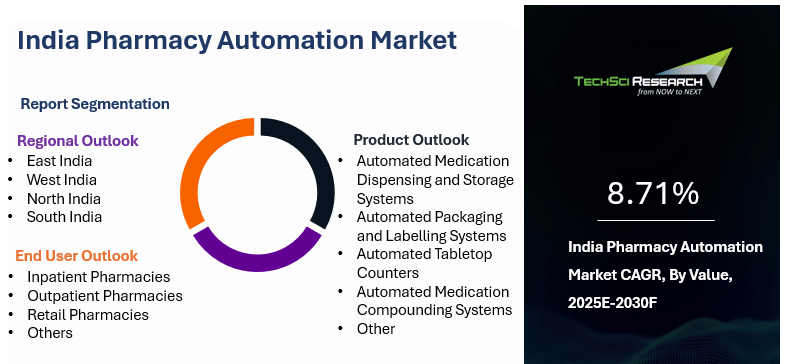
By Product | By End User | By Region |
- Automated Medication Dispensing and Storage Systems
- Automated Packaging and Labelling Systems
- Automated Tabletop Counters
- Automated Medication Compounding Systems
- Other
| - Inpatient Pharmacies
- Outpatient Pharmacies
- Retail Pharmacies
- Others
| - East India
- West India
- North India
- South India
|
Key Market Players
- Becton Dickinson Private Limited
- Omnicell, Inc.
- Baxter International Inc.
- Cerner Corporation
- TouchPoint, Inc.
Regional Insights
Based on Region, South India emerged as the dominating region in the India Pharmacy Automation Market in 2024 driven by several key factors including a strong
healthcare infrastructure, increasing adoption of advanced healthcare
technologies, and a rapidly growing urban population. South Indian states such
as Tamil Nadu, Karnataka, Telangana, Andhra Pradesh,
and Kerala are at the forefront of healthcare innovations, making the
region a significant player in the pharmacy automation market.
One of the primary drivers of South India's dominance
in pharmacy automation is the region's well-established healthcare ecosystem,
which includes numerous leading hospitals, healthcare institutions, and retail
pharmacy chains. Cities like Chennai, Bengaluru,
and Hyderabad are recognized as healthcare hubs, with cutting-edge
medical facilities and a high concentration of tech-savvy consumers. These
urban centers have seen increased demand for automated dispensing
systems, inventory management solutions, and medication compounding
systems due to the rising patient volumes and the need for operational
efficiency.
Recent Development
- In March 2025, Manipal Hospitals has expanded its adoption of advanced AI and data analytics solutions from Google Cloud to enhance pharmacy ordering, medication management, and nurse handoff processes. The hospital has deployed an ePharmacy platform, powered by Google’s generative AI assistant Gemini, to streamline prescription processing and ensure accurate transfer of drug information. The platform leverages advanced visual analytics to monitor user behavior, optimize cart management, delivery tracking, and ordering workflows. It also integrates patients’ post-consultation transaction data across disparate systems via cloud-based APIs. As a result, order processing time on ePharmacy has been reduced from 15 minutes to less than five minutes. The platform currently processes over 60,000 data entries daily and is hosted on Google Kubernetes Engine, enabling it to efficiently manage prescription surges during peak demand. In parallel, Manipal Hospitals has implemented a cloud-based nurse handoff solution, also enabled by GenAI, which provides instant access to critical patient information and streamlines workflow. This has led to a 78% reduction in handover duration, from 90 minutes to 20 minutes, saving millions of caregiver minutes each month.
- In June 2024, Schneider Electric, the
global leader in the digital transformation of energy management and NextGen
automation, has launched EcoStruxure for Life Sciences Segment. This
cutting-edge software technology aims to accelerate the efficiency and
decarbonization of the pharmaceutical sector by facilitating the transition to
Pharma 4.0.
- In June 2024, NIDO Group, a leader in
warehouse automation, announced a strategic integration with 1Pharmacy, an
innovative tech solutions company. This collaboration aims to revolutionize
order fulfillment and sorting processes in the pharmaceutical supply chain,
enhancing efficiency and reducing errors. The partnership leverages NIDO Group's advanced
automation technology and ERP integration to optimize operations and digitalize
the entire value chain. This integration is expected to boost order processing
by 100%, reduce order processing time by 50%, and increase sorting accuracy to
99.9%, setting new standards for efficiency and operational excellence in the
pharmaceutical industry.
- In March
2024, Abbott introduced the GLP Systems Track, an advanced automation
solution designed to enhance laboratory efficiency in India. This system
automates at least 80% of manual steps, reducing errors and accelerating test
result turnaround times. Installed in cities including Ahmedabad, Bengaluru,
Chennai, and Srinagar, it aims to meet the growing demand for diagnostic
services amid India's rising chronic disease burden.
- In February 2024, Chennai Metro Rail
Limited (CMRL) partnered with SIMS Hospital to launch SIMS
Pharmacy outlets at 40 metro stations across Chennai. The first pharmacy
was inaugurated at Vadapalani Metro Station. These AI-integrated pharmacies offer
home delivery, personalized care, and automated prescription processing,
enhancing healthcare accessibility for commuters.
|
Market
Scope
|
Details
|
|
Market
Size (2024)
|
USD
40.30 Million
|
|
Market Size (2030)
|
USD 66.67 Million
|
|
CAGR
(2025–2030)
|
8.71%
|
|
Historic Data
|
2019–2024
|
|
Base
Year
|
2024
|
|
Forecast Period
|
2026–2030
|
|
Fastest
Growing Segment
|
- Automated
Medication Dispensing and Storage Systems
|
|
Largest Market
|
|
|
By
Product
|
- Automated
Medication Dispensing and Storage Systems; Automated Packaging and Labelling
Systems; Automated Tabletop Counters; Automated Medication Compounding
Systems; Others
|
|
By End User
|
- Inpatient Pharmacies; Outpatient Pharmacies; Retail
Pharmacies; Others
|
|
Regional
Scope
|
- East
India; West India; North India; South India
|
|
Key Market Players
|
- Becton Dickinson Private Limited; Omnicell, Inc.; Baxter
International Inc.; Cerner Corporation; TouchPoint, Inc.
|
Report Scope
In this report, the India Pharmacy Automation
Market has been segmented into the following categories, in addition to the
industry trends which have also been detailed below:
- India Pharmacy Automation
Market, By
Product:
o Automated Medication Dispensing and Storage Systems
o Automated Packaging and Labelling Systems
o Automated Tabletop Counters
o Automated Medication Compounding Systems
o Other
- India Pharmacy Automation
Market, By
End User:
o Inpatient Pharmacies
o Outpatient Pharmacies
o Retail Pharmacies
o Others
- India Pharmacy Automation
Market, By Region:
o East India
o West India
o North India
o South India
Competitive Landscape
Company Profiles: Detailed analysis of the major companies
present in the India Pharmacy Automation Market.
Available Customizations:
India Pharmacy Automation Market report with the
given market data, TechSci Research offers customizations according to a
company's specific needs. The following customization options are available for
the report:
Company Information
- Detailed analysis and
profiling of additional market players (up to five).
India Pharmacy
Automation Market is an upcoming report to be released soon. If you wish an
early delivery of this report or want to confirm the date of release, please
contact us at sales@techsciresearch.com