|
Key Insights
|
Details
|
|
Forecast Period
|
2027-2031
|
|
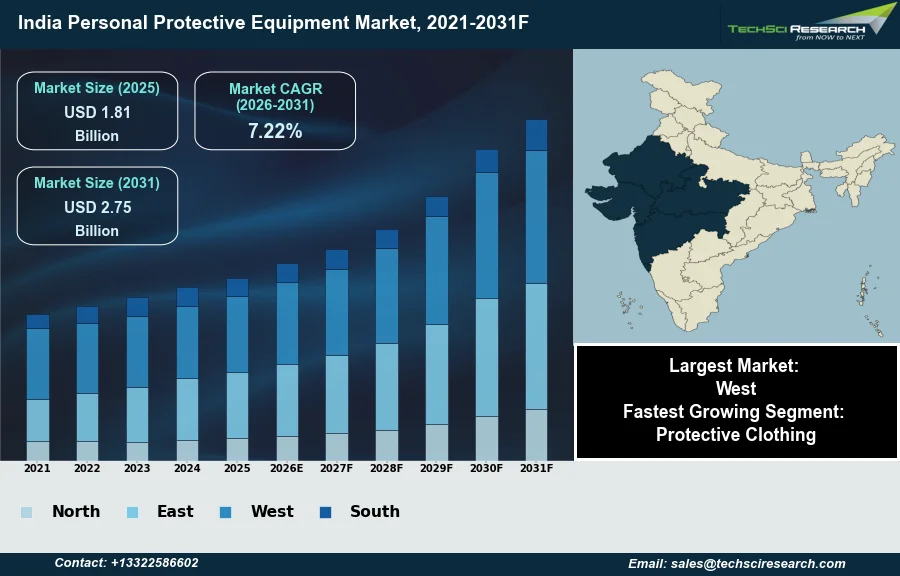
Market Size (2025)
|
USD 1.81 Billion
|
|
CAGR (2026-2031)
|
7.22%
|
|
Fastest Growing Segment
|
Protective Clothing
|
|
Largest Market
|
West
|
|
Market Size (2031)
|
USD 2.75 Billion
|
Market Overview
The India Personal Protective Equipment Market is expected to grow from USD 1.81 Billion in 2025 to USD 2.75 Billion by 2031 at a 7.22% CAGR. Personal Protective Equipment (PPE) encompasses specialized gear and clothing meticulously engineered to safeguard individuals from workplace hazards, including physical, chemical, electrical, and biological threats. The India Personal Protective Equipment Market is primarily driven by rigorous government regulations mandating worker safety, alongside robust industrialization and increasing awareness of occupational health and safety standards across diverse sectors such as manufacturing, construction, and healthcare. According to the Safe in India Foundation's CRUSHED2025 report, India's annual productivity losses due to industrial injuries were estimated at ₹12.5 lakh crore, representing 4.2% of the national GDP in 2025, highlighting the critical importance of effective protective measures.
However, market expansion confronts a significant impediment in the form of acute price sensitivity among end-users and intense competition from the unorganized sector. This market dynamic often leads to a preference for lower-cost, frequently uncertified, alternatives over quality and compliance, thereby hindering the broader adoption of certified and higher-value PPE solutions.
Key Market Drivers
Regulatory Framework Driving PPE Growth
Strict government regulations and compliance standards are a primary catalyst for the expansion of the India Personal Protective Equipment Market. The operationalization of the Occupational Safety, Health and Working Conditions Code, 2020 (OSH Code) and its subsequent rules, such as the Occupational Safety, Health and Working Conditions (Central) Rules, 2026, notified in May 2026, have unified previous fragmented labor laws, creating a singular, comprehensive framework for workplace safety. This rigorous regulatory environment mandates employers across various sectors to implement robust safety protocols and provide certified PPE to their workforce. According to Komico Safety Shoes, May 2026, in 'India's Safety Industry 2026 — PPE Growth & Komico,' non-compliance with the OSH Code now carries penalties of up to ₹3 lakh and potential imprisonment. This regulatory enforcement extends to specific product standards, with the Bureau of Indian Standards continually updating certifications for items like safety footwear.
Industrial and Healthcare Growth Driving PPE Demand
Simultaneously, the substantial growth witnessed in India’s industrial and healthcare sectors directly fuels the demand for personal protective equipment. The manufacturing sector, for instance, has demonstrated considerable expansion. According to India Briefing, June 2026, in its 'India Manufacturing Sector Market Size, Growth' report, manufacturing capital expenditure (CAPEX) reached INR 2.98 trillion (approximately USD 31.45 billion) in FY 2025–26, indicating significant investment in industrial capacity that necessitates enhanced worker protection. Similarly, the healthcare sector's ongoing expansion, driven by infrastructure development and increasing health consciousness, further bolsters PPE consumption. The cumulative impact of these drivers positions the India PPE market strongly; according to The Report Cube, in 2026, the India PPE market is valued at USD 2.96 billion.
Download Free Sample Report
Key Market Challenges
Price sensitivity and unorganized competition curb certified PPE growth
Acute price sensitivity among end-users and intense competition from the unorganized sector represent a significant impediment to the expansion of India's certified Personal Protective Equipment market. This market dynamic fosters a preference for lower-cost, frequently uncertified alternatives over solutions that meet stringent quality and compliance standards. The widespread availability of these cheaper options directly undermines the value proposition of certified PPE, making it challenging for reputable manufacturers to gain market share based on product efficacy and worker protection.
Uncertified PPE sustains protection gaps and injuries
This preference for uncertified products directly hampers market growth for high-quality PPE. It prolongs the use of inadequate protective measures, contributing to continued workplace injuries despite growing industrialization. According to the Safe In India Foundation's CRUSHED2026 report, in 2025, 72% of worker injuries in automobile supply chain factories were crush injuries. This statistic underscores the persistent gap in effective worker protection, a gap often exacerbated by the adoption of sub-standard or counterfeit PPE driven by cost considerations rather than safety performance.
Key Market Trends
IoT-Enabled Smart PPE Driving Proactive Safety Management
The integration of Smart Personal Protective Equipment (PPE) and Internet of Things (IoT) technology represents a significant transformative trend within the India Personal Protective Equipment Market. This shift moves beyond traditional passive protection towards proactive safety management through real-time monitoring and data analytics. Smart helmets, vests, and other wearables equipped with sensors can detect hazardous gases, monitor worker fatigue, and identify potential impacts, instantly alerting both the wearer and supervisors. This advanced capability allows for immediate intervention and a reduction in workplace incidents, enhancing overall occupational safety. According to a report by the Confederation of Indian Industry (CII) published in December 2024, manufacturing companies are projected to increase their technology integration investments, including IoT, from 10% to 11-15% of their overall budget in 2025 and 2026, indicating a growing commitment to such digital safety solutions.
Sustainable Materials and Circular Economy in PPE
Simultaneously, a growing emphasis on sustainable and eco-friendly PPE materials is reshaping product development and consumer preferences in the Indian market. Driven by increasing environmental awareness and a push for circular economy principles, manufacturers are exploring and adopting materials that reduce environmental impact throughout the product lifecycle. This includes the use of recycled content, biodegradable polymers, and ethically sourced natural fibers for various PPE components, such as gloves, protective clothing, and footwear. This trend addresses concerns related to waste generation from disposable PPE and promotes resource efficiency. For instance, according to The Textile Magazine, April 2026, in its article "Polyester Reimagined: Reliance's Vision to Transform Fibre into a Platform for Sustainable Innovation and Global Textile Leadership," Reliance Industries currently possesses a 30 KTA capacity for textile-grade recycled polyester, a material increasingly pertinent to sustainable protective apparel.
Segmental Insights
Rising Demand for Protective Clothing Driven by Industrialization and Regulatory Compliance
The India Personal Protective Equipment Market is experiencing dynamic growth, with Protective Clothing emerging as the fastest-growing segment. This accelerated expansion is largely attributable to rapid industrialization across key sectors such as manufacturing, construction, and chemical industries, which inherently elevate workplace risks. Consequently, stricter occupational safety standards and increased awareness regarding worker protection are driving substantial demand for advanced protective garments. Regulatory bodies like the Bureau of Indian Standards (BIS) and the Directorate General Factory Advice Service & Labour Institutes (DGFASLI) are instrumental in this trend, enforcing mandatory compliance with safety protocols that necessitate continuous investment in high-performance protective clothing solutions.
Regional Insights
West India Emerges as Dominant PPE Market Driven by Industrial Landscape
West India emerges as the dominant region in the India Personal Protective Equipment market, primarily driven by its robust industrial landscape. The states of Maharashtra and Gujarat, central to this region, host significant manufacturing clusters across chemicals, petrochemicals, engineering, and pharmaceuticals, necessitating substantial industrial PPE requirements. This concentration of high-risk industries contributes to an elevated PPE spend per worker, particularly within Gujarat's prominent chemical clusters. Additionally, major industrial entities and ongoing large-scale infrastructure projects, such as Mumbai's construction initiatives, consistently fuel demand for premium-specification protective gear, solidifying the West's leading position.
Recent Developments
-
In September 2025, KARAM Safety entered into a joint venture with ReflectoSafe, a Mumbai-based producer of reflective workwear. This collaboration was established to broaden KARAM Safety's existing safety workwear portfolio within India. The joint venture aimed to leverage ReflectoSafe's robust manufacturing and compliance capabilities alongside KARAM's established distribution network and innovation strengths. This strategic partnership was intended to enhance the high-visibility safety product line, catering to both domestic consumption and export markets, and was focused on developing the estimated ₹500 crore reflective workwear segment in India.
-
In June 2025, Mallcom (India) Ltd., a prominent Indian PPE manufacturer, introduced several new product lines to the market. These launches included GARUD® safety shoes, engineered with wider toes and single-density soles for enhanced wearer comfort and reduced fatigue. The company also unveiled Kaala Peela leather gloves, a premium series designed to combine safety with cultural aesthetics for the Indian consumer. Additionally, Mallcom expanded its offerings with featherlight helmets and ergonomic comfort-fit apparel, catering to evolving consumer preferences for comfortable and effective personal protective equipment within the Indian market.
-
In May 2024, KARAM Safety, a major global and Indian personal protective equipment provider, announced its acquisition of Midas Safety India. Midas Safety India was recognized for its strong presence in the hand protection safety products segment. This strategic acquisition aimed to bolster KARAM Safety's leadership position in India's safety industry by integrating Midas Safety India's extensive portfolio of hand protection products with KARAM's existing expertise. The transaction was a slump deal valued at ₹110 crore for Midas Safety India's operations, significantly expanding KARAM Group's offerings for the Indian PPE market.
-
In the fiscal year 2025, Mallcom (India) Ltd. undertook significant infrastructure investments to support its growth trajectory in the Indian Personal Protective Equipment Market. The company completed Phase I of a new greenfield manufacturing facility in Sanand, Gujarat, dedicated to 'Protec' workwear, with production trials commencing during this period. Concurrently, a new industrial safety shoe plant was developed at Chandpur, West Bengal, which included a DIPP-approved design studio and also began trial production in FY25. These expansions were designed to add critical manufacturing capacity, particularly in the apparel and footwear divisions for the Indian market.
Key Market Players
- 3M India Ltd
- Honeywell
- Ansell
- Kimberly-Clark
- DuPont
- MSA Safety
- Uvex
- Dräger
- Polymax
- Safety First
|
By Product
|
By Application
|
By Distribution Channel
|
By Region
|
- Head
- Eye & Face Protection
- Hearing Protection
- Protective Clothing
- Respiratory Protection
- Protective Footwear
- Hand & Arm Protection
- Fall Protection
|
- Construction & Manufacturing
- Oil & Gas
- Healthcare
- Mining
- Firefighting
- Food & Beverages
- Others (Chemical, Transportation, etc.)
|
- Direct Sales
- Indirect Sales
|
- North India
- East India
- West India
- South India
|
Report Scope:
In this report, the India Personal Protective Equipment Market has been segmented into the following categories, in addition to the industry trends which have also been detailed below:
-
India Personal Protective Equipment Market, By Product:
-
Head
-
Eye & Face Protection
-
Hearing Protection
-
Protective Clothing
-
Respiratory Protection
-
Protective Footwear
-
Hand & Arm Protection
-
Fall Protection
-
India Personal Protective Equipment Market, By Application:
-
Construction & Manufacturing
-
Oil & Gas
-
Healthcare
-
Mining
-
Firefighting
-
Food & Beverages
-
Others (Chemical, Transportation, etc.)
-
India Personal Protective Equipment Market, By Distribution Channel:
-
Direct Sales
-
Indirect Sales
-
India Personal Protective Equipment Market, By Region:
-
North India
-
East India
-
West India
-
South India
Competitive Landscape
Company Profiles: Detailed analysis of the major companies present in the India Personal Protective Equipment Market.
Available Customizations:
India Personal Protective Equipment Market report with the given market data, TechSci Research offers customizations according to a company's specific needs. The following customization options are available for the report:
Company Information
- Detailed analysis and profiling of additional market players (up to five).
India Personal Protective Equipment Market is an upcoming report to be released soon. If you wish an early delivery of this report or want to confirm the date of release, please contact us at sales@techsciresearch.com