|
Key Insights
|
Details
|
|
Forecast Period
|
2027-2031
|
|
Market Size (2025)
|
USD 450.79 Million
|
|
CAGR (2026-2031)
|
9.31%
|
|
Fastest Growing Segment
|
Reverse Osmosis
|
|
Largest Market
|
West
|
|
Market Size (2031)
|
USD 769.01 Million
|
Market Overview
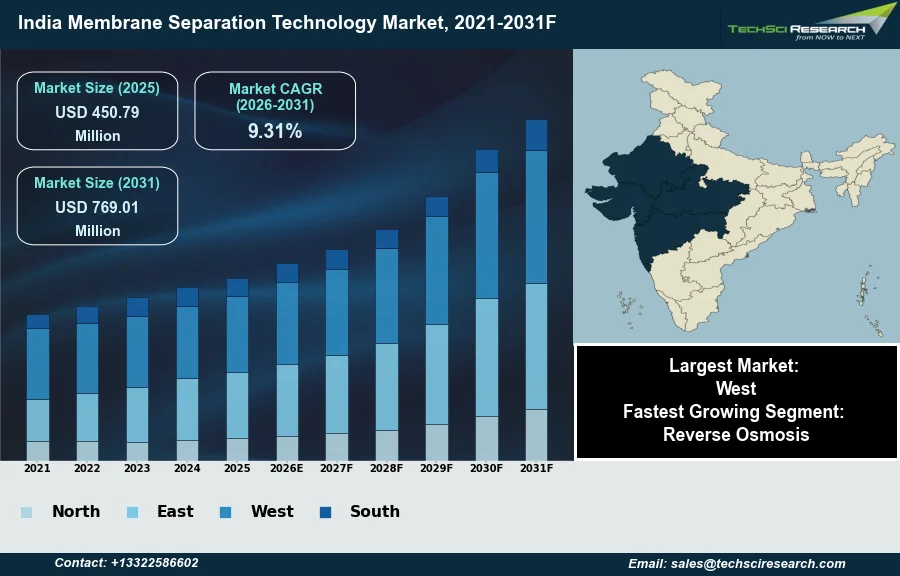
The India Membrane Separation Technology Market is expected to grow from USD 450.79 Million in 2025 to USD 769.01 Million by 2031 at a 9.31% CAGR. Membrane separation technology constitutes a physical process utilizing semi-permeable barriers to selectively separate components from liquid or gas mixtures, typically driven by a pressure differential without requiring heating, thereby offering lower energy consumption than traditional thermal methods. The India Membrane Separation Technology Market is primarily supported by drivers including intensifying water scarcity, necessitating advanced solutions for water and wastewater treatment, and stringent environmental regulations promoting sustainable industrial practices. Furthermore, the robust expansion of key industries such as pharmaceuticals, food and beverage, and chemicals significantly fuels the demand for high-purity separation processes.
While comprehensive, recent statistical numerical data directly from Indian industrial associations for the membrane separation technology market within the last year could not be ascertained under the specified parameters, a significant challenge to market expansion remains the considerable initial capital investment associated with implementing these advanced systems.
Key Market Drivers
Water scarcity drives membrane adoption and desalination investment
Increasing water scarcity and the escalating demand for advanced wastewater treatment are foundational drivers for the India Membrane Separation Technology Market. India, facing significant water stress, necessitates efficient solutions to ensure water security across municipal and industrial sectors. This pressing need directly stimulates the adoption of membrane technologies for processes such as desalination and purification. For instance, according to VA Tech Wabag Limited, October 2026, in its 'VA TECH WABAG LIMITED October 27, 2026 Nat' press release, the company secured a significant order from Reliance Industries Limited for a Desalination Plant with an expandable capacity of 12,600 m3/hr (302 MLD) in Jamnagar, Gujarat. This substantial investment in membrane-based desalination highlights the direct market response to industrial water demands amidst diminishing freshwater resources, ensuring process continuity and sustainability.
Regulatory pushes and government programs accelerate membrane-based treatment
Stringent environmental regulations and proactive government initiatives further propel the market's expansion by mandating higher standards for effluent treatment and promoting water reuse. Regulations increasingly focus on achieving zero liquid discharge (ZLD) and enhancing water recycling rates to mitigate pollution and conserve water bodies. According to SUSBIO, June 2026, in its 'Wastewater Reuse Policies in India 2026: Complete Expert Guide', the Ministry of Jal Shakti mandates all cities to recycle and reuse at least 20% of their water consumption, with the Liquid Waste Management Rules 2024 requiring bulk users to treat and reuse 20% of wastewater by 2027–28, escalating to 50% by 2031. These directives necessitate the deployment of advanced membrane separation systems to meet compliance. Furthermore, according to the Ministry of Jal Shakti, in 2026, under the Namami Gange Programme, 219 sewerage infrastructure projects have been sanctioned, aiming to create a treatment capacity of 6,603 MLD, reflecting extensive government-led investment in water treatment infrastructure that often incorporates membrane technologies.
Download Free Sample Report
Key Market Challenges
Significant upfront capital investment for membrane systems
The challenging factor identified in the overview is the considerable initial capital investment associated with implementing advanced membrane separation systems.
Upfront capital expenditure as a barrier to growth and SME adoption
This significant upfront capital expenditure presents a direct impediment to the growth of the India Membrane Separation Technology Market. The substantial financial outlay acts as a primary barrier to entry, particularly constraining small and medium-sized enterprises (SMEs) and other organizations with limited capital budgets from adopting these crucial solutions. The extended payback periods resulting from these investments often deter potential adopters, making it difficult to justify the immediate financial outlay despite long-term operational benefits.
Capital intensity limiting market penetration and project deployment
This capital intensity hinders market penetration and project implementation across crucial sectors. According to the Confederation of Indian Industry (CII), private sector capital expenditure in India grew by 67% to ₹7.7 lakh crore in September 2025. However, even amidst this overall investment growth, the high initial cost of advanced membrane systems necessitates robust capital allocation and protracted financial planning, often leading businesses to delay adoption, scale back planned installations, or opt for less capital-intensive alternatives. This directly constrains the overall expansion of the membrane separation market within India.
Key Market Trends
Nanomaterial-Enhanced Membranes Transforming India's Market
Advancements in nanomaterial-enhanced membranes are fundamentally reshaping the performance and application scope within India's membrane separation technology market. Innovations leveraging materials such as metal-organic frameworks, graphene oxide, and zinc oxide nanoparticles are leading to the development of membranes with superior filtration capabilities, increased durability, and enhanced resistance to fouling. These next-generation membranes are crucial for addressing complex industrial effluents, particularly from the textile and chemical sectors, where traditional methods often fall short in removing persistent pollutants. According to CSIR–Indian Institute of Chemical Technology (CSIR-IICT), June 2026, in its 'CSIR-IICT develops advanced nanofiber membranes for efficient textile wastewater treatment' news, its electrospun nanofiber membrane achieved nearly 99.1% dye rejection efficiency for textile wastewater treatment, demonstrating the significant leap in purification effectiveness.
Digital and Smart Monitoring in Membrane Systems
The integration of digital and smart monitoring technologies constitutes another pivotal trend influencing the market by optimizing operational efficiency and predictive maintenance. This involves deploying IoT-enabled sensors, AI-driven analytics, and automated control systems that provide real-time insights into membrane performance, potential leakages, and overall system health. Such technologies enable proactive management, reduce downtime, and minimize manual intervention, thereby decreasing operational costs and improving system reliability across municipal and industrial applications. For instance, according to a May 2026 update from Rite Water, in its 'Inside India's Water-Tech Revolution Powered by IoT, Solar Energy & Decentralised Purification' article, the company has established more than 9,130 water purification plants across India, with installed purification capacity exceeding 626 million litres per day (MLD), utilizing IoT-driven water management systems.
Segmental Insights
Drivers of RO Market Growth and Regulatory Influence
In the India Membrane Separation Technology Market, Reverse Osmosis (RO) stands out as the fastest-growing segment. This significant expansion is primarily driven by the critical need for safe drinking water and effective wastewater treatment across residential, commercial, and industrial sectors. India's prevalent issue of high dissolved salts, heavy metals, and contaminants in groundwater necessitates RO technology for purification, making water potable and suitable for diverse industrial processes. Furthermore, rapid urbanization and industrialization, coupled with government initiatives promoting clean water access and sustainability, accelerate the adoption of RO systems. Regulatory bodies such as the National Green Tribunal and the Ministry of Environment, Forest and Climate Change also influence the market through guidelines for appropriate RO system usage, ensuring compliance with standards like those set by the Bureau of Indian Standards.
Regional Insights
West India Emerges as Market Leader Driven by Industrial Growth, ZLD Mandates, and Water Scarcity
The West region emerges as a leading area within India's Membrane Separation Technology Market, driven by its significant industrialization. States such as Maharashtra and Gujarat are key hubs for the pharmaceutical and chemical industries, which necessitate high-purity water for manufacturing processes and stringent effluent treatment. The escalating need to comply with environmental regulations, including Zero Liquid Discharge mandates set by regulatory bodies like the Central Pollution Control Board, compels these industrial sectors to adopt advanced membrane-based solutions. Concurrently, increasing water scarcity in these industrially dense areas further accelerates the demand for efficient wastewater recycling and reuse, solidifying the West's market dominance.
Recent Developments
-
In July 2025, Daltech Engineering Pvt. Ltd. announced a partnership with Airrane, a global leader in membrane technology, to introduce advanced membrane-based solutions to the Indian market. This strategic collaboration aimed to enhance the accessibility of high-efficiency, compact, and sustainable gas separation systems across diverse industries in India. The partnership sought to establish a new category within India's gas technology sector, providing smarter, greener, and more cost-effective solutions to support the nation's drive towards self-reliance and sustainable industrial operations in the India Membrane Separation Technology Market.
-
In March 2025, Memsift Innovations and the Murugappa Group officially launched the GOSEP ultrafiltration (UF) membrane, along with a new manufacturing facility in India. This collaboration marked a substantial step in making advanced membrane chemistries widely available. The newly established plant featured an annual production capacity of 1,200,000 square meters of membranes, equating to 2,000 industrial-scale membrane modules monthly. This capacity was expected to enable the treatment of up to 1.1 billion liters of water daily, addressing critical water challenges across various industries within the India Membrane Separation Technology Market.
-
In late 2025, Vipul Organics Limited's unit, AdiMem Technologies, commenced the commercial sale of its indigenously developed membranes, following its showcase at IFAT India 2025. The company initiated full-scale manufacturing of Reverse Osmosis (RO) and Ultrafiltration (UF) membranes at its Sayakha, Gujarat, facility, utilizing proprietary Reverse Phase Transition technology. This launch positioned AdiMem Technologies as India's first fully indigenous membrane manufacturer, aiming to reduce reliance on imports and provide comprehensive water and wastewater treatment solutions across industrial sectors in the India Membrane Separation Technology Market.
-
In April 2024, Thermax inaugurated a new manufacturing facility in Pune, India, dedicated to water and wastewater treatment solutions. This state-of-the-art facility significantly expanded the company's capabilities, encompassing a range of solutions including Reverse Osmosis (RO) and Sewage Treatment Plants (STP), as well as Effluent Recycling Systems and Zero Liquid Discharge technologies. Notably, the plant was also equipped to produce tubular membrane modules and Capacitive Deionization solutions, reinforcing Thermax's commitment to advancing membrane separation technologies for environmental stewardship in the India Membrane Separation Technology Market.
Key Market Players
- DuPont
- Dow
- Toray
- Koch Membrane
- Pall Corporation
- Hyflux
- Suez
- Mann+Hummel
- 3M India
- Alfa Laval
|
By Application
|
By Region
|
- Water & Wastewater Treatment
- Food & Beverage
- Industry Processing
- Medical & Pharmaceutical and Others
|
- North India
- East India
- West India
- South India
|
Report Scope:
In this report, the India Membrane Separation Technology Market has been segmented into the following categories, in addition to the industry trends which have also been detailed below:
-
India Membrane Separation Technology Market, By Application:
-
Water & Wastewater Treatment
-
Food & Beverage
-
Industry Processing
-
Medical & Pharmaceutical and Others
-
India Membrane Separation Technology Market, By Region:
-
North India
-
East India
-
West India
-
South India
Competitive Landscape
Company Profiles: Detailed analysis of the major companies present in the India Membrane Separation Technology Market.
Available Customizations:
India Membrane Separation Technology Market report with the given market data, TechSci Research offers customizations according to a company's specific needs. The following customization options are available for the report:
Company Information
- Detailed analysis and profiling of additional market players (up to five).
India Membrane Separation Technology Market is an upcoming report to be released soon. If you wish an early delivery of this report or want to confirm the date of release, please contact us at sales@techsciresearch.com