|
Key Insights
|
Details
|
|
Forecast Period
|
2027-2032
|
|
Market Size (2025)
|
USD 4.04 Billion
|
|
CAGR (2026-2031)
|
5.97%
|
|
Fastest Growing Segment
|
Polycarbonate
|
|
Largest Market
|
West
|
|
Market Size (2031)
|
USD 5.72 Billion
|
Market Overview
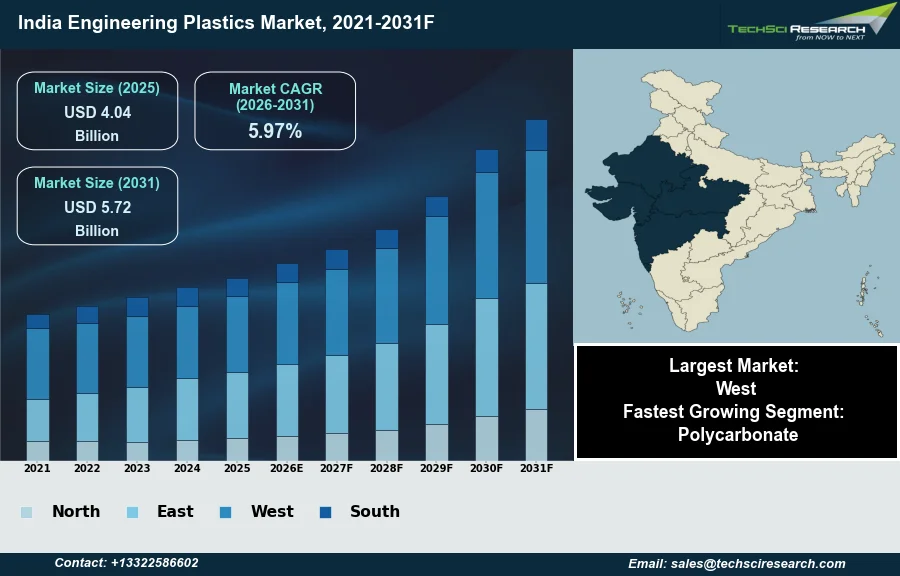
The India Engineering Plastics Market is expected to grow from USD 4.04 Billion in 2025 to USD 5.72 Billion by 2031 at a 5.97% CAGR. Engineering plastics are a class of polymers specifically engineered to possess enhanced mechanical, thermal, and chemical properties, distinguishing them from commodity plastics. These materials are crucial for applications demanding high performance, often serving as lightweight yet durable alternatives to metals. The India Engineering Plastics Market is primarily driven by the escalating demand from the automotive sector for lightweight components promoting fuel efficiency and the increasing adoption of electric vehicles. Furthermore, the expanding electronics industry significantly contributes to market growth, relying on these materials for durable and heat-resistant applications, alongside the growing consumer goods manufacturing.
Supporting this expansion, the Indian plastics industry demonstrates robust activity. According to the Plastics Export Promotion Council of India (PLEXCONCIL), during April-July 2026, India's plastics exports experienced a significant 17.4% growth, reaching US$ 4,996.8 million from US$ 4,257.3 million in the previous year's corresponding period. A notable challenge impeding market expansion is the inherent volatility in raw material prices, such as petrochemical feedstocks, which are susceptible to global supply chain disruptions and geopolitical factors, directly impacting manufacturing costs and profitability.
Key Market Drivers
Automotive and EV Growth Driving Engineering Plastics Demand
The expanding automotive sector and increasing adoption of electric vehicles are significant drivers for the India Engineering Plastics Market. Engineering plastics are increasingly replacing traditional materials like metal in vehicle manufacturing due to their lightweight properties, which contribute to enhanced fuel efficiency in conventional automobiles and extended range in electric vehicles. Their superior strength-to-weight ratio, corrosion resistance, and design flexibility make them essential for components ranging from interior parts and under-the-hood applications to battery casings and structural elements in electric vehicles. According to EVreporter, referencing Vahan Dashboard data, India recorded 3,333,424 electric vehicle sales from November 2025 to October 2026, underscoring the rapid growth in this segment that necessitates high-performance polymeric materials.
Electronics Manufacturing Expansion and Policy Support Boost Engineering Plastics Demand
Concurrently, the robust growth in electronics manufacturing strongly influences the demand for engineering plastics in India. These materials are critical for the production of consumer electronics, telecommunications equipment, and industrial electronics, offering essential properties such as heat resistance, electrical insulation, and durability. According to the Ministry of Electronics and Information Technology (MeitY), India's electronics manufacturing production rose to an estimated ₹13.11 lakh crore in FY 2025-26, highlighting the sector's substantial scale and its continuous need for advanced plastic components. Furthermore, government initiatives like the Electronics Component Manufacturing Scheme are actively boosting domestic production capabilities. According to the Ministry of Electronics and Information Technology, as of August 2026, 106 projects have been approved under this scheme, involving an approved investment of ₹69,548 crore.
Download Free Sample Report
Key Market Challenges
Volatility in Raw Material Prices Elevates Costs and Planning Risk
The inherent volatility in raw material prices, particularly petrochemical feedstocks, presents a significant challenge to the India Engineering Plastics Market. This fluctuation, often driven by global supply chain disruptions and geopolitical factors, directly escalates manufacturing costs for producers of engineering plastics. Such unpredictable cost structures hinder effective business planning and pricing strategies.
Rising Input Costs Compress Profits and Impede Investment
The direct impact on profitability is substantial. According to the All India Plastics Manufacturers' Association (AIPMA), input costs for plastic producers, including those manufacturing engineering plastics, surged by 50 to 60 percent during March 2026, primarily due to increased prices of crude-linked polymers. This sharp rise in expenses compresses profit margins for manufacturers, making it difficult to maintain sustainable operations. Furthermore, the inability to consistently absorb or pass on these elevated costs can deter investment in capacity expansion, technological upgrades, or new product development, directly stifling the overall growth of the India Engineering Plastics Market.
Key Market Trends
Biopolymer Production Accelerating Sustainable Engineering Plastics in India
Growing adoption of sustainable and eco-friendly engineering plastics represents a key evolutionary pathway for the India Engineering Plastics Market, driven by increasing environmental consciousness and regulatory pressures for a circular economy. This trend signifies a shift towards bio-based and biodegradable alternatives that reduce reliance on petrochemical derivatives and mitigate plastic pollution. A notable development supporting this is the upcoming launch of India's first large-scale biopolymer plant. According to Jagran Josh, in its August 2026 article "India's First Large-Scale Biopolymer Plant Set for October Launch: Transforming Sugarcane into Eco-Friendly Plastics", Balrampur Chini Mills Limited's facility in Lakhimpur Kheri is slated to commence operations by October 2026 with an annual production capacity of 80,000 tonnes of Polylactic acid, a significant move towards indigenous sustainable material production.
Recycling Technologies and Investment Driving India's Plastics Recovery
Advancements in recycling technologies for engineering plastics are further shaping the market by enabling the recovery and reuse of high-performance polymers, addressing waste management challenges and creating new material streams. Innovations in mechanical and chemical recycling are crucial for processing complex plastic waste into valuable secondary raw materials, thereby enhancing resource security and reducing virgin material consumption. Reflecting confidence in this sector, Singapore-based investment firm Circulate Capital committed US$150 million to recycling and resource recovery businesses in India in June 2026. This investment, reported by Envirotec Magazine in its June 2026 article "Group commits $150m to expand recycling infrastructure across India", is aimed at expanding recycling infrastructure and supporting companies involved in plastics recycling and materials recovery.
Segmental Insights
Polycarbonate: Fastest-growing segment driven by automotive and electronics demand, supported by Make in India and PLI schemes.
In the India Engineering Plastics Market, Polycarbonate stands out as the fastest-growing segment, primarily driven by its expanding applications across critical industries. This rapid growth is largely attributed to the increasing demand from the automotive sector, where Polycarbonate's properties such as lightweight and high impact resistance are crucial for components like headlamp lenses and interior trims, particularly with the push for fuel efficiency and electric vehicles. Concurrently, the booming electrical and electronics industry heavily utilizes Polycarbonate for durable, heat-resistant, and flame-retardant enclosures, switchgear, and LED lighting, supported by ongoing urbanization and infrastructure development. Furthermore, government initiatives like "Make in India" and Production Linked Incentive (PLI) schemes foster domestic manufacturing, further accelerating the adoption of high-performance materials such as Polycarbonate.
Regional Insights
West India's Engineering Plastics Leadership: Ecosystem, Infrastructure, and Logistics
West India holds a leading position in the India Engineering Plastics Market, primarily driven by its well-established industrial ecosystem. The region benefits from a significant concentration of major polymer and plastic manufacturers, supported by robust infrastructure including advanced petrochemical complexes and polymer processing clusters in states such as Maharashtra and Gujarat. This dominance is further attributed to the substantial presence of key end-use industries, including automotive, electronics, and construction, generating high demand for engineering plastics. Additionally, strategic geographical advantages, such as proximity to raw material sources and major ports, facilitate efficient logistics and bolster market leadership.
Recent Developments
-
In April 2025, Steer World, a Bengaluru-based company, announced a significant breakthrough in plastic recycling technology with its Omega Twin-Screw Extrusion Technology. This innovation enables the recycling of traditionally difficult-to-melt plastics, such as crosslinked polyethylene (XLPE), commonly used in electrical wiring. The technology effectively breaks down the strong chemical bonds in XLPE, converting plastic scraps into reusable pellets called De-XLPE. This development holds substantial implications for the India Engineering Plastics Market by offering a sustainable solution for high-performance plastic waste, supporting the circular economy.
-
In December 2024, the ENGEL Group, a prominent provider of injection molding technology, established a strategic partnership with Electronica Plastic Machines (EPM), an Indian manufacturer based in Pune. Through acquiring a stake in EPM, the Indian company officially became a part of the ENGEL Group, fostering deeper collaboration within the Indian plastics sector. This alliance aims to strengthen local production capacities for advanced injection molding machines, particularly for the Indian Engineering Plastics Market, aligning with the "Make in India" initiative and enhancing access to technology.
-
In August 2024, LG Chem Ltd. unveiled a new PFAS-free flame-retardant PC/ABS material, marking a notable development for the India Engineering Plastics Market. This innovative engineering plastic incorporates over 50% recycled content and achieved the highest UL94 V-0 flame retardancy rating. The material was developed to significantly reduce carbon emissions by approximately 46% during its production. It is specifically engineered for a range of applications in critical sectors such as electronics, electric vehicle chargers, and various industrial equipment, contributing to sustainable material solutions.
-
In May 2024, BASF India significantly expanded its engineering plastics production capabilities within the country. The company announced an increase of over 40% in the compounding capacity for its Ultramid (polyamide) and Ultradur (polybutylene terephthalate) materials. This expansion occurred at their facilities located in Panoli, Gujarat, and Thane, Maharashtra. The enhancement was undertaken to meet the growing demand from crucial sectors in the Indian market, particularly the automotive and electrical and electronics industries, underscoring a commitment to local manufacturing in the India Engineering Plastics Market.
Key Market Players
- Gujarat Fluorochemicals Limited
- BASF India Limited
- LG Polymers India Pvt. Ltd.
- Radici Plastics India Pvt. Ltd.
- APPL Industries Limited
- E.I. DuPont India Private Limited
|
By Polymer Type
|
By End User
|
By Region
|
- ABS
- Polycarbonate
- SAN
- Polyamide
- PBT
- Others
|
- Automotive
- Electrical & Electronics
- Consumer Goods
- Others
|
- North India
- East India
- West India
- South India
|
Report Scope:
In this report, the India Engineering Plastics Market has been segmented into the following categories, in addition to the industry trends which have also been detailed below:
-
India Engineering Plastics Market, By Polymer Type:
-
ABS
-
Polycarbonate
-
SAN
-
Polyamide
-
PBT
-
Others
-
India Engineering Plastics Market, By End User:
-
Automotive
-
Electrical & Electronics
-
Consumer Goods
-
Others
-
India Engineering Plastics Market, By Region:
-
North India
-
East India
-
West India
-
South India
Competitive Landscape
Company Profiles: Detailed analysis of the major companies present in the India Engineering Plastics Market.
Available Customizations:
India Engineering Plastics Market report with the given market data, TechSci Research offers customizations according to a company's specific needs. The following customization options are available for the report:
Company Information
- Detailed analysis and profiling of additional market players (up to five).
India Engineering Plastics Market is an upcoming report to be released soon. If you wish an early delivery of this report or want to confirm the date of release, please contact us at sales@techsciresearch.com