|
Forecast Period
|
2026-2030
|
|
Market Size (2024)
|
USD 389.07 Million
|
|
Market Size (2030)
|
USD 551.97 Million
|
|
CAGR (2025-2030)
|
6.08%
|
|
Fastest Growing Segment
|
Helicopter
|
|
Largest Market
|
West India
|
Market Overview
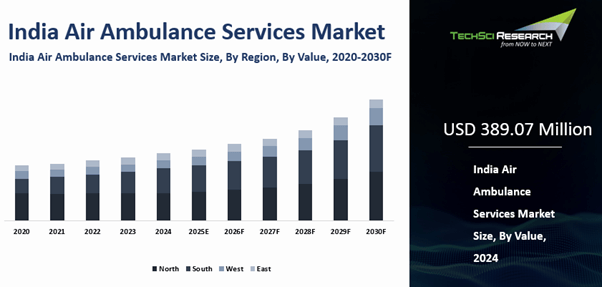
India Air Ambulance Services Market was valued at USD 389.07 Million in 2024 and is anticipated to reach USD 551.97 Million by 2030, with a CAGR of 6.08% during 2025-2030.
Several key factors are driving the India Air Ambulance Services Market. The growing demand for
emergency medical transportation services, particularly in remote or
inaccessible areas, is fueling the expansion of the air ambulance sector. Advancements
in aviation technology and medical equipment have enhanced the capabilities of
air ambulance providers, enabling them to deliver rapid, specialized medical
care during critical emergencies. Increasing awareness about the importance of
timely medical intervention and the availability of air ambulance services for
medical evacuation and repatriation are further driving market growth.
Collaborations
between air ambulance operators, hospitals, and insurance providers to
streamline operations and improve access to emergency medical services are also
contributing to the market's expansion. As the demand for high-quality
emergency medical transportation continues to rise, the India Air Ambulance Services
Market is expected to witness sustained growth in the coming years.
Download Free Sample Report
Key Market Drivers
Growing Demand for Emergency Medical Services
The increasing demand for emergency medical
services, particularly in regions with limited access to advanced healthcare
facilities, is a significant driver of the India Air Ambulance Services Market.
In India, where vast rural areas often lack adequate healthcare infrastructure,
air ambulances play a crucial role in providing timely medical assistance and
transportation for critically ill or injured patients.
The rising awareness
about the importance of prompt medical intervention, especially in cases of
trauma, cardiac emergencies, and obstetric complications, has led to a surge in
demand for air ambulance services across the country. The emergence of India as
a popular medical tourist destination due to the availability of world-class
services at an affordable price is expected to create lucrative opportunities
for the growth of the India Ambulance Service Market for both inbound and outbound
medical tourism, growing adoption of modern technologies, and the implementation
of swift technological developments in such services across the country.
According to the Minister of State for Civil Aviation, India has only 49 air ambulances operated by 19 operators. Out of these 49,
Delhi has 39 air ambulances, followed by Maharashtra with 5. Around 4,100
patients have availed air ambulance services in India in the last two to three years. Over the years, the number of people availing air ambulance services has significantly increased, and this is expected to create huge prospects for market growth in the coming years.
Advancements in Aviation Technology and Medical
Equipment
Technological progress is reshaping air ambulance operations in India by turning aircraft into flying critical-care units that can deliver hospital-like support while the patient is still in transit. Indian Air Ambulance Services highlights that its aircraft carry advanced cardiac and respiratory equipment such as Propaq monitors, Zoll defibrillators, external and transvenous pacemakers, oxygen concentrators, portable ventilators, aeromedical oxygen cylinders, intubation tools, chest drain sets, and specialized stretchers, which together strengthen onboard stabilization for high-acuity cases and make long-distance emergency transfers far more reliable than conventional transport alone.
This medical sophistication is being matched by a broader aviation upgrade, as route planning, navigation, and communication technologies help crews coordinate faster with hospitals and ground responders and support more precise emergency deployment across challenging geographies. The ePlane Company agreed to supply 788 air ambulances to ICATT in a deal valued at more than 1 billion dollars, a strong signal that India is moving toward a much larger and more technology-driven emergency air mobility network.
Increasing Incidence of Road Accidents and Medical
Emergencies
The growing burden of trauma and time-sensitive medical emergencies is making air ambulance support more essential in India, especially when patients must be moved quickly from accident sites or smaller hospitals to advanced tertiary centers. India recorded 461,312 road accidents in 2022, leading to 168,491 deaths and 443,366 injuries, a scale of emergency demand that reinforces the value of rapid medical evacuation when every minute affects survival and neurological recovery.
Drawing largely from India Air Ambulance Services, the case for faster aerial transfer is strengthened by the fact that these providers operate with onboard intensive-care capability, carrying equipment such as portable ventilators, oxygen systems, defibrillators, infusion pumps, and patient monitors so that stabilization can continue during flight rather than waiting until hospital arrival. A strong operational reference point also comes from Medanta’s published four-year experience in India, where 586 patients were air transported over 3,030 flying hours with no transport-related mortality, underscoring how air medical transfer can function as a dependable bridge to specialized care for cardiac, neurological, and other critical cases.
Increasing Medical Tourism and International
Patient Transfers
India’s rise as a medical tourism hub is creating stronger demand for cross-border air ambulance and medical repatriation services, especially for international patients who need continuous clinical supervision before or after complex treatment. Drawing largely from India’s air ambulance ecosystem, these transfers are increasingly structured around ICU-equipped aircraft, trained critical-care teams, and coordination with hospitals, insurers, and facilitators so that patients can move safely across borders without breaking the treatment pathway.
Medanta’s published clinical experience offers a strong high-authority proof point here, showing that over a four-year period it air transported 586 patients, including international evacuations from locations as distant as San Francisco with a maximum transfer time of 1,560 minutes, demonstrating that India-linked medical air transfer is already operating across long-haul global corridors for specialized care access. The international patient flow itself is substantial, with the Press Information Bureau reporting 131,856 foreign tourist arrivals for medical purposes in India up to April 2025, which reinforces why air ambulance operators are becoming an important enabler of inbound treatment journeys and outbound repatriation support.
Key Market Challenges
Regulatory Compliance and Licensing
Regulatory compliance and licensing requirements
present significant challenges for air ambulance operators in India. The
Directorate General of Civil Aviation (DGCA) regulates civil aviation
operations in the country and mandates stringent safety standards and licensing
procedures for air ambulance services. Obtaining necessary approvals, permits,
and licenses from regulatory authorities can be a time-consuming and
bureaucratic process, delaying the launch or expansion of air ambulance
operations. Compliance with aviation regulations and adherence to safety
protocols impose additional operational costs and administrative burdens on air
ambulance operators, impacting their profitability and sustainability.
High Operational Costs and Financial Sustainability
The high operational costs associated with air
ambulance services pose a significant challenge for operators in the India Air
Ambulance Services Market. Acquiring and maintaining specialized aircraft,
medical equipment, and trained medical personnel entail substantial capital
investment. Fuel costs, maintenance expenses, insurance premiums, and
regulatory compliance fees contribute to the overall operational expenditure.
Despite high demand for air ambulance services, operators often struggle to achieve financial sustainability and profitability because of significant
overhead costs and limited reimbursement mechanisms. Inadequate insurance
coverage and reimbursement rates for air ambulance services further exacerbate operators' financial challenges, posing a barrier to market growth and expansion.
Key Market Trends
Strategic Partnerships and Collaborations
Strategic partnerships and collaborations among air ambulance operators, hospitals, healthcare providers, and insurance companies are driving growth in the India Air Ambulance Services Market. Air ambulance operators collaborate with hospitals and healthcare facilities to streamline patient transfers, with some offering "bed-to-bed" services. For instance, Aeromed International Rescue Services has partnered with Sarla Aviation to develop Vertical Take-Off and Landing (VTOL) aircraft and integrate this air mobility into hospital emergency protocols. Similarly, Lifesavers has established connections with leading Delhi hospitals like Sir Ganga Ram Hospital and Fortis Escorts Heart Institute to ensure seamless patient transfers.
Partnerships with insurance companies enable air ambulance operators to offer cashless settlement facilities, direct billing, and discounted rates for policyholders. Many health insurance plans in India now include coverage for air ambulance charges. For example, the New India Premier Mediclaim Policy provides up to INR 1,00,000 for air ambulance services for any one illness, while some Care Health Insurance plans offer benefits up to ₹5 lakhs. The government of Madhya Pradesh launched the PM Shri Air Ambulance Service, which is completely free for Ayushman Bharat cardholders. These collaborations enhance the accessibility and affordability of air ambulance services for insured patients.
Technological Innovations and Telemedicine
Integration
Technological innovations and the integration of telemedicine solutions are transforming the India Air Ambulance Services Market. Air ambulance operators are leveraging telemedicine platforms, remote monitoring devices, and teleconsultation services to provide real-time medical assistance and specialist consultation to patients during transit. Telemedicine enables medical personnel on board air ambulances to communicate with healthcare professionals on the ground, share vital patient data, and make informed medical decisions, thereby improving the quality of care and patient outcomes. For example, a study of the Indian Armed Forces found that teleconsultations helped manage 18 casualties per year at peripheral sites, avoiding air evacuation and resulting in an estimated cost savings of Rs. 146,111 per case.
Advancements in drone technology and unmanned aerial vehicles (UAVs) hold the potential to revolutionize medical logistics and emergency response. Drones are being piloted to deliver essential medical supplies like blood and organs to remote areas, addressing logistical challenges posed by difficult terrain or heavy traffic. The Haridwar District Jail in Uttarakhand, for instance, has introduced a drone ambulance service to enhance healthcare access for inmates. These innovations are further enhancing the efficiency and effectiveness of air ambulance services in India.
Segmental Insights
Type Insights
Based on the Type, helicopters currently dominate airplanes due to several factors unique to the
Indian context. Helicopters offer unparalleled versatility and manoeuvrability,
making them well-suited for navigating India's diverse terrain, including
densely populated urban areas, remote rural regions, and mountainous terrain
where access to traditional runways may be limited or non-existent. This
flexibility enables helicopters to reach patients in hard-to-reach locations
quickly and efficiently, providing timely medical evacuation and critical care
services in emergency situations.
Helicopters have a smaller
footprint and can land in confined spaces, such as hospital helipads, open
fields, or makeshift landing zones, allowing for direct access to patients
without the need for additional ground transportation. This capability is
particularly advantageous in densely populated urban areas, where congested
roadways and traffic congestion can impede the timely arrival of ground
ambulances. Helicopters offer rapid response times and can be airborne within
minutes of receiving an emergency call, reducing the time taken to reach
patients and initiate medical interventions. This swift response is crucial in
critical medical emergencies, such as trauma incidents, cardiac arrests, and
obstetric complications, where every minute counts in determining patient
outcomes.
Service Provider Insights
Based on Service Provider, hospital-based
operators currently dominate the landscape, followed closely by independent
operators and government/non-profit organizations. Hospital-based air ambulance
services are typically integrated within established healthcare institutions,
including tertiary care hospitals, trauma centers, and medical colleges. These
operators leverage existing hospital infrastructure, resources, and medical
expertise to provide seamless emergency medical transportation and critical
care services to patients in need. With direct access to hospital facilities,
such as emergency departments, operating theaters, and intensive care units,
hospital-based air ambulance services offer a comprehensive continuum of care,
ensuring patients receive timely and specialized medical treatment from the
moment of retrieval to arrival at the receiving facility.
Hospital-based operators
often collaborate with multidisciplinary healthcare teams, including emergency
physicians, critical care specialists, trauma surgeons, and paramedics, to
deliver advanced medical interventions and ensure optimal patient outcomes.
This integrated approach enables hospital-based air ambulance services to
provide a higher level of medical care, including advanced life support, trauma
management, and specialized interventions such as organ retrieval and neonatal
transport.

Download Free Sample Report
Regional Insights
In the India Air Ambulance Services Market, the
Western region emerges as the dominant force, exerting significant influence
and contributing substantially to market growth and development. Comprising
states such as Maharashtra, Gujarat, Rajasthan, and Goa, the Western region
boasts several factors that underpin its dominance in the air ambulance sector.
The Western region is home to several major
metropolitan cities, including Mumbai, Pune, Ahmedabad, and Surat, which serve
as key hubs of economic activity, commerce, and healthcare infrastructure.
These cities house world-class medical facilities, tertiary care hospitals, and
trauma centers equipped with advanced medical technology and specialized
healthcare services. As a result, the demand for air ambulance services in the
Western region is driven by the need to provide rapid medical evacuation and
specialized critical care to patients requiring urgent medical attention. The
Western region has a well-developed transportation infrastructure, including
airports, helipads, and road networks, facilitating seamless air and ground
transportation for air ambulance operations. This infrastructure enables air
ambulance operators to deploy their fleets quickly and efficiently, minimizing
response times and ensuring timely access to patients in need across urban and
rural areas.
Recent Developments
- In March 2026, Apollo Hospitals expanded its air ambulance services by signing MoUs with multiple national and international operators and coordinating transfers through its 1066 Emergency Response Network. The article said the initiative combines Apollo’s emergency coordination, ground ambulance support, airport-to-hospital connectivity, and partner-operated air transfers to provide bed-to-bed movement for critically ill patients from remote regions, Tier II and Tier III cities, and even international locations. This was an important collaboration-led development because it aimed to reduce fragmentation in patient transfers and make advanced critical-care air evacuation more organized and accessible in India.
- In January 2026, Andhra Pradesh government partnered with the Dr Kalam Advanced UAV Research Center at Anna University, Chennai, to develop a long-range human-carrying drone ambulance for remote-area emergency response. The article said the drone ambulance is being designed to carry patients and essential medical supplies, with a payload capacity of about 150 kg, flight endurance of up to 90 minutes, and a prototype test flight targeted for May 2026. As a breakthrough innovation, this project stands out because it extends the idea of air ambulance services into unmanned medical evacuation for hard-to-reach terrain where conventional road and helicopter response can be slower or costlier.
- In September 2025, Aeromed International Rescue Services and Sarla Aviation signed an MoU to develop VTOL and STOL aircraft for emergency medical evacuation in India. The agreement covered not only aircraft deployment for patient transfer and organ transport, but also plans to integrate air mobility into hospital emergency protocols through rooftop and vertiport landing facilities and specially designed medical cabins fitted with ventilators and other onboard equipment. The development is significant because it moves India’s air ambulance model beyond chartered transfers toward a more structured, hospital-connected emergency aviation ecosystem.
Key Market Players
- Blade India
- Accretion Aviation
- Air Charter Services Pvt. Ltd.
- Apollo Hospital Enterprise,
Ltd.
- Air Rescuers World Wide Pvt Ltd.
- Flaps Aviation Pvt. Ltd.
- Medanta (Global Health
Limited)
- Vedanta Air Ambulance
- AmbiPalm
- EMSOS Medical Pvt Ltd
|
By Type
|
By Service Provider
|
By Service
|
By Region
|
|
|
- Hospital-Based
- Independent Operators
- Government/Non-Profit Organization
- Others
|
|
|
Report Scope:
In this report, the India Air Ambulance Services
Market has been segmented into the following categories, in addition to the
industry trends which have also been detailed below:
- India Air Ambulance Services
Market, By
Type:
o Aeroplane
o Helicopter
- India Air Ambulance Services
Market, By
Service Provider:
o Hospital-Based
o Independent Operators
o Government/Non-Profit
Organization
o Others
- India Air Ambulance Services
Market, By
Service:
o Domestic
o International
- India Air Ambulance Services
Market, By
Region:
o North
o South
o West
o East
Competitive Landscape
Company Profiles: Detailed analysis of the major companies
present in the India Air Ambulance Services Market.
Available Customizations:
India Air Ambulance Services Market report with
the given market data, TechSci Research offers customizations according to a
company's specific needs. The following customization options are available for
the report:
Company Information
- Detailed analysis and
profiling of additional market players (up to five)