|
Key Insights
|
Details
|
|
Forecast Period
|
2026 - 2031
|
|
Market Size (2025)
|
USD 4.63 Billion
|
|
CAGR (2026-2031)
|
4.66%
|
|
Fastest Growing Segment
|
Para-aramid synthetic fibers
|
|
Largest Market
|
Asia Pacific
|
|
Market Size (2031)
|
USD 6.09 Billion
|
Market Overview
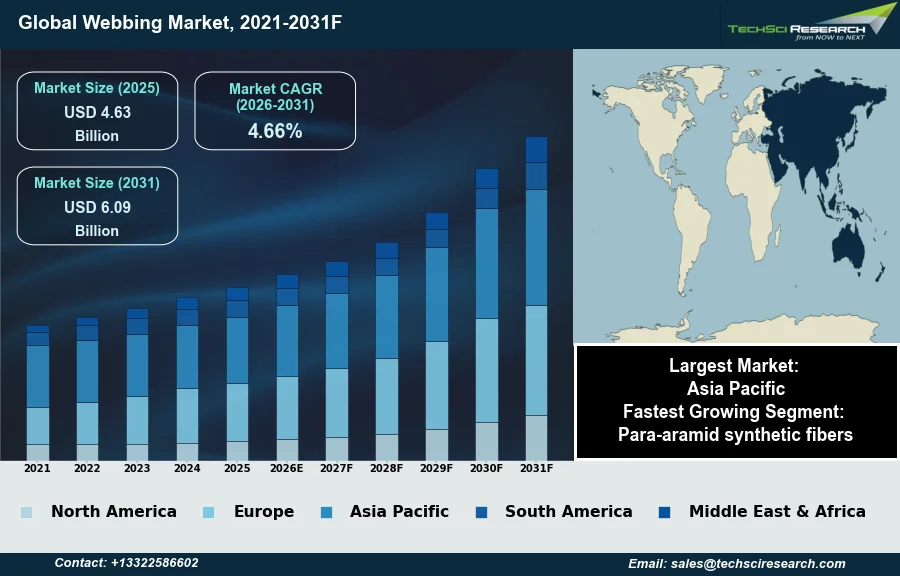
The Global Webbing Market is expected to grow from USD 4.63 Billion in 2025 to USD 6.09 Billion by 2031 at a 4.66% CAGR. Webbing is a strong, narrow woven fabric, typically manufactured from synthetic fibers such as polyester, nylon, or polypropylene, employed across diverse applications where robust tensile strength and durability are critical. The global market's expansion is fundamentally driven by stringent automotive safety regulations necessitating seatbelts and airbag components, escalating defense expenditures for tactical equipment, and the sustained growth of outdoor and adventure sports requiring high-performance gear. According to India's Ministry of Textiles, in March 2025, the National Technical Textiles Mission supported 168 research projects valued at approximately INR 509 crore (approximately USD 61 million), fostering innovation in high-performance textiles, including those relevant to webbing applications.
A significant challenge impeding market expansion involves the volatility of raw material prices for synthetic fibers, which directly impacts production costs and profit margins for manufacturers. This instability introduces complexities in strategic planning and pricing, potentially hindering investment in new product development and market penetration.
Key Market Drivers
Regulatory and production growth driving automotive webbing demand
Increasing automotive safety regulations and production is a primary driver for the global webbing market. As governments worldwide implement stricter mandates for occupant protection, the demand for webbing in critical components such as seatbelts and airbag systems continues to rise. This regulatory emphasis directly correlates with vehicle manufacturing volumes, requiring robust materials that meet stringent safety certifications and performance standards. According to the International Organization of Motor Vehicle Manufacturers (OICA), global automobile production expanded to nearly 94 million units in 2023, representing an increase of approximately 10% over the 2022 figure. This growth necessitates a corresponding increase in the supply of high-strength, durable webbing materials throughout the automotive supply chain.
Safety standards and enforcement expanding PPE and narrow fabrics markets
Concurrently, rising industrialization and workplace safety standards significantly influence the webbing market by increasing the adoption of personal protective equipment and industrial lifting solutions. Industries are facing heightened scrutiny and regulatory enforcement to safeguard employees, driving demand for safety harnesses, lanyards, and cargo restraint systems. For instance, according to an analysis by Ogletree Deakins, effective January 15, 2025, the Occupational Safety and Health Administration (OSHA) increased its maximum penalties for serious and "other-than-serious" violations to $16,550 per violation. This demonstrates a strong impetus for companies to invest in compliant safety equipment. Overall, this growth contributes to the broader narrow fabrics sector, with global trade of Narrow Woven Fabric reaching $4.33 billion in 2024, an increase of 7.3% from 2023, according to The Observatory of Economic Complexity.
Download Free Sample Report
Key Market Challenges
Cost and margin pressures from raw-material price volatility
The global webbing market faces a significant challenge from the volatility of raw material prices for synthetic fibers. This instability directly impacts production costs for manufacturers, as the primary inputs like polyester, nylon, and polypropylene experience unpredictable price swings. Such fluctuations compress profit margins, making it difficult for companies to maintain consistent pricing strategies or offer competitive rates in the market.
Strategic planning and investment constrained by price volatility
The unpredictable nature of raw material costs also complicates strategic planning and hinders investment in product development and market penetration. Manufacturers are hesitant to commit to long-term projects or expand capacities when their cost base is unstable, leading to cautious investment decisions. According to Fibre2Fashion, in April 2026, polyester raw materials experienced intra-month price fluctuations of over 10 percent, directly impacting the textile value chain where webbing is a key component. This persistent uncertainty limits the overall growth potential of the global webbing market by eroding financial stability and discouraging innovation.
Key Market Trends
Adoption of Sustainable Webbing Materials
Sustainable Webbing Materials Adoption is emerging as a pivotal trend in the global webbing market, driven by increasing environmental consciousness among consumers and industries alike. This shift necessitates the development and integration of eco-friendly alternatives to traditional synthetic fibers. Manufacturers are focusing on incorporating recycled content and bio-based materials to reduce the environmental footprint of their products, addressing concerns such as carbon emissions and waste generation. For instance, according to Powertex, in their 'Sustainable and Ethical Practices for Powertex & Ropetex' information, released in 2023, their innovative range of webbing slings, round slings, and web lashings made entirely from recycled polyester has a reduced CO2e footprint of up to 65%. This trend reflects a broader industry movement towards circular economy principles and greener manufacturing processes.
Smart and Functional Technologies in Webbing
Concurrently, the Integration of Smart and Functional Technologies is revolutionizing webbing applications by embedding advanced capabilities directly into the fabric. This trend extends beyond mere material strength, incorporating features such as sensors, conductive elements, and active response mechanisms to enhance product utility and performance. Such innovations are enabling real-time monitoring, improved safety, and data collection in diverse applications ranging from industrial safety harnesses to performance sportswear. This technological progression is supported by significant strategic investments. For example, according to 'Smart Textiles — Four Decades of Promise, Funding, and Fractured Commercialisation', published in May 2026, the 'Textiles of the Future' European Partnership committed at least EUR 60 million from 2025 to 2030 towards structured textile research and development, aiming for rapid industrial deployment. These advancements create new market segments and value propositions for webbing manufacturers.
Segmental Insights
Para-aramid fibers propel rapid market growth via superior strength-to-weight and thermal/abrasion resistance.
The Para-aramid synthetic fibers segment demonstrates rapid growth within the Global Webbing Market, primarily driven by its unique performance characteristics essential for demanding applications. These fibers offer an exceptional strength-to-weight ratio, significantly exceeding conventional materials, which facilitates the development of lightweight yet highly durable webbing structures. Furthermore, their superior resistance to heat, fire, and abrasion ensures reliability and extended service life in harsh operational environments. This combination of robust attributes is increasingly critical across various sectors, particularly in automotive safety for enhanced occupant protection and in aerospace and defense industries for ballistic resistance and high-strength structural components, where stringent performance requirements are paramount.
Regional Insights
APAC Leads the Global Webbing Market
Asia Pacific stands as the leading region in the global webbing market, propelled by its extensive industrialization and robust economic expansion across key nations like China and India. This dominance is primarily driven by the region's vast manufacturing capabilities, particularly within the automotive sector, where stringent safety regulations and escalating vehicle production necessitate substantial volumes of webbing for critical components such as seatbelts and restraint systems. Furthermore, significant industrial investments and heightened awareness regarding worker protection contribute to the strong demand for webbing in applications like safety harnesses and lifting slings. Regulatory advancements, including China's enhanced QC/T 946-2024 standards, further strengthen the regional market by elevating quality requirements for local production.
Recent Developments
-
In July 2025, REMA introduced its Re-Line range of industrial lifting slings, crafted entirely from 100% recycled post-consumer polyester. This new product line includes both flat webbing slings and roundslings, specifically engineered for diverse industrial lifting applications. The introduction of the Re-Line range signifies a notable advancement in the global webbing market, integrating circular materials while upholding established safety standards and product traceability. This initiative by REMA showcases a commitment to environmental responsibility within industrial webbing solutions, demonstrating how recycled content can meet rigorous performance requirements for critical applications.
-
In July 2025, Xiamen Jude Webbing successfully renewed its Global Recycled Standard certification. This renewal reinforced the company's strong commitment to utilizing recycled materials and ensuring supply-chain traceability in its manufacturing processes. The certification specifically highlights the company's dedication to environmentally responsible webbing production for various sectors, including outdoor, tactical, and industrial applications. This development underscores the increasing importance of sustainability within the global webbing market, as manufacturers aim to meet evolving environmental requirements while delivering high-quality and reliable webbing products.
-
In January 2025, a significant collaboration was announced between Ocean State Innovations, 1947LLC, and Murdock Webbing. Through this partnership, Ocean State Innovations and 1947LLC became the exclusive international distributors of Murdock Webbing’s Jacquard-woven MultiCam® webbing. This strategic alliance aims to expand the global reach of specialized, high-performance webbing products, particularly in markets requiring advanced camouflage patterns and durable woven fabrics. The collaboration represents a concerted effort to enhance distribution networks and provide access to premium webbing solutions for diverse applications worldwide.
-
In September 2024, Bally Ribbon Mills (BRM) showcased its advanced, high-performance webbing designs, including its innovative E-WEBBINGS®, at the Advanced Textiles Expo. These E-WEBBINGS® are unique woven fabrics that combine traditional fibers with functional elements such as conductivity, light transmission, and integrated sensors. The display highlighted BRM's capabilities in creating custom weave designs and utilizing high-performance fiber combinations for critical applications in sectors like aerospace, medical, and safety. This demonstration underscored ongoing advancements in technical textile webbing, offering enhanced functionality and specialized properties for demanding end-use environments.
Key Market Players
- American Cord & Webbing Co., Inc.
- American Webbing and Fittings, Inc.
- Autoliv
- Bally Ribbon Mills
- Belt-tech
- Berger GmbH & Co. Holding KG
- BioThane
- Bowmer Bond Narrow Fabrics Ltd
- E. Oppermann GmbH
- Jiangsu Daxin Ribbon Co., Ltd.
|
By Product
|
By Application
|
By Region
|
- Polyester
- Nylon
- Polypropylene
- Carbon Fiber Webbing
- Para-Aramid Synthetic Fibers
- Ultra-High-Molecular-Weight Polyethylene (UHMWPE)
|
- Automotive
- Sporting Goods
- Furniture
- Industrial Safety
- Rescue
- Military and Aerospace
|
- North America
- Europe
- Asia Pacific
- South America
- Middle East & Africa
|
Report Scope:
In this report, the Global Webbing Market has been segmented into the following categories, in addition to the industry trends which have also been detailed below:
-
Webbing Market, By Product:
-
Polyester
-
Nylon
-
Polypropylene
-
Carbon Fiber Webbing
-
Para-Aramid Synthetic Fibers
-
Ultra-High-Molecular-Weight Polyethylene (UHMWPE)
-
Webbing Market, By Application:
-
Automotive
-
Sporting Goods
-
Furniture
-
Industrial Safety
-
Rescue
-
Military and Aerospace
-
Webbing Market, By Region:
-
North America
-
United States
-
Canada
-
Mexico
-
Europe
-
France
-
United Kingdom
-
Italy
-
Germany
-
Spain
-
Asia Pacific
-
China
-
India
-
Japan
-
Australia
-
South Korea
-
South America
-
Brazil
-
Argentina
-
Colombia
-
Middle East & Africa
-
South Africa
-
Saudi Arabia
-
UAE
Competitive Landscape
Company Profiles: Detailed analysis of the major companies present in the Global Webbing Market.
Available Customizations:
Global Webbing Market report with the given market data, TechSci Research offers customizations according to a company's specific needs. The following customization options are available for the report:
Company Information
- Detailed analysis and profiling of additional market players (up to five).
Global Webbing Market is an upcoming report to be released soon. If you wish an early delivery of this report or want to confirm the date of release, please contact us at sales@techsciresearch.com