|
Key Insights
|
Details
|
|
Forecast Period
|
2026 - 2031
|
|
Market Size (2025)
|
USD 1.37 Billion
|
|
CAGR (2026-2031)
|
7.48%
|
|
Fastest Growing Segment
|
Livestock
|
|
Largest Market
|
Asia Pacific
|
|
Market Size (2031)
|
USD 2.11 Billion
|
Market Overview
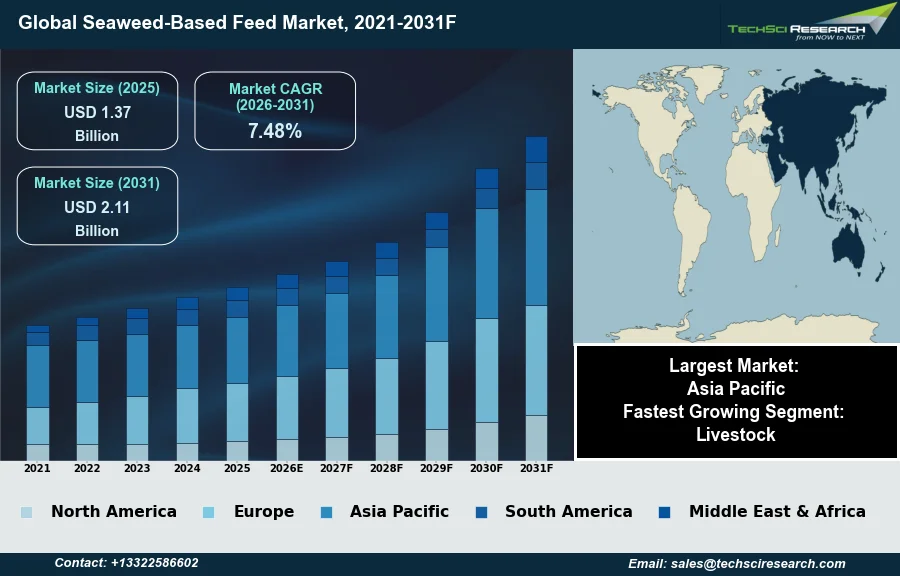
The Global Seaweed-Based Feed Market is expected to grow from USD 1.37 Billion in 2025 to USD 2.11 Billion by 2031 at a 7.48% CAGR. The seaweed-based feed market encompasses products utilizing various macroalgae species as a nutritional component in animal diets, including aquaculture, poultry, and livestock. This market's growth is primarily driven by an increasing emphasis on sustainable agricultural practices, a desire for natural alternatives to conventional feed additives, and the documented benefits of seaweed for animal health and productivity. Furthermore, the role of certain seaweed varieties in mitigating methane emissions from ruminants serves as a significant driver, aligning with global environmental objectives.
A notable challenge impeding market expansion is the scalability of seaweed cultivation and processing for feed applications to meet widespread demand efficiently. Despite these challenges, the broader feed industry remains substantial. According to the European Feed Manufacturers' Federation (FEFAC), in 2025, total industrial compound feed production in the EU227 was expected to reach 147.5 million tonnes, indicating a robust underlying market for feed ingredients, including emerging options like seaweed. The Scottish Association for Marine Science, in its 2025 "State of the World's Seaweeds" report, highlighted the increasing recognition of seaweeds as an economic and environmentally beneficial alternative to other feed sources for both terrestrial and aquaculture species.
Key Market Drivers
Rising demand for sustainable and natural feed additives drives seaweed adoption
Growing demand for sustainable and natural feed additives significantly propels the global seaweed-based feed market. As agricultural practices increasingly prioritize environmental stewardship and consumer preference shifts towards naturally sourced animal products, feed manufacturers are seeking alternatives to conventional synthetic ingredients. Seaweed offers a compelling solution, providing essential nutrients, enhancing digestibility, and contributing to the overall well-being of animals without relying on artificial compounds. This trend is evident in the broader animal nutrition sector; according to ADM Animal Nutrition, 2026, global demand growth for their amino acids, which are critical natural feed components, ranges from seven to 20 percent, consistently outpacing total feed demands. This indicates a strong industry push towards ingredient solutions that align with sustainability goals, benefiting the adoption of seaweed-based alternatives.
Methane-reduction potential as a pivotal driver for seaweed-based feed
The methane emission reduction potential in livestock stands as a pivotal driver for the seaweed-based feed market, particularly in ruminant agriculture. Enteric methane from cattle represents a substantial contributor to greenhouse gas emissions, creating an urgent need for effective mitigation strategies. Certain varieties of red seaweed, notably Asparagopsis, have demonstrated remarkable efficacy in inhibiting methanogenesis in the rumen. For instance, according to Irish startup company Dúlabio, October 2026, new research revealed that supplementary feeding of seaweed to Irish beef cattle reduced methane emissions by an average of 79%. This environmental benefit positions seaweed as a high-value ingredient for livestock producers aiming to reduce their carbon footprint and meet sustainability targets. Overall, the broader feed industry continues to demonstrate substantial scale; according to Alltech, in 2026, world feed production reached an estimated 1.44 billion metric tons in 2025, underscoring the vast potential for seaweed integration.
Download Free Sample Report
Key Market Challenges
Scalability Constraints in Seaweed Cultivation and Processing
A notable challenge impeding market expansion in the global seaweed-based feed market is the scalability of seaweed cultivation and processing for feed applications. Current production methods struggle to achieve the industrial-scale output necessary to meet the widespread demand from the substantial animal feed industry. This directly restricts the volume of seaweed ingredients that can be consistently supplied to feed manufacturers, thereby limiting market penetration and broader adoption of seaweed as a natural alternative to conventional feed additives.
Supply, Costs, and Market Share Implications of Limited Scale
The inability to scale cultivation and processing efficiently results in supply inconsistencies and potentially higher production costs. These factors hinder large-scale integration into animal diets. According to Alltech's 2026 Agri-Food Outlook, global compound feed production reached 1.44 billion metric tons in 2025, with aquaculture feed alone accounting for 55.5 million metric tons. The existing scalability bottleneck prevents seaweed-based feed from capturing a more significant share of this expansive market, consequently constraining the overall growth trajectory of the sector despite its documented benefits for animal health and environmental objectives.
Key Market Trends
Advances in seaweed processing and biorefinery enable scalable, high-value feed ingredients.
Advancements in seaweed processing and biorefinery technologies represent a significant trend, enhancing the efficiency and versatility of seaweed utilization in animal feed. These technological improvements are crucial for overcoming the scalability challenges of seaweed cultivation and transforming raw biomass into high-value, consistent feed ingredients. Innovations focus on extracting specific bioactive compounds more effectively, reducing waste, and improving the overall economic viability of seaweed-derived products. For instance, according to Origin by Ocean, May 2026, the European Investment Bank is appraising a proposed EUR 30 million participation as part of a EUR 65 million blended finance round to build Origin by Ocean's first industrial-scale biorefinery in Kokkola, Finland, designed to process invasive Sargassum seaweed into high-value ingredients. This investment underscores the push towards more sophisticated and large-scale processing capabilities, broadening the scope of seaweed applications beyond basic nutritional inclusion.
Standardized regulatory frameworks for seaweed feed additives enhance market clarity and trust.
Concurrently, the emergence of standardized regulatory frameworks for feed additives is profoundly shaping the global seaweed-based feed market by providing clarity and fostering trust. As seaweed ingredients gain traction, clear guidelines on their safety, efficacy, and labeling are essential for market acceptance and expansion. Standardized regulations reduce uncertainty for manufacturers and facilitate market entry, ensuring product quality and consumer confidence. This trend is exemplified by the US Food and Drug Administration, August 2026, which published a proposed rule (Docket No. FDA-2025-N-3262) that would replace the voluntary Generally Recognized As Safe notification program with a mandatory filing obligation for animal food substances, with comments due by December 9, 2026. Such regulatory shifts aim to increase oversight and transparency, creating a more predictable environment for the development and adoption of novel feed ingredients, including those derived from seaweed.
Segmental Insights
Livestock Growth Driven by Methane-Reducing, Nutrient-Rich Seaweed Feeds
The key segmental insight for the Global Seaweed-Based Feed Market highlights the Livestock segment as experiencing rapid growth, driven by increasing demand for sustainable animal nutrition alternatives. This acceleration is primarily attributed to seaweed's proven ability to significantly reduce methane emissions from ruminants, aligning with global climate goals and evolving regulatory pressures to lower the carbon footprint of the animal agriculture sector. Furthermore, seaweed-based feeds are rich in essential vitamins, minerals, and bioactive compounds, which enhance animal health, improve gut function, and boost feed efficiency, diminishing reliance on synthetic additives. Regulatory bodies, such as the U.S. Department of Agriculture, and agricultural policies globally are increasingly supporting such environmentally responsible feed solutions.
Regional Insights
Asia-Pacific Dominates the Seaweed-Based Feed Market
Asia-Pacific dominates the Global Seaweed-Based Feed Market due to its established history of seaweed cultivation and consumption, deeply ingrained in regional practices. The vast coastal resources and favorable climatic conditions across the region provide optimal environments for extensive seaweed farming. A significant driver is the region's robust and expanding aquaculture sector, which relies heavily on seaweed-based feed for diverse aquatic species. This dominance is further strengthened by consistent government support for sustainable production initiatives and continuous technological advancements in cultivation and processing across numerous nations.
Recent Developments
-
In December 2024, scientists at the University of California, Davis, published breakthrough research demonstrating the effectiveness of seaweed supplements in mitigating methane emissions from grazing beef cattle. The study, detailed in a peer-reviewed journal, indicated that providing grazing animals with a pelleted seaweed supplement reduced their methane output by approximately 40% without compromising their health or growth. This scientific advancement is crucial for developing sustainable agricultural practices, offering a scalable method for integrating seaweed additives into extensive grazing systems, and thereby advancing research within the global seaweed-based feed market.
-
In August 2024, Scoular, a prominent supplier of pet food ingredients in North America, formed an exclusive partnership with SEADLING, a biotechnology firm based in Borneo. This collaboration led to the introduction of a novel fermented dried seaweed powder for North American pet food manufacturers. The innovative ingredient, developed using SEADLING’s proprietary technology, aims to enhance pet health by supporting vital functions such as skin, coat, gut, and brain. This product launch signifies a response to the growing consumer demand for functional and sustainable ingredients in pet nutrition, contributing to the expansion of the global seaweed-based feed market.
-
In July 2024, Morrisons, a leading retail chain, partnered with Sea Forest, an innovative aquaculture company, to launch a new seaweed-based feed product. This collaboration aimed to reduce methane emissions from cattle within their supply chain. The introduction of this specialized feed into commercial operations highlights the increasing adoption of seaweed as a sustainable dietary component for livestock. This initiative represents a tangible step in offering environmentally responsible feed alternatives to farmers and underscores the evolving landscape of the global seaweed-based feed market.
-
In January 2024, CH4 Global commenced the commercial delivery of its formulated seaweed-based cattle feed supplement, Methane Tamer™, which is designed to substantially reduce enteric methane emissions. This significant action supported the company's broader objective of mitigating greenhouse gas emissions within the livestock industry. Concurrently, CH4 Global initiated construction of its first commercial-scale facility in Louth Bay, South Australia, dedicated to cultivating Asparagopsis seaweed. This "EcoPark" is projected to produce enough seaweed to supply up to 30,000 cattle daily, thereby enhancing the global availability of seaweed-based feed solutions.
Key Market Players
- Cargill, Incorporated
- Olmix SA
- BioMar Group A/S
- Acadian Seaplants Limited
- Alltech, Inc.
- Ocean Harvest Technology Group Limited
- DSM-Firmenich AG
- CP Kelco U.S., Inc.
- Algaia SA
- Seakura Ltd.
|
By Application
|
By Species
|
By Form
|
By Distribution Channel
|
By Region
|
- Aquaculture
- Livestock
- Poultry
- Swine
- Pet food
|
- Red Seaweed
- Brown Seaweed
- Green Seaweed
- Micro-algae Blends
|
- Powder
- Liquid Extract
- Pellets
- Flakes
|
- Direct (B2B)
- Indirect Channels
|
- North America
- Europe
- Asia Pacific
- South America
- Middle East & Africa
|
Report Scope:
In this report, the Global Seaweed-Based Feed Market has been segmented into the following categories, in addition to the industry trends which have also been detailed below:
-
Seaweed-Based Feed Market, By Application:
-
Aquaculture
-
Livestock
-
Poultry
-
Swine
-
Pet food
-
Seaweed-Based Feed Market, By Species:
-
Red Seaweed
-
Brown Seaweed
-
Green Seaweed
-
Micro-algae Blends
-
Seaweed-Based Feed Market, By Form:
-
Powder
-
Liquid Extract
-
Pellets
-
Flakes
-
Seaweed-Based Feed Market, By Distribution Channel:
-
Direct (B2B)
-
Indirect Channels
-
Seaweed-Based Feed Market, By Region:
-
North America
-
United States
-
Canada
-
Mexico
-
Europe
-
France
-
United Kingdom
-
Italy
-
Germany
-
Spain
-
Asia Pacific
-
China
-
India
-
Japan
-
Australia
-
South Korea
-
South America
-
Brazil
-
Argentina
-
Colombia
-
Middle East & Africa
-
South Africa
-
Saudi Arabia
-
UAE
Competitive Landscape
Company Profiles: Detailed analysis of the major companies present in the Global Seaweed-Based Feed Market.
Available Customizations:
Global Seaweed-Based Feed Market report with the given market data, TechSci Research offers customizations according to a company's specific needs. The following customization options are available for the report:
Company Information
- Detailed analysis and profiling of additional market players (up to five).
Global Seaweed-Based Feed Market is an upcoming report to be released soon. If you wish an early delivery of this report or want to confirm the date of release, please contact us at sales@techsciresearch.com