|
Key Insights
|
Details
|
|
Forecast Period
|
2026 - 2031
|
|
Market Size (2025)
|
USD 322.25 Million
|
|
CAGR (2026-2031)
|
7.4%
|
|
Fastest Growing Segment
|
Solanaceae
|
|
Largest Market
|
Asia Pacific
|
|
Market Size (2031)
|
USD 494.56 Million
|
Market Overview
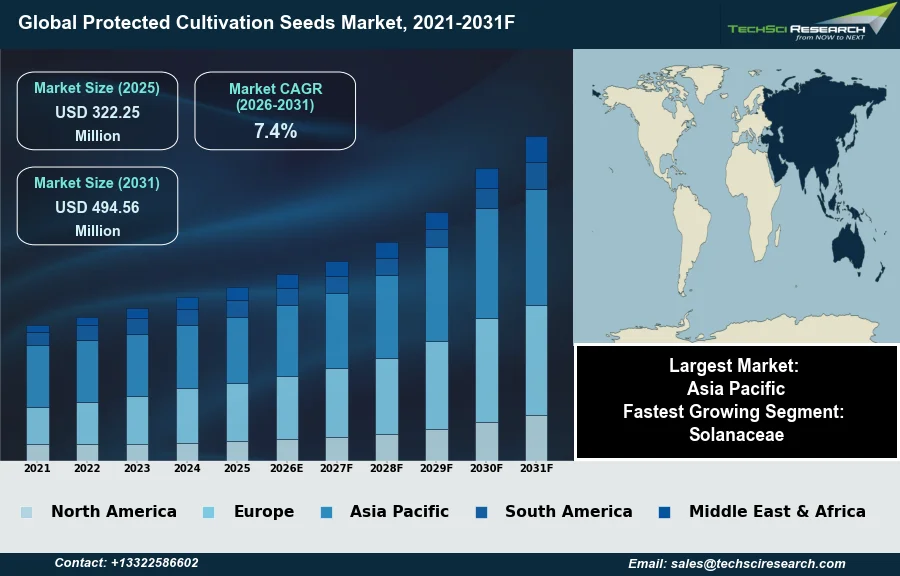
The Global Protected Cultivation Seeds Market is expected to grow from USD 322.25 Million in 2025 to USD 494.56 Million by 2031 at a 7.4% CAGR. Protected cultivation seeds represent specialized genetic material engineered for deployment within controlled agricultural environments, such as greenhouses and net houses, thereby facilitating optimal plant development and increased productivity irrespective of external climatic variations. The market's expansion is primarily driven by the enduring global demand for year-round premium quality vegetables and the essential requirement for enhanced yields coupled with superior resource efficiency in agricultural practices. These fundamental drivers underscore the strategic imperative of maximizing output from limited arable land resources.
The proliferation of protected cultivation infrastructure directly correlates with the demand for specific seeds; for instance, according to Statistics Canada, in 2025, the total greenhouse area in Canada experienced a 1.4% increase compared to 2024, reaching 35.9 million square meters. Nevertheless, a significant impediment to market growth is the elevated pricing of advanced hybrid and disease-resistant seed varieties, which often poses a substantial financial barrier to adoption for growers, particularly within emerging markets.
Key Market Drivers
Rising demand and food-security concerns drive protected cultivation adoption.
Rising global food demand and food security concerns serve as a primary catalyst for the Global Protected Cultivation Seeds Market, as controlled agricultural environments offer a consistent and intensified approach to food production. Traditional farming methods increasingly contend with unpredictable weather patterns, shrinking arable land, and environmental degradation, rendering protected cultivation an essential strategy for reliable food supply. The urgency of this challenge is clearly articulated in the United Nations' 2026 State of Food Security and Nutrition in the World report, which indicated that 645 million people faced hunger in 2025. By utilizing specialized seeds within protected settings, growers can achieve higher yields per unit area and extend growing seasons, directly addressing food scarcity and ensuring a stable supply of fresh produce irrespective of external climatic variations.
Biotech innovations and investments accelerate seed performance in protected cultivation.
Concurrently, advancements in seed breeding and biotechnology represent a significant driver, as these innovations are crucial for developing specialized seed varieties optimized for the unique conditions of protected cultivation. These advancements focus on engineering seeds with enhanced disease resistance, superior nutritional profiles, and improved adaptation to controlled environmental factors, thereby maximizing productivity and resource efficiency. For instance, according to AgFunderNews, in October 2026, BioConsortia secured $15 million to scale microbial nitrogen-fixing seed treatment, illustrating ongoing investments in biotechnology aimed at improving seed performance. Such developments enable growers to achieve optimal crop quality and higher economic returns. Furthermore, reflecting a wider commitment to enhancing global food systems, according to the World Bank Group, in 2026, the organization pledged to double its annual investments in the agribusiness sector, bringing the total to $9 billion.
Download Free Sample Report
Key Market Challenges
Economic Barriers to Adopting Advanced Hybrid and Disease-Resistant Seeds
The elevated pricing of advanced hybrid and disease-resistant seed varieties presents a substantial financial barrier to growers, particularly within emerging markets. This directly hampers the growth of the global protected cultivation seeds market by limiting the adoption of specialized genetic material essential for optimal plant development and increased productivity. Despite the clear benefits of enhanced yields and superior resource efficiency offered by these advanced seeds, their high cost restricts wider utilization among a significant segment of the agricultural community.
Affordability and Access Challenges Affect Market Growth
The financial impediment means that many growers cannot invest in the seeds necessary to leverage controlled agricultural environments effectively. This directly slows market expansion, as the uptake of high-value seeds is curtailed by economic constraints rather than a lack of perceived benefit. According to the Asia and Pacific Seed Association (APSA) – World Vegetable Center Vegetable Breeding Consortium, its membership increased to 58 in 2024, reflecting continuous efforts to enhance access to advanced breeding lines for smallholder farmers in Asia. Such initiatives underscore the persistent challenge of making specialized seeds affordable and accessible, thereby impacting the overall market's growth trajectory and preventing full realization of the benefits of protected cultivation.
Key Market Trends
Rise of biological seed treatments in protected cultivation
The increased integration of biological seed treatments represents a significant trend, moving beyond traditional chemical applications to enhance seed performance and crop resilience. These treatments, which include beneficial microbes and biostimulants, improve nutrient uptake, strengthen early plant development, and offer protection against environmental stresses. This shift is particularly impactful for protected cultivation, where precise control over inputs and environmental conditions can maximize the benefits of such biological solutions. The rising adoption reflects a broader industry movement towards sustainable agricultural practices and reduced reliance on synthetic chemicals. According to AgroLatam, September 2026, crop protection giants boosted biological research and development investment by 43% as chemical spending decreased, indicating a strategic pivot within the industry.
AI-driven seed selection for controlled-environment cultivation
The rising influence of artificial intelligence and data-driven approaches in seed selection is fundamentally transforming how seeds are developed and optimized for specific growing conditions, especially within controlled environments. AI algorithms analyze vast datasets encompassing genetic information, phenotypic traits, and environmental interactions to predict optimal seed performance. This allows for more targeted breeding and selection processes, significantly reducing the time and resources traditionally required. Such advancements facilitate the rapid identification of seeds best suited for the unique demands of protected cultivation, ensuring higher yields and improved crop quality. According to Chinadaily.com.cn, November 2026, Chinese researchers are using artificial intelligence to accelerate crop breeding by up to hundreds of times by predicting plant growth from genetic code through computer simulations.
Segmental Insights
Solanaceae: Fastest-Growing Segment in Protected Cultivation Seeds
The Solanaceae segment is experiencing rapid growth within the Global Protected Cultivation Seeds Market, driven by its critical role in meeting consistent consumer and retailer demand for high-value vegetables such as tomatoes, peppers, and eggplants. These crops are highly amenable to controlled environment agriculture, including greenhouses and polyhouses, which facilitates year-round production and enhances crop consistency and quality. The expansion is further fueled by significant investments in research and development, leading to advanced hybrid seed varieties offering superior yields, robust disease resistance, and improved adaptability to protected growing conditions. This technological advancement and the inherent market appeal of Solanaceae crops solidify its position as the fastest-growing segment.
Regional Insights
Asia-Pacific Dominates the Global Market Through Protected Structures and Policy Support
Asia-Pacific stands as the leading region in the Global Protected Cultivation Seeds Market, primarily driven by the extensive adoption of protected structures such as greenhouses and polyhouses across major economies including China, India, and Japan. This regional dominance stems from high vegetable consumption, increasing pressure on available arable land, and significant government support for controlled-environment agriculture and horticultural development. Furthermore, the rising demand for advanced seed varieties that offer superior productivity, enhanced disease resistance, and improved quality traits contributes to market growth. Government initiatives, often reflecting priorities highlighted by organizations like the Food and Agriculture Organization, actively promote agricultural modernization and ensure food security throughout the region.
Recent Developments
-
In November 2025, Rijk Zwaan introduced over 200 new vegetable varieties as part of its 2024/2025 financial year portfolio. This significant launch included several ToBRFV-resistant tomato varieties, which are crucial for the global protected cultivation seeds market due to the virus's severe impact on tomato crops grown in controlled environments. The company's continuous investment in research and development, totaling €204 million for the year, enabled the creation of varieties that perform effectively under diverse climatic conditions and align with sustainable production methods, thereby enhancing reliability and quality for growers in protected cultivation worldwide.
-
In October 2025, Corteva Agriscience announced its board had unanimously approved a plan to separate the company into two independent, publicly traded entities by the second half of 2026. This strategic reorganization will create one company focused on crop protection, called New Corteva, and another dedicated to the seed business, known as SpinCo. SpinCo, which includes the Pioneer brand, was projected to have net sales of $9.9 billion in 2025 and will concentrate on advanced genetics. This move is anticipated to unlock value by allowing each entity to pursue distinct growth strategies, impacting the innovation and supply dynamics within the global protected cultivation seeds market through a specialized focus on seed development.
-
In April 2025, Rijk Zwaan inaugurated its Seed Connect Centre in De Lier, marking the largest investment project in the company's history. This new facility was designed to significantly expand seed processing capacity and strengthen logistical operations. By enhancing these capabilities, Rijk Zwaan aimed to further safeguard the reliability of vegetable seed delivery globally. This infrastructure development is directly relevant to the Global Protected Cultivation Seeds Market, as efficient processing and dependable supply chains are essential for growers who rely on high-quality vegetable seeds for their controlled environment agriculture operations.
-
In 2025, Syngenta substantially expanded its capabilities in biological solutions, which are increasingly vital for the Global Protected Cultivation Seeds Market. The company opened a new 22,000 m² biologicals manufacturing facility in Orangeburg, South Carolina, capable of producing 16,000 tons of biostimulants annually. This strategic investment in infrastructure, complementing existing global networks, was a direct response to the rising demand for sustainable, high-performance tools in agriculture. These biologicals support plant health and productivity in various growing systems, including protected cultivation, by offering nature-inspired solutions that complement conventional crop protection strategies.
Key Market Players
- Bayer AG
- BASF SE
- Rijk Zwaan Zaadteelt en Zaadhandel B.V.
- Syngenta AG
- Enza Zaden Beheer B.V.
|
By Crop Type
|
By Region
|
|
|
- North America
- Europe
- Asia Pacific
- South America
- Middle East & Africa
|
Report Scope:
In this report, the Global Protected Cultivation Seeds Market has been segmented into the following categories, in addition to the industry trends which have also been detailed below:
-
Protected Cultivation Seeds Market, By Crop Type:
-
Protected Cultivation Seeds Market, By Region:
-
North America
-
United States
-
Canada
-
Mexico
-
Europe
-
France
-
United Kingdom
-
Italy
-
Germany
-
Spain
-
Asia Pacific
-
China
-
India
-
Japan
-
Australia
-
South Korea
-
South America
-
Brazil
-
Argentina
-
Colombia
-
Middle East & Africa
-
South Africa
-
Saudi Arabia
-
UAE
Competitive Landscape
Company Profiles: Detailed analysis of the major companies present in the Global Protected Cultivation Seeds Market.
Available Customizations:
Global Protected Cultivation Seeds Market report with the given market data, TechSci Research offers customizations according to a company's specific needs. The following customization options are available for the report:
Company Information
- Detailed analysis and profiling of additional market players (up to five).
Global Protected Cultivation Seeds Market is an upcoming report to be released soon. If you wish an early delivery of this report or want to confirm the date of release, please contact us at sales@techsciresearch.com