|
Key Insights
|
Details
|
|
Forecast Period
|
2026 - 2031
|
|
Market Size (2025)
|
USD 0.98 Billion
|
|
CAGR (2026-2031)
|
11.04%
|
|
Fastest Growing Segment
|
Liquid products
|
|
Largest Market
|
Asia Pacific
|
|
Market Size (2031)
|
USD 1.84 Billion
|
Market Overview
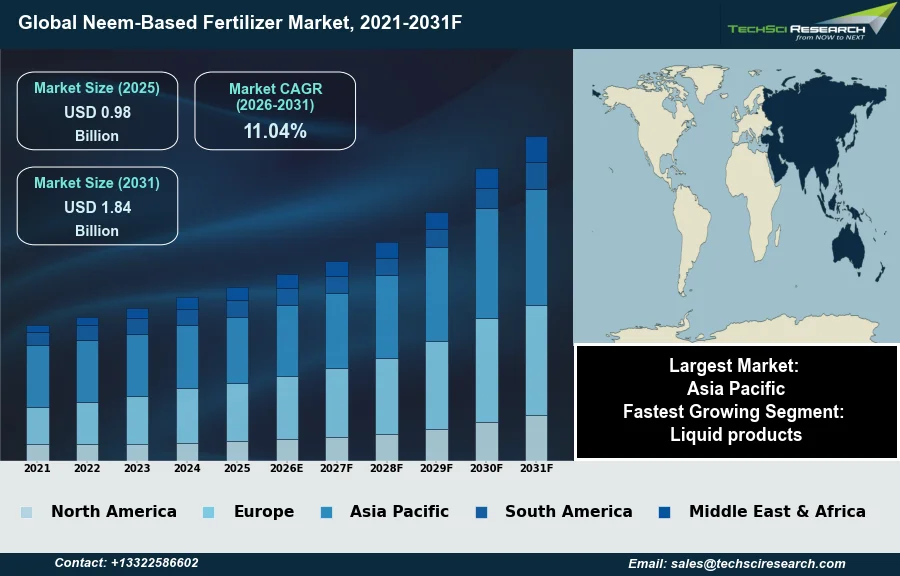
The Global Neem-Based Fertilizer Market is expected to grow from USD 0.98 Billion in 2025 to USD 1.84 Billion by 2031 at a 11.04% CAGR. Neem-based fertilizers are organic agricultural inputs derived primarily from the neem tree, Azadirachta indica, typically from seed by-products like neem cake, which remains after oil extraction. These products supply essential macronutrients such as nitrogen, phosphorus, and potassium, along with micronutrients, enriching soil fertility and improving its structure. Key drivers supporting market growth include increasing global demand for organic and sustainable farming practices, driven by heightened environmental awareness and a desire to reduce chemical input reliance. Additionally, supportive government policies and initiatives promoting bio-fertilizers contribute significantly to market expansion.
According to the Research Institute of Organic Agriculture (FiBL) and IFOAM – Organics International, in their 2025 report, the global organic farming area increased by 2.5 million hectares in 2023, reaching almost 99 million hectares, reflecting a 2.6 percent increase from 2022. A significant challenge impeding market expansion is the restricted geographic availability of neem, leading to supply chain volatility and inconsistent raw material quality.
Key Market Drivers
Organic Farming Adoption Drives Neem-Based Fertilizer Demand
The increasing adoption of organic and sustainable farming practices significantly propels the Global Neem-Based Fertilizer Market by providing a natural and eco-friendly alternative to synthetic inputs. Farmers worldwide are progressively transitioning to methods that enhance soil health, biodiversity, and ecosystem balance, recognizing the long-term benefits over conventional chemical-intensive agriculture. Neem-based fertilizers, being entirely natural and biodegradable, directly align with these principles, offering nutrient enrichment without detrimental environmental impact. This growing commitment to sustainable land management creates a substantial demand for organic inputs. According to Farmonaut, in their January 2026 "Worldwide Organic Farming 2026: Trends & Bio Growth" report, global organic farmland is projected to surpass 80 million hectares by 2026, increasing from 75 million hectares in 2022. This expansion underscores a foundational shift in agricultural paradigms that favors neem-derived products.
Consumer Demand for Organic Produce Drives Neem-Based Fertilizers
Growing consumer demand for chemical-free and organic food products significantly influences the market by compelling the agricultural sector to adopt organic cultivation methods. Increasingly health-conscious consumers, concerned about synthetic chemical residues, show a strong preference for certified organic produce. This directly creates market pull for organic inputs like neem-based fertilizers, as farmers aim to meet stringent organic certification standards. According to the Organic Trade Association, in their September 2026 "Organic Month 2026: Growing the Organic Opportunity Together" report, the U.S. organic market reached a record $76.6 billion in sales in 2025, representing a 6.8 percent growth and doubling the rate of the overall comparable marketplace. This consumer-driven expansion fuels the need for effective organic fertilizers. Furthermore, the global agricultural landscape's reliance on synthetic inputs remains substantial, with the Food and Agriculture Organization reporting in July 2026 that global agricultural use of inorganic fertilizers reached 190 million tonnes, underscoring the imperative for sustainable alternatives.
Download Free Sample Report
Key Market Challenges
Geographic Constraints and Neem Supply Volatility
A significant challenge impeding the growth of the global neem-based fertilizer market is the restricted geographic availability of the neem tree, Azadirachta indica. This limitation primarily concentrates raw material sourcing to specific regions, leading to inherent supply chain volatility. Manufacturers of neem-based fertilizers often contend with inconsistent access to crucial by-products like neem seeds and neem cake, impacting production capacities and input costs. This variability in supply translates directly into unpredictable market conditions for producers, limiting their ability to scale operations and meet increasing global demand for organic agricultural inputs.
Localized Supply and Quality Variability of Neem By-Products
Furthermore, the localized nature of supply contributes to inconsistent raw material quality. Variations in agro-climatic conditions across the limited growing regions can affect the active ingredient concentration in neem by-products, posing challenges for product standardization and efficacy. Such inconsistencies can undermine buyer confidence and hinder the development of stable, high-quality product lines. For instance, despite a 12% increase in India's neem cake and other neem-based fertilizer exports in 2024, according to UN Comtrade data, the market's heavy reliance on a limited number of primary producing nations like India introduces significant vulnerability to global supply. This concentrated dependency makes the global market highly susceptible to regional climate fluctuations, harvest yields, and agricultural policies, directly impeding consistent growth and broader adoption of neem-based fertilizers worldwide.
Key Market Trends
Advanced Neem-Based Fertilizer Formulations and Industry Investment
Advanced formulation technologies significantly influence the Global Neem-Based Fertilizer Market, transforming product forms beyond traditional neem cake. Innovations include liquid, granulated, and slow-release formulations that enhance nutrient delivery and user convenience. These advancements optimize the efficacy of neem-derived compounds, providing targeted nutrient availability and minimizing environmental impact. Such progression improves the performance and market acceptance of neem-based fertilizers, enabling their integration into modern agriculture. Supporting this evolution, in November 2025, Alltech initiated construction on a $4.6 million, 15,000-square-foot biofertilizer production facility, signaling investment in advanced bio-based products.
Integration with Precision Agriculture Technologies and Adoption Outlook
The increasing integration of neem-based fertilizers with precision agriculture methodologies represents another pivotal trend. This involves leveraging technologies like IoT sensors, satellite imagery, and variable rate application equipment for precise organic nutrient delivery based on real-time crop needs and soil conditions. This integration optimizes fertilizer usage, reduces waste, and enhances overall farm efficiency and sustainability, moving beyond uniform application. Precision agriculture enables better yields with fewer inputs, aligning with the sustainable benefits of neem products. This approach is gaining traction, as according to Farmonaut, in their December 2025 report "Precision Agricole: 7 Trends Revolutionizing Farming 2026", over 65% of global farms are expected to adopt precision agriculture technologies by 2026.
Segmental Insights
Growth Drivers and Benefits of Liquid Neem-Based Fertilizers
The liquid products segment is experiencing rapid growth in the global neem-based fertilizer market, driven by its inherent advantages in modern agricultural practices. This accelerated adoption stems from the ease of application and enhanced convenience offered by liquid formulations, particularly through efficient foliar spray and fertigation methods, which minimize product wastage and contamination. Furthermore, liquid neem-based fertilizers boost plant vitality by promoting robust growth and improved nutrient uptake, owing to their ability to stimulate micronutrient absorption. Their significant anti-pathogenic and antifeedant properties protect crops from various diseases and pests without fostering resistance, aligning with the increasing global demand for biodegradable and eco-friendly agricultural inputs. This trend is also supported by regulatory shifts towards sustainable farming, exemplified by initiatives like the European Union Fertilizing Products Regulation, which encourages natural alternatives over synthetic chemicals.
Regional Insights
Asia-Pacific Leads Neem Fertilizer Market due to Resource Availability and Policy Support
Asia-Pacific emerges as the leading region in the global neem-based fertilizer market, driven by a convergence of environmental advantages and strategic policy support. The region possesses extensive natural availability of neem trees, particularly in India, which benefits from conducive climatic conditions for their cultivation and is a major producer. This botanical abundance, combined with deeply ingrained traditional agricultural practices utilizing neem, underpins its market dominance. Furthermore, robust government initiatives, notably from the Government of India through mandatory neem-coated urea policies and subsidies promoting organic farming, substantially boost regional demand and market expansion.
Recent Developments
-
In August 2025, Kan Biosys unveiled its ROFA™ range of specialty fertilizers and three next-generation neem-based crop protection products. These innovations were introduced at an event in Pune, India, emphasizing science and sustainability for improved agricultural outcomes. The company also announced a collaboration with French agri-tech leader De Sangosse, which developed the ROFA™ range. This partnership aimed to deliver precise nutrition solutions, integrating neem-based technologies to empower farmers with world-class agricultural solutions and promote healthier, more profitable farming.
-
In June 2025, Kothari Industrial Corporation Ltd (KICL) launched a new portfolio comprising 30 agriculture-focused products in Chennai. This extensive range included neem-based and bio-organic inputs, along with bio-fertilizers, insecticides, fungicides, and herbicides. The company stated that these products were developed to support farmers in boosting productivity and addressing various agricultural challenges. The new offerings were also designed for versatile application methods, including drone-based spraying, reflecting KICL's commitment to modern and sustainable crop protection solutions within the global neem-based fertilizer market.
-
In May 2025, Rijona Biochemicals, a Ghanaian company, introduced organic and neem-enhanced fertilizers as part of its efforts to transform neem seeds into high-impact products for sustainable farming. Supported by the Kosmos Innovation Center (KIC), this woman-led enterprise is leveraging modern biochemistry to produce eco-friendly agricultural solutions. The company's innovation focuses on supporting healthier lifestyles and environmentally safe farming practices, contributing to inclusive economic growth, particularly for smallholder farmers. This development marks a significant new product launch within the global neem-based fertilizer market in Africa.
-
In May 2024, Coromandel International launched a neem-coated bio plant and soil health promoter. This new product was specifically designed to enhance soil fertility and support sustainable crop nutrition practices. The introduction of this neem-based solution aimed to improve nutrient availability, encourage beneficial soil microbial activity, and contribute to long-term soil health management for agricultural producers. This initiative directly expanded the company's offerings within the global neem-based fertilizer market, aligning with the increasing demand for organic and environmentally friendly farming inputs.
Key Market Players
- Coromandel International Limited
- Indian Farmers Fertiliser Cooperative Limited
- National Fertilizers Limited
- E.I.D. Parry (India) Limited
- Godrej Agrovet Limited
- UPL Limited
- ICL Group Ltd
- Krishak Bharati Cooperative Limited
- NACL Industries Ltd
- NutriAg Group
|
By Formulation
|
By Crop Type
|
By Application Method
|
By Distribution Channel
|
By Region
|
- Granular
- Liquid (Fertigation)
|
- Cereals and Grains
- Fruits and Vegetables
|
- Soil Incorporation
- Fertigation
|
- Retail/Dealer Networks
- Direct-to-Farmer (Digital)
|
- North America
- Europe
- Asia Pacific
- South America
- Middle East & Africa
|
Report Scope:
In this report, the Global Neem-Based Fertilizer Market has been segmented into the following categories, in addition to the industry trends which have also been detailed below:
-
Neem-Based Fertilizer Market, By Formulation:
-
Granular
-
Liquid (Fertigation)
-
Neem-Based Fertilizer Market, By Crop Type:
-
Cereals and Grains
-
Fruits and Vegetables
-
Neem-Based Fertilizer Market, By Application Method:
-
Soil Incorporation
-
Fertigation
-
Neem-Based Fertilizer Market, By Distribution Channel:
-
Retail/Dealer Networks
-
Direct-to-Farmer (Digital)
-
Neem-Based Fertilizer Market, By Region:
-
North America
-
United States
-
Canada
-
Mexico
-
Europe
-
France
-
United Kingdom
-
Italy
-
Germany
-
Spain
-
Asia Pacific
-
China
-
India
-
Japan
-
Australia
-
South Korea
-
South America
-
Brazil
-
Argentina
-
Colombia
-
Middle East & Africa
-
South Africa
-
Saudi Arabia
-
UAE
Competitive Landscape
Company Profiles: Detailed analysis of the major companies present in the Global Neem-Based Fertilizer Market.
Available Customizations:
Global Neem-Based Fertilizer Market report with the given market data, TechSci Research offers customizations according to a company's specific needs. The following customization options are available for the report:
Company Information
- Detailed analysis and profiling of additional market players (up to five).
Global Neem-Based Fertilizer Market is an upcoming report to be released soon. If you wish an early delivery of this report or want to confirm the date of release, please contact us at sales@techsciresearch.com