|
Key Insights
|
Details
|
|
Forecast Period
|
2026 - 2031
|
|
Market Size (2025)
|
USD 4.51 Trillion
|
|
CAGR (2026-2031)
|
10.65%
|
|
Fastest Growing Segment
|
Takaful
|
|
Largest Market
|
Middle East & Africa
|
|
Market Size (2031)
|
USD 8.28 Trillion
|
Market Overview
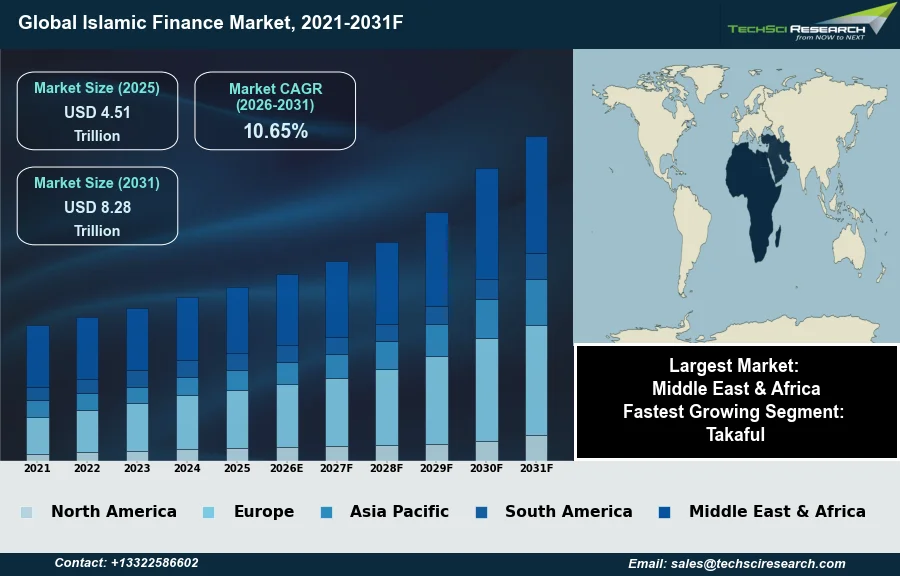
The Global Islamic Finance Market is expected to grow from USD 4.51 Trillion in 2025 to USD 8.28 Trillion by 2031 at a 10.65% CAGR. Islamic finance encompasses financial services structured according to Shariah principles, prohibiting interest, excessive uncertainty, and speculative activities, while promoting risk-sharing and ethical, asset-backed investments. This market's expansion is fundamentally driven by a large and expanding global Muslim population, increasing demand for Shariah-compliant financial products, and robust governmental support through favorable regulatory frameworks in key jurisdictions. Additionally, the inherent alignment of Islamic finance principles with broader ethical and socially responsible investing criteria increasingly attracts a wider investor base, distinguishing these foundational drivers from market trends. According to the Islamic Financial Services Board (IFSB), total Islamic Financial Services Industry (IFSI) assets reached US$4.4 trillion in 2025, marking a significant 13.4% year-on-year growth.
A significant challenge impeding further market expansion is the persistent lack of standardization and harmonization in Shariah interpretations and regulatory frameworks across diverse jurisdictions. This fragmentation complicates the development of universally accepted compliance guidelines, hinders cross-border product scalability, and can reduce investor confidence due to inconsistencies in legal enforceability.
Key Market Drivers
Demographic Growth Driving Islamic Finance Demand
Demographic growth and rising affluence are pivotal in driving the Global Islamic Finance Market. The increasing global Muslim population naturally expands the customer base for Shariah-compliant financial products, from retail banking to investment services. As economic development progresses in Muslim-majority regions, a growing middle class with enhanced disposable income seeks ethical and faith-based avenues for savings, investments, and wealth management. This demographic shift directly translates into higher demand for Islamic financial institutions. For instance, according to Indonesia's Financial Services Authority (OJK), in November 2026, Islamic banking financing in the country maintained double-digit growth, reaching 12.05 percent year-on-year as of September 2026. This robust expansion underscores the direct correlation between population dynamics, economic empowerment, and the increasing adoption of Islamic financial solutions.
Core Segment Expansion and Market Integration
The expansion of core Islamic finance segments, particularly banking and Sukuk, represents another significant driver. The steady growth of Islamic banks and the burgeoning Sukuk market are fundamental to strengthening the overall Islamic financial ecosystem. This expansion is supported by both individual preference for Shariah-compliant services and institutional engagement in Islamic capital markets, which offer alternative funding and investment instruments. According to the Malaysia International Islamic Financial Centre (MIFC), in March 2025, citing Bank Negara Malaysia’s Annual Report 2024, the Islamic banking sector's contribution to Malaysia's overall financial system increased to 46.6% in 2024. This signifies a growing integration and acceptance of Islamic finance within conventional financial landscapes. Furthermore, according to Bank Negara Malaysia, in 2024, Takaful net contributions in Malaysia also rose to 23.9%, indicating broader segment development.
Download Free Sample Report
Key Market Challenges
Fragmentation in Shariah standards and regulatory frameworks hampers cross-border growth
A significant challenge impeding the expansion of the Global Islamic Finance Market is the persistent lack of standardization and harmonization in Shariah interpretations and regulatory frameworks across diverse jurisdictions. This fragmentation directly complicates the development of universally accepted compliance guidelines for Islamic financial products and services. As a result, it significantly hinders cross-border product scalability, making it difficult for financial institutions to offer consistent Shariah-compliant solutions in multiple markets. Inconsistencies in legal enforceability further reduce investor confidence, as varying interpretations introduce uncertainty regarding the Shariah authenticity and operational integrity of financial instruments.
Notable scale and growth potential with US$6.5 trillion in 2025 assets
These discrepancies limit the market's potential for greater integration and seamless transactional flows, constraining its overall growth trajectory. Despite these structural challenges, the industry demonstrates considerable scale. According to the Islamic Finance Development Report 2026, released by LSEG and ICD, in 2025, the global Islamic finance industry's total assets reached US$6.5 trillion, indicating the substantial opportunity for further expansion with enhanced uniformity.
Key Market Trends
Digital Transformation of Islamic Finance
Advanced digitalization and the integration of Fintech solutions represent a pivotal trend reshaping the Global Islamic Finance Market. This trend is characterized by the accelerated adoption of digital platforms for Sharia-compliant banking, investment, and payment services, enhancing accessibility and operational efficiency. Digitalization enables Islamic financial institutions to reach a wider, technologically-savvy customer base, particularly among younger demographics and unbanked populations. The emergence of Islamic neobanks, crowdfunding platforms, and Sharia-compliant robo-advisors exemplifies this shift, driving innovation in product offerings and service delivery. According to Arab News, February 2026, citing the Global Islamic Fintech Report 2025/26 by DinarStandard and Elipses, global Islamic fintech transaction volumes were estimated at $198 billion in 2024/25, highlighting the significant scale and ongoing growth in this sector. This digital transformation is not merely about technology adoption but fundamentally about recalibrating the operational models of Islamic finance to meet modern market demands.
Sustainable and Green Islamic Finance Growth
Another significant trend is the proliferation of sustainable and green Islamic finance products. This involves the increasing alignment of Islamic financial instruments with environmental, social, and governance (ESG) principles, reflecting a global shift towards responsible investing. Islamic finance, with its inherent ethical foundations, finds a natural synergy with sustainable development goals, leading to a rise in green Sukuk, Sharia-compliant ESG funds, and other responsible investment vehicles. This trend appeals to both Muslim and non-Muslim investors seeking ethical and impactful investment opportunities. For instance, according to Fitch Ratings, January 2026, global ESG sukuk issuance rose by over 60% to USD18.5 billion in 2025, demonstrating the strong market momentum and growing investor appetite for these specialized Sharia-compliant instruments. This convergence of Islamic finance with sustainability frameworks is positioning the market as a key contributor to global ethical and green financing initiatives.
Segmental Insights
Takaful: Fastest-Growing Segment Driven by Demand and Regulatory Support
A key segmental insight for the Global Islamic Finance Market reveals Takaful as the fastest-growing segment. This rapid expansion is primarily driven by the increasing global Muslim population seeking ethical and Sharia-compliant alternatives to conventional insurance products. Furthermore, supportive regulatory frameworks established by bodies such as the Islamic Financial Services Board and national governments, particularly in the GCC and Southeast Asia, have fostered a conducive environment for Takaful operations and increased market confidence. The expanding Islamic banking sector also creates a natural demand for complementary Sharia-compliant risk management solutions, further propelling Takaful's growth.
Regional Insights
MEA: Leader in Islamic Finance Driven by Infrastructure, Regulation, and Demand
The Middle East & Africa region unequivocally leads the global Islamic finance market, underpinned by its deeply rooted Islamic banking infrastructure and proactive governmental support. Countries such as Saudi Arabia and the UAE have fostered well-established Sharia-compliant financial systems, reinforced by comprehensive regulatory frameworks and strategic national visions. Institutions like the Accounting and Auditing Organisation for Islamic Financial Institutions (AAOIFI) contribute to standardizing practices and enhancing confidence within the industry. Additionally, the region benefits from substantial financial resources and a significant Muslim population, which consistently drives demand for a wide array of Islamic financial products and services, including robust Sukuk issuance for development projects. This integrated ecosystem collectively solidifies Middle East & Africa's dominant position.
Recent Developments
-
In October 2025, the International Finance Corporation (IFC) established its initial Islamic financing partnership within sub-Saharan Africa, committing up to $40 million to Banque Islamique du Sénégal (BIS). This collaboration aims to significantly enhance access to finance for micro, small, and medium-sized enterprises (MSMEs) in Senegal, with a specific portion of the funds allocated to support women entrepreneurs. This landmark transaction facilitates the expansion of Islamic finance in underserved African markets, aligning with broader objectives to mobilize capital for inclusive growth and sustainable development within the global Islamic finance market.
-
In June 2024, the Islamic Development Bank Institute (IsDBI) and the General Council for Islamic Banks and Financial Institutions (CIBAFI) formally entered into a collaboration through a Grant Agreement. This strategic partnership is designed to advance Islamic finance and its role in fostering sustainable economic development. The project focuses on evaluating the economic progress of five Organisation of Islamic Cooperation (OIC) member countries in critical areas such as climate change mitigation, digitalization, and financial inclusion, all examined through the lens of Islamic financial institutions. This collaboration highlights a commitment to integrating sustainability and innovation within the global Islamic finance industry.
-
In January 2024, Emirates Islamic introduced a Shariah-compliant digital wealth and equity trading platform, directly integrated into its mobile banking application. This pioneering launch positioned the bank as the first Islamic institution in the UAE to offer such a feature. The platform allows customers to manage investments in Shariah-compliant equities across both local and international markets, providing a comprehensive view of their portfolios and facilitating trading activities directly through their existing banking application. This initiative marks a significant advancement in digital Islamic financial services within the global Islamic finance market.
-
In January 2024, Maybank Islamic Berhad unveiled its Shariah-compliant portfolio financing solution, marking it as the first Islamic bank in Malaysia to offer this innovative product. This new offering enhances the bank's Islamic Wealth Management solutions, providing customers with tools for wealth creation and accumulation. The solution accepts various Shariah-compliant collaterals, including cash, fixed deposits, unit trusts, and retail sukuk. This initiative underscores Maybank Islamic's commitment to developing new propositions for clients seeking Shariah-compliant financial instruments, thereby strengthening its position in the global Islamic finance market.
Key Market Players
- Al Rajhi Bank
- Dubai Islamic Bank
- Kuwait Finance House
- Qatar Islamic Bank
- Maybank Islamic
- Abu Dhabi Islamic Bank
- Saudi National Bank (SNB)
- Boubyan Bank
- Meezan Bank
- Jaiz Bank
|
By Financial Sector
|
By Customer Type
|
By Region
|
|
|
- Businesses
- Retail Consumers
|
- North America
- Europe
- Asia Pacific
- South America
- Middle East & Africa
|
Report Scope:
In this report, the Global Islamic Finance Market has been segmented into the following categories, in addition to the industry trends which have also been detailed below:
-
Islamic Finance Market, By Financial Sector:
-
Islamic Finance Market, By Customer Type:
-
Businesses
-
Retail Consumers
-
Islamic Finance Market, By Region:
-
North America
-
United States
-
Canada
-
Mexico
-
Europe
-
France
-
United Kingdom
-
Italy
-
Germany
-
Spain
-
Asia Pacific
-
China
-
India
-
Japan
-
Australia
-
South Korea
-
South America
-
Brazil
-
Argentina
-
Colombia
-
Middle East & Africa
-
South Africa
-
Saudi Arabia
-
UAE
Competitive Landscape
Company Profiles: Detailed analysis of the major companies present in the Global Islamic Finance Market.
Available Customizations:
Global Islamic Finance Market report with the given market data, TechSci Research offers customizations according to a company's specific needs. The following customization options are available for the report:
Company Information
- Detailed analysis and profiling of additional market players (up to five).
Global Islamic Finance Market is an upcoming report to be released soon. If you wish an early delivery of this report or want to confirm the date of release, please contact us at sales@techsciresearch.com