|
Key Insights
|
Details
|
|
Forecast Period
|
2026 - 2031
|
|
Market Size (2025)
|
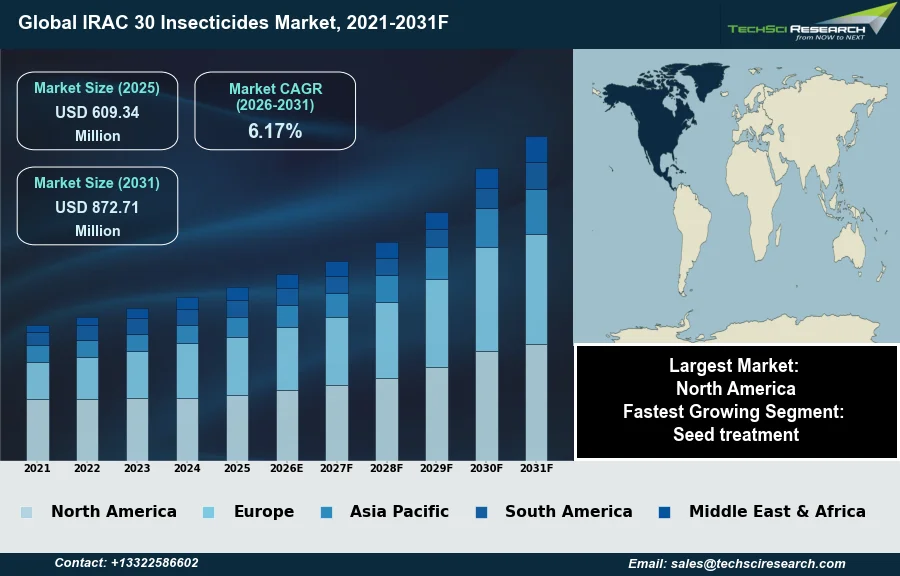
USD 609.34 Million
|
|
CAGR (2026-2031)
|
6.17%
|
|
Fastest Growing Segment
|
Seed treatment
|
|
Largest Market
|
North America
|
|
Market Size (2031)
|
USD 872.71 Million
|
Market Overview
The Global IRAC 30 Insecticides Market is expected to grow from USD 609.34 Million in 2025 to USD 872.71 Million by 2031 at a 6.17% CAGR. IRAC 30 insecticides, defined as GABA-gated chloride channel allosteric modulators, represent a recent chemistry in agricultural crop protection, with registrations commencing in 2018. The market is driven by increasing global food demand, the need for novel pest management against resistance, and the imperative to optimize yields from limited arable land. Significant investment supports this; according to a 2024 infographic from CropLife International members, bringing a new pesticide to market incurred costs exceeding $300 million.
A significant challenge impeding market expansion stems from stringent environmental regulations and heightened safety concerns. These evolving frameworks, enforced by bodies like the U.S. Environmental Protection Agency, elevate compliance costs and extend product approval timelines, potentially hindering rapid commercialization and broad adoption of IRAC 30 chemistries.
Key Market Drivers
Resistance-Management as a Driver of IRAC 30 Adoption
Rising insecticide resistance management strategies significantly drive the Global IRAC 30 Insecticides Market as agricultural systems face persistent threats from evolving pest populations. The continuous application of conventional insecticides has led to pests developing resistance, thereby reducing the efficacy of established pest control methods. This challenge necessitates the development and adoption of novel chemistries with distinct modes of action, such as IRAC 30, to maintain effective pest control and protect crop yields. According to the Food and Agriculture Organization of the United Nations (FAO), as highlighted in a May 2026 report by AgriBusiness Global, plant pests and diseases are responsible for destroying up to 40 percent of global crop production annually, underscoring the critical need for advanced resistance management tools. IRAC 30 compounds offer a new option for rotation in integrated pest management programs, helping farmers overcome resistance issues and safeguard their harvests.
Rising Food Demand and Agricultural Intensification Propel IRAC 30 Growth
The increasing global food demand and the intensification of agriculture also represent a primary driver for the IRAC 30 Insecticides Market. With a growing world population, there is immense pressure on agricultural producers to maximize output from existing arable land. Effective pest control is fundamental to achieving higher crop yields and ensuring food security. The demonstrated efficacy of IRAC 30 insecticides in controlling target pests and enhancing crop productivity directly supports the intensification of agriculture required to meet burgeoning demand. According to the International Food Security Assessment (IFSA) from the USDA's Economic Research Service (ERS), in October 2024, global food demand is projected to increase by 2.8 percent annually over the next decade. This sustained demand underpins the necessity for advanced crop protection solutions. In the broader context of agricultural inputs, according to Syngenta Group, in March 2024, their sales for the full year 2023 reached $32.2 billion.
Download Free Sample Report
Key Market Challenges
Regulatory Constraints and Approval Delays
A significant challenge impeding the expansion of the Global IRAC 30 Insecticides Market arises from stringent environmental regulations and heightened safety concerns. These evolving regulatory frameworks, enforced by bodies such as the U.S. Environmental Protection Agency, directly elevate compliance costs and extend product approval timelines. This protracted process consequently hinders rapid commercialization and broad adoption of IRAC 30 chemistries.
Costs of Regulatory Compliance and Renewal Impeding Innovation
The imperative to meet increasing regulatory demands places a substantial financial burden on manufacturers. For instance, according to CropLife Europe, in 2026, renewing an existing active substance can require between €5 million and €20 million in scientific studies alone, with an additional €1 million to €2 million for associated product renewals. These escalating costs for maintaining and re-registering products disincentivize continued investment in current offerings and new innovations, limiting the overall portfolio of available pest management solutions. Extended timelines for regulatory approval further delay market entry for novel IRAC 30 insecticides, preventing farmers from accessing advanced tools to combat pest resistance and optimize crop yields effectively.
Key Market Trends
Asia-Pacific Shift Drives IRAC 30 Demand
The Global IRAC 30 Insecticides Market is significantly influenced by a regional market shift towards Asia-Pacific dominance. This trend reflects the region's vast agricultural lands, growing populations, and increasing adoption of modern farming practices to boost productivity and secure food supplies. Countries within Asia-Pacific are increasingly investing in advanced crop protection solutions, including novel insecticide chemistries, to combat prevalent pests and enhance crop yields efficiently. This regional pivot is further underscored by robust economic expansion and government initiatives supporting agricultural modernization. For instance, according to Global Agriculture, in October 2026, Syngenta Crop Protection sales in China experienced a notable 20% growth during the first nine months of 2026. This demonstrates the expanding demand for effective agricultural inputs in key regional markets, creating a fertile ground for the increased uptake of IRAC 30 insecticides.
Seed Treatments Driving IRAC 30 Expansion
Accelerated growth in seed treatment applications represents another pivotal trend shaping the Global IRAC 30 Insecticides Market. Seed treatments offer targeted and early-season protection against a spectrum of pests, minimizing the need for later-stage foliar sprays and supporting sustainable agricultural practices. This method ensures uniform crop establishment and safeguards young plants from insect damage, which is crucial for maximizing yield potential from the outset. As farmers seek more efficient and environmentally considerate pest control strategies, the integration of advanced IRAC 30 chemistries into seed treatment formulations gains momentum. According to Cultivar Magazine, in October 2026, Corteva sold US$122 million in seed treatment products in the first half of 2026. This highlights the increasing commercial value and farmer reliance on advanced seed-applied solutions, providing a significant avenue for IRAC 30 market expansion.
Segmental Insights
Seed Treatment: Fastest-Growing IRAC Group 30 Application
The seed treatment segment is experiencing rapid expansion within the Global IRAC 30 Insecticides Market, establishing itself as the fastest-growing application mode. This acceleration is primarily driven by the critical need to protect early plant establishment, particularly in high-value crops such as cereals and oilseeds, where safeguarding against soil-dwelling pests during germination and seedling stages is paramount. Furthermore, seed treatment aligns with integrated pest management strategies by reducing the necessity for repeated foliar insecticide applications. Increased regulatory scrutiny on conventional chemistries and rising concerns regarding pest resistance are compelling growers and seed companies to integrate IRAC Group 30 insecticides into preventive crop protection programs, leveraging their novel mode of action and proven efficacy against early-season threats.
Regional Insights
Key Drivers of IRAC 30 Adoption in North America
North America is a key region within the Global IRAC 30 Insecticides Market, demonstrating a leading position due to several distinct factors. The region's extensive cultivation of cereal and specialty crops in the United States significantly contributes to market demand. Furthermore, Canada plays a substantial role through robust seed treatment programs, particularly for canola and spring wheat rotations that require early-season wireworm control and diverse chemical solutions beyond traditional options. A significant commercial driver was the Environmental Protection Agency (EPA) in the United States, which facilitated the market's expansion with the final registration of multiple isocycloseram products in late 2025. The increasing necessity for resistance-management chemistries and tightening active-ingredient re-registration timelines further support the adoption of IRAC 30 insecticides in the region.
Recent Developments
-
In April 2025, Syngenta further expanded its in-season insect management portfolio by announcing the brand names for three new foliar-applied insecticide products containing isocycloseram (PLINAZOLIN technology) for the U.S. market. These products, Incipio, Vertento, and Zivalgo, were developed to control a broad spectrum of pests in cotton, vegetables, and tree fruit crops. The introduction of these foliar solutions, leveraging the IRAC Group 30 mode of action, provided growers with additional options for resistance management against increasingly challenging insect populations.
-
In February 2025, Syngenta Group Co., Ltd. announced that it was seeking registration in the United States for a novel active ingredient, isocycloseram, marketed as PLINAZOLIN technology. This new insecticide, classified under IRAC Group 30, was anticipated to become available in various product formulations to manage insect pests in field corn, cereals, and pulses, among other crops. Early-season insecticide seed treatments, Opello and Equento, were specifically mentioned as initial offerings designed to control soil-dwelling pests like wireworms. This represented a significant introduction of new chemistry to the Global IRAC 30 Insecticides Market.
-
In December 2024, FMC Corporation secured registrations for two new insecticide products featuring active ingredients from IRAC Group 30. These approvals enabled the company to expand its offerings within the specialized segment of crop protection, targeting specific pest challenges faced by farmers. The new registrations positioned FMC Corporation to enhance its market presence by providing advanced solutions with a distinct mode of action, which is crucial for effective resistance management strategies in the Global IRAC 30 Insecticides Market.
-
In June 2024, Corteva Agriscience introduced a new seed treatment product, contributing to the advancements in early-season crop protection. While the specific IRAC group was not detailed in all announcements, this launch highlighted the company's continuous efforts to develop innovative solutions for seed-applied technologies. Such developments are vital for providing farmers with tools to manage soil-dwelling pests from the outset, supporting sustainable agriculture practices and impacting the broader insecticide market, including specialized segments like IRAC Group 30, through improved crop establishment.
Key Market Players
- FMC Corporation
- Syngenta Group Co., Ltd.
- BASF SE
- Bayer AG
- Corteva, Inc.
- Helm Agro US, Inc.
- UPL Limited
- Sumitomo Chemical Co., Ltd.
- Nufarm Limited
- Rotam Global AgroSciences Ltd.
|
By Application Mode
|
By Crop Type
|
By Region
|
|
|
- Grains and Cereals
- Pulses and Oilseeds
|
- North America
- Europe
- Asia Pacific
- South America
- Middle East & Africa
|
Report Scope:
In this report, the Global IRAC 30 Insecticides Market has been segmented into the following categories, in addition to the industry trends which have also been detailed below:
-
IRAC 30 Insecticides Market, By Application Mode:
-
IRAC 30 Insecticides Market, By Crop Type:
-
Grains and Cereals
-
Pulses and Oilseeds
-
IRAC 30 Insecticides Market, By Region:
-
North America
-
United States
-
Canada
-
Mexico
-
Europe
-
France
-
United Kingdom
-
Italy
-
Germany
-
Spain
-
Asia Pacific
-
China
-
India
-
Japan
-
Australia
-
South Korea
-
South America
-
Brazil
-
Argentina
-
Colombia
-
Middle East & Africa
-
South Africa
-
Saudi Arabia
-
UAE
Competitive Landscape
Company Profiles: Detailed analysis of the major companies present in the Global IRAC 30 Insecticides Market.
Available Customizations:
Global IRAC 30 Insecticides Market report with the given market data, TechSci Research offers customizations according to a company's specific needs. The following customization options are available for the report:
Company Information
- Detailed analysis and profiling of additional market players (up to five).
Global IRAC 30 Insecticides Market is an upcoming report to be released soon. If you wish an early delivery of this report or want to confirm the date of release, please contact us at sales@techsciresearch.com