|
Key Insights
|
Details
|
|
Forecast Period
|
2026 - 2031
|
|
Market Size (2025)
|
USD 1.27 Billion
|
|
CAGR (2026-2031)
|
14.11%
|
|
Fastest Growing Segment
|
Poultry
|
|
Largest Market
|
North America
|
|
Market Size (2031)
|
USD 2.8 Billion
|
Market Overview
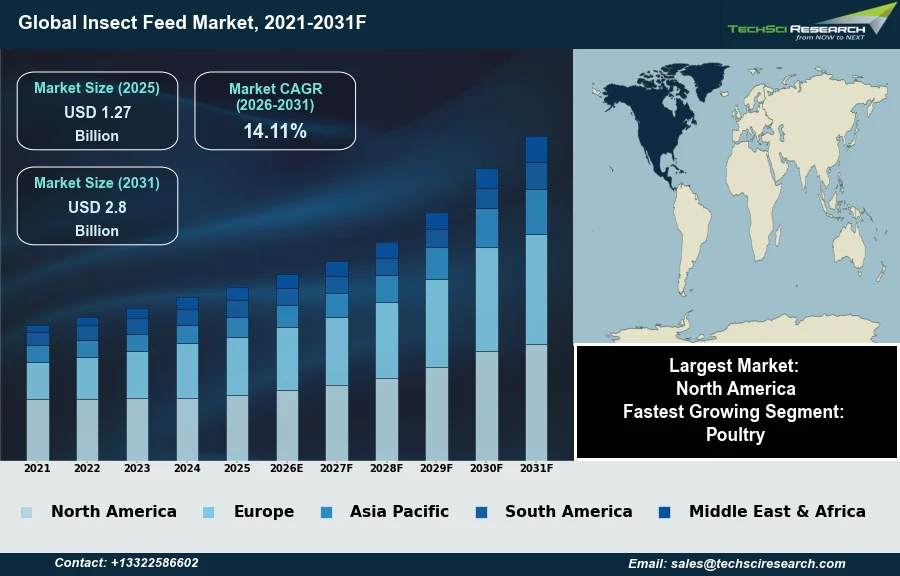
The Global Insect Feed Market is expected to grow from USD 1.27 Billion in 2025 to USD 2.8 Billion by 2031 at a 14.11% CAGR. Insect feed refers to the utilization of insects or their processed derivatives, including protein meals, oils, and frass, as sustainable and nutrient-rich components within animal feed formulations for sectors such as aquaculture, livestock, and pet food. The market's expansion is fundamentally driven by growing global demand for sustainable protein alternatives, necessitated by resource scarcity and environmental impact concerns associated with conventional feed ingredients. Furthermore, the high nutritional value of insect protein and increasing raw material costs for traditional feeds significantly contribute to this growth. According to the International Platform of Insects for Food and Feed (IPIFF), European insect producing companies are projected to produce over 120,000 tons of insect feed products by the end of 2025.
Despite this positive momentum, a notable challenge impeding widespread market expansion involves the fragmented and evolving regulatory landscape across different geographical regions. Inconsistencies in approvals for specific insect species, permissible substrates, and processing methods create complexities for producers seeking to scale operations and standardize products for international trade.
Key Market Drivers
Sustainable Protein Demand Driving Insect Feed Growth
The global insect feed market is significantly propelled by the increasing demand for sustainable protein sources within animal feed formulations. This imperative stems from the need to reduce reliance on conventional ingredients facing environmental and resource constraints. As the agricultural sector strives for greater self-sufficiency and reduced ecological impact, insect-based proteins offer a viable and environmentally friendly alternative. For instance, according to the European Commission, in July 2026, only 25% of the oilseeds and protein crops used in EU animal feed were domestically produced in 2025, with a target to reach 35% by 2035. This strategic push towards local and sustainable protein solutions is a crucial driver, given insect feed's efficient bioconversion capabilities.
Technological Advances and Investments Driving Insect Protein Production
Further driving the market's expansion are ongoing technological advancements and substantial investments in insect rearing infrastructure. These developments enhance the efficiency, scalability, and cost-effectiveness of insect protein production, improving competitiveness against traditional feed ingredients. Significant capital injections enable larger, more automated facilities, boosting yields and reducing operational costs. For example, according to GlobeNewswire, in November 2026, Innovafeed secured an additional €51 million in June 2026, confirming its Nesle production facility was fully operational and reporting a tenfold increase in production volumes with a sevenfold reduction in production costs over three years. Such efficiency gains are crucial for broader market adoption. This is further underscored by the United States Department of Agriculture animal nutrition bulletins, which confirmed in January 2025 that black soldier fly larvae meal output across monitored agricultural conversion units rose by 24%, demonstrating tangible growth in key segments.
Download Free Sample Report
Key Market Challenges
Fragmented Regulations Hamper Market Expansion and International Trade
The fragmented and evolving regulatory landscape across different geographical regions presents a significant challenging factor for the Global Insect Feed Market. Inconsistencies in approvals for specific insect species, permissible substrates, and processing methods create substantial complexities for producers. This lack of harmonization directly hampers their ability to scale operations efficiently and standardize products for international trade, thereby restricting market expansion.
Regulatory Uncertainty Elevates Costs and Slows Commercialization
The absence of a unified regulatory framework introduces considerable uncertainty, leading to increased compliance burdens and operational costs for companies navigating diverse national and regional requirements. This regulatory labyrinth discourages investment and slows the commercialization of novel insect-based feed solutions. For instance, according to the European Feed Manufacturers' Federation (FEFAC), in September 2025, it joined seven other industry sector federations to launch an initiative aimed at raising awareness regarding regulatory obstacles currently limiting feed circularity in livestock production. These widespread and complex regulatory hurdles underscore the systemic challenges faced by innovative feed components like insect protein, directly impeding broader market penetration and growth.
Key Market Trends
Circular economy through waste valorization and carbon reduction in insect protein
Circular economy integration through waste valorization represents a significant trend, as insect farming efficiently converts organic side-streams into high-value feed ingredients. This approach not only provides sustainable protein but also addresses pressing waste management challenges by diverting organic waste from landfills and reducing environmental impact. Insect larvae, particularly black soldier fly larvae, act as powerful bioconverters, transforming agricultural by-products and food waste into biomass and frass. For example, according to InnovaFeed and Protix B.V., September 2026, their published industrial Life Cycle Assessment data demonstrated a fivefold carbon reduction in insect protein production compared to conventional alternatives. This valorization pathway enhances the market's sustainability credentials and reduces reliance on finite resources, establishing a more resilient feed supply chain.
Diversification of insect-based forms and tailored formulations to expand adoption
Product form and customized formulation innovation is another pivotal trend, expanding the utility and adoption of insect-based ingredients across diverse animal nutrition applications. Producers are developing various forms, such as defatted meals, oils, and precise formulations, to meet the specific dietary needs of different livestock, aquaculture species, and pets. This strategic diversification moves beyond generic insect meal, offering tailored solutions that optimize performance and palatability in target animals. According to the International Platform of Insects for Food and Feed, October 2026, dry extruded pet and aquaculture rations accounted for 58% of European commercial insect meal tonnage in March 2025. This indicates a strong market acceptance for specialized insect-derived products, facilitating broader integration into premium and conventional feed markets.
Segmental Insights
Nutritional Benefits and Regulatory Advances Propel Poultry Insect Protein Adoption
The Global Insect Feed Market identifies poultry as the fastest-growing segment due to its superior nutritional profile and the escalating demand for sustainable animal protein. Insect meal offers poultry highly digestible protein, essential amino acids, and beneficial fats, contributing to improved feed conversion ratios and enhanced bird health. Crucially, regulatory advancements like EU Regulation 2021/1372, authorizing insect protein for poultry feed, alongside supportive guidelines from bodies such as the Association of American Feed Control Officials (AAFCO) and the U.S. Food and Drug Administration (FDA), have significantly increased market adoption. This supports the industry's transition towards eco-friendly alternatives and reduced dependency on conventional protein sources.
Regional Insights
North America Leads the Insect Feed Market Through Regulatory Advancements and Investments
The key regional insight for the Global Insect Feed Market highlights North America as a leading region, driven by its robust regulatory advancements and significant industry investments. The United States, in particular, benefits from the Association of American Feed Control Officials (AAFCO) approvals for insect-derived ingredients, such as Black Soldier Fly Larvae meal and oil, in various animal feeds including aquaculture, poultry, swine, and adult dog food. This supportive regulatory environment, alongside increasing investments in large-scale insect farming facilities and partnerships with biotechnology companies, fuels market growth. Furthermore, strong domestic demand from the aquaculture and premium pet food sectors seeking sustainable protein alternatives underpins North America's dominance.
Recent Developments
-
In September 2025, BioMar, Innovafeed, and Auchan announced a strategic partnership to commercialize insect meal for the Ecuadorian shrimp sector. This collaboration integrates Innovafeed's black soldier fly meal into BioMar's shrimp feed formulations. The initiative, revealed at the Global Shrimp Forum, aimed to establish an economically viable model for incorporating insect protein into aquaculture diets. Retailer Auchan committed to supporting the rollout by integrating shrimp fed with this next-generation feed into its responsible sourcing strategy, signaling a significant step towards wider acceptance and scaling of insect-based solutions in the global insect feed market.
-
In October 2024, EnviroFlight, a Darling Ingredients company, collaborated with Entocycle to trial its Entosight Neo optical dosing solution at EnviroFlight's research and development center. This breakthrough research focused on enhancing the production efficiency of black soldier fly larvae through advanced technological precision in counting and dosing neonates. The trials demonstrated a substantial improvement in accuracy, which is critical for optimizing feedstock utilization and improving feed conversion efficiency. This collaboration represents a significant advancement in the operational methodologies for large-scale insect farming within the global insect feed market.
-
In April 2024, Innovafeed inaugurated its North American Insect Innovation Center in Decatur, Illinois, marking a crucial step in its industrial expansion into the North American market. This pilot plant, co-located with ADM's corn processing wet mill, was designed to leverage industrial symbiosis by repurposing agricultural by-products. The facility aims to scale up the production and commercialization of high-quality insect ingredients, specifically black soldier fly meal and oil, for animal feed, pet food, and plant nutrition. This strategic move strengthens Innovafeed’s presence and capacity in the global insect feed market.
-
In January 2024, Protix secured a loan of up to €37 million from the European Investment Bank (EIB) to support its international expansion and boost sustainable protein production. This significant investment was earmarked to accelerate the company's efforts in developing and scaling alternative protein sources derived from insects for use in pet food, aquaculture, and livestock feed. The funding underscored growing confidence in the commercial viability of insect-based ingredients within the global feed market, enabling Protix to further establish its advanced technologies for a circular food chain.
Key Market Players
- Darling Ingredients Inc.
- Protix B.V.
- InnovaFeed SAS
- Entobel Holding Pte. Ltd.
- Entomo Farms Inc. (Next Millennium Farms Inc.)
- Cargill
- ADM
- Nestlé
- Elanco
- Entosystem
|
By Animal Type
|
By Insect Species
|
By Product Form
|
By End User
|
By Region
|
|
|
- Black Soldier Fly Larvae
- Mealworm
|
|
- Commercial Feed Mills
- Integrated Livestock Producers
|
- North America
- Europe
- Asia Pacific
- South America
- Middle East & Africa
|
Report Scope:
In this report, the Global Insect Feed Market has been segmented into the following categories, in addition to the industry trends which have also been detailed below:
-
Insect Feed Market, By Animal Type:
-
Insect Feed Market, By Insect Species:
-
Black Soldier Fly Larvae
-
Mealworm
-
Insect Feed Market, By Product Form:
-
Insect Feed Market, By End User:
-
Commercial Feed Mills
-
Integrated Livestock Producers
-
Insect Feed Market, By Region:
-
North America
-
United States
-
Canada
-
Mexico
-
Europe
-
France
-
United Kingdom
-
Italy
-
Germany
-
Spain
-
Asia Pacific
-
China
-
India
-
Japan
-
Australia
-
South Korea
-
South America
-
Brazil
-
Argentina
-
Colombia
-
Middle East & Africa
-
South Africa
-
Saudi Arabia
-
UAE
Competitive Landscape
Company Profiles: Detailed analysis of the major companies present in the Global Insect Feed Market.
Available Customizations:
Global Insect Feed Market report with the given market data, TechSci Research offers customizations according to a company's specific needs. The following customization options are available for the report:
Company Information
- Detailed analysis and profiling of additional market players (up to five).
Global Insect Feed Market is an upcoming report to be released soon. If you wish an early delivery of this report or want to confirm the date of release, please contact us at sales@techsciresearch.com