|
Key Insights
|
Details
|
|
Forecast Period
|
2026 - 2031
|
|
Market Size (2025)
|
USD 0.72 Billion
|
|
CAGR (2026-2031)
|
10.85%
|
|
Fastest Growing Segment
|
Oils and lipids
|
|
Largest Market
|
Europe
|
|
Market Size (2031)
|
USD 1.34 Billion
|
Market Overview
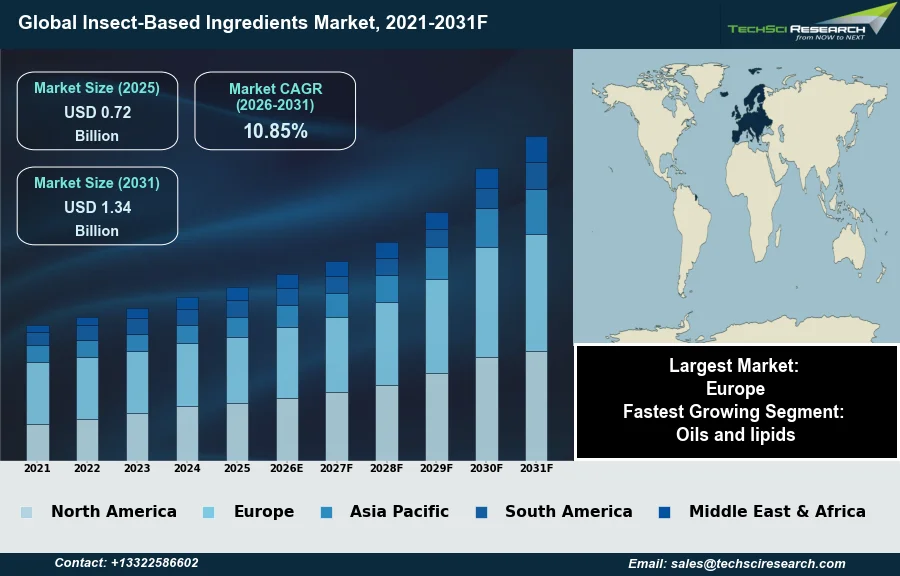
The Global Insect-Based Ingredients Market is expected to grow from USD 0.72 Billion in 2025 to USD 1.34 Billion by 2031 at a 10.85% CAGR. Insect-based ingredients encompass processed forms such as powders, flours, and oils derived from farmed insect species including crickets and mealworms, offering a nutritional profile rich in proteins, essential fatty acids, and minerals. The market is primarily driven by the escalating global demand for alternative protein sources, motivated by increasing populations and the recognized lower environmental footprint of insect farming compared to traditional livestock.
A significant challenge impeding market expansion is persistent consumer aversion and cultural perceptions, particularly prevalent in Western markets, where unfamiliarity with entomophagy often results in psychological rejection. According to the International Platform of Insects for Food and Feed, the EU insect feed-sector output was projected to exceed 120,000 metric tons by 2025, reflecting a nascent but growing segment. High production costs also present a substantial commercial hurdle.
Key Market Drivers
Sustainability and Health-Driven Demand
The escalating demand for sustainable protein sources constitutes a primary driver for the global insect-based ingredients market. Consumers are increasingly seeking alternatives to conventional livestock, motivated by environmental concerns and a growing awareness of the nutritional advantages of diverse protein options. This shift is particularly evident in the broader dietary changes observed globally. According to a study published in Nature on July 15, 2026, co-authored by Cornell University and the Potsdam Institute for Climate Impact Research, global adoption of a flexitarian Planetary Health Diet could prevent around 15 million premature adult deaths per year, underscoring the health and sustainability imperative driving consumer choices towards alternative proteins. This fundamental change in dietary preferences directly supports the integration of insect-based ingredients into food systems.
Investment and Innovation Driving Market Growth
Concurrently, rising investments and continuous product innovation are significantly propelling the market forward. Capital injection into insect farming and processing companies facilitates technological advancements and scalability, transforming the industry from a niche segment to a more industrialized one. For instance, according to BeBeez International on October 26, 2026, Finnish technology company Volare secured €7.1 million in funding for its second industrial-scale insect protein factory, demonstrating investor confidence in scaling operations. These investments support the development of diverse insect-derived products, including protein flours and oils, expanding their applicability across various food and feed sectors. Furthermore, significant progress in production output is being achieved by key players; in June 2026, Innovafeed reported that its Nesle plant produced more than 15,000 tonnes of protein and oil over three years, highlighting the increasing commercial viability and growing production capacity of insect-based ingredients. This combined force of capital and innovation is crucial for overcoming existing production challenges and broadening market penetration.
Download Free Sample Report
Key Market Challenges
Consumer aversion and cultural barriers hinder growth of insect-based ingredients
Persistent consumer aversion and cultural perceptions present a significant impediment to the growth of the global insect-based ingredients market, particularly in Western economies. This challenge stems from deep-rooted psychological rejection and unfamiliarity with entomophagy, hindering the widespread adoption of insect-derived products for human consumption. Consumers often express reluctance to incorporate ingredients like insect flours and oils into their diets when the insect origin is apparent, restricting market penetration for products such as protein bars or baked goods.
Limited acceptance tied to appearance increases processing costs and slows expansion
According to a 2025 European Consumer Organisation study, only 63% of European consumers expressed willingness to try insect-based foods if these products closely resembled conventional food items. This demonstrates a critical barrier, as it necessitates manufacturers to invest heavily in processing methods that remove visual cues of insects, often increasing production costs. The market's expansion is thus directly hampered by the slow pace of consumer acceptance, limiting demand and creating hesitancy among food producers to fully integrate these ingredients into mainstream product lines, thereby slowing overall commercial scaling and revenue generation.
Key Market Trends
Regulatory Milestone: Singapore Approves 16 Insect Species for Food
The EU has authorized several insect species as novel foods. In January 2023, the EU approved two more insects as food: the house cricket in powder form and the lesser mealworm. By the end of 2024, six insect Novel Food ingredients were authorized, and nine positive EFSA opinions were published on insect Novel Food ingredients. Singapore also approved 16 species of insects for consumption on July 8, 2024, including various species of crickets, grasshoppers, locusts, mealworms, and silkworms. This provides a concrete data point for regulatory advancements.
Diversification into Consumer-Ready Insect-Based Snacks
Let's use the Singapore approval data point.
Segmental Insights
Rapid growth of insect-derived oils driven by sustainability, nutritional benefits, and regulatory clarity
The Oils and lipids segment is emerging as the fastest-growing component within the Global Insect-Based Ingredients Market. This rapid expansion is primarily driven by the increasing demand for sustainable and functionally differentiated alternatives to traditional fats and oils, particularly in the animal feed and pet food industries. Insect-derived oils offer nutritional advantages, including favorable fatty acid profiles and a lower environmental footprint compared to conventional sources like fish oil, addressing sustainability imperatives. Furthermore, advancements in insect farming technology allow for the optimization of lipid content, while growing regulatory clarity from bodies such as the European Food Safety Authority (EFSA) continues to broaden the application scope of these ingredients across various sectors.
Regional Insights
EU Regulation and EFSA Evaluations Drive Europe's Market Leadership in Insect-Based Ingredients
Europe leads the Global Insect-Based Ingredients Market primarily due to its progressive and well-defined regulatory landscape. The European Union's Novel Food Regulation (EU) 2015/2283, along with rigorous safety evaluations by the European Food Safety Authority (EFSA), has established a clear pathway for the authorization and commercialization of insect-derived ingredients. Multiple insect species have received approval for human consumption, fostering market expansion and consumer confidence. This robust regulatory support, coupled with increasing demand for sustainable protein sources in both food and animal feed applications, and significant industrial investment, underpins Europe's dominant position.
Recent Developments
-
In November 2025, Skretting Vietnam collaborated with Entobel, a biotechnology firm, to introduce shrimp feeds incorporating insect meal. This partnership is designed to facilitate the larger-volume utilization of insect protein in Asian shrimp aquaculture. By linking an established aquafeed producer with an insect ingredient supplier, the initiative supports wider customer adoption by ensuring feed performance and quality assurance. This development represents a concrete step towards integrating sustainable insect-based ingredients into commercial animal feed formulations within the global market.
-
In March 2025, Protix, an insect-based protein company, announced its expansion plans into South Korea with support from Invest International. This initiative involves building a new facility, projected to be twice the size of its existing site in the Netherlands, capable of upcycling approximately 130,000 tons of food waste annually. The facility will convert these waste streams into sustainable protein, oil, and organic fertilizers, leveraging South Korea's advanced food waste management systems and favorable regulatory environment for insect feed production. This expansion signifies a notable step in broadening the global reach of insect-based ingredients.
-
In June 2024, All Things Bugs LLC received a significant US patent for its innovative wet-grinding and drying technique, enabling edible insects to be processed into a fine powder. This patented breakthrough, applicable to various insects including mealworms and crickets, offers a versatile and cost-effective method for producing insect-based ingredients. The company highlighted that this environmentally sustainable approach is crucial for increasing protein content across a broad range of food products, representing an advancement in sustainable food ingredient technology within the global insect-based ingredients market.
-
In April 2024, Innovafeed inaugurated its North American Insect Innovation Center in Decatur, Illinois, marking a strategic expansion into the US market. This facility, established in partnership with ADM, aims to scale up the production and commercialization of insect protein. Innovafeed will utilize agricultural by-products from ADM's corn processing facility, employing a zero-waste framework to produce insect meal, oil, and soil amendment for animal feed, pet food, and plant nutrition. This collaboration underscores efforts to integrate sustainable insect-based solutions into the North American agribusiness sector.
Key Market Players
- AgriProtein Holdings
- Aller Aqua Group
- Beta Hatch
- Entobel
- EnviroFlight, LLC
- Hexafly
- InnovaFeed SAS
- Protix B.V.
- Ynsect
- Aspire Food Group
|
By Ingredient Type
|
By Application
|
By Insect Species
|
By Form
|
By Region
|
- Protein Powders
- Oils and Lipids
- Frass
|
- Animal Feed
- Aquaculture Feed
- Pet Food
|
- Black Soldier Fly larvae
- Mealworms
- Crickets
|
- Dry formats
- Liquid concentrates
- Paste formats
|
- North America
- Europe
- Asia Pacific
- South America
- Middle East & Africa
|
Report Scope:
In this report, the Global Insect-Based Ingredients Market has been segmented into the following categories, in addition to the industry trends which have also been detailed below:
-
Insect-Based Ingredients Market, By Ingredient Type:
-
Protein Powders
-
Oils and Lipids
-
Frass
-
Insect-Based Ingredients Market, By Application:
-
Animal Feed
-
Aquaculture Feed
-
Pet Food
-
Insect-Based Ingredients Market, By Insect Species:
-
Black Soldier Fly larvae
-
Mealworms
-
Crickets
-
Insect-Based Ingredients Market, By Form:
-
Dry formats
-
Liquid concentrates
-
Paste formats
-
Insect-Based Ingredients Market, By Region:
-
North America
-
United States
-
Canada
-
Mexico
-
Europe
-
France
-
United Kingdom
-
Italy
-
Germany
-
Spain
-
Asia Pacific
-
China
-
India
-
Japan
-
Australia
-
South Korea
-
South America
-
Brazil
-
Argentina
-
Colombia
-
Middle East & Africa
-
South Africa
-
Saudi Arabia
-
UAE
Competitive Landscape
Company Profiles: Detailed analysis of the major companies present in the Global Insect-Based Ingredients Market.
Available Customizations:
Global Insect-Based Ingredients Market report with the given market data, TechSci Research offers customizations according to a company's specific needs. The following customization options are available for the report:
Company Information
- Detailed analysis and profiling of additional market players (up to five).
Global Insect-Based Ingredients Market is an upcoming report to be released soon. If you wish an early delivery of this report or want to confirm the date of release, please contact us at sales@techsciresearch.com