|
Key Insights
|
Details
|
|
Forecast Period
|
2027 - 2031
|
|
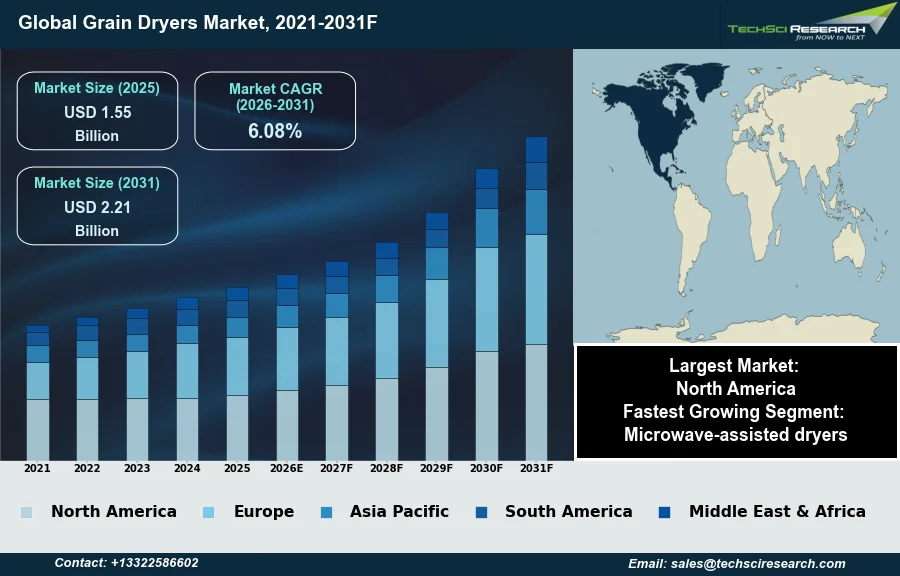
Market Size (2025)
|
USD 1.55 Billion
|
|
CAGR (2026-2031)
|
6.08%
|
|
Fastest Growing Segment
|
Microwave-assisted dryers
|
|
Largest Market
|
North America
|
|
Market Size (2031)
|
USD 2.21 Billion
|
Market Overview
The Global Grain Dryers Market is expected to grow from USD 1.55 Billion in 2025 to USD 2.21 Billion by 2031 at a 6.08% CAGR. Grain dryers are essential agricultural processing systems engineered to reduce moisture content in harvested grains, preserving quality, extending storage life, and minimizing post-harvest losses. The market's growth is primarily driven by the increasing global grain production and the imperative for enhanced food security worldwide. Additionally, a heightened focus on mitigating post-harvest losses, coupled with the expansion of commercial farming operations and the modernization of agricultural practices, significantly propels demand. Changing climatic patterns, leading to more unpredictable harvest conditions and moisture levels in crops, further necessitate reliable drying solutions.
However, a significant challenge impeding market expansion is the substantial initial capital investment required for these systems, coupled with ongoing energy costs, which can deter adoption, particularly for smaller agricultural enterprises. This economic pressure on farmers is evident in broader agricultural machinery markets. According to the Food and Agriculture Organization (FAO), in 2025, global grain production is forecast to reach 2,971 million tons, representing a 3.8% increase from 2024, highlighting the continuous need for effective post-harvest management.
Key Market Drivers
Rising Global Demand Drives Grain-Drying Needs
Increasing Global Food and Feed Demand is a primary catalyst for the Global Grain Dryers Market. As the world population expands, the need to maximize agricultural output and ensure food security intensifies, driving demand for efficient post-harvest solutions. Farmers and large-scale operations require robust systems to handle larger harvests and prevent spoilage. This sustained demand for grain directly translates into investments in infrastructure preserving crop quality and quantity. According to the International Grains Council (IGC) in its October 15, 2026, report, global grains consumption is forecast to reach a record 2,446 million tonnes in 2026/27. This rising consumption underscores the critical role of grain dryers in preparing crops for safe storage and distribution.
Mitigating Post-Harvest Losses Through Efficient Drying
A second significant factor propelling the market is the imperative for Minimizing Post-Harvest Losses and Spoilage. Inefficient drying or inadequate storage leads to considerable degradation in grain quality and volume, impacting farmer income and food availability. Grain dryers reduce moisture content to safe levels, preventing molds, insects, and contaminants. For example, BriefingWire.com reported in March 2026 that nearly 25% of harvested grains globally face moisture levels above the safe storage limit of 14%, necessitating effective drying. This market operates within a broader agricultural equipment landscape. According to the Association of Equipment Manufacturers (AEM), in November 2026, U.S. tractor sales fell 16.4% in September from a year ago, reflecting ongoing market dynamics. Investment in grain drying technology is therefore vital for maintaining crop value and ensuring supply chain resilience.
Download Free Sample Report
Key Market Challenges
Financial Barriers to Grain Dryer Adoption
The substantial initial capital investment required for grain drying systems, combined with ongoing energy costs, represents a significant impediment to the growth of the Global Grain Dryers Market. This economic burden disproportionately affects smaller agricultural enterprises, limiting their ability to adopt modern drying technologies. Such high upfront costs deter farmers from upgrading or investing in new equipment, even when faced with the increasing unpredictability of harvest conditions that necessitate effective moisture reduction.
Broader Economic Constraints on Agricultural Equipment Investment
This financial constraint is reflected in broader agricultural machinery trends. According to the Association of Equipment Manufacturers (AEM), U.S. farm tractor sales, which represent a component of agricultural capital expenditure, declined by 9.9% in 2025 compared to 2024, with self-propelled combine sales falling by 35.6% in the same period. These declines highlight a general reluctance among farmers to make substantial equipment purchases, driven by factors such as fluctuating commodity prices, rising interest rates, and overall tightening farm budgets. Grain dryers, being a significant capital outlay, fall under this same umbrella of reduced investment capacity, thereby directly hindering market expansion as adoption rates slow due to these pervasive economic pressures on agricultural producers.
Key Market Trends
Automation and IoT Driving Grain Dryer Efficiency
Increasing automation and the integration of Internet of Things (IoT) technologies represent a significant evolution within the global grain dryers market, moving beyond general modernization to reshape operational efficiency and precision. This trend involves the deployment of advanced sensors, real-time monitoring systems, and automated controls that enable dynamic adjustments to drying parameters such as temperature and airflow, thereby optimizing grain quality and minimizing spoilage. Such integrated solutions reduce manual labor requirements and enhance the consistency of the drying process, ensuring optimal moisture levels are achieved with greater accuracy. According to company officials cited by the News Agency of Nigeria, in its November 4, 2026, report, Nongyou Agricultural Machinery Group Co, Ltd., a manufacturer of grain dryers, has automation exceeding 90 percent across its production operations, reflecting the industry’s broader push towards highly automated processes throughout the value chain.
Growing Demand for Energy-Efficient Drying Solutions
Complementing this technological shift is the growing demand for energy-efficient and sustainable drying solutions. With rising operational costs and increasing environmental regulations, market participants are increasingly adopting dryers that consume less energy and reduce their carbon footprint. This imperative drives the development and adoption of technologies such as heat pump dryers, biomass-fueled systems, and advanced combustion mechanisms, which not only lower energy consumption but also promote the use of renewable energy sources. This focus on sustainability contributes to lower long-term operating costs for farmers and commercial operators, addressing a critical economic challenge. According to the Propane Education & Research Council (PERC), in its April 14, 2026, "A Clearer Forecast for the Grain Drying Market" report, modern grain dryers use about half the propane of older systems, highlighting substantial improvements in energy efficiency.
Segmental Insights
Microwave-Assisted Drying: Fastest-Growing Segment Driven by Quality Preservation and Efficiency
In the Global Grain Dryers Market, microwave-assisted dryers represent the fastest-growing segment, driven by their superior capabilities in grain quality preservation and operational efficiency. This rapid growth stems from the technology's ability to provide precise and uniform internal heating, which significantly reduces drying time and minimizes local overheating, thus safeguarding the nutritional content and sensory attributes of grains. Furthermore, microwave-assisted drying leads to substantial energy consumption reductions compared to conventional methods, addressing the increasing demand for sustainable agricultural practices and lower operational costs. Their effectiveness for high-value and specialty crops, where maintaining product integrity is crucial, further accelerates adoption.
Regional Insights
Drivers of North America's Dominance in Grain Dryers
North America holds a dominant position in the Global Grain Dryers Market, driven by its advanced agricultural infrastructure and extensive large-scale grain production, particularly across the United States and Canada. The region exhibits a strong propensity for adopting modern drying technologies, including automated and energy-efficient systems, to effectively manage substantial harvests. This leadership is further bolstered by a supportive regulatory framework, with entities like the United States Department of Agriculture (USDA) establishing stringent quality standards for grains and offering initiatives to promote efficient storage and sustainable practices. This integrated approach ensures optimal grain preservation and sustains regional market competitiveness.
Recent Developments
-
In November 2025, Sukup Manufacturing Company received the 2025 Manufacturing Innovation of the Year award at the Prometheus Awards for its Pistachio Mixed Flow Dryer. This recognition highlighted the company's dedication to developing gentle and efficient drying solutions for specialty crops, aiming to protect harvest quality. The Pistachio Mixed Flow Dryer was specifically engineered to meet the needs of the pistachio farming community, showcasing an application of advanced mixed-flow technology to preserve delicate agricultural products. The award reinforces Sukup's position in the global grain dryers market as an innovator in specialized drying equipment.
-
In October 2025, reports detailed a significant breakthrough in grain drying technology achieved in 2024 through the Leandry project. This initiative, a collaboration between Agtech Sweden, Lund University, Hasta Gård, and the U.S.-based company Water Harvesting, developed a prototype for heatless grain drying. The technology utilizes Metal Organic Framework (MOF) material, which was recognized with a Nobel Prize in Chemistry. The prototype successfully generated a dry air stream, demonstrating the potential to halve energy consumption compared to conventional dryers. This research offers a new, energy-efficient approach for the global grain dryers market, reducing reliance on traditional heating methods.
-
In October 2024, Bühler Group inaugurated its new Grain Innovation Center (GIC) in Uzwil, Switzerland. This state-of-the-art 2,000 square meter facility replaced the company's former Grain Technology Center and was designed to foster customer collaboration in food and feed processing. The GIC serves as a hub for developing future foods and addressing evolving market dynamics in grain processing, including aspects related to grain drying efficiency and quality preservation. Following this, Bühler also opened its new Milling Academy in January 2025, further emphasizing its commitment to advancing sustainable milling technology and industry expertise.
-
In September 2024, GSI announced the upcoming launch of its new lineup of mixed-flow grain dryers, set to be available for the 2025 harvest season. These dryers were designed to optimize efficiency and safeguard grain quality. A conditioning product manager at GSI stated that the new models would decrease downtime and maintain capacity without requiring screen cleaning, a significant advantage during busy harvest periods. Key features include a modular design allowing for expansion with farm growth, lower airflow rates for improved fuel efficiency, and the capability to dry multiple crops without changeover. This innovation expands GSI's offerings, providing farmers with advanced drying solutions.
Key Market Players
- AGCO Corporation
- Buhler Holding AG
- Cimbria A/S
- Sukup Manufacturing Co.
- Alvan Blanch Development Company Limited
|
By Dryer Type
|
By Mode of Operation
|
By Grain Type
|
By End User
|
By Region
|
- Mixed-flow dryers
- Microwave-assisted dryers
- Rotary dryers
- Cross-flow dryers
|
- Continuous-flow dryers
- Solar-assisted dryers
|
- Corn
- Pulses and others
- Wheat
- Rice
|
- Commercial grain elevators
- On-farm facilities
|
- North America
- Europe
- Asia Pacific
- South America
- Middle East & Africa
|
Report Scope:
In this report, the Global Grain Dryers Market has been segmented into the following categories, in addition to the industry trends which have also been detailed below:
-
Grain Dryers Market, By Dryer Type:
-
Mixed-flow dryers
-
Microwave-assisted dryers
-
Rotary dryers
-
Cross-flow dryers
-
Grain Dryers Market, By Mode of Operation:
-
Continuous-flow dryers
-
Solar-assisted dryers
-
Grain Dryers Market, By Grain Type:
-
Corn
-
Pulses and others
-
Wheat
-
Rice
-
Grain Dryers Market, By End User:
-
Commercial grain elevators
-
On-farm facilities
-
Grain Dryers Market, By Region:
-
North America
-
United States
-
Canada
-
Mexico
-
Europe
-
France
-
United Kingdom
-
Italy
-
Germany
-
Spain
-
Asia Pacific
-
China
-
India
-
Japan
-
Australia
-
South Korea
-
South America
-
Brazil
-
Argentina
-
Colombia
-
Middle East & Africa
-
South Africa
-
Saudi Arabia
-
UAE
Competitive Landscape
Company Profiles: Detailed analysis of the major companies present in the Global Grain Dryers Market.
Available Customizations:
Global Grain Dryers Market report with the given market data, TechSci Research offers customizations according to a company's specific needs. The following customization options are available for the report:
Company Information
- Detailed analysis and profiling of additional market players (up to five).
Global Grain Dryers Market is an upcoming report to be released soon. If you wish an early delivery of this report or want to confirm the date of release, please contact us at sales@techsciresearch.com