|
Key Insights
|
Details
|
|
Forecast Period
|
2025 - 2030
|
|
Market Size (2025)
|
USD 2.97 Billion
|
|
CAGR (2026-2031)
|
5.1%
|
|
Fastest Growing Segment
|
Poultry
|
|
Largest Market
|
Asia Pacific
|
|
Market Size (2031)
|
USD 4.0 Billion
|
Market Overview
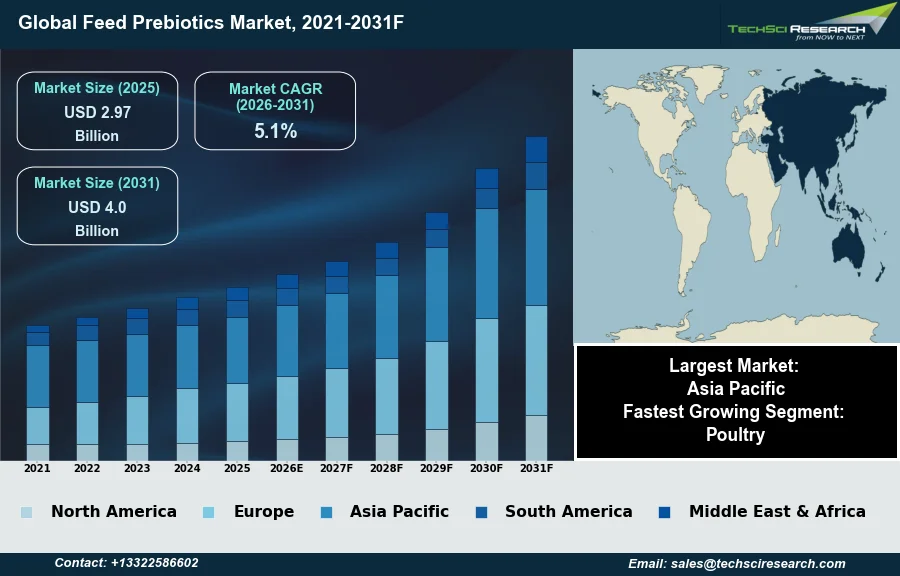
The Global Feed Prebiotics Market is expected to grow from USD 2.97 Billion in 2025 to USD 4.0 Billion by 2031 at a 5.1% CAGR. Feed prebiotics are defined as non-digestible feed ingredients that beneficially affect the host by selectively stimulating the growth and activity of beneficial bacteria in the gastrointestinal tract, thereby improving gut health and overall animal performance. Main drivers supporting market growth include stringent global regulations restricting the use of antibiotic growth promoters in animal feed, compelling producers to seek natural alternatives. Additionally, increasing consumer demand for antibiotic-free animal protein products and a heightened focus on animal gut health, immunity, and feed efficiency in livestock production systems further propel adoption.
The global animal feed industry, within which prebiotics are utilized, produced an estimated 1.44 billion metric tons of compound feed in 2025, marking a 2.9% increase from 2024, according to the Alltech 2026 Agri-Food Outlook, a report compiled in partnership with feed associations and official data-collecting organizations. However, a significant challenge impeding market expansion is the inherent variability in product efficacy and limited standardization across diverse animal species and farming conditions.
Key Market Drivers
Stricter Antibiotic Regulations Drive Prebiotic Demand
Stringent global regulations banning antibiotic growth promoters represent a primary force reshaping the feed industry. As governments increasingly restrict the use of these compounds to combat antimicrobial resistance, livestock and aquaculture producers are compelled to adopt alternative strategies to maintain animal health and performance. This regulatory shift directly benefits the feed prebiotics market by creating an urgent demand for functional ingredients that support gut microbiome health without contributing to resistance. For instance, according to NFU, August 2026, the EU is set to strip Brazil's export authorization for products of animal origin starting September 2026, due to non-compliance with new regulations explicitly prohibiting antibiotic growth promoters in imported livestock farming for meat.
Rising Protein Demand Accelerates Prebiotic Innovation
Concurrently, the rising global demand for animal protein significantly propels the feed prebiotics market. Expanding populations and improving living standards worldwide contribute to a substantial increase in the consumption of meat, dairy, and aquaculture products. This increased demand drives producers to seek innovative feed solutions that enhance feed conversion ratios and overall animal productivity to meet market needs efficiently and sustainably. According to the Brazilian Animal Protein Association (ABPA), August 2026, Brazilian production of animal feed and supplements is projected to grow at a year-over-year rate of 3% in 2026. Furthermore, the continued innovation and adoption of these beneficial ingredients are underscored by recent industry developments; for instance, according to Feed Strategy, November 2026, the Spanish animal nutrition company Norel opened a 10,000-ton feed additives plant in Johor, Malaysia, to produce gut health and feed quality additives for the Asia-Pacific market.
Download Free Sample Report
Key Market Challenges
Efficacy Variability and Standardization Gaps Impede Adoption
The inherent variability in product efficacy and limited standardization across diverse animal species and farming conditions presents a significant impediment to the growth of the global feed prebiotics market. This inconsistency directly erodes producer confidence, as livestock operators are hesitant to broadly adopt ingredients that may not deliver predictable or consistent performance benefits. The lack of standardized metrics and universally recognized efficacy data makes it difficult for producers to compare and select prebiotic products, thereby slowing down their widespread integration into animal nutrition programs.
Standardization Gaps Limit Market Expansion and Cross-Border Trade
This challenge hampers market expansion by increasing the perceived risk for buyers and creating barriers to market entry for new products. For instance, while the broader animal food sector demonstrates robust activity, such as US animal food exports reaching US$7.8 billion in 2025, according to the American Feed Industry Association's 2025–26 State of the US Animal Food Industry Report, the specific segment of feed prebiotics struggles to fully capitalize on this growth. The absence of clear standardization also complicates regulatory processes and cross-border trade, further limiting the geographical reach and commercial viability of prebiotic innovations.
Key Market Trends
Aquaculture Expansion Drives Prebiotic Demand
Expanded application in aquaculture represents a significant trend driving the global feed prebiotics market, as producers increasingly adopt functional ingredients to improve the health and productivity of farmed aquatic species. This expansion is critical for meeting the rising global demand for seafood, necessitating more efficient and sustainable aquaculture practices. Prebiotics aid in enhancing gut health, improving disease resistance, and optimizing feed conversion ratios in fish and shrimp. According to the Department of Agriculture, Fisheries, and Forestry (DAFF), March 2024, aquaculture production in Australia was forecast to rise in 2023−24 by 0.5% to $3.56 billion, underscoring sustained sector growth and the corresponding demand for advanced nutritional solutions. This growth prompts manufacturers to invest in species-specific prebiotic formulations.
Synbiotic Formulations and Strategic Industry Investment
Another pivotal trend shaping the market is the development of synergistic formulations with synbiotics, which combine prebiotics and probiotics to deliver enhanced gut health benefits to animals. This approach leverages the complementary actions of both components, where prebiotics serve as nutrients for beneficial probiotic microorganisms, leading to a more robust gut microbiome. The integration of synbiotics addresses complex animal health challenges by offering comprehensive support for immunity, digestion, and overall performance, particularly in response to the push for antibiotic reduction. This strategic shift is evident in significant industry activities; for example, according to a news article, November 2026, dsm-firmenich agreed on February 9, 2026, to sell its Animal Nutrition & Health business to CVC for approximately EUR 2.2 billion, reflecting substantial investment in this evolving sector.
Segmental Insights
Poultry as a Key Growth Driver in the Global Feed Prebiotics Market
The poultry segment is a significant driver within the Global Feed Prebiotics Market, demonstrating rapid growth due to evolving industry practices and consumer demands. This acceleration is primarily fueled by the global shift away from routine antibiotic use in livestock, driven by concerns over antimicrobial resistance. Prebiotics offer a crucial alternative, enhancing poultry gut health, bolstering immune function, and improving nutrient absorption, which collectively support better growth performance and overall bird welfare. Furthermore, the increasing worldwide demand for high-quality poultry meat and eggs necessitates efficient and healthy production methods, where prebiotics play a vital role in preventing diseases and maintaining flock productivity.
Regional Insights
Asia Pacific: Market Leader Driven by Demand, Urbanization, and Regulatory Advances
Asia Pacific leads the Global Feed Prebiotics Market due to its expansive livestock base and surging demand for animal protein. Rapid urbanization and increasing disposable incomes across countries like China and India fuel a significant rise in poultry, dairy, and meat consumption. This drives producers to enhance animal health and productivity to meet both domestic demand and stringent international quality standards for exported products. Furthermore, evolving regulatory landscapes, such as India's stricter controls on antibiotic usage in animal production, accelerate the adoption of feed prebiotics as effective, natural alternatives for promoting animal gut health and overall performance.
Recent Developments
-
In November 2024, Evonik showcased several new feed ingredients at Eurotier 2024, underscoring its commitment to sustainable animal nutrition. Among these launches was SpeoCare®, a novel butyric acid formulation specifically developed for enhancing gut integrity in livestock. This product launch is directly relevant to the Global Feed Prebiotics Market as butyric acid serves as a crucial short-chain fatty acid, supporting the growth of beneficial gut bacteria and overall digestive health in animals. Evonik's focus aligns with industry trends emphasizing feed additives that promote animal health and reduce reliance on antibiotics.
-
In July 2024, NutriLeads and dsm-firmenich announced a collaboration aimed at exploring the application of Benicaros, a precision prebiotic, for the global pet food market. This partnership signifies a strategic move to leverage advanced prebiotic technology in companion animal nutrition. The initiative seeks to develop innovative solutions that can enhance gut health and overall well-being in pets by modulating their microbiome. This collaboration is a direct example of companies focusing on research and development within the Global Feed Prebiotics Market to deliver science-backed ingredients for evolving animal dietary needs.
-
In June 2024, ADM, a prominent global natural ingredients company, introduced a range of seven new turnkey pet product formulas in Europe. These solutions, available in soft chews and supplement powder sachets, were designed to support various aspects of pet wellness. The formulations integrate prebiotics, probiotics, and postbiotics to foster a healthy gastrointestinal environment, as well as skin and oral microbiomes in pets. This launch directly addresses the increasing consumer demand for functional pet nutrition, highlighting the growing role of prebiotics in the global animal feed market for companion animals. The products are backed by scientific evidence and comply with European regulations.
-
In 2025, BENEO significantly expanded its production capacity for chicory inulin in Belgium. This expansion was a direct response to the escalating global demand for prebiotic fibers across various applications, including the animal feed sector. Chicory inulin is a recognized prebiotic that supports digestive health by selectively fostering beneficial gut bacteria. The company's investment in increased manufacturing capabilities highlights the strong market growth and the crucial role of plant-based functional ingredients in meeting the rising need for effective and sustainable feed prebiotics worldwide.
Key Market Players
- Alltech, Inc.
- DSM-Firmenich AG
- Cargill, Inc.
- Archer Daniels Midland Co.
- Evonik Industries AG
- Biochem Zusatzstoffe Handels- und Produktionsgesellschaft mbH
- Land O'Lakes, Inc.
- Kemin Industries
- EW Nutrition
- Impextraco NV
|
By Sub Additive
|
By Animal
|
By Region
|
- Inulin
- Fructo-oligosaccharides
- Galacto-oligosaccharides
- Mannan-oligosaccharides
- Xylo-oligosaccharides
|
- Poultry
- Layer
- Ruminant
- Aquaculture
|
- North America
- Europe
- Asia Pacific
- South America
- Middle East & Africa
|
Report Scope:
In this report, the Global Feed Prebiotics Market has been segmented into the following categories, in addition to the industry trends which have also been detailed below:
-
Feed Prebiotics Market, By Sub Additive:
-
Inulin
-
Fructo-oligosaccharides
-
Galacto-oligosaccharides
-
Mannan-oligosaccharides
-
Xylo-oligosaccharides
-
Feed Prebiotics Market, By Animal:
-
Poultry
-
Layer
-
Ruminant
-
Aquaculture
-
Feed Prebiotics Market, By Region:
-
North America
-
United States
-
Canada
-
Mexico
-
Europe
-
France
-
United Kingdom
-
Italy
-
Germany
-
Spain
-
Asia Pacific
-
China
-
India
-
Japan
-
Australia
-
South Korea
-
South America
-
Brazil
-
Argentina
-
Colombia
-
Middle East & Africa
-
South Africa
-
Saudi Arabia
-
UAE
Competitive Landscape
Company Profiles: Detailed analysis of the major companies present in the Global Feed Prebiotics Market.
Available Customizations:
Global Feed Prebiotics Market report with the given market data, TechSci Research offers customizations according to a company's specific needs. The following customization options are available for the report:
Company Information
- Detailed analysis and profiling of additional market players (up to five).
Global Feed Prebiotics Market is an upcoming report to be released soon. If you wish an early delivery of this report or want to confirm the date of release, please contact us at sales@techsciresearch.com