|
Key Insights
|
Details
|
|
Forecast Period
|
2026 - 2031
|
|
Market Size (2025)
|
USD 4.3 Billion
|
|
CAGR (2026-2031)
|
4.49%
|
|
Fastest Growing Segment
|
Fava Bean Protein
|
|
Largest Market
|
North America
|
|
Market Size (2031)
|
USD 5.6 Billion
|
Market Overview
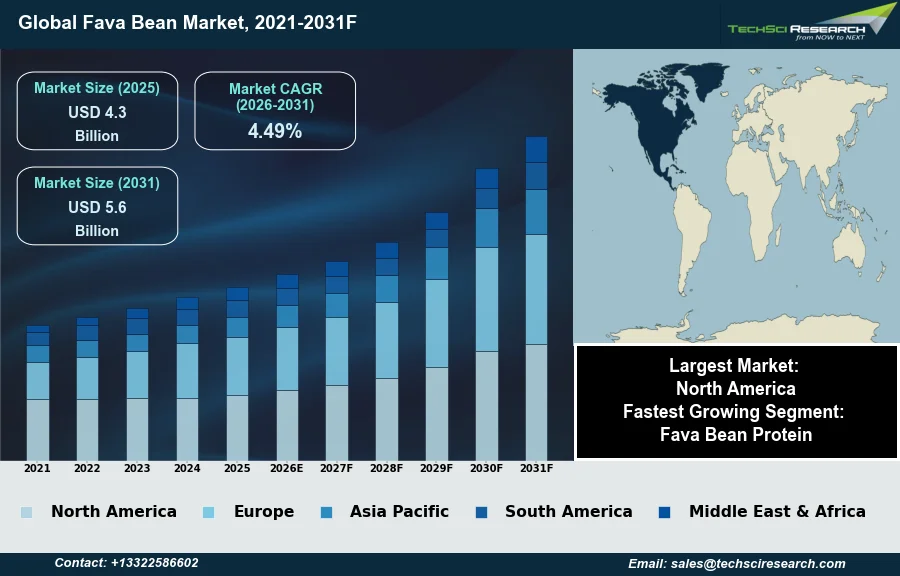
The Global Fava Bean Market is expected to grow from USD 4.3 Billion in 2025 to USD 5.6 Billion by 2031 at a 4.49% CAGR. Fava beans, also known as broad beans or horse beans, are the edible seeds of the legume crop Vicia faba, recognized for their nutritional profile as a source of protein and essential nutrients. The global market for this product is primarily driven by the increasing demand for plant-based proteins, a growing awareness of health benefits, and the adoption of sustainable agricultural practices that leverage fava beans' soil-enriching properties. Furthermore, the expanding integration of fava bean ingredients into meat and dairy substitutes underscores their versatility and market appeal.
However, the market's expansion faces a significant challenge from robust competition presented by other established alternative protein sources like soybeans and peas. According to Saskatchewan Pulse Growers, in 2026, faba bean plantings in Canada were recorded at just 51,300 acres, indicating a reduced cultivation area. This, combined with limited consumer familiarity in some regions, could impede broader market penetration despite the crop's inherent advantages.
Key Market Drivers
Rising Demand for Plant-Based Proteins Fuels Fava Bean Growth
Surging demand for plant-based proteins and vegan diets is a primary catalyst for the global fava bean market. As consumers increasingly prioritize health and sustainable food choices, the nutritional advantages of fava beans, particularly their high protein content, position them as a compelling alternative to traditional animal-derived proteins. This trend is evident in the broader plant-based sector, where the global retail market for plant-based products grew to $28.6 billion in 2024, according to the Good Food Institute. Fava beans are increasingly utilized in meat and dairy alternatives, catering to a growing segment of flexitarian and vegan consumers seeking diverse and nutritious plant-based options.
Diversified Applications and Strategic Investments Drive Fava Bean Expansion
The expanding product development and application versatility of fava beans further contribute to market growth. Innovations in processing technology have enabled the creation of fava bean isolates and concentrates, which are being incorporated into a wider array of food products beyond traditional uses. This includes novel applications in snacks, baked goods, and beverages, enhancing their appeal to various food manufacturers. For example, according to Just Food, in February 2025, Valio acquired two fava-bean brands, Härkis and Beanit, from Finnish food group Raisio in a €7 million deal, signifying strategic expansion in plant-based offerings. This strategic investment highlights the industry's confidence in fava beans' potential to diversify product portfolios. Overall, global faba bean cultivation covered approximately 2.8 million hectares in 2023, according to MDPI, underscoring its agricultural significance and potential for further market expansion.
Download Free Sample Report
Key Market Challenges
Competition from established proteins and production-scale disparity.
The global fava bean market faces a significant challenge from robust competition presented by established alternative protein sources, particularly soybeans and peas. These competitors benefit from entrenched market positions, widespread consumer recognition, and mature supply chains, making it difficult for fava beans to secure substantial market share. Food manufacturers often prioritize readily available and economically advantageous ingredients. For example, according to Saskatchewan Pulse Growers, recent estimates indicate faba bean production among key exporting countries totaled approximately 2.14 million tonnes in 2026. This volume is considerably lower compared to global soybean production, which was estimated at 426 million tonnes in 2025/26 by the United States Department of Agriculture. This disparity in production scale allows rival proteins to offer more competitive pricing and greater supply consistency.
Limited consumer familiarity impeding demand.
Furthermore, limited consumer familiarity with fava beans in several regions intensifies this competitive pressure. Despite their nutritional benefits and sustainable cultivation properties, insufficient consumer awareness hinders broader adoption and demand. By July 2026, faba bean demand was reported as very thin in Australian export and domestic markets due to oversupply in traditional importing regions. This illustrates how low consumer recognition and preference for alternatives directly impede market expansion and optimal price realization for fava bean products.
Key Market Trends
Expansion into clean-label and sustainable product formulations
The global fava bean market is significantly shaped by the increasing integration of fava beans in clean-label and sustainable product formulations. Manufacturers are increasingly leveraging fava beans for their natural, allergen-friendly profile and their role in environmentally conscious product development, extending beyond traditional human food applications. This trend highlights the versatility of fava beans in addressing consumer demand for transparency and ecological responsibility across various sectors. For instance, according to The Farming Blog, in February 2026, McArthur Agriculture Ltd.'s project demonstrated how UK-grown faba bean feed ingredients could notably cut greenhouse gas emissions from English dairy farming by up to 1.6 million tonnes of CO₂e per year, showcasing a direct environmental benefit within the agricultural supply chain.
Advances in low anti-nutrient varieties and breeding investment
Concurrently, the development of low anti-nutrient fava bean varieties is a pivotal trend enhancing market accessibility and product quality. This breeding focus aims to reduce compounds like vicine and convicine, which historically limited broader fava bean consumption and required intensive processing. By improving the inherent nutritional profile and digestibility of the beans, these new varieties make fava beans more appealing for direct consumption and as a premium ingredient in processed foods. A strong indicator of this trend is the establishment of the National Faba Bean Breeding Program, a $9.5 million co-investment involving the GRDC, InterGrain, and Adelaide University, launched in April 2026, specifically targeting improved, higher-yielding faba bean varieties with enhanced quality traits.
Segmental Insights
Fava Bean Protein: Rapid Growth Driven by Plant-Based Demand and Sustainability
The Global Fava Bean Market is experiencing substantial growth, with Fava Bean Protein identified as the most rapidly expanding segment. This acceleration is primarily attributed to a global paradigm shift in consumer dietary preferences towards plant-based and sustainable food choices, driven by heightened health awareness and ethical considerations. Fava bean protein offers a compelling, nutritionally dense, and allergen-friendly alternative to conventional animal-derived and common plant-based proteins, boasting a complete amino acid profile. Its inherent functional versatility, allowing broad application in diverse food formulations such as meat analogues, dairy alternatives, and fortified snacks, alongside its demonstrably lower environmental impact compared to traditional agriculture, collectively underpins its strong market penetration and sustained growth.
Regional Insights
North America’s Leadership in Fava Beans: Plant-Based Demand, Processing Capacity, and Policy Support
North America is a key region in the global fava bean market, demonstrating leadership primarily due to strong consumer shifts towards plant-based protein sources and heightened health consciousness. The region's dominance is underpinned by a growing embrace of vegetarian and vegan diets, which recognize fava beans for their rich protein, fiber, and essential nutrient profiles. Significant investments in processing infrastructure and advanced technologies have facilitated the production of high-value fava bean protein isolates and flours, meeting diverse food industry demands, including meat and dairy alternatives. Additionally, government initiatives, such as the USDA's support for climate-resilient pulse crops and incentives for agricultural diversification, further enhance cultivation and processing capabilities, strengthening North America's competitive position.
Recent Developments
-
In June 2025, Nuttee Bean Co. launched its new Favalicious brand, introducing a line of fava bean-based pasta products to the U.S. foodservice and retail sectors. This new pasta offers a clean-label, high-protein, and gluten-free alternative for consumers. The product contains 19 grams of protein, 16 grams of fiber, and 13 net carbohydrates per serving, addressing consumer demand for healthier, plant-based food options. The company highlighted the sustainable nature of fava beans, noting their lower water requirements compared to other plant-based protein sources.
-
In May 2024, Roquette, a prominent global manufacturer of plant-based ingredients, introduced NUTRALYS® Fava S900M, its inaugural fava bean protein isolate, to the European and North American markets. This new ingredient is designed to provide 90% protein content and features a clean taste and light color, making it suitable for a diverse range of applications, including meat substitutes and non-dairy alternatives. The company presented this innovation at Future Food-Tech's Alternative Proteins Summit in Chicago, emphasizing its functional versatility and its ability to broaden options for food manufacturers seeking sustainable and nutritious plant-based ingredients.
-
In 2025, a significant collaboration commenced between Maia Farms, Protein Industries Canada, and Phytokana Ingredients. This partnership focused on a project valued at C$32.5 million (approximately $24 million USD) aimed at transforming fava beans into sustainable and nutritious components for plant-centric food products. The initiative specifically involves Maia Farms utilizing fava bean byproducts from Phytokana as fermentation media components to create mycelium proteins, showcasing an innovative approach to upcycling and developing next-generation plant-based proteins.
-
In the second quarter of 2025, Beneo's new €50 million faba bean processing facility in Offstein, Germany, became fully operational. This facility was established to support the company's expanding portfolio of faba bean applications, particularly for meat and dairy alternatives. The investment reflects Beneo's commitment to the fava bean market, enabling the production of ingredients with improved profiles and ensuring a sustainable and chemical-free processing approach by sourcing faba beans locally, thereby reducing its carbon footprint.
Key Market Players
- Goya Foods, Inc.
- Roquette Frères S.A.
- Archer Daniels Midland (ADM)
- Prairie Fava
- BENEO GmbH
- Nutris Group / Meelunie
- The Scoular Company
- Global Food & Ingredients (GFI) Inc.
- Puris Proteins LLC
- Emsland Group
|
By Product Type
|
By End User
|
By Region
|
- Whole fava beans
- Fava bean protein
- Protein isolates
|
- Retail
- Foodservice/Horeca
|
- North America
- Europe
- Asia Pacific
- South America
- Middle East & Africa
|
Report Scope:
In this report, the Global Fava Bean Market has been segmented into the following categories, in addition to the industry trends which have also been detailed below:
-
Fava Bean Market, By Product Type:
-
Whole fava beans
-
Fava bean protein
-
Protein isolates
-
Fava Bean Market, By End User:
-
Retail
-
Foodservice/Horeca
-
Fava Bean Market, By Region:
-
North America
-
United States
-
Canada
-
Mexico
-
Europe
-
France
-
United Kingdom
-
Italy
-
Germany
-
Spain
-
Asia Pacific
-
China
-
India
-
Japan
-
Australia
-
South Korea
-
South America
-
Brazil
-
Argentina
-
Colombia
-
Middle East & Africa
-
South Africa
-
Saudi Arabia
-
UAE
Competitive Landscape
Company Profiles: Detailed analysis of the major companies present in the Global Fava Bean Market.
Available Customizations:
Global Fava Bean Market report with the given market data, TechSci Research offers customizations according to a company's specific needs. The following customization options are available for the report:
Company Information
- Detailed analysis and profiling of additional market players (up to five).
Global Fava Bean Market is an upcoming report to be released soon. If you wish an early delivery of this report or want to confirm the date of release, please contact us at sales@techsciresearch.com