|
Key Insights
|
Details
|
|
Forecast Period
|
2026 - 2031
|
|
Market Size (2025)
|
USD 24.2 Billion
|
|
CAGR (2026-2031)
|
10.21%
|
|
Fastest Growing Segment
|
Africa
|
|
Largest Market
|
North America
|
|
Market Size (2031)
|
USD 43.37 Billion
|
Market Overview
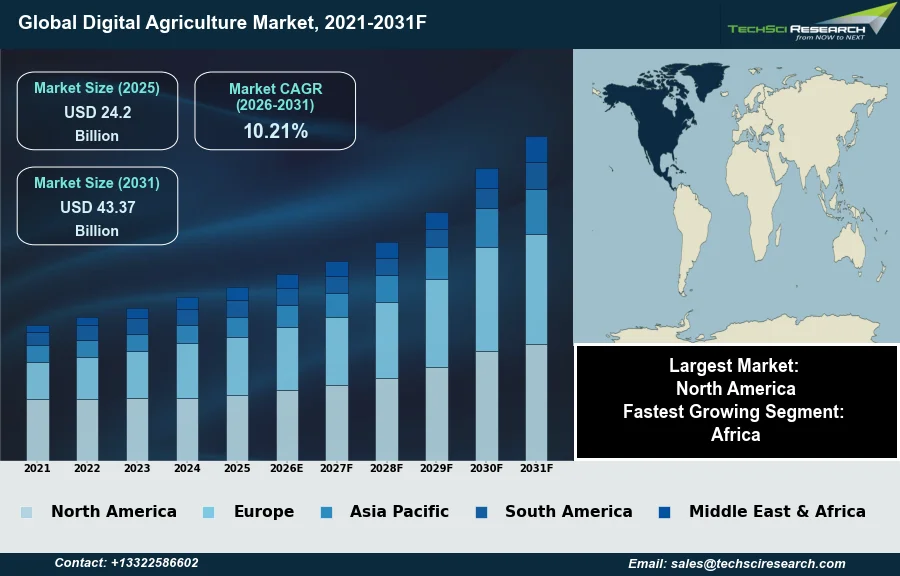
The Global Digital Agriculture Market is expected to grow from USD 24.2 Billion in 2025 to USD 43.37 Billion by 2031 at a 10.21% CAGR. Digital agriculture encompasses the application of advanced technologies, including sensors, artificial intelligence, big data analytics, and automation, to monitor, analyze, and manage agricultural systems throughout the entire agri-food value chain, thereby optimizing farming practices for improved efficiency and sustainability. This market's growth is primarily driven by the escalating global demand for increased food production and the imperative for optimized resource utilization. Furthermore, supportive government initiatives promoting smart farming and the necessity to mitigate agricultural labor shortages through automation are key contributors to market expansion.
Demonstrating tangible benefits, according to the Association of Equipment Manufacturers, in 2025, the utilization of precision agriculture in the United States led to an estimated 8% reduction in fertilizer use and a 9% reduction in herbicide use. Despite these advancements, a significant challenge impeding global market expansion is the considerable upfront investment required for implementing digital agricultural technologies, particularly for smaller farming operations, coupled with persistent issues of insufficient digital infrastructure in many rural regions.
Key Market Drivers
Population growth and food insecurity drive digital agriculture
The escalating global demand for food security and the continuous growth of the world's population are fundamental drivers propelling the digital agriculture market. As the global population expands, the pressure to enhance agricultural output sustainably intensifies, necessitating innovations that optimize resource utilization and maximize yields without further environmental degradation. The urgency of this challenge is underscored by persistent food insecurity worldwide. According to the Food and Agriculture Organization, in 2023, more than 259 million people suffered from acute hunger across the globe. Digital agriculture solutions, such as precision irrigation, crop monitoring, and predictive analytics, are therefore critical for increasing productivity on existing farmland and mitigating supply chain inefficiencies to meet burgeoning consumption needs.
Technological advancement and policy support propel digital agriculture
The integration of emerging technologies, including artificial intelligence (AI), the Internet of Things (IoT), robotics, and drones, significantly fuels the expansion of the digital agriculture market. These advanced tools enable unprecedented levels of precision and automation in farming practices, from autonomous machinery performing tasks like planting and harvesting to sensors collecting real-time data on soil health and crop conditions. Such technological adoption directly addresses operational challenges and enhances overall farm efficiency. For example, according to the USDA Economic Research Service, in December 2024, guidance autosteering systems were used by 70 percent of large-scale crop-producing farms in 2023, demonstrating a substantial uptake of precision technologies. Furthermore, supportive governmental frameworks encourage this technological transition; according to the U.S. Department of Agriculture, in April 2024, USD 1.5 billion was earmarked for Conservation Innovation Grants and SBIR/STTR initiatives designed to integrate climate-smart tools into farming.
Download Free Sample Report
Key Market Challenges
Upfront capital barriers and ROI uncertainty
The considerable upfront investment required for implementing digital agricultural technologies presents a significant impediment to the global market's expansion. This financial barrier is particularly acute for smaller farming operations, which often have limited capital for technology adoption. The substantial initial expenditure required for sensors, artificial intelligence systems, big data analytics platforms, and automation equipment can deter potential users, especially when the return on investment may not be immediately apparent or guaranteed.
Rural connectivity gaps intensify investment barriers
Furthermore, persistent issues of insufficient digital infrastructure in many rural regions compound this financial challenge. Without reliable high-speed internet connectivity, the efficacy and practical application of many advanced digital agricultural tools are severely curtailed. For example, the inability to transmit large volumes of sensor data or utilize cloud-based AI analytics in real-time limits the perceived value and feasibility of these investments for farmers. According to an April 2026 survey by the American Farm Bureau Federation, 94 percent of farmers reported their financial situation had worsened or remained unchanged over the previous year, directly impacting their capacity for significant capital outlay. This combination of substantial capital outlay and inadequate foundational infrastructure directly retards the widespread adoption necessary for robust market growth.
Key Market Trends
AI-Driven Predictive Analytics for Farm Decision Support
AI-Driven Predictive Analytics and Decision Support Systems are fundamentally transforming agricultural operations by providing advanced insights into complex farming variables. These systems analyze vast datasets, including weather patterns, soil conditions, and crop health, enabling farmers to forecast yields, predict disease outbreaks, and optimize resource allocation with greater accuracy. This moves beyond basic data collection to offer actionable intelligence, supporting more informed and proactive management decisions across the growing cycle. According to Bushel's 2026 State of the Farm Report, approximately 15% of farms in the U.S. and Canada currently utilize some form of artificial intelligence, underscoring the foundational adoption of these advanced analytical tools within the sector. This integration helps farmers fine-tune irrigation, fertilization, and pest control, enhancing efficiency.
Digital Twin Technology for Farm Simulation
The adoption of Digital Twin Technology for Farm Simulation is emerging as another significant trend, offering a virtual replica of physical farm environments. These digital twins integrate real-time data from sensors, drones, and IoT devices to create dynamic models that simulate crop growth, livestock conditions, and machinery performance under various scenarios. This simulation allows for comprehensive testing of different farming strategies, such as crop rotation or irrigation schedules, without incurring real-world risks or costs, facilitating precise operational adjustments and strategic planning. According to Farmonaut, in January 2026, over 40% of large farms globally are expected to implement digital twin technology for precision agriculture, highlighting its growing importance in advanced farm management. This technology aids in proactive risk mitigation and resource optimization.
Segmental Insights
Africa: Fastest-Growing Market for Digital Agriculture Fueled by Mobile Tech and Policy Initiatives
The Global Digital Agriculture Market is experiencing significant expansion, with Africa emerging as its fastest-growing segment. This rapid growth is largely propelled by the widespread adoption of mobile technology, which provides smallholder farmers with essential access to real-time weather forecasts, market prices, and agronomic advice. Digital platforms effectively bridge information gaps and enhance financial inclusion, enabling farmers to make informed decisions, access financial services, and connect directly with buyers to improve profitability and market access. Furthermore, supportive governmental and regional initiatives, such as the African Union's Digital Transformation Strategy for Africa and the Comprehensive Africa Agriculture Development Programme, are fostering an environment conducive to agricultural modernization and digital adoption across the continent, ultimately aiming to boost productivity and strengthen food security.
Regional Insights
North America: Leading Market Driven by Tech Adoption, Investment, and Large-Scale Farming
North America stands as the leading region in the Global Digital Agriculture Market, primarily driven by its advanced technological infrastructure and high rates of technology adoption across the agricultural sector. The region benefits from substantial venture capital investment in agtech startups and strong government backing, including initiatives from the U.S. Department of Agriculture (USDA), which actively promotes sustainable farming practices and technology integration. Furthermore, the prevalence of large-scale commercial farms and the presence of major agricultural equipment manufacturers facilitate widespread deployment of precision farming tools, IoT sensors, and AI-driven analytics, addressing challenges such as labor shortages and rising operational costs.
Recent Developments
-
In March 2025, Syngenta and Planet announced an expansion of their multi-year collaboration to provide advanced satellite imagery services for digital agriculture. This renewed partnership aimed to deliver near-daily, 3-meter resolution satellite imagery through Syngenta's Cropwise platform. The high-resolution data enabled earlier detection of crop stress, pests, and diseases, allowing farmers to implement timely and targeted interventions. This collaboration represented a significant step in leveraging satellite technology for enhanced agronomic applications and improved farm management.
-
In November 2024, CropX launched an innovative, first-of-its-kind sensor for real-time plant water use monitoring through evapotranspiration (ET) across the Australasia region. This above-canopy sensor integrates with the CropX agronomic farm management system, offering growers unprecedented insights into crop water requirements. The technology facilitates data-driven irrigation scheduling and remote management, which significantly enhances water efficiency. This new solution provides field-specific ET measurements, moving beyond regional estimations to support precise water resource management in digital agriculture.
-
In October 2024, CropX, a prominent provider of digital agricultural solutions, introduced an enhanced variable rate application (VRA) planning capability. This new feature was designed to empower growers to optimize the precision of their in-field operations. It allowed for the tailored optimization of seeding, irrigation water, and fertilizer application based on specific in-field variations, thereby maximizing the productivity and overall efficiency of agricultural fields. This advancement further solidified the integration of data-driven decision-making in modern farm management.
-
In January 2024, John Deere significantly advanced its precision agriculture offerings with the integration of new G5 CommandCenter displays across its 6, 7, 8, and 9 Series tractors. This enhancement provided farmers with standard features such as documentation, data synchronization, JDLink connectivity, variable rate application, section control, and AutoTrac guidance. The G5Plus CommandCenter, notably larger and with a high-definition screen, enabled improved efficiency and user experience in precision farming operations. These technological updates aimed to ensure tractors were equipped for future digital agriculture demands.
Key Market Players
- Deere & Company
- CNH Industrial N.V.
- Bayer AG
- AGCO Corporation
- Syngenta Group
- International Business Machines Corporation
- Microsoft Corporation
- Hexagon AB
- KUBOTA Corporation
- Topcon Corporation
|
By Technology
|
By Component
|
By Application
|
By Farm Size
|
By Region
|
- Guidance Systems
- Artificial Intelligence and Advanced Analytics
- Internet of Things and Connected Sensors
- Blockchain and Traceability
- Robotics and Automation
|
- Hardware
- Software
- Services
|
- Crop Monitoring
- Drone Analytics
- Yield Mapping and Forecasting
- Precision Spraying and Input Optimization
- Soil Monitoring
- Livestock Monitoring
- Farm Financial Management
- Weather Modules
|
- Small-Scale Farms
- Medium-Scale Farms
- Large-Scale Farms
|
- North America
- Europe
- Asia Pacific
- South America
- Middle East & Africa
|
Report Scope:
In this report, the Global Digital Agriculture Market has been segmented into the following categories, in addition to the industry trends which have also been detailed below:
-
Digital Agriculture Market, By Technology:
-
Guidance Systems
-
Artificial Intelligence and Advanced Analytics
-
Internet of Things and Connected Sensors
-
Blockchain and Traceability
-
Robotics and Automation
-
Digital Agriculture Market, By Component:
-
Hardware
-
Software
-
Services
-
Digital Agriculture Market, By Application:
-
Crop Monitoring
-
Drone Analytics
-
Yield Mapping and Forecasting
-
Precision Spraying and Input Optimization
-
Soil Monitoring
-
Livestock Monitoring
-
Farm Financial Management
-
Weather Modules
-
Digital Agriculture Market, By Farm Size:
-
Small-Scale Farms
-
Medium-Scale Farms
-
Large-Scale Farms
-
Digital Agriculture Market, By Region:
-
North America
-
United States
-
Canada
-
Mexico
-
Europe
-
France
-
United Kingdom
-
Italy
-
Germany
-
Spain
-
Asia Pacific
-
China
-
India
-
Japan
-
Australia
-
South Korea
-
South America
-
Brazil
-
Argentina
-
Colombia
-
Middle East & Africa
-
South Africa
-
Saudi Arabia
-
UAE
Competitive Landscape
Company Profiles: Detailed analysis of the major companies present in the Global Digital Agriculture Market.
Available Customizations:
Global Digital Agriculture Market report with the given market data, TechSci Research offers customizations according to a company's specific needs. The following customization options are available for the report:
Company Information
- Detailed analysis and profiling of additional market players (up to five).
Global Digital Agriculture Market is an upcoming report to be released soon. If you wish an early delivery of this report or want to confirm the date of release, please contact us at sales@techsciresearch.com