|
Key Insights
|
Details
|
|
Forecast Period
|
2026 - 2031
|
|
Market Size (2025)
|
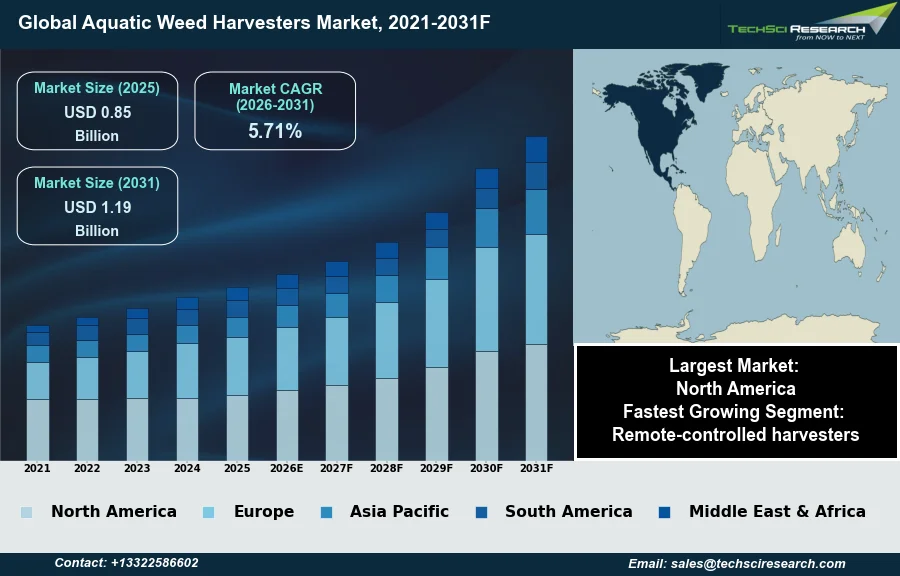
USD 0.85 Billion
|
|
CAGR (2026-2031)
|
5.71%
|
|
Fastest Growing Segment
|
Remote-controlled harvesters
|
|
Largest Market
|
North America
|
|
Market Size (2031)
|
USD 1.19 Billion
|
Market Overview
The Global Aquatic Weed Harvesters Market is expected to grow from USD 0.85 Billion in 2025 to USD 1.19 Billion by 2031 at a 5.71% CAGR. Aquatic weed harvesters are specialized mechanical equipment designed for the management of inland watercourses, serving to cut, collect, and remove submerged, emergent, and floating aquatic vegetation from lakes, rivers, and canals. These machines are integral to maintaining ecological balance, facilitating navigation, and protecting water infrastructure. Key drivers supporting market growth include escalating environmental concerns regarding water quality degradation caused by excessive aquatic weed proliferation and increasingly stringent government regulations that promote mechanical removal over chemical control methods. Additionally, the rising demand for maintaining clear waterways for recreational and tourism activities significantly contributes to market expansion.
Despite these drivers, a notable challenge impeding market expansion is the substantial upfront capital investment required for acquiring specialized harvesting fleets. Comprehensive statistical numerical data specifically detailing the global aquatic weed harvesters market size or sales volume for 2025 or 2026, originating solely from industrial associations and not from market research reports or similar commercial sources, could not be identified through available public information.
Key Market Drivers
Invasive aquatic species drive demand for mechanical harvesters
The increasing spread of invasive aquatic species represents a significant driving factor for the global aquatic weed harvesters market, as these species choke waterways, disrupt ecosystems, and impede human activities. These non-native plants proliferate rapidly, necessitating mechanical intervention to restore ecological balance and maintain water functionality. For instance, according to the U.S. Fish and Wildlife Service's Fiscal Year 2025 Interior Budget in Brief, the agency requested $239.3 million to support aquatic habitat conservation, restoration, and the prevention and control of aquatic invasive species. This substantial allocation underscores the escalating financial commitment required to manage such widespread infestations, directly driving demand for efficient removal technologies.
Regulatory pressure promotes mechanical aquatic weed control
Furthermore, stricter government regulations and environmental policies are compelling a shift towards mechanical aquatic weed control methods. As environmental concerns grow, regulators are increasingly scrutinizing and limiting the use of chemical herbicides due to their potential adverse effects on water quality and biodiversity. This regulatory pressure actively promotes sustainable alternatives like aquatic weed harvesters. According to the European Commission, October 2026, in its 'Commission presents Water Resilience Investment Accelerator' announcement, an estimated €23 billion per year is required to implement existing water legislation, indicating the vast investment needed to meet environmental standards. Such legislative frameworks and their associated financial implications directly foster market growth for mechanical solutions. Overall, according to the European Investment Bank, in 2025, it committed to increasing investment in water to €15 billion between 2025 and 2027.
Download Free Sample Report
Key Market Challenges
Upfront Capital Costs as a Barrier to Market Entry
The substantial upfront capital investment required for acquiring specialized harvesting fleets poses a significant challenge to the growth of the Global Aquatic Weed Harvesters Market. The high cost of these machines, which can range from several hundred thousand dollars for a single large, self-propelled harvester, creates a considerable barrier to entry for potential buyers, including municipalities, private contractors, and lake associations. This financial hurdle often limits the ability of smaller entities or those with constrained budgets to invest in mechanical removal solutions, despite the increasing environmental pressures and regulatory push for non-chemical weed control methods.
Capital Intensity Hinders Adoption and Expansion
The capital-intensive nature of these specialized fleets can deter new market entrants and slow down the adoption of mechanical harvesting technology, particularly in developing regions or areas with less established water management infrastructures. While mechanical control offers a sustainable alternative to chemical treatments, the initial expenditure acts as a primary impediment. For instance, according to Dataintelo, mechanical control services for aquatic weed and algae management generated $1.63 billion in revenues in 2025, representing a 32.7% market share, despite the high upfront costs associated with equipment. This indicates a persistent demand, yet the significant initial investment continues to limit broader market penetration and expansion.
Key Market Trends
Electrification and Hybrid Propulsion as Drivers for Sustainable Aquatic Weed Harvesters
Electrification and Hybrid Propulsion Systems Adoption is a pivotal trend driving the aquatic weed harvesters market towards environmentally sustainable and operationally efficient power sources. This shift reduces carbon emissions and operational noise, aligning with stricter environmental regulations and growing demand for cleaner water management. Integrating battery technology and alternative fuels, these systems promise lower long-term fuel consumption and maintenance costs, addressing initial capital expenditure concerns. Supporting this green technology focus, the European Commission, June 2026, in its '2026 CEF Transport Calls for proposals' announcement, opened a €200 million call for physical deployment of electricity charging infrastructure in maritime and inland ports and equipping vessels for alternative fuels.
Remote-Controlled and Autonomous Harvesters: Enhanced Safety, Efficiency, and Precision
The market is significantly trending towards remote-controlled and autonomous harvesting solutions, enhancing operational efficiency, worker safety, and precision in weed removal. These advanced systems minimize on-board human presence in hazardous environments and enable more targeted operations, reducing labor costs and boosting productivity. Autonomous harvesters, with their sophisticated navigation and sensing technologies, execute repetitive tasks with greater accuracy and consistency, thereby improving water quality management. This commitment to fostering autonomy in waterborne operations is further underscored by the European Commission, November 2026, which announced an upcoming grant opportunity for 'Autonomous vessels in short sea shipping and inland waterways' with a total budget of €15,000,000.
Segmental Insights
Key Growth Drivers for Remote-Controlled Harvesters
Remote-controlled harvesters represent the fastest-growing segment in the Global Aquatic Weed Harvesters Market, driven by several compelling operational and environmental factors. This rapid expansion is primarily attributed to their enhanced safety, as they remove operators from direct exposure to aquatic hazards, and their increased operational efficiency and precision in managing aquatic vegetation. These systems offer superior maneuverability and easier deployment, particularly in confined or complex waterways and private water bodies, addressing limitations of larger, traditional equipment. Furthermore, the shift towards cleaner, battery-driven technologies in remote-controlled units aligns with escalating environmental awareness and stricter regulatory frameworks, such as those from the U.S. Environmental Protection Agency, which increasingly favor mechanical, eco-friendly weed removal over chemical treatments.
Regional Insights
Regulatory Push and Public Funding Drive North America's Market Leadership
North America stands as the leading region in the Global Aquatic Weed Harvesters Market, driven by a combination of established environmental regulations and proactive management strategies. The region benefits from consistent public funding allocated for invasive species management across federal, state, and local agencies. Notably, areas like Florida and Texas exhibit substantial recurring treatment requirements, leading to sustained procurement needs for mechanical harvesting equipment rather than one-off cleanups. Furthermore, stricter enforcement of regulations such as the U.S. Environmental Protection Agency's Clean Water Act, which controls nutrient runoff, increasingly mandates mechanical alternatives over chemical treatments for water body maintenance. This regulatory pressure, combined with a significant presence of managed waterways and a focus on ecological balance, underpins North America's market dominance.
Recent Developments
-
In April 2025, reKVR launched its new one-person aquatic work-boat weed harvester, known as the reKVR. This lightweight vessel, constructed from aluminum, features advanced hydraulic propulsion and is designed for single-operator use. It can operate in shallow drafts and boasts a substantial carrying capacity of over 2,000 pounds of harvested material. This product offers a practical and efficient solution for aquatic weed management in various settings, including golf courses, ponds, and marinas.
-
In June 2024, the Okanagan Basin Water Board introduced an amphibious milfoil harvester, the first of its kind in North America, which was designed and built by the German company Berky. This machine demonstrated significant operational advancements within the aquatic weed harvesters market. Its unique capability allows it to self-launch into a lake from a trailer and self-load harvested weeds onto the beach for disposal, streamlining the weed removal process and enhancing efficiency in aquatic vegetation control.
-
In March 2024, Lake Weeders Digest introduced its new Eco-Dredger, an aquatic weed harvester designed with dual capabilities for suction harvesting and dredging. This innovation aimed to enhance operational efficiency and reduce costs, being presented at approximately half the price of comparable models from competitors. The Eco-Dredger effectively removes both aquatic plants and accumulated sediment without requiring divers, making it a notable advancement in aquatic vegetation management for various water bodies.
-
In March 2024, Lake Weeders Digest also unveiled the WaterGator, an innovative robotic aquatic weed harvester. This new product features touchless operation via a video screen, allowing for remote control from distances up to 1,000 feet. The WaterGator boasts a 3-in-1 functionality, capable of cutting, skimming, and collecting aquatic vegetation, with an impressive capacity to harvest up to 1,200 pounds of weeds. This development aimed to provide a more efficient and user-friendly solution for managing aquatic vegetation in lakes and channels.
Key Market Players
- Aquarius Systems (D and D Products, Inc.)
- Inland Lake Harvesters, Inc.
- Berky GmbH
- Weedoo Greenboat, Inc.
- Stonbury Limited
- Alamo Group, Inc. (Conver B.V.)
- Aquamarine Inc.
- Elastec, Inc.
- Eco-Harvesters LLC (Silver Mist Aquatics)
- Lake Weeders Digest LLC (Shoretech Industries)
|
By Region
|
- North America
- Europe
- Asia Pacific
- South America
- Middle East & Africa
|
Report Scope:
In this report, the Global Aquatic Weed Harvesters Market has been segmented into the following categories, in addition to the industry trends which have also been detailed below:
-
Aquatic Weed Harvesters Market, By Region:
-
North America
-
United States
-
Canada
-
Mexico
-
Europe
-
France
-
United Kingdom
-
Italy
-
Germany
-
Spain
-
Asia Pacific
-
China
-
India
-
Japan
-
Australia
-
South Korea
-
South America
-
Brazil
-
Argentina
-
Colombia
-
Middle East & Africa
-
South Africa
-
Saudi Arabia
-
UAE
Competitive Landscape
Company Profiles: Detailed analysis of the major companies present in the Global Aquatic Weed Harvesters Market.
Available Customizations:
Global Aquatic Weed Harvesters Market report with the given market data, TechSci Research offers customizations according to a company's specific needs. The following customization options are available for the report:
Company Information
- Detailed analysis and profiling of additional market players (up to five).
Global Aquatic Weed Harvesters Market is an upcoming report to be released soon. If you wish an early delivery of this report or want to confirm the date of release, please contact us at sales@techsciresearch.com