|
Key Insights
|
Details
|
|
Forecast Period
|
2026 - 2031
|
|
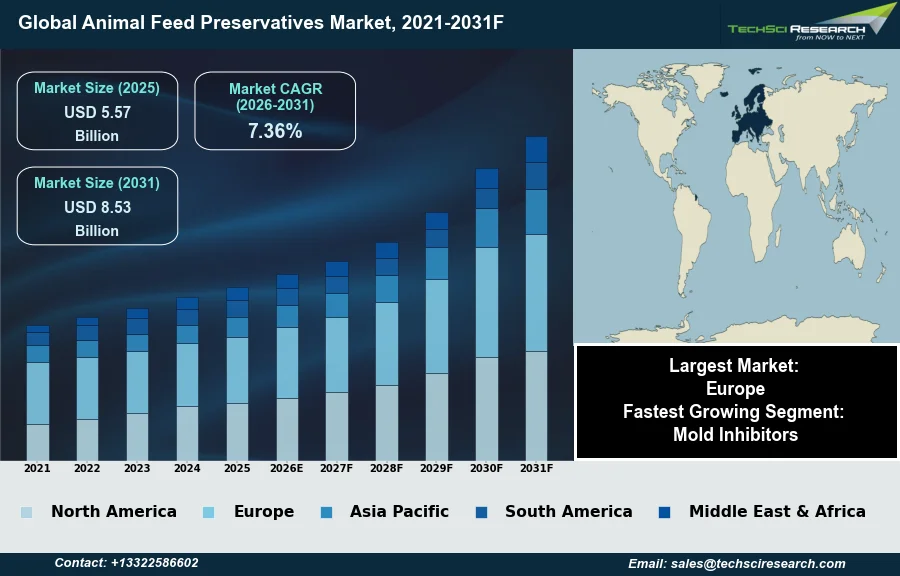
Market Size (2025)
|
USD 5.57 Billion
|
|
CAGR (2026-2031)
|
7.36%
|
|
Fastest Growing Segment
|
Mold Inhibitors
|
|
Largest Market
|
Europe
|
|
Market Size (2031)
|
USD 8.53 Billion
|
Market Overview
The Global Animal Feed Preservatives Market is expected to grow from USD 5.57 Billion in 2025 to USD 8.53 Billion by 2031 at a 7.36% CAGR. Animal feed preservatives are substances intentionally added to animal feed or water to prevent spoilage, inhibit microbial growth, and maintain nutritional quality during storage and transport. These critical additives ensure feed safety and extend shelf life. The market's growth is primarily driven by the escalating global demand for high-quality animal protein, which necessitates stable and nutritious feed for intensive livestock production. Furthermore, increasing awareness regarding mycotoxin contamination and spoilage prevention, alongside stringent feed safety regulations imposed by governments, propel the adoption of these preservation solutions. According to Alltech's 2026 Agri-Food Outlook, global feed production reached an estimated 1.44 billion metric tons in 2025, underscoring the substantial base for preservative application.
A significant challenge impeding market expansion includes the volatility of raw material prices, which can impact production costs for feed preservative manufacturers and ultimately influence product affordability for end-users. Additionally, evolving regulatory landscapes and the industry's shift towards more natural and sustainable preservation solutions also present complexities for product development and market penetration.
Key Market Drivers
Rising global demand for animal protein drives demand for feed preservatives
The rising global demand for animal protein is a primary driver fueling the Global Animal Feed Preservatives Market, as increasing human populations and evolving dietary preferences necessitate higher volumes of efficiently produced meat, dairy, and eggs. This escalating demand places considerable pressure on the livestock industry to maximize productivity and ensure the quality and safety of animal feed. To meet this need, feed must remain nutritious and free from spoilage throughout increasingly complex supply chains. According to the Food and Agriculture Organization (FAO), in its June 2026 'Food Outlook', global meat production is forecast to increase by 1.0 percent year on year to reach 391 million tonnes (carcass weight equivalent) in 2026. This substantial growth directly translates into a greater requirement for feed, which in turn elevates the demand for preservatives to prevent microbial contamination, oxidation, and nutrient degradation.
Industrial-scale farming and expanding livestock production boost demand for feed preservatives
Complementing this, the increasing livestock production and industrialization of farming practices significantly bolster the demand for feed preservatives. Modern intensive farming systems involve larger animal populations, bulk feed handling, and longer storage periods, all of which heighten the risk of feed spoilage and mycotoxin formation. Preservatives are crucial in these settings to maintain feed integrity, optimize animal health, and prevent economic losses. For instance, according to Cargill's 2025 Annual Report, the company is investing in a canola processing facility in Western Canada with the capacity to process 1 million metric tons of canola annually for animal feed and other markets, reflecting the industrial scale of feed ingredient production. Furthermore, Evonik's Animal Nutrition business, a significant player in feed additives, reported achieving slightly higher revenue in 2025, with sales volumes increasing, underscoring continued activity and growth in the broader animal nutrition and feed preservation sector. These factors collectively emphasize the essential role of feed preservatives in sustaining the efficiency and safety of global animal protein production.
Download Free Sample Report
Key Market Challenges
Raw material price volatility hampers market growth and pricing stability
The volatility of raw material prices significantly hampers the growth of the global animal feed preservatives market. Manufacturers of these critical additives face fluctuating input costs for key ingredients, directly impacting their production expenditures and making stable pricing strategies challenging. This unpredictability in pricing translates to higher and less predictable costs for end-users in the livestock industry, which can influence their purchasing decisions. According to a 2026 WATT Global Media Poultry Nutrition & Feed Survey, 74% of respondents rated raw material costs as their foremost concern, underscoring the widespread impact across the feed sector. Such persistent cost pressures can lead to delayed adoption of advanced preservation technologies or a preference for cheaper, less effective alternatives, directly impeding market expansion for high-quality animal feed preservatives.
Key Market Trends
Rising Demand for Natural and Clean-Label Feed Preservatives
The global animal feed preservatives market is significantly shaped by the rising demand for natural and clean-label solutions. This trend reflects increasing consumer scrutiny over the origin and composition of animal protein products, which translates into pressure on livestock producers to utilize feed additives perceived as more natural and sustainable. Consequently, there is a heightened preference for botanical extracts, essential oils, and organic acids that effectively inhibit microbial growth and prevent spoilage without relying on synthetic compounds. Manufacturers are actively innovating to develop and validate these natural alternatives, ensuring they meet stringent efficacy and safety standards while aligning with evolving regulatory landscapes. According to Research and Markets, in its 'Animal Nutrition Organic Acids Market Report 2026', the animal nutrition organic acids market size has grown from $2.11 billion in 2025 to $2.26 billion in 2026, representing a compound annual growth rate (CAGR) of 6.7%.
Technological Innovations Driving Feed Preservation and AI Optimization
Concurrently, technological advancements in preservation solutions are driving market evolution, enhancing both the effectiveness and efficiency of feed protection. Innovations include the development of advanced encapsulation techniques, targeted delivery systems, and precision application technologies that optimize preservative efficacy. These technological strides allow for more precise dosage, reduced waste, and improved stability of active ingredients under various environmental conditions, thereby extending feed shelf life and maintaining nutritional integrity. The integration of artificial intelligence and real-time data analytics is also emerging, enabling feed mills to proactively manage spoilage risks and optimize formulation. For example, a speaker at the '2026 Feed Mill of the Future Conference', as noted by Feed Strategy and Feed & Grain magazines in November 2025, highlighted that real-time AI dashboards have cut waste by up to 30% and over-formulation by up to 50% in feed manufacturing.
Segmental Insights
Key Growth Drivers for Mold Inhibitors
The Mold Inhibitors segment demonstrates rapid expansion within the Global Animal Feed Preservatives Market, primarily driven by the escalating industrialization of livestock farming, which demands longer feed storage durations and enhanced preservation methods. A crucial factor is the widespread issue of mycotoxin contamination, frequently amplified by changing climate patterns affecting crop quality. This necessitates feed manufacturers to adopt effective mold inhibition solutions to prevent substantial economic losses from reduced animal productivity and associated veterinary costs. Furthermore, increasingly stringent regulatory frameworks, supported by organizations such as the Food and Agriculture Organization (FAO) highlighting mycotoxin risks, underscore the critical importance of maintaining feed safety and nutritional integrity for animal health.
Regional Insights
Regulatory Rigor and Advanced Farming Drive Europe's Lead in Feed Preservatives
Europe leads the global animal feed preservatives market primarily due to its stringent regulatory frameworks, which mandate high standards for feed safety and quality across the region. These comprehensive regulations, enforced by bodies such as the European Food Safety Authority, drive the consistent adoption of advanced preservation solutions to ensure feed integrity and animal health. Furthermore, Europe's advanced livestock farming practices and intensive production systems necessitate reliable feed preservation to prevent spoilage and mycotoxin contamination, thereby safeguarding animal performance and food safety for consumers. This emphasis on maintaining superior feed quality and the ongoing transition towards sustainable, antibiotic-free livestock production further solidify Europe's prominent position in the market.
Recent Developments
-
In November 2025, Biochem and BASF entered into a binding agreement for Biochem's acquisition of BASF's global glycinate business. Biochem, an animal nutrition company specializing in feed additives and dietary supplements, strengthened its portfolio of organic trace minerals through this acquisition. Glycinates are crucial feed additives that support animal health and performance by providing essential micronutrients. This strategic move impacts the global animal feed preservatives market by ensuring a more robust supply of ingredients that enhance animal well-being, which in turn improves feed conversion efficiency and helps maintain the nutritional value and stability of animal feed products.
-
In October 2025, BASF introduced Lutavit® A/D3 1000/200 NXT, a new vitamin formulation for animal nutrition. This product combined vitamin A and vitamin D3 in a single, microencapsulated form, marking BASF's re-entry into the combined vitamin market with a focus on convenience, performance, and sustainability. The microencapsulation technology ensures the stability and effective delivery of these essential vitamins within animal feed. This innovation is relevant to the global animal feed preservatives market by enhancing the nutritional integrity and stability of feed over time, thereby contributing to the preservation of its quality and efficacy until consumption.
-
In November 2024, Evonik launched Ecobiol Soluble Plus, a novel water-soluble probiotic, at the Poultry India event in Hyderabad. This product was designed to revolutionize poultry production by significantly enhancing gut health and overall animal performance. Ecobiol Soluble Plus supports gut integrity, improves nutrient absorption, and aids in combating pathogenic bacteria. For the global animal feed preservatives market, a healthy gut flora fostered by such probiotics can reduce the presence of undesirable microorganisms in the animal's digestive system, thereby diminishing the potential for feed-borne challenges and supporting the long-term effectiveness of preserved feed.
-
In September 2024, Novus International, Inc. and Ginkgo Bioworks announced a strategic partnership to develop advanced feed additives. This collaboration aimed to meet the evolving requirements of the animal agriculture sector by utilizing Ginkgo Enzyme Services to create more efficient enzymes for cost-effective production. By enhancing the health and performance of livestock, these innovations contribute to the overall quality and stability of animal feed. Such advancements in feed additives are crucial within the global animal feed preservatives market, as they support optimized feed utilization and can indirectly reduce the reliance on certain preservation methods by maintaining feed integrity and promoting robust animal health.
Key Market Players
- Cargill, Incorporated
- BASF SE
- Archer-Daniels-Midland Company
- Kemin Industries, Inc.
- Nutreco N.V.
- Novus International, Inc.
- DSM-Firmenich AG
- Alltech, Inc.
- Evonik Industries AG
- Lallemand Inc.
|
By Product Type
|
By Livestock
|
By Form
|
By Region
|
- Acidifiers
- Mold Inhibitors
|
|
|
- North America
- Europe
- Asia Pacific
- South America
- Middle East & Africa
|
Report Scope:
In this report, the Global Animal Feed Preservatives Market has been segmented into the following categories, in addition to the industry trends which have also been detailed below:
-
Animal Feed Preservatives Market, By Product Type:
-
Acidifiers
-
Mold Inhibitors
-
Animal Feed Preservatives Market, By Livestock:
-
Animal Feed Preservatives Market, By Form:
-
Animal Feed Preservatives Market, By Region:
-
North America
-
United States
-
Canada
-
Mexico
-
Europe
-
France
-
United Kingdom
-
Italy
-
Germany
-
Spain
-
Asia Pacific
-
China
-
India
-
Japan
-
Australia
-
South Korea
-
South America
-
Brazil
-
Argentina
-
Colombia
-
Middle East & Africa
-
South Africa
-
Saudi Arabia
-
UAE
Competitive Landscape
Company Profiles: Detailed analysis of the major companies present in the Global Animal Feed Preservatives Market.
Available Customizations:
Global Animal Feed Preservatives Market report with the given market data, TechSci Research offers customizations according to a company's specific needs. The following customization options are available for the report:
Company Information
- Detailed analysis and profiling of additional market players (up to five).
Global Animal Feed Preservatives Market is an upcoming report to be released soon. If you wish an early delivery of this report or want to confirm the date of release, please contact us at sales@techsciresearch.com