|
Key Insights
|
Details
|
|
Forecast Period
|
2026 - 2031
|
|
Market Size (2025)
|
USD 1.98 Billion
|
|
CAGR (2026-2031)
|
6.07%
|
|
Fastest Growing Segment
|
Vitamins
|
|
Largest Market
|
Asia Pacific
|
|
Market Size (2031)
|
USD 2.82 Billion
|
Market Overview
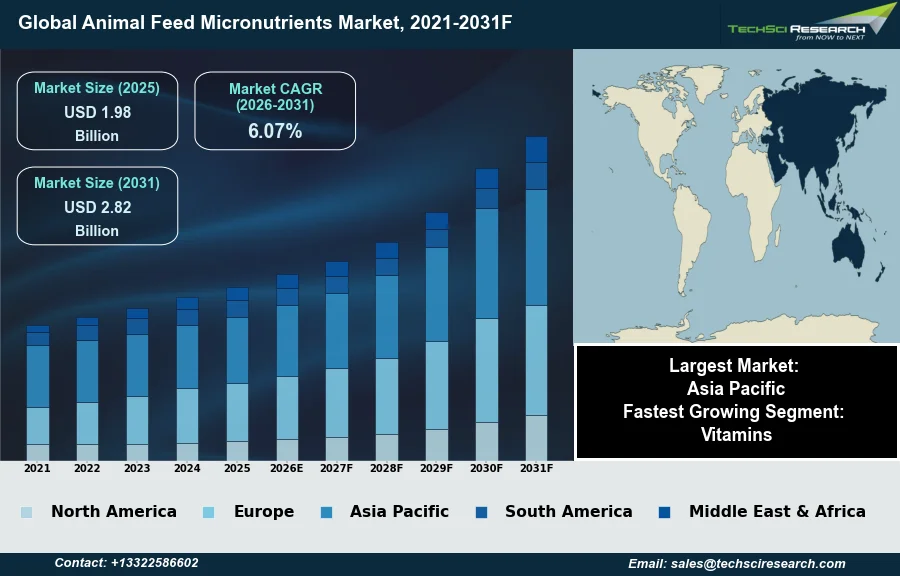
The Global Animal Feed Micronutrients Market is expected to grow from USD 1.98 Billion in 2025 to USD 2.82 Billion by 2031 at a 6.07% CAGR. Animal feed micronutrients encompass essential vitamins, minerals, and trace elements incorporated into animal diets to enhance growth, health, and overall productivity. The market's expansion is fundamentally driven by the escalating global demand for animal protein, the widespread adoption of intensified livestock farming practices, and an increasing industry focus on optimizing animal welfare and performance.
A significant challenge impeding market growth stems from the complex and disparate regulatory frameworks governing feed additive usage across various international jurisdictions. Despite these hurdles, the foundational demand remains robust; for instance, according to the European Feed Manufacturers' Federation (FEFAC), in 2025, the total industrial compound feed production in the EU27 is forecast to reach 147.5 million tonnes, indicating a substantial base for micronutrient integration.
Key Market Drivers
Rising global demand for animal protein drives micronutrient use in feed
The increasing global demand for animal protein is a primary catalyst for the animal feed micronutrients market. As the world population grows and dietary patterns shift towards higher protein consumption, the livestock industry is pressured to produce more efficiently and sustainably. This necessitates optimized animal nutrition, where micronutrients play a critical role in maximizing growth rates and feed conversion ratios. According to the Food and Agriculture Organization of the United Nations (FAO), in June 2026, in the 'Food Outlook' report, global meat production is expected to rise by 1.0 percent to 391.3 million tonnes in 2026, with poultry leading this increase. To achieve such production targets, feed manufacturers are integrating vitamins, minerals, and trace elements to ensure animals reach their full genetic potential, thereby directly fueling the demand for these essential additives.
Health, welfare, and economic gains underpin precision micronutrition
Further driving the market is the heightened focus on enhanced animal health and productivity requirements. Modern livestock farming seeks to improve animal welfare, reduce disease incidence, and optimize performance throughout an animal's life cycle. Micronutrients are vital for immune function, reproductive health, and overall physiological well-being, translating directly into economic benefits for producers through better yields and reduced veterinary costs. According to dsm-firmenich, in 2026, inadequate nutrition, welfare, and health management can reduce livestock production efficiency by up to 33%, with approximately US$300 billion annually lost to animal disease. This substantial economic impact underscores the imperative for precision nutrition, incorporating specific micronutrient formulations to mitigate losses and boost profitability. The broader market for feed production, which includes these micronutrients, is significant; according to the International Feed Industry Federation (IFIF), in October 2026, global commercial feed manufacturing generates an estimated annual turnover of over US$400 billion.
Download Free Sample Report
Key Market Challenges
Regulatory Fragmentation Impedes Global Market Growth
The intricate and varying regulatory frameworks governing feed additive usage across different international jurisdictions pose a significant impediment to the growth of the Global Animal Feed Micronutrients Market. These disparate regulations establish inconsistent requirements for product registration, efficacy demonstration, and safety evaluations. This regulatory fragmentation creates a complex operating environment for manufacturers and suppliers, necessitating substantial investment in understanding and complying with diverse legal stipulations in each target market.
Costs and Delays from Regulatory Complexity
This regulatory complexity directly hampers market expansion by increasing operational costs and extending timelines for product commercialization. For instance, according to the European Feed Ingredients Association (FEFANA), in March 2025, the existing 10-year authorization period for feed additives in the European Union was highlighted as a factor that hinders innovation and can limit the continuous market availability of safe products. This protracted regulatory cycle delays the timely introduction of advanced micronutrient solutions, thereby restricting market penetration and the revenue potential for industry participants who must navigate these prolonged approval processes across various regions.
Key Market Trends
Sustainable sourcing and organic certifications shaping the market
A growing emphasis on sustainable and organic micronutrient sourcing is significantly influencing the Global Animal Feed Micronutrients Market as consumers and regulators increasingly demand environmentally responsible production practices. This trend drives manufacturers to invest in cleaner supply chains, traceable ingredients, and reduced ecological footprints. For instance, Cargill Animal Nutrition & Health reported in May 2026 that across all aquafeeds produced in 2025, the business reduced its Scope 1 and 2 emissions per ton of feed by 41.9% since 2020, demonstrating the industry's commitment to verifiable sustainability improvements. This shift fosters innovation in alternative ingredient development and encourages certifications for organic and ethically sourced micronutrients, catering to a premium market segment valuing transparency and environmental stewardship.
Advances in micronutrient delivery and bioavailability
Advancements in micronutrient delivery systems and bioavailability represent another pivotal trend, focusing on enhancing the efficacy and absorption of essential nutrients within animals. These innovations aim to optimize feed utilization, reduce nutrient excretion, and improve animal performance through more targeted applications. Technologies such as encapsulation, chelation, and specialized coatings protect sensitive micronutrients from degradation during feed processing and digestion, ensuring maximum benefit. For example, Evonik, a German chemicals giant, announced in October 2026 that it had expanded its methionine facility on Jurong Island, adding 40,000 tonnes to its production capacity, bringing the total to 340,000 tonnes per year for this protein component used in animal feed supplements, highlighting significant investments in enhancing the supply of highly available feed ingredients. This trend enables lower inclusion rates while maintaining or improving animal health outcomes, offering economic advantages to producers.
Segmental Insights
Accelerating Growth of Vitamins Across Poultry, Dairy, and Aquaculture
The Vitamins segment is experiencing the fastest growth in the Global Animal Feed Micronutrients Market, driven by their essential role in enhancing animal health, productivity, and reproductive performance across various livestock sectors. Stronger utilization of vitamins such as A, D3, E, and K in poultry and dairy systems is crucial for maintaining stable nutrient delivery, which directly impacts immunity and production persistence. Furthermore, the increasing importance of water-soluble vitamins in aquaculture addresses nutritional stress and environmental variability in intensive shrimp and fish farming. This growth is also supported by the rising global demand for animal protein and the shift towards advanced, efficient livestock production practices that prioritize balanced nutrition for optimal output and animal welfare.
Regional Insights
Asia Pacific Leads the Global Animal Feed Micronutrients Market Driven by Livestock Growth and Policy Support.
Asia Pacific leads the Global Animal Feed Micronutrients Market due to its expanding livestock population and increasing demand for protein-rich food products, driven by rapid urbanization and rising disposable incomes. This necessitates significant commercial feed production across poultry, swine, dairy, and aquaculture sectors, particularly in major economies like China and India, where intensive farming practices are prevalent. Producers and consumers in the region are increasingly prioritizing balanced nutrition and animal health to enhance productivity, further boosting the adoption of feed micronutrients. Additionally, supportive government initiatives for agriculture and food security encourage the use of advanced nutritional solutions in animal husbandry.
Recent Developments
-
In November 2025, Cargill Animal Nutrition & Health completed a significant expansion of its micronutrition facility located in Engerwitzdorf, Austria. This development boosted the plant's production capacity by 50%, reaching 30,000 metric tons per year, to address the increasing global demand for advanced micronutrition solutions. The investment enhanced Cargill's rapidly growing Micronutrition & Health Solutions business, which integrates expertise from previously acquired entities. This expansion aims to deliver more precise and effective animal nutrition, focusing on how microelements interact within the animal's microbiome to maximize productivity and promote digestive health.
-
In October 2025, BASF launched Lutavit® A/D3 1000/200 NXT, a new generation vitamin formulation for animal nutrition. This product combines vitamin A and vitamin D3 into a single, microencapsulated form, marking BASF's re-entry into the market with this combined offering. The innovative formulation aims to provide convenience, enhanced performance, and increased sustainability for animal feed applications. The introduction of Lutavit® A/D3 1000/200 NXT reflects the company's strategic focus on delivering advanced micronutrient solutions that support animal health and productivity globally.
-
In March 2025, Cargill unveiled a new portfolio of brands under its Micronutrition and Health Solutions (MHS) business at VIV Asia 2025. This launch introduced innovations such as Biostrong™ products, designed to enhance digestive health and optimize growth in poultry by improving feed conversion ratios. Additionally, Notox™ solutions were presented for advanced mycotoxin management, aiming to improve risk assessment accuracy and mitigate harmful mycotoxin impacts. These offerings, developed through scientific research, were intended to optimize animal production, enhance efficiency, and foster long-term sustainability within the animal nutrition industry.
-
In November 2024, Zinpro Corporation introduced Zinpro® IsoFerm®, a novel dairy nutrition product, at EuroTier 2024. This innovation was recognized with a Silver Medal at the EuroTier Innovation Awards for its significant improvements in functionality and efficiency. Zinpro® IsoFerm® is a proprietary blend of isoacids, or branched-chain volatile fatty acids, which naturally enhance fiber digestion and microbial protein production in the rumen. This advanced nutrient is designed to improve rumen function, leading to superior performance in lactating and transition cows within the global animal feed micronutrients market.
Key Market Players
- Cargill, Incorporated
- ADM
- Nutreco N.V. (SHV Holdings N.V.)
- BASF SE
- Adisseo France S.A.S. (China National Bluestar Group Co., Ltd.)
- Evonik Industries AG
- Alltech, Inc.
- Kemin Industries, Inc.
- Novus International, Inc. (Mitsui and Co., Ltd. and Nippon Soda Co., Ltd.)
- Phibro Animal Health Corporation
|
By Nutrient Type
|
By Livestock
|
By Region
|
|
|
|
- North America
- Europe
- Asia Pacific
- South America
- Middle East & Africa
|
Report Scope:
In this report, the Global Animal Feed Micronutrients Market has been segmented into the following categories, in addition to the industry trends which have also been detailed below:
-
Animal Feed Micronutrients Market, By Nutrient Type:
-
Animal Feed Micronutrients Market, By Livestock:
-
Animal Feed Micronutrients Market, By Region:
-
North America
-
United States
-
Canada
-
Mexico
-
Europe
-
France
-
United Kingdom
-
Italy
-
Germany
-
Spain
-
Asia Pacific
-
China
-
India
-
Japan
-
Australia
-
South Korea
-
South America
-
Brazil
-
Argentina
-
Colombia
-
Middle East & Africa
-
South Africa
-
Saudi Arabia
-
UAE
Competitive Landscape
Company Profiles: Detailed analysis of the major companies present in the Global Animal Feed Micronutrients Market.
Available Customizations:
Global Animal Feed Micronutrients Market report with the given market data, TechSci Research offers customizations according to a company's specific needs. The following customization options are available for the report:
Company Information
- Detailed analysis and profiling of additional market players (up to five).
Global Animal Feed Micronutrients Market is an upcoming report to be released soon. If you wish an early delivery of this report or want to confirm the date of release, please contact us at sales@techsciresearch.com