|
Key Insights
|
Details
|
|
Forecast Period
|
2021 - 2031
|
|
Market Size (2025)
|
USD 40.15 Billion
|
|
CAGR (2026-2031)
|
6.19%
|
|
Fastest Growing Segment
|
Fish
|
|
Largest Market
|
North America
|
|
Market Size (2031)
|
USD 57.57 Billion
|
Market Overview
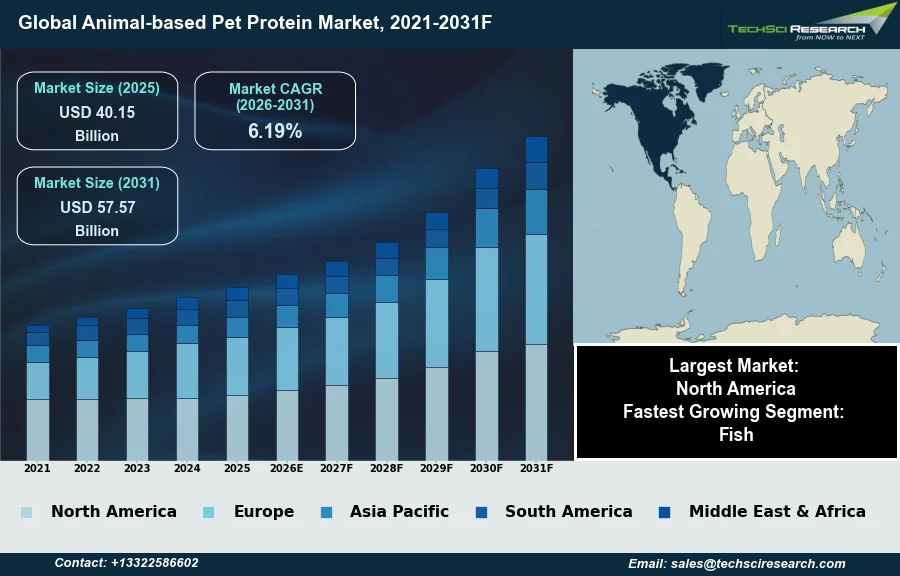
The Global Animal-based Pet Protein Market is expected to grow from USD 40.15 Billion in 2025 to USD 57.57 Billion by 2031 at a 6.19% CAGR. Animal-based pet protein comprises nutrient-rich components derived from animal sources, such as meat, poultry, and fish by-products, essential for balanced pet nutrition. The market's expansion is fundamentally driven by the escalating humanization of pets, leading consumers to demand premium, high-quality food formulations. Growing global pet ownership, alongside heightened scientific understanding of animal proteins' essential amino acid contributions to pet health and vitality, further fuels this growth.
According to the 2025 Pet Food Production and Ingredient Analysis report from industrial associations including the Institute for Feed Education and Research, the American Feed Industry Association, the North American Renderers Association, and the Pet Food Institute, upcycled materials, primarily animal-derived, constituted 44% of United States pet food ingredients in 2024, totaling over 4 million tons, reflecting robust demand for these protein sources. A significant challenge impeding market expansion involves navigating complex and fragmented global regulatory frameworks for ingredient approval and sourcing, which can hinder innovation and market entry.
Key Market Drivers
Pet humanization drives demand for premium animal-based pet protein formulations.
Increasing pet humanization significantly propels the demand for premium animal-based pet protein formulations. As pets are increasingly considered integral family members, owners prioritize their health and well-being by seeking high-quality, nutritionally superior food. This trend manifests in a strong consumer preference for diets featuring identifiable, high-quality animal protein sources that align with human dietary standards, such as antibiotic-free or grass-fed claims. Pet owners are willing to invest more in formulations that offer enhanced health benefits, palatability, and ingredient transparency, directly driving the market for specialized animal protein products. According to Morgan Stanley, June 2026, among pet owners, 66% consider pets part of the family, indicating a deep emotional bond that translates into higher spending on pet nutrition.
Global pet ownership expansion enlarges the consumer base for animal-based pet proteins.
Simultaneously, the rising global pet ownership expands the fundamental consumer base for animal-based pet proteins. An increasing number of households worldwide are adopting pets, creating a larger market for all pet food categories, including those rich in animal-derived proteins. This demographic expansion is a robust foundational driver, ensuring a continuous increase in demand for staple and specialized pet food products. For instance, US dog ownership rose from 51% to 53% of households in 2025, representing 4 million additional households, according to the American Pet Products Association's (APPA) 2026 State of the Industry report. Overall, this combined influence contributes to the substantial size and growth of the broader pet food industry, with global retail pet food sales reporting $153.6 billion in 2025, according to Agriculture and Agri-Food Canada analysis, 2026.
Download Free Sample Report
Key Market Challenges
Fragmented global regulations hinder innovation and market entry
The challenging factor is navigating complex and fragmented global regulatory frameworks for ingredient approval and sourcing. This directly hampers the growth of the global animal-based pet protein market by impeding innovation and market entry. The disparate nature of regulations across various jurisdictions creates significant hurdles for manufacturers seeking to introduce new, nutrient-rich protein sources and specialized formulations. This leads to prolonged approval timelines, increased compliance costs, and necessitates extensive resources for adapting products to diverse regional standards.
Regulatory activity heightens compliance burden and slows market expansion
Such intricate regulatory landscapes restrict the ability of manufacturers to respond swiftly to evolving consumer demands for premium animal protein ingredients. According to the Pet Food Institute's 2025 Impact Report, the organization actively tracked over 4,000 state legislative measures, monitored more than 650 state bills, and followed over 100 federal bills related to pet food and animal feed regulation in the United States alone. This volume of regulatory activity and oversight underscores the complexity manufacturers face in achieving nationwide compliance and expanding into new markets, consequently slowing the pace of market development and limiting overall global reach.
Key Market Trends
Shift Toward Sustainable Sourcing and Transparent Supply Chains
The global animal-based pet protein market is undergoing a significant shift towards sustainable protein sourcing. This trend is driven by increasing consumer awareness and concern regarding the environmental impact of traditional protein production methods, prompting manufacturers to re-evaluate their supply chains. Pet owners are increasingly seeking products that align with their ethical values, favoring ingredients with verifiable sustainability credentials and lower ecological footprints. This consumer sentiment is evidenced by research, where 62% of pet parents reported purchasing an environmentally friendly product in the month prior to being surveyed in 2025, according to GlobalPETS, March 2026, citing a survey by the Pet Sustainability Coalition. This demand is pushing for greater transparency and the integration of eco-conscious practices throughout the protein supply chain.
Adoption of Novel and Cultivated Animal Proteins in Pet Nutrition
Another prominent trend reshaping the market is the adoption of novel and alternative animal proteins. This involves the introduction of previously uncommon animal-derived protein sources into pet food formulations, driven by a desire for diversification, allergen management, and exploring new nutritional profiles. These alternatives include proteins from insects and cultivated meat, which offer sustainable and hypoallergenic benefits compared to conventional sources. A notable milestone in this area was achieved with Meatly becoming the first company to sell cultivated meat in Europe, launching the world’s first cultivated pet food in 2025, as reported by Pet Business World, November 2026. Such pioneering commercialization highlights the growing industry acceptance and innovation in exploring new animal protein frontiers for pet nutrition.
Segmental Insights
Rapid Growth of Fish-Based Pet Proteins Driven by Nutrition and Sustainability
The Fish segment is rapidly emerging as the fastest-growing component within the Global Animal-based Pet Protein Market. This accelerated growth is primarily driven by increasing consumer awareness regarding the superior nutritional benefits fish offers to pets. Fish provides a highly digestible, lean protein source rich in essential omega-3 fatty acids like EPA and DHA, which are crucial for promoting healthy skin and coat, supporting cognitive function, alleviating joint inflammation, and enhancing cardiovascular health. Furthermore, fish-based proteins are increasingly preferred for pets with dietary sensitivities or allergies, offering a gentler alternative to traditional meat proteins. The ongoing premiumization trend in pet food, coupled with a focus on sustainable and natural ingredients, further bolsters the demand for fish-derived proteins.
Regional Insights
North America Leads Through Pet Ownership, Humanization, and Regulatory Standards
North America leads the global animal-based pet protein market due to significant pet ownership, especially of dogs, and a strong emphasis on pet humanization. This trend results in owners prioritizing premium, high-quality, and nutritionally beneficial pet food products, mirroring human dietary preferences for natural and specialized ingredients. The region benefits from a developed pet food industry infrastructure, robust consumer spending on pet health, and established regulatory frameworks from bodies like the U.S. Food and Drug Administration (FDA) and the Association of American Feed Control Officials (AAFCO), which ensure product safety and quality standards, fostering consumer trust and market expansion.
Recent Developments
-
In August 2025, Natural Balance Pet Foods launched its innovative Ultra Protein portfolio, marking a significant advancement in feline nutrition. This new product line featured diets meticulously crafted with protein-rich organ meats, delivering high protein levels tailored to cats' inherent carnivorous requirements. Available in both dry kibble and wet varieties, these formulations were designed to provide essential strength, energy, and the palatability cats naturally seek. The introduction of the Ultra Protein range reinforced the brand's commitment to utilizing high-quality animal-based protein sources for optimal pet health and satisfaction.
-
In May 2025, Post Consumer Brands introduced several new pet food offerings, expanding its product presence within the global animal-based pet protein market. Among the launches was the 9Lives™ Kitten Essentials Chicken & Ocean Fish Dry Cat Food, specifically formulated with essential protein to support muscle development in growing felines. Additionally, the company launched Kibbles 'n Bits™ Triple Steak Flavor Dry Dog Food, a high-protein recipe designed for adult dogs. These new products underscore the company's strategy to provide diverse and nutritionally targeted animal-based protein options for various pet life stages and preferences.
-
In April 2025, BioCraft Pet Nutrition announced a pioneering partnership with Prefera Petfood to commercialize a novel, hypoallergenic cat food. This product was developed to be almost entirely composed of BioCraft's innovative cell-cultured mouse protein. The collaboration represented a breakthrough in functional and sustainable pet nutrition, offering a complete and biologically appropriate protein source that addresses feline dietary needs while minimizing reliance on traditional livestock agriculture. This initiative introduced a new form of animal-based protein, aiming to meet growing consumer demand for environmentally conscious pet food solutions.
-
In February 2024, Bond Pet Foods, a biotechnology company, achieved a significant milestone by delivering two metric tons of animal protein, produced through precision fermentation, to Hill's Pet Nutrition. This delivery was a crucial step towards the commercialization of fermentation technology for pet food applications, allowing Hill's to formulate and evaluate a variety of test products for eventual regulatory review and market introduction. The companies further expanded their collaboration to develop a second animal protein, demonstrating a shared commitment to advancing sustainable and novel animal-based protein sources within the global pet protein market.
Key Market Players
- Mars, Incorporated
- Nestlé Purina PetCare Company
- Hill's Pet Nutrition Inc.
- Blue Buffalo Company, Ltd. (General Mills, Inc.)
- Diamond Pet Foods Inc. (Schell & Kampeter Inc.)
|
By Protein Source
|
By Pet Type
|
By Form
|
By Region
|
|
|
|
- Dry kibble
- Frozen/Raw formats
|
- North America
- Europe
- Asia Pacific
- South America
- Middle East & Africa
|
Report Scope:
In this report, the Global Animal-based Pet Protein Market has been segmented into the following categories, in addition to the industry trends which have also been detailed below:
-
Animal-based Pet Protein Market, By Protein Source:
-
Animal-based Pet Protein Market, By Pet Type:
-
Animal-based Pet Protein Market, By Form:
-
Dry kibble
-
Frozen/Raw formats
-
Animal-based Pet Protein Market, By Region:
-
North America
-
United States
-
Canada
-
Mexico
-
Europe
-
France
-
United Kingdom
-
Italy
-
Germany
-
Spain
-
Asia Pacific
-
China
-
India
-
Japan
-
Australia
-
South Korea
-
South America
-
Brazil
-
Argentina
-
Colombia
-
Middle East & Africa
-
South Africa
-
Saudi Arabia
-
UAE
Competitive Landscape
Company Profiles: Detailed analysis of the major companies present in the Global Animal-based Pet Protein Market.
Available Customizations:
Global Animal-based Pet Protein Market report with the given market data, TechSci Research offers customizations according to a company's specific needs. The following customization options are available for the report:
Company Information
- Detailed analysis and profiling of additional market players (up to five).
Global Animal-based Pet Protein Market is an upcoming report to be released soon. If you wish an early delivery of this report or want to confirm the date of release, please contact us at sales@techsciresearch.com