|
Key Insights
|
Details
|
|
Forecast Period
|
2025 - 2030
|
|
Market Size (2025)
|
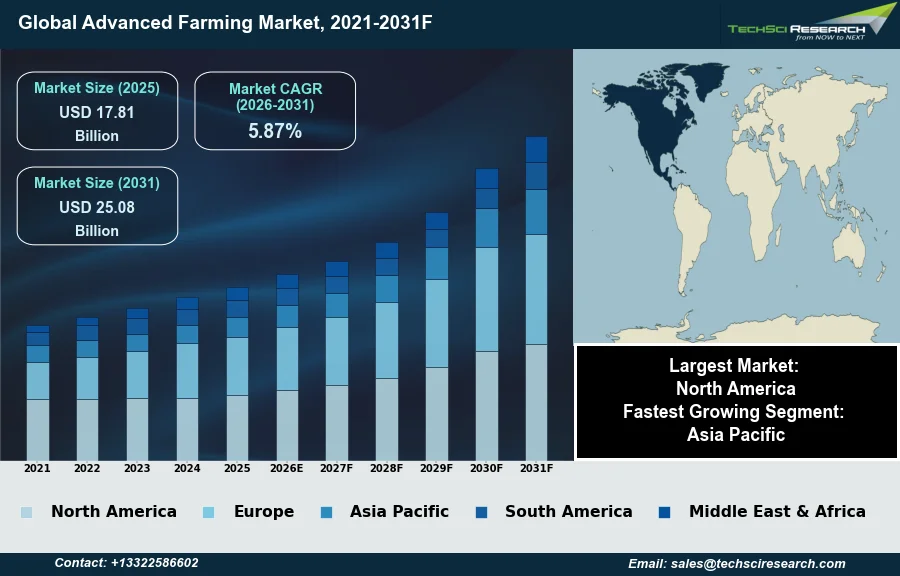
USD 17.81 Billion
|
|
CAGR (2026-2031)
|
5.87%
|
|
Fastest Growing Segment
|
Asia Pacific
|
|
Largest Market
|
North America
|
|
Market Size (2031)
|
USD 25.08 Billion
|
Market Overview
The Global Advanced Farming Market is expected to grow from USD 17.81 Billion in 2025 to USD 25.08 Billion by 2031 at a 5.87% CAGR. Advanced farming broadly encompasses the integration of innovative technologies and techniques into agricultural practices to enhance productivity, efficiency, and sustainability. This includes precision agriculture, smart irrigation, autonomous machinery, and AI-driven analytics. Key drivers supporting the market’s expansion are the escalating global demand for food production, diminishing arable land, persistent labor shortages across agricultural sectors, and growing environmental concerns necessitating optimized resource utilization. Government initiatives promoting digital agriculture and sustainable practices further stimulate market adoption.
Regarding market specifics, according to the International Federation of Robotics, in October 2025, approximately 19,500 agricultural robots were sold worldwide in 2024. Despite established adoption, a significant challenge impeding global market expansion is the substantial initial investment required for advanced farming systems, which can be prohibitive for many small and medium-sized farms, coupled with prevailing limited digital literacy and uneven connectivity in traditional agricultural communities.
Key Market Drivers
Tech Advancements Driving Advanced Farming Growth
Technological Advancements in Agri-tech serve as a fundamental catalyst for the expansion of the Global Advanced Farming Market. The continuous evolution of innovative solutions such as artificial intelligence, the Internet of Things, and autonomous systems significantly enhances agricultural productivity and efficiency. These innovations enable precision agriculture techniques, smart irrigation, and data-driven decision making, optimizing resource allocation and improving overall farm management. For instance, according to CNH's Farmer Pulse report, in August 2026, 54% of surveyed farmers indicated their intent to invest in additional precision agriculture technology within the next two years, underscoring the strong adoption outlook for advanced solutions. Such investments reflect a growing recognition among farmers of the tangible benefits offered by these advancements, from yield optimization to improved sustainability.
Labor Shortage Spurs Automation and Market Growth
Complementing technological innovation, agricultural labor scarcity represents another critical driver compelling the adoption of advanced farming practices. Regions globally face persistent challenges in securing sufficient farm workers, particularly for labor-intensive tasks. This shortage incentivizes farmers to integrate automated machinery and robotic systems to maintain operational capacity and efficiency. For example, according to RobotToday, in February 2026, it was projected that American agriculture could address 25-35% of its labor shortage through robotics by 2030, highlighting the strategic role of automation in mitigating workforce challenges. These solutions not only address immediate labor gaps but also contribute to long-term operational resilience and cost savings. Furthermore, supporting broader market development, according to The AgTech Network, in 2026, the OpenAI Foundation is providing USD 60 million to an initiative designed to bring AI-powered weather and crop disease forecasting to 100 million smallholder farmers over the next three years.
Download Free Sample Report
Key Market Challenges
Upfront capital costs limit adoption of advanced farming technologies.
A significant factor impeding the growth of the global advanced farming market is the substantial initial investment required for these sophisticated systems. This high capital outlay often proves prohibitive for many small and medium-sized farms, directly limiting their ability to adopt technologies such as precision agriculture tools, smart irrigation, and autonomous machinery. The economic burden of acquiring these advanced solutions creates a barrier to entry, particularly for farms operating with tighter budgets or less access to capital. Consequently, market expansion is restricted as a considerable segment of the agricultural community cannot participate in the technological transition.
Market hesitancy and subdued orders dampen growth.
The market reflects this financial constraint, with overall business sentiment showing hesitancy. For instance, according to the European Agricultural Machinery Industry Association (CEMA), in November 2025, while their business climate index for the agricultural machinery industry in Europe saw a slight increase from +4 to +9 points on a scale of -100 to +100, the underlying sentiment indicated that an upturn had not materialized in many business segments. This suggests ongoing reluctance among farmers to make significant capital expenditures, leading industry representatives to lower their expectations for incoming orders in the subsequent months. This stagnation in new orders and delayed investment decisions directly hampers the sustained growth of the advanced farming market.
Key Market Trends
Rising Regenerative Agriculture Adoption and Environmental Benefits
The growing adoption of regenerative agriculture practices represents a significant trend within the global advanced farming market, shifting focus towards ecological restoration and long-term land productivity. These methods prioritize soil health, biodiversity, and ecosystem resilience through techniques such as cover cropping, reduced tillage, and diverse crop rotations, aiming to enhance the natural capital of farmland. The influence of this trend extends to improved water retention, reduced reliance on synthetic inputs, and enhanced carbon sequestration, offering a pathway to more sustainable food systems. According to an analysis by the American Farm Bureau Federation, in July 2026, nearly 40 million acres were enrolled in USDA-supported regenerative agriculture practices by fiscal year 2023, underscoring the expanding commitment to these environmentally beneficial approaches.
Expansion of Indoor and Vertical Farming for Controlled Environment Agriculture
Concurrently, the rising investment and implementation of indoor and vertical farming systems are profoundly shaping the market by enabling controlled environment agriculture, particularly in urban areas. This trend addresses critical challenges such as diminishing arable land, unpredictable climate patterns, and the demand for localized food production. By utilizing technologies like hydroponics, aeroponics, and advanced LED lighting, these systems optimize resource use, reduce water consumption, and allow for year-round cultivation independent of external weather conditions. This specialized form of farming contributes to food security and offers consistent, high-quality produce closer to consumers. According to Just Vertical, in November 2026, GoodLeaf made a significant investment in 2025, raising $52 million to scale its production capacity and develop a new Agricultural Centre of Excellence in Canada.
Segmental Insights
Policy and Investment Drive Smart Farming Adoption in Asia Pacific
The Asia Pacific segment is experiencing rapid growth in the Global Advanced Farming Market, driven by its extensive agricultural bases and increasing food demand from a growing population. Governments across the region, alongside institutions like the United Nations Food and Agriculture Organization (FAO) and the Asian Development Bank (ADB), are actively promoting modernization programs and providing significant support for smart farming initiatives. This governmental emphasis, coupled with rising investments in agritech and improved rural connectivity, facilitates the widespread adoption of advanced technologies including IoT sensors, drones, and AI analytics, even among smaller farms. These concerted efforts address critical food security challenges and enhance resource efficiency.
Regional Insights
North America: Leader in Advanced Farming Fueled by Technology, Investment, and Policy Support
North America leads the global advanced farming market due to its robust technological infrastructure and the proactive adoption of precision agriculture techniques across extensive cultivated lands. The region benefits from significant investments in research and development, fostering innovation in areas such as automation, data analytics, and artificial intelligence for farming. Furthermore, supportive government policies and programs, alongside the active involvement of institutions like the USDA (United States Department of Agriculture) and Agriculture and Agri-Food Canada, encourage farmers to integrate advanced solutions, thereby enhancing productivity and resource efficiency. This combination of technological readiness, investment, and institutional support solidifies North America's prominent position in the market.
Recent Developments
-
In November 2025, DJI Agriculture introduced its highly anticipated Agras T100, T70P, and T25P agricultural drones, making them available across Europe, Central Asia, and Africa. These new generation spray drones were designed with enhanced capabilities, including heavier payloads and support for multiple application scenarios, significantly increasing operational efficiency. Each model featured industry-leading safety systems, such as LiDAR, millimeter-wave radar, and a Penta-Vision system, facilitating more intelligent and automated operations. This launch underscored DJI Agriculture's continuous advancement in precision farming technology, empowering farmers with sophisticated tools for smarter and more environmentally conscious crop protection.
-
In May 2025, Gardin Agritech announced it had secured $4.5 million in funding, intending to advance its breakthrough photosynthesis sensor and AI platform. This technology was developed to monitor greenhouse crop health in real-time, providing growers with early insights into plant development and potential stress. The system allows for more targeted interventions, resulting in improved yields, better crop quality, and more efficient use of resources like water, light, and energy. Gardin's innovations are contributing to light optimization and energy efficiency, with trials demonstrating potential savings of 20-30%, thereby supporting a more sustainable and resilient controlled environment agriculture market.
-
In November 2024, Orbia's Precision Agriculture business Netafim and Bayer expanded their strategic collaboration, focusing on new digital farming solutions for fruit and vegetable growers. This initiative aimed to streamline primary data collection and provide tailored recommendations to optimize crop production and resource use. The expanded partnership included the development of Bayer's HortiView digital platform to simplify data sharing and Netafim's integration of irrigation insights into this system. This advanced connectivity further extended to GrowSphere™, Netafim's comprehensive irrigation operating system, enhancing overall precision agriculture in horticulture and offering significant value to growers globally.
-
In September 2024, Corteva, Inc. and Pairwise announced a strategic collaboration to accelerate the delivery of advanced gene editing solutions to farmers. This partnership was established to develop and deploy gene-edited products designed to be more resilient to extreme weather events and climate change. Corteva supported this venture with a $25 million equity investment in Pairwise, made through its Corteva Catalyst platform. The collaboration also formed a joint venture to enhance the delivery of gene-edited technologies aimed at increasing crop yield for food, fuel, and fiber production, significantly advancing agricultural climate resilience.
Key Market Players
- John Deere & Company
- Raven Industries, Inc.
- AGCO Corp.
- CNH Industrial
- Trimble Inc.
- Yanmar Co., Ltd.
- Escorts Ltd.
- Kverneland AS
|
By Region
|
- North America
- Europe
- Asia Pacific
- South America
- Middle East & Africa
|
Report Scope:
In this report, the Global Advanced Farming Market has been segmented into the following categories, in addition to the industry trends which have also been detailed below:
-
Advanced Farming Market, By Region:
-
North America
-
United States
-
Canada
-
Mexico
-
Europe
-
France
-
United Kingdom
-
Italy
-
Germany
-
Spain
-
Asia Pacific
-
China
-
India
-
Japan
-
Australia
-
South Korea
-
South America
-
Brazil
-
Argentina
-
Colombia
-
Middle East & Africa
-
South Africa
-
Saudi Arabia
-
UAE
Competitive Landscape
Company Profiles: Detailed analysis of the major companies present in the Global Advanced Farming Market.
Available Customizations:
Global Advanced Farming Market report with the given market data, TechSci Research offers customizations according to a company's specific needs. The following customization options are available for the report:
Company Information
- Detailed analysis and profiling of additional market players (up to five).
Global Advanced Farming Market is an upcoming report to be released soon. If you wish an early delivery of this report or want to confirm the date of release, please contact us at sales@techsciresearch.com